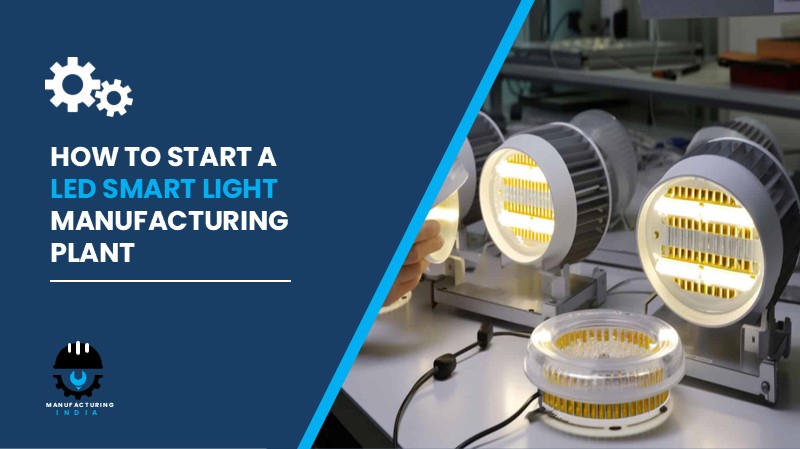
Setting up an LED smart light manufacturing plant in India presents a compelling investment case driven by rising adoption of smart home technologies, increasing demand for energy-efficient lighting solutions, and rapid integration of IoT-enabled devices in residential and commercial spaces. LED smart lights – advanced lighting solutions that combine energy-efficient LED technology with smart controls such as Wi-Fi, Bluetooth, Zigbee, or Matter connectivity – are transforming how Indian consumers and businesses think about lighting, moving the category from a basic utility into a connected, personalised, and energy-optimising smart home and commercial infrastructure component. As India’s smart home ecosystem expands and as commercial, industrial, and smart city infrastructure projects accelerate their adoption of connected lighting, the demand for high-quality, IoT-enabled LED smart lights is structurally positioned for exceptional long-term growth.
India’s structural advantages reinforce the investment case strongly. The widespread shift toward LED technology – with most lighting installations expected to adopt LEDs by 2035 – is significantly driving the LED smart light market, and the potential annual energy savings of 569 TWh, equivalent to the output of more than 921,000 MW power plants, highlight the strong economic and environmental benefits that are encouraging governments, businesses, and consumers worldwide to accelerate adoption. The global LED smart light market was valued at USD 31.39 billion in 2025 and is expected to reach USD 109.57 billion by 2034, exhibiting an exceptional CAGR of 14.9% from 2026 to 2034 according to IMARC Group estimates – making this one of the fastest-growing electronics manufacturing categories globally. Government and infrastructure support promoting energy-efficient lighting and smart city development, combined with India’s rapidly expanding electronics manufacturing base, position a domestic LED smart light manufacturing plant in India to capture a substantial share of this high-growth global category.
India’s expanding smart home ecosystem, government-backed smart city and energy-efficiency initiatives, and a global LED smart light market growing at 14.9% CAGR through 2034 make an LED smart light manufacturing plant a high-growth, financially compelling investment opportunity. With gross margins of 35–45% and net margins of 15–22% across an annual capacity of 100,000–500,000 units, the return profile is exceptionally strong and the demand outlook structurally durable.
What is an LED Smart Light?
LED smart lights are advanced lighting solutions that combine energy-efficient LED technology with smart controls such as Wi-Fi, Bluetooth, Zigbee, or Matter connectivity. These lights allow users to remotely control brightness, colour temperature, scheduling, and automation through mobile apps, voice assistants, or smart home ecosystems. LED smart lights often integrate with home automation systems to enable features such as motion sensing, adaptive lighting, energy monitoring, and scene customisation.
Compared to conventional lighting, LED smart lights offer significantly lower power consumption, longer lifespan, and enhanced user convenience. Their ability to support smart living, energy optimisation, and personalised lighting experiences makes them increasingly popular across residential, commercial, and industrial environments. The product category spans applications including smart home lighting, automated and voice-controlled lighting, energy-efficient commercial lighting, mood and ambient lighting, and security and outdoor smart lighting.
The primary production method is LED chip fabrication and procurement, PCB assembly and driver integration, smart module integration (Wi-Fi/Bluetooth/Zigbee), housing assembly and thermal management, testing, calibration, and packaging – a multi-stage electronics manufacturing process that converts LED chips, PCBs, smart drivers, and connectivity modules into a finished, app-controllable smart lighting product. End-use industries served include residential smart homes, commercial buildings, hospitality and retail, industrial facilities, and smart cities and infrastructure.
Cost of Setting Up an LED Smart Light Manufacturing Plant in India
The cost of establishing this facility depends on capacity, technology selection, plant location, degree of automation, and regulatory compliance requirements.
1. Capital Expenditure (CapEx)
Total capital investment for an LED smart light manufacturing plant in India covers land acquisition, site preparation, civil construction, machinery, and pre-operative expenses. The cost of land and site development – including charges for land registration, boundary development, and other related expenses – forms a substantial part of the overall investment. This allocation ensures a solid foundation for safe and efficient plant operations. Investors can reduce land acquisition costs by locating the unit in an electronics manufacturing cluster, IT/electronics SEZ, or Special Economic Zone (SEZ), which also provide shared utility infrastructure and potential state-level fiscal incentives aligned with India’s electronics manufacturing push.
Civil works and construction cover the main SMT assembly and housing assembly production building, raw material storage areas for LEDs, smart drivers/controllers, sensors, housings, and PCBs, a finished goods warehouse, a quality control laboratory, and an administrative block. Given that LED smart light manufacturing is a precision electronics process requiring controlled environments for SMT assembly, civil infrastructure must incorporate electrostatic discharge (ESD) protection, climate control, and appropriate cleanroom-adjacent standards for electronic component handling.
Machinery costs account for the largest portion of total capital expenditure. Key machinery required includes:
- SMT assembly lines
- PCB mounting and soldering machines
- LED testing and calibration systems
- Injection molding machines
- Automated packaging equipment
All machinery must be high-quality and corrosion-resistant, tailored for LED smart light manufacturing, and must comply with industry standards for safety, efficiency, and reliability. Other capital costs include the effluent treatment plant (ETP), advanced process monitoring systems, pre-operative expenses, trial production costs, and commissioning charges.
Request a Sample Report for In-Depth Market Insights: https://www.imarcgroup.com/led-smart-light-manufacturing-plant-project-report/requestsample
2. Operational Expenditure (OpEx)
The operating cost structure of an LED smart light manufacturing plant is primarily driven by raw material consumption, particularly LEDs, which account for approximately 60–70% of total operating expenses (OpEx). Smart drivers/controllers, sensors, housings, and PCBs are the secondary raw material inputs. Securing long-term supply agreements with reliable LED chip and electronic component suppliers is essential to mitigate price volatility and ensure a consistent supply of materials. Minimising transportation costs by selecting nearby suppliers is essential at the procurement planning stage.
Utility costs – comprising electricity for SMT lines, soldering machines, testing and calibration systems, and injection molding machines, as well as water – account for 5–10% of total OpEx. Other ongoing operating costs include transportation, packaging, salaries and wages, depreciation, taxes, equipment repairs and maintenance, and other miscellaneous expenses.
In the first year of operations, the operating cost for the LED smart light manufacturing plant is projected to be significant, covering raw materials, utilities, depreciation, taxes, packing, transportation, and repairs and maintenance. By the fifth year, the total operational cost is expected to increase substantially due to factors such as inflation, market fluctuations, and potential rises in the cost of key materials. Additional factors, including supply chain disruptions, rising consumer demand, and shifts in the global economy, are expected to contribute to this increase.
3. Plant Capacity
The proposed manufacturing facility is designed with an annual production capacity ranging between 100,000 and 500,000 units, enabling economies of scale while maintaining operational flexibility. Capacity can be customised per investor requirements based on target residential, commercial, or smart city infrastructure markets, available capital, and chosen automation level. Profitability improves materially with higher capacity utilisation, making off-take agreements with smart home device retailers, commercial lighting distributors, and smart city infrastructure project developers a commercial priority from the commissioning stage.
4. Profit Margins and Financial Projections
The project demonstrates healthy profitability potential under normal operating conditions. Gross profit margins typically range between 35–45%, supported by stable demand and value-added applications. Net profit margins range between 15–22%. A comprehensive financial model covering NPV (net present value), IRR (internal rate of return), payback period, liquidity analysis, uncertainty analysis, sensitivity analysis, and a full five-year profit and loss account provides investors with a rigorous analytical framework for assessing financial viability and long-term sustainability across different capacity and pricing scenarios.
Why Set Up an LED Smart Light Plant in India?
Energy Efficiency and Sustainability Driving Global Policy Alignment. LED smart lights significantly reduce energy consumption and carbon emissions, aligning with global sustainability goals and energy-efficiency regulations. The widespread shift toward LED technology – with most lighting installations expected to adopt LEDs by 2035 – and the potential annual energy savings of 569 TWh, equivalent to the output of more than 921,000 MW power plants, illustrate why governments and regulators worldwide are accelerating adoption of energy-efficient and smart lighting solutions, creating policy tailwinds for domestic manufacturers.
Rapid Growth of Smart Homes. The increasing penetration of smart home ecosystems is creating strong demand for connected lighting solutions with advanced control features. The expansion of smart homes, supported by voice assistants and home automation platforms, is further boosting demand for LED smart lights – a trend directly applicable to India’s rapidly growing urban middle class and its accelerating adoption of smart home devices and connected living standards.
Technological Innovation Opportunities. Manufacturers can innovate through IoT integration, AI-based automation, and compatibility with emerging smart home standards. Continuous advancements in wireless communication technologies, sensor integration, and lighting control software are enhancing product functionality, making LED smart lights more accessible and appealing to a broader customer base – creating opportunities for Indian manufacturers to differentiate through software-enabled features rather than competing purely on hardware cost.
Government and Infrastructure Support. Public initiatives promoting energy-efficient lighting and smart city development are supporting long-term demand for LED smart lights. Smart city initiatives worldwide are accelerating the deployment of connected street lighting systems, and India’s own smart city and urban infrastructure modernisation programmes are creating an institutional procurement channel for domestically manufactured smart LED lighting solutions, including for remote monitoring and fault detection applications in public infrastructure.
Commercial and Industrial Demand for Operational Efficiency. Commercial and industrial sectors are adopting smart lighting for operational efficiency, cost savings, and centralised control. Offices, malls, and corporate spaces use LED smart lights for energy management, occupancy-based lighting, and centralised control systems, while industrial facilities deploy LED smart lighting to support operational efficiency through automated scheduling, motion sensing, and centralised monitoring – creating a broad-based institutional demand pool beyond residential consumers alone.
Active Global Industry Developments Confirming Market Momentum. In December 2025, IKEA introduced Gömpyssling, a new LED light with a built-in motion sensor, in several European markets – a battery-operated light designed to automatically illuminate spaces when movement is detected, offered at an affordable price in a convenient pack of two. Also in December 2025, Goldmedal Electricals introduced the G-Sense LED Batten, a smart lighting product equipped with motion-sensor technology, combining a sleek, modern design with intelligent functionality suitable for homes, offices, hotels, corridors, and other indoor spaces while delivering bright illumination and promoting a safer, more energy-efficient environment. These developments confirm that the global LED smart light category – including from a domestic Indian manufacturer in Goldmedal Electricals – is actively expanding through continuous product innovation.
Manufacturing Process – Step by Step
The LED smart light manufacturing process uses LED chip fabrication and procurement, PCB assembly and driver integration, smart module integration, housing assembly and thermal management, testing, calibration, and packaging as the primary production method. Each stage is precision-controlled to ensure electrical performance, connectivity reliability, and compliance with the safety and quality standards required by residential, commercial, industrial, and smart city infrastructure customers.
- Raw Material Receipt and Inspection: LEDs, smart drivers/controllers, sensors, housings, and PCBs are received at the facility and subjected to incoming quality checks for electrical specification, dimensional compliance, and component grade verification before entering the production line.
- LED Chip Fabrication and Procurement: LED chips are either fabricated in-house or procured from qualified suppliers, with incoming inspection verifying luminous efficacy, colour temperature consistency, and binning specification compliance for the target product line.
- PCB Assembly and Driver Integration: Bare PCBs are populated with electronic components – including LED chips, resistors, capacitors, and driver circuitry – using PCB mounting and soldering machines within SMT assembly lines, integrating the driver electronics that regulate current and voltage to the LED array.
- Smart Module Integration: Wi-Fi, Bluetooth, Zigbee, or Matter-compatible smart connectivity modules are integrated onto the assembled PCB, enabling the finished product’s remote control, scheduling, automation, and smart home ecosystem compatibility features.
- Housing Assembly and Thermal Management: The assembled PCB and smart module are integrated into the light housing, manufactured using injection molding machines, with thermal management components – including heat sinks – incorporated to manage LED operating temperature and ensure product longevity.
- Testing and Calibration: Finished units are evaluated on LED testing and calibration systems for luminous output, colour accuracy, connectivity functionality, power consumption, and overall electrical safety compliance before release for packaging.
- Quality Inspection: Comprehensive quality assurance checks confirm product concentration, purity, and stability of performance characteristics using analytical instruments, with documentation maintained for traceability and regulatory compliance throughout the production batch.
- Packaging and Dispatch: Approved LED smart lights are packaged using automated packaging equipment and dispatched to end-use customers across residential smart homes, commercial buildings, hospitality and retail, industrial facilities, and smart cities and infrastructure.
Key Applications
The LED smart light manufacturing plant serves a diverse and rapidly growing range of industries and applications across India’s connected lighting economy.
- Residential Sector: LED smart lights are widely used in homes for automated lighting control, energy savings, and personalised lighting scenes integrated with smart home platforms – the largest and fastest-growing consumer application segment.
- Commercial Buildings: Offices, malls, and corporate spaces use LED smart lights for energy management, occupancy-based lighting, and centralised control systems, supporting both operational cost savings and modern workplace experience standards.
- Hospitality and Retail: Hotels, restaurants, and retail stores use smart lighting to enhance ambiance, customer experience, and brand aesthetics while optimising energy usage – a segment where lighting design directly contributes to commercial differentiation.
- Industrial Facilities: In industrial environments, LED smart lighting supports operational efficiency through automated scheduling, motion sensing, and centralised monitoring, reducing energy costs across large industrial floor areas.
- Smart Cities and Infrastructure: Smart LED lights are deployed in street lighting and public infrastructure to enable remote monitoring, fault detection, and energy optimisation – a growing institutional procurement channel aligned with India’s smart city development initiatives.
- Security and Outdoor Smart Lighting: Motion-sensor enabled LED smart lights, as demonstrated by recent product launches, serve security and outdoor lighting applications across residential, commercial, and public infrastructure settings.
Leading Manufacturers
The global LED smart light industry is served by several established multinational manufacturers with extensive production capacities and diverse application portfolios. Key players operating in this market include:
- Cree Lighting USA LLC
- Eaton
- Koninklijke Philips N.V.
- Wipro
- Syska
- TVILIGHT Projects B.V.
- SiteWorx Software
- Bridgelux, Inc.
All of these manufacturers serve end-use sectors including residential smart homes, commercial buildings, hospitality and retail, industrial facilities, and smart cities and infrastructure – the same markets that a domestic Indian LED smart light manufacturing plant can target, with Wipro and Syska already representing established Indian players in this category.
Timeline to Start the Plant
Investors should plan for a structured pre-production and commissioning phase covering the following key stages:
- Feasibility study and project report preparation
- Land acquisition and site development
- Regulatory approvals and environmental clearances
- Factory licence and fire safety compliance
- Machinery procurement and installation
- Raw material supplier agreements and supply chain setup
- Trial production and quality testing
- Commercial production launch
Licences and Regulatory Requirements
Starting an LED smart light manufacturing unit in India requires several approvals:
- Business registration (Proprietorship, LLP, or Private Limited Company)
- Factory Licence under the Factories Act
- Environmental Clearance from the State Pollution Control Board
- GST Registration
- Fire Safety NOC
- BIS (Bureau of Indian Standards) and electrical safety compliance for LED lighting and electronic component products
- Effluent Treatment Plant (ETP) operational clearance
- Occupational Health and Safety compliance
Key Challenges to Consider
High Capital Requirements. Establishing a fully equipped LED smart light manufacturing plant – with SMT assembly lines, PCB mounting and soldering machines, LED testing and calibration systems, injection molding machines, and automated packaging equipment – at the 100,000–500,000 unit annual capacity range requires significant upfront capital investment. Access to electronics manufacturing PLI incentives, MSME credit-linked subsidy schemes, and electronics SEZ infrastructure support can help manage this requirement.
Raw Material Price Volatility. LEDs, accounting for 60–70% of total OpEx, are subject to global semiconductor and electronic component supply chain price fluctuations and availability constraints. Long-term procurement contracts with reliable LED chip suppliers and a diversified sourcing strategy across smart drivers, sensors, housings, and PCBs are essential risk mitigation measures for maintaining production cost stability.
Regulatory Compliance. LED smart light manufacturing facilities must comply with BIS certification and electrical safety standards applicable to connected electronic lighting products. Safety protocols must be implemented throughout the manufacturing process, advanced monitoring systems installed to detect deviations, and effluent treatment systems maintained to minimise environmental impact and ensure compliance with applicable emission standards.
Technology and Innovation Pressure. The market rewards continuous innovation through IoT integration, AI-based automation, and compatibility with emerging and evolving smart home connectivity standards such as Matter. Domestic manufacturers must invest continuously in R&D and software development capabilities to remain competitive as global connectivity standards and consumer expectations for smart lighting functionality continue to advance rapidly.
Competition from Global and Domestic Players. Established international manufacturers – including Koninklijke Philips N.V., Cree Lighting USA LLC, Eaton, and Bridgelux Inc. – alongside established Indian players such as Wipro and Syska set high benchmarks for product quality, connectivity reliability, and brand trust. New entrants must compete through competitive pricing, rapid product development cycles, and the ability to integrate emerging smart home standards ahead of slower-moving competitors.
Skilled Manpower. Operating SMT assembly lines, PCB mounting and soldering machines, and LED testing and calibration systems in a precision electronics manufacturing environment requires trained electronics engineers, SMT technicians, and quality assurance personnel. Recruiting, training, and retaining qualified technical staff – particularly for firmware, connectivity, and smart module integration – is an ongoing operational challenge in India’s competitive electronics manufacturing labour market.
Frequently Asked Questions
1. How much does it cost to set up an LED smart light manufacturing plant in India?
Total setup cost depends on plant capacity, location, technology selection, and automation level. Key cost components include land and site development, ESD-protected civil construction, machinery (SMT assembly lines, PCB mounting and soldering machines, LED testing and calibration systems, injection molding machines, automated packaging equipment), and pre-operative expenses. A detailed feasibility study is recommended to generate accurate project-specific cost estimates.
2. Is LED smart light manufacturing profitable in India in 2026?
Yes. The project delivers exceptional financial performance, with gross margins of 35–45% and net profit margins of 15–22% under normal operating conditions. The global LED smart light market was valued at USD 31.39 billion in 2025 and is projected to reach USD 109.57 billion by 2034 at a CAGR of 14.9% according to IMARC Group, representing one of the fastest-growing electronics manufacturing categories and positioning India’s expanding smart home and smart city sectors as strong domestic demand drivers.
3. What machinery is required for an LED smart light plant in India?
Essential equipment includes SMT assembly lines, PCB mounting and soldering machines, LED testing and calibration systems, injection molding machines, and automated packaging equipment.
4. What licences and approvals are required to start an LED smart light plant in India?
Required approvals include business registration, Factory Licence, Environmental Clearance from the State Pollution Control Board, GST Registration, Fire Safety NOC, BIS and electrical safety compliance for LED and electronic products, ETP operational clearance, and Occupational Health and Safety compliance.
5. What raw materials are needed for LED smart light manufacturing?
The primary raw materials are LEDs, smart drivers/controllers, sensors, housings, and PCBs. LEDs are the dominant cost driver, accounting for 60–70% of total operating expenses, and must be sourced from suppliers meeting luminous efficacy, colour consistency, and electrical specification requirements.
6. What are the environmental compliance requirements for an LED smart light plant in India?
The facility must obtain Environmental Clearance from the State Pollution Control Board, operate an approved ETP, and install advanced monitoring systems to detect leaks or deviations in the manufacturing process. Effluent treatment systems are necessary to minimise environmental impact and ensure compliance with applicable emission standards for electronics manufacturing operations.
7. What is the best location to set up an LED smart light plant in India?
Locations offering easy access to key raw materials such as LEDs, smart drivers/controllers, sensors, housings, and PCBs, combined with proximity to target markets to minimise distribution costs, robust infrastructure including reliable transportation, utilities, and waste management systems, are preferred. Electronics manufacturing clusters in states such as Tamil Nadu, Karnataka, Uttar Pradesh (Noida), and Maharashtra offer strong supplier ecosystems and skilled electronics manufacturing labour.
8. What is the break-even period for this type of plant in India?
The break-even period depends on plant capacity, total capital investment, product selling price, and capacity utilisation rate. A comprehensive financial analysis covering NPV, IRR, payback period, and uncertainty and sensitivity analysis is the most reliable method for generating project-specific break-even timelines.
9. What government incentives are available for manufacturers in India?
LED smart light manufacturers in India can access public initiatives promoting energy-efficient lighting and smart city development, which support long-term demand alongside electronics manufacturing incentives such as the Production Linked Incentive (PLI) scheme for electronics, MSME credit-linked capital subsidy schemes, and state government investment promotion subsidies within electronics manufacturing clusters and SEZs.
Key Takeaways for Investors
An LED smart light manufacturing plant in India offers an exceptionally high-growth investment opportunity anchored by rising adoption of smart home technologies, increasing demand for energy-efficient lighting, and the rapid integration of IoT-enabled devices across residential smart homes, commercial buildings, hospitality and retail, industrial facilities, and smart cities and infrastructure. The project is financially viable across the 100,000 to 500,000 unit annual capacity range, with gross margins of 35–45% and net margins of 15–22% representing one of the strongest return profiles among electronics manufacturing categories. According to IMARC Group estimates, the global LED smart light market is set to grow from USD 31.39 billion in 2025 to USD 109.57 billion by 2034 at a CAGR of 14.9%, driven by the widespread shift toward LED technology – with most lighting installations expected to adopt LEDs by 2035 – and potential annual energy savings of 569 TWh that are accelerating policy and consumer adoption worldwide. With active global product innovation confirmed by December 2025 launches from both IKEA and India’s own Goldmedal Electricals, and with government and infrastructure support for energy-efficient and smart city lighting solutions continuing to strengthen, the long-term demand sustainability for domestically produced LED smart lights is structurally sound and among the most compelling growth opportunities in India’s electronics manufacturing landscape.
About the Author