Setting up a welding electrode manufacturing plant in India presents a compelling investment case driven by robust demand across the construction and infrastructure sector, automotive manufacturing, shipbuilding, oil and gas pipelines, heavy machinery production, and metal fabrication. Welding electrodes are rods of metal coated with flux that conduct electric current and join metal pieces through arc welding – a critical consumable used at virtually every stage of India’s industrial and infrastructure manufacturing chain. As India accelerates its infrastructure build-out across roads, railways, bridges, power transmission, and urban construction, the consumption of welding consumables is growing at a pace that positions domestic electrode manufacturers advantageously relative to import-dependent competitors. The Indian government increased capital spending on key infrastructure sectors – including roads, railways, power, and coal – by an average of 38.8% between FY20 and FY24, according to the 2024–25 Economic Survey, directly boosting demand for welding electrodes across construction and industrial projects.
India’s structural advantages make this investment strategically compelling. The country’s expanding steel manufacturing base – which feeds the construction, automotive, and fabrication sectors – provides a co-located raw material ecosystem for steel wire rod procurement, the dominant feedstock in electrode production. The global welding electrode market was valued at USD 5.3 billion in 2025 and is projected to reach USD 7.08 billion by 2034 at a CAGR of 3.0% according to IMARC Group estimates, with construction, automotive, and shipbuilding as the primary demand drivers – all of which are actively growing within India. The Government of India’s Make in India initiative and its infrastructure-led growth agenda are simultaneously expanding domestic demand and creating a clear policy signal for industrial component manufacturing investments, making a welding electrode manufacturing plant in India a commercially sound and strategically well-timed industrial venture.
India’s 38.8% average infrastructure capital spending growth between FY20 and FY24, the global welding electrode market growing from USD 5.3 billion in 2025 to USD 7.08 billion by 2034, and the country’s expanding construction, automotive, and shipbuilding industries make a welding electrode manufacturing plant a financially viable and demand-backed investment. With gross margins of 25–35% and net margins of 10–15% across a capacity of 10,000–20,000 MT annually, the return profile is robust and the demand outlook structurally durable.
What are Welding Electrodes?
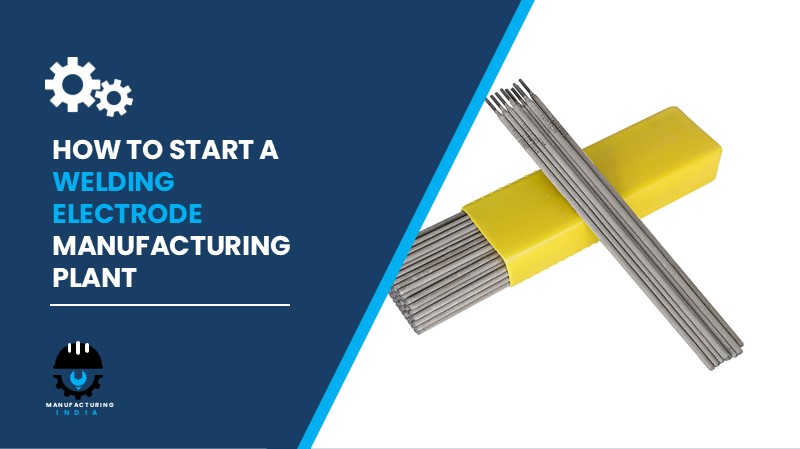
Welding electrodes are rods of metal with a coating of flux that are used for electric current conduction and for joining metal pieces in the process of arc welding. There are different types of electrodes – classified into coated, bare, rutile, basic, and stainless steel varieties – depending on the specific application and the materials involved. The coating plays a crucial role in controlling the arc, shielding the molten metal from air contamination, and enhancing the mechanical features of the welded area.
Welding electrodes are made by using specific combinations of iron powder, binders, flux materials, and alloying agents, which create consistent output of strong, less-spattering, and high-performance welds. Their regular quality and extended shelf life make them suitable for both large and small fabrication works. Among the various types, advanced electrodes such as rutile, basic coated, and stainless steel are becoming widely accepted due to their excellent tensile strength, stable arc, and easy application across different welding environments.
The primary production method is raw material weighing and batching, electrode wire drawing, flux coating, drying and curing, finishing, quality inspection, and packaging – a multi-stage precision manufacturing process that converts steel wire rods and flux materials into specification-grade welding consumables ready for construction, automotive, shipbuilding, oil and gas, heavy machinery, and metal fabrication end-users.
Cost of Setting Up a Welding Electrode Manufacturing Plant in India
The cost of establishing this facility depends on capacity, technology selection, plant location, degree of automation, and regulatory compliance requirements.
1. Capital Expenditure (CapEx)
Total capital investment for a welding electrode manufacturing plant in India covers land acquisition, site preparation, civil construction, machinery, and pre-operative expenses. The cost of land and site development – including charges for land registration, boundary development, and other related expenses – forms a substantial part of the overall investment. This allocation ensures a solid foundation for safe and efficient plant operations. Investors can reduce land acquisition costs by locating the unit in an industrial estate, steel or metalworking ancillary cluster, or Special Economic Zone (SEZ), which also provide shared utility infrastructure and potential state-level fiscal incentives aligned with India’s manufacturing push.
Civil works and construction cover the main wire drawing and coating production building, raw material storage areas for steel wire rods and flux materials, a finished goods warehouse, a quality control laboratory, and an administrative block. Given that the facility involves drying ovens and curing furnaces operating at elevated temperatures, civil infrastructure must incorporate heat-resistant construction elements, appropriate fire safety provisions, and adequate ventilation throughout the production areas.
Machinery costs account for the largest portion of total capital expenditure. Key machinery required includes:
- Wire drawing machines
- Coating machines
- Drying ovens
- Curing furnaces
- Finishing units
- Packaging systems
Other capital costs include the effluent treatment plant (ETP), advanced process monitoring systems, pre-operative expenses, trial production costs, and commissioning charges. All machinery must comply with industry standards for safety, efficiency, and reliability applicable to welding consumable manufacturing.
Request a Sample Report for In-Depth Market Insights: https://www.imarcgroup.com/welding-electrode-manufacturing-plant-project-report/requestsample
2. Operational Expenditure (OpEx)
The operating cost structure of a welding electrode manufacturing plant is primarily driven by raw material consumption. Steel wire rods – the dominant input material – account for approximately 70–80% of total operating expenses (OpEx), making steel procurement strategy the single most critical determinant of production economics and margin protection. Flux materials, including iron powder, binders, and alloying agents, are the secondary raw material inputs. Securing long-term supply agreements with reliable domestic steel wire rod producers is essential for cost stability and production continuity. Minimising transportation costs by selecting suppliers in proximity to the plant is a key procurement criterion.
Utility costs – comprising electricity for wire drawing machines, coating machines, drying ovens, and curing furnaces, as well as water and steam – account for 10–15% of total OpEx. Other ongoing operating costs include transportation, packaging, salaries and wages, depreciation, taxes, equipment repairs and maintenance, quality control, and other miscellaneous expenses.
By the fifth year of operations, the total operational cost is expected to increase substantially due to factors such as inflation, market fluctuations, and potential rises in the cost of key materials. Additional factors including supply chain disruptions, rising consumer demand, and shifts in the global economy are expected to contribute to this increase.
3. Plant Capacity
The proposed manufacturing facility is designed with an annual production capacity ranging between 10,000 and 20,000 MT, enabling economies of scale while maintaining operational flexibility. Capacity can be customised per investor requirements based on target OEM, infrastructure, and fabrication market segments, available capital, and degree of automation. Profitability improves materially with higher capacity utilisation, making domestic supply agreements with construction contractors, automotive component manufacturers, and industrial fabrication workshops – along with government infrastructure project procurement channels – a commercial priority from the commissioning stage.
4. Profit Margins and Financial Projections
The project demonstrates healthy profitability potential under normal operating conditions. Gross profit margins typically range between 25–35%, supported by stable demand and value-added applications. Net profit margins range between 10–15%. A comprehensive financial model covering NPV (net present value), IRR (internal rate of return), payback period, liquidity analysis, uncertainty analysis, sensitivity analysis, and a full five-year profit and loss account provides investors with a rigorous analytical framework for assessing financial viability and long-term sustainability across different capacity and pricing scenarios.
Why Set Up a Welding Electrode Plant in India?
India’s Infrastructure Spending Surge Creating Direct Demand. The Indian government increased capital spending on key infrastructure sectors – including roads, railways, power, and coal – by an average of 38.8% between FY20 and FY24, as reported in the 2024–25 Economic Survey. This surge in infrastructure development has directly boosted demand for welding electrodes across construction and industrial projects, creating a large, government-backed institutional procurement channel for domestic electrode manufacturers that is structurally embedded in India’s long-term national development planning.
Growing Construction and Shipbuilding Sectors. Rapid urbanisation, infrastructure projects, and the expansion of global construction, oil and gas, and maritime projects are driving consistent electrode consumption. Welding electrodes enable durable, high-strength joints in structural steel, pipelines, and bridges – applications that are multiplying rapidly across India’s expanding construction and industrial project pipeline. The shipbuilding and offshore sector’s requirement for corrosion-resistant, high-performance welding of ship hulls and offshore structures is an additional large-volume demand channel.
Automotive and Heavy Machinery Demand. Welding electrodes are essential for manufacturing vehicle frames, chassis, and industrial equipment components – making the automotive sector one of the most consistent and volume-driven procurement channels for domestic electrode producers. India’s rapidly expanding automotive manufacturing base, spanning passenger vehicles, commercial vehicles, two-wheelers, and electric vehicles, generates ongoing and growing consumption of welding consumables across both OEM and tier-1 supplier facilities.
Adoption of Advanced Electrode Types. Advanced welding electrode types – rutile, basic coated, and stainless steel – are becoming widely accepted due to their excellent tensile strength, stable arc, and easy application in different welding environments. The increasing adoption of automated welding processes and the demand for high-performance welding consumables in India’s automotive and heavy engineering sectors are further boosting consumption of premium electrode grades, supporting higher average selling prices and improved margin profiles for quality-focused domestic manufacturers.
Product Customisation Driving Value-Added Opportunities. Electrodes can be designed for specific materials, welding processes, and performance standards to meet individual client needs – a product customisation capability that enables domestic manufacturers to differentiate from commodity imports and command premium pricing in specialised fabrication, pipeline welding, and stainless steel joining applications across India’s chemical, pharmaceutical, and food processing plant construction markets.
Active Global Industry Investment Confirming Market Momentum. In June 2025, ESAB Corporation signed a definitive agreement to acquire EWM GmbH for approximately EUR 275 million, strengthening its welding electrode portfolio and automation reach, enhancing its presence in Europe, and expanding its welding solutions and industrial equipment offerings – a transaction that confirms the commercial confidence global welding industry leaders are placing in the long-term growth of welding consumable demand. In October 2024, Linde Bangladesh reported earning BDT 910 crore in sales from its welding electrodes business during the latest fiscal year, driven by strong demand across industrial sectors, confirming the scale of electrode demand that a well-positioned South Asian manufacturer can achieve across construction, manufacturing, and infrastructure project customers.
Manufacturing Process – Step by Step
The welding electrode manufacturing process uses raw material weighing and batching, electrode wire drawing, flux coating, drying and curing, finishing, quality inspection, and packaging as the primary production method. Each stage is precision-controlled to ensure arc stability, consistent mechanical properties, and compliance with the weld quality and safety standards required by construction, automotive, shipbuilding, and industrial fabrication customers.
- Raw Material Receipt and Inspection: Steel wire rods, flux materials including iron powder and binders, and alloying agents are received at the facility and subjected to incoming quality checks for dimensional specification, chemical composition, and moisture content before entering the production line.
- Raw Material Weighing and Batching: Steel wire rods and flux coating ingredients – iron powder, binders, flux materials, and alloying agents – are weighed and batched to the precise formulation required for the target electrode type: rutile, basic, stainless steel, or bare configuration. Accurate batching is critical to achieving consistent arc characteristics and mechanical properties across production batches.
- Electrode Wire Drawing: Steel wire rod is fed through wire drawing machines to produce electrode core wire of the precise diameter, surface finish, and tensile property specification required for the target electrode size and performance grade.
- Flux Coating: Drawn core wire is fed through coating machines where the flux paste – formulated from iron powder, binders, flux materials, and alloying agents – is applied uniformly around the core wire to the specified coating thickness and weight. Coating uniformity and concentricity are critical to arc stability and weld quality performance.
- Drying and Curing: Coated electrodes are conveyed through drying ovens to remove free moisture from the coating, followed by curing furnaces that bake the coating to the required hardness, bond strength, and moisture content specification, ensuring dimensional stability and shelf-life performance.
- Finishing: Cured electrodes are processed through finishing units to remove coating imperfections, trim the bare end for holder contact, and achieve the surface finish and dimensional tolerances required by the target electrode specification.
- Quality Inspection: Finished electrodes are evaluated on quality inspection equipment for coating concentricity, moisture content, arc performance, tensile strength of deposited weld metal, and dimensional compliance – ensuring every batch meets the required performance and traceability standards before release for packaging.
- Packaging and Dispatch: Approved electrodes are packed into protective cartons or canisters using packaging systems and dispatched to end-use customers across the construction sector, automotive manufacturing, shipbuilding, oil and gas, heavy machinery production, and metal fabrication workshops.
Key Applications
The welding electrode manufacturing plant serves a diverse and commercially critical range of industries across India’s industrial and infrastructure economy.
- Construction and Infrastructure Sector: Electrodes enable durable, high-strength joints in structural steel, pipelines, and bridges – the foundational application that drives the highest volume consumption of welding electrodes across India’s government-led infrastructure build-out.
- Automotive and Heavy Machinery: Essential for manufacturing vehicle frames, chassis, and industrial equipment components – a consistent, large-volume procurement channel across India’s expanding OEM and tier-1 automotive component manufacturing base.
- Shipbuilding and Marine Industry: Welding electrodes support corrosion-resistant and high-performance joining of ship hulls and offshore structures – a technically demanding application segment requiring premium rutile or basic coated electrode grades.
- Oil and Gas Pipelines: Used in the high-integrity welding of petroleum, natural gas, and petrochemical pipelines where weld quality, structural integrity, and pressure-bearing reliability are mandatory performance requirements.
- Metal Fabrication Workshops: Facilitate repair, maintenance, and fabrication in industrial workshops and service centres across India’s manufacturing sector – a large-volume, widely dispersed aftermarket channel for electrode consumption.
- Heavy Machinery and Industrial Equipment: Used in the fabrication and repair of industrial machinery frames, boilers, pressure vessels, and structural components across India’s capital goods and heavy engineering manufacturing sectors.
Leading Manufacturers
The global welding electrode industry is served by several established multinational manufacturers with extensive production capacities and diverse application portfolios. Key players operating in this market include:
- Lincoln Electric Holdings, Inc.
- ESAB Corporation
- voestalpine Böhler Welding
- Air Liquide Welding (Oerlikon)
- Tianjin Golden Bridge Welding Materials Group
All of these manufacturers serve end-use sectors including construction, shipbuilding, automotive, oil and gas, and industrial fabrication – the same markets that a domestic Indian welding electrode manufacturing plant can target at competitive landed cost advantage relative to imports.
Timeline to Start the Plant
Investors should plan for a structured pre-production and commissioning phase covering the following key stages:
- Feasibility study and project report preparation
- Land acquisition and site development
- Regulatory approvals and environmental clearances
- Factory licence and fire safety compliance
- Machinery procurement and installation
- Raw material supplier agreements and supply chain setup
- Trial production and quality testing
- Commercial production launch
Licences and Regulatory Requirements
Starting a welding electrode manufacturing unit in India requires several approvals:
- Business registration (Proprietorship, LLP, or Private Limited Company)
- Factory Licence under the Factories Act
- Environmental Clearance from the State Pollution Control Board
- GST Registration
- Fire Safety NOC
- Hazardous chemical compliance for storage and handling of flux materials, binders, and alloying agents
- Effluent Treatment Plant (ETP) operational clearance
- Occupational Health and Safety compliance
Key Challenges to Consider
High Capital Requirements. Establishing a fully equipped welding electrode manufacturing plant – with wire drawing machines, coating machines, drying ovens, curing furnaces, finishing units, and packaging systems – at the 10,000–20,000 MT annual capacity range requires significant upfront capital investment. Access to MSME credit-linked subsidy schemes, industrial estate support, and state government investment promotion grants can help bridge funding requirements for new entrants to this manufacturing segment.
Raw Material Price Volatility. Steel wire rods – accounting for 70–80% of total OpEx – are directly linked to global iron ore and coking coal commodity cycles, and domestic steel price movements can significantly impact production cost and margin outcomes. Long-term procurement contracts with reliable domestic steel wire rod producers and a diversified sourcing strategy are the primary risk mitigation measures for managing this dominant cost driver.
Regulatory Compliance. Welding electrode manufacturing involves handling flux materials, binders, and alloying agents that may be subject to hazardous chemical regulations depending on formulation. Effluent treatment for coating waste and dust management for powder handling operations are mandatory environmental compliance requirements. Factory safety standards for drying ovens and curing furnaces – which operate at elevated temperatures – require ongoing inspection and documentation.
Adoption of Automated Welding Reducing Consumable Demand. The increasing adoption of automated welding processes in large-scale automotive and heavy engineering manufacturing can, over time, reduce per-unit electrode consumption in certain segments as robotic welding systems shift to wire-feed processes. Domestic manufacturers must monitor this technology transition and position their product portfolio accordingly – including developing flux-cored and solid wire products to complement coated electrode offerings.
Competition from Global Players. Established multinational manufacturers – including Lincoln Electric Holdings Inc., ESAB Corporation, voestalpine Böhler Welding, Air Liquide Welding (Oerlikon), and Tianjin Golden Bridge Welding Materials Group – set high benchmarks for product quality, arc performance consistency, and pricing. Indian manufacturers must compete through domestic supply security, competitive pricing relative to imports, rapid delivery, and the ability to supply BIS-certified electrode grades tailored for India-specific construction and fabrication requirements.
Skilled Manpower. Operating wire drawing machines, coating machines, curing furnaces, and quality inspection equipment in a precision manufacturing environment requires trained metalworking technicians and quality assurance personnel. Recruiting, training, and retaining qualified production staff – particularly for flux coating formulation and arc performance testing – is a recurring operational challenge in India’s competitive industrial labour market.
Frequently Asked Questions
1. How much does it cost to set up a welding electrode manufacturing plant in India?
Total setup cost depends on plant capacity, location, machinery selection, and automation level. Key cost components include land and site development, civil construction with fire safety provisions, machinery (wire drawing machines, coating machines, drying ovens, curing furnaces, finishing units, packaging systems), and pre-operative expenses. A detailed feasibility study is recommended to generate accurate project-specific cost estimates.
2. Is welding electrode manufacturing profitable in India in 2026?
Yes. The project delivers healthy financial performance, with gross margins of 25–35% and net profit margins of 10–15% under normal operating conditions. The global welding electrode market was valued at USD 5.3 billion in 2025 and is projected to reach USD 7.08 billion by 2034 at a CAGR of 3.0% according to IMARC Group, with India’s infrastructure capital expenditure growing at an average of 38.8% between FY20 and FY24 providing a large and government-backed domestic demand base.
3. What machinery is required for a welding electrode plant in India?
Essential equipment includes wire drawing machines, coating machines, drying ovens, curing furnaces, finishing units, and packaging systems.
4. What licences and approvals are required to start a welding electrode plant in India?
Required approvals include business registration, Factory Licence, Environmental Clearance from the State Pollution Control Board, GST Registration, Fire Safety NOC, hazardous chemical compliance for flux materials and binders, ETP operational clearance, and Occupational Health and Safety compliance.
5. What raw materials are needed for welding electrode manufacturing?
The primary raw materials are steel wire rods and fluxes – including iron powder, binders, flux materials, and alloying agents. Steel wire rods are the dominant cost driver, accounting for 70–80% of total operating expenses, and must be sourced from suppliers meeting the tensile strength and dimensional specification requirements for welding electrode core wire production.
6. What are the environmental compliance requirements for a welding electrode plant in India?
The facility must obtain Environmental Clearance from the State Pollution Control Board, operate an approved ETP for coating wastewater management, and implement dust management systems for powder handling operations. Regular effluent monitoring, emission reporting, and safety documentation for drying and curing furnace operations are mandatory throughout operations.
7. What is the best location to set up a welding electrode plant in India?
Locations offering proximity to steel wire rod raw material suppliers, reliable industrial-grade utilities, and construction, automotive, and industrial fabrication end-user clusters are preferred. States such as Maharashtra, Gujarat, Tamil Nadu, Uttar Pradesh, and West Bengal – which host major steel, construction, and automotive manufacturing ecosystems – are strong candidates for plant location.
8. What is the break-even period for this type of plant in India?
The break-even period depends on plant capacity, total capital investment, product selling price, and capacity utilisation rate. A comprehensive financial analysis covering NPV, IRR, payback period, and uncertainty and sensitivity analysis is the most reliable method for generating project-specific break-even timelines.
9. What government incentives are available for manufacturers in India?
Welding electrode manufacturers in India can access MSME credit-linked capital subsidy schemes, state government investment promotion subsidies in industrial estates and metalworking clusters, and export promotion incentives for welding consumables under schemes administered by the Ministry of Commerce and Industry. Access to government infrastructure project procurement channels – including CPWD, NHAI, Railways, and state PWD tenders – provides direct institutional demand for BIS-certified domestic electrode products.
Key Takeaways for Investors
A welding electrode manufacturing plant in India offers a well-grounded investment opportunity anchored by growing demand across the construction and infrastructure sector, automotive manufacturing, shipbuilding, oil and gas pipelines, heavy machinery production, and metal fabrication – all of which depend on welding electrodes as a critical, high-volume industrial consumable. The project is financially viable across the 10,000–20,000 MT annual capacity range, with gross margins of 25–35% and net margins of 10–15% providing a consistent return framework for investors at multiple capital scales. According to IMARC Group estimates, the global welding electrode market is set to grow from USD 5.3 billion in 2025 to USD 7.08 billion by 2034 at a CAGR of 3.0%, and India’s government-driven infrastructure capital expenditure growth of 38.8% per year between FY20 and FY24 – as reported in the 2024–25 Economic Survey – provides a structurally expanding and policy-backed domestic demand base that positions India as one of the most compelling welding electrode manufacturing destinations in Asia. With global industry consolidation accelerating through transactions such as ESAB’s EUR 275 million acquisition of EWM GmbH in June 2025 confirming long-term commercial confidence in this category, the demand sustainability for domestically produced welding electrodes is structurally sound across all investment planning horizons.
About the Author