Introduction
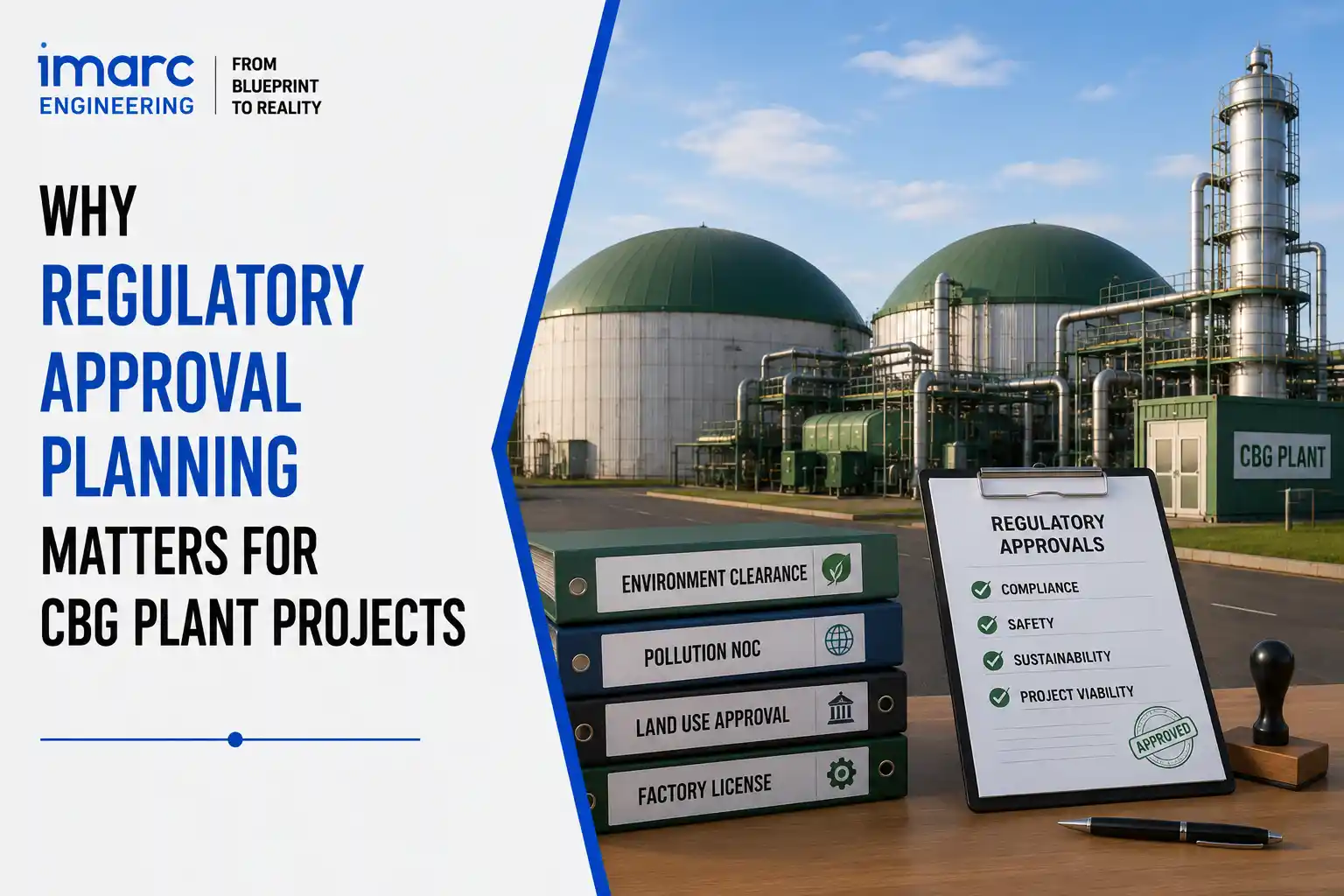
Regulatory approval planning is one of the highest-leverage controls on a CBG project timeline — and one of the most often started too late.
Once land is purchased, equipment is ordered or civil work begins, the hidden problems surface: stop-work exposure, consent conditions that force layout changes, delayed power or water connections, and holding costs that erode returns while clearances catch up. These risks are rarely visible in an LOI or a technology brochure. They become clear only when land-use, environmental, factory, fire and utility pathways are mapped against the specific site and capacity before major commitments are made.
IMARC Engineering provides CBG project advisory, feasibility and regulatory approval planning support across India. This article explains why regulatory approval planning matters for CBG plant projects, which clearances typically sit on the critical path, and how structured sequencing can protect both project schedules and investment.
Why Approval Planning Matters in India’s CBG Build-Out
India’s CBG sector is expanding under clear policy targets and structured demand.
- The SATAT framework was designed around a target of 5,000 CBG plants with 15 million metric tonnes of annual production capacity.
- More than 100 plants have been commissioned; 1,000+ LOIs have been issued by Oil Marketing Companies.
- The CBG Blending Obligation, phased from FY 2025-26, supports demand from the CNG and PNG network.
- The National Bioenergy Programme has also supported biogas and Bio-CNG projects through its Waste-to-Energy component.
Wider manufacturing context:
- Manufacturing growth estimated at around 7% in FY 2025-26 (MoSPI First Advance Estimates).
- FDI into manufacturing US$19.04 billion in FY 2024-25 (DPIIT / Ministry of Commerce).
- PLI cumulative investment ₹2.16 lakh crore+; cumulative production and sales ₹20.41 lakh crore+ (PIB, as of December 2025).
- Logistics costs improved to an estimated 7.97% of GDP (DPIIT-NCAER study).
Policy creates the opportunity. Regulatory sequencing decides whether a specific plant can move from land to construction and commissioning on a workable timeline. Approval delays are among the most common causes of cost overrun and utilisation lag in industrial bioenergy projects.
What Regulatory Approval Planning Covers for CBG Plants
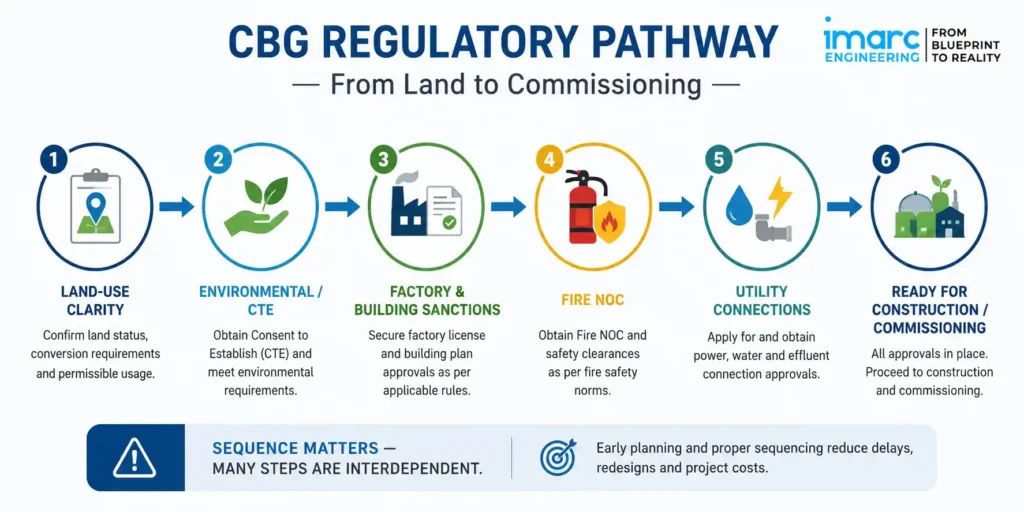
Approval planning is not a single application. It is the structured identification and sequencing of clearances that typically include:
- Land-use and conversion permissions where required
- Environmental pathways, including Consent to Establish (CTE) from the State Pollution Control Board where applicable
- Factory and industrial licences under applicable state rules
- Building plan and layout sanctions
- Fire NOC and safety-related clearances
- Power, water and effluent connection applications
- Any sector- or location-specific conditions attached to the plot or process
Exact requirements vary by state, site status, capacity and feedstock route. The planning task is to map what applies to this project early enough to protect the critical path.
Why Late Approval Work Damages Project Economics
When clearances are treated as a post-design formality, projects typically face:
- Stop-work and redesign risk — consent conditions that conflict with frozen layout or technology
- Utility lead-time shock — power and water connections that take longer than the construction schedule assumed
- Holding cost — interest, lease and overhead continuing while applications wait
- Funding stress — lenders and boards expecting a clear pathway that is not yet documented
- Compressed execution — construction rushed into short windows after late approvals, raising quality and safety risk
Early regulatory planning does not remove every delay. It moves discovery to a stage where design and procurement can still absorb conditions.
Key Dependencies Sponsors Often Under-Estimate
Approvals are interdependent. Environmental conditions can affect layout, technology and effluent design, while building and utility applications may depend on earlier land-use or consent decisions. Mapping these dependencies before detailed engineering reduces rework and keeps approval timelines aligned with construction.
A practical sequence should establish land-use and environmental pathway clarity first, followed by applicable consent, building and fire requirements, while utility applications are tracked in parallel according to their lead times.
What Good Regulatory Planning Delivers
When regulatory requirements are identified early and linked to project design, sponsors typically gain:
- More realistic project schedules
- Fewer mid-project redesigns driven by consent conditions
- Clearer conditions that can be built into layout and process design
- Stronger documentation for internal approvals and lenders
- Better coordination between project, environmental and statutory workstreams
Regulatory readiness is part of project risk control — not only a compliance task.
Regulatory Planning Focus Areas at a Glance
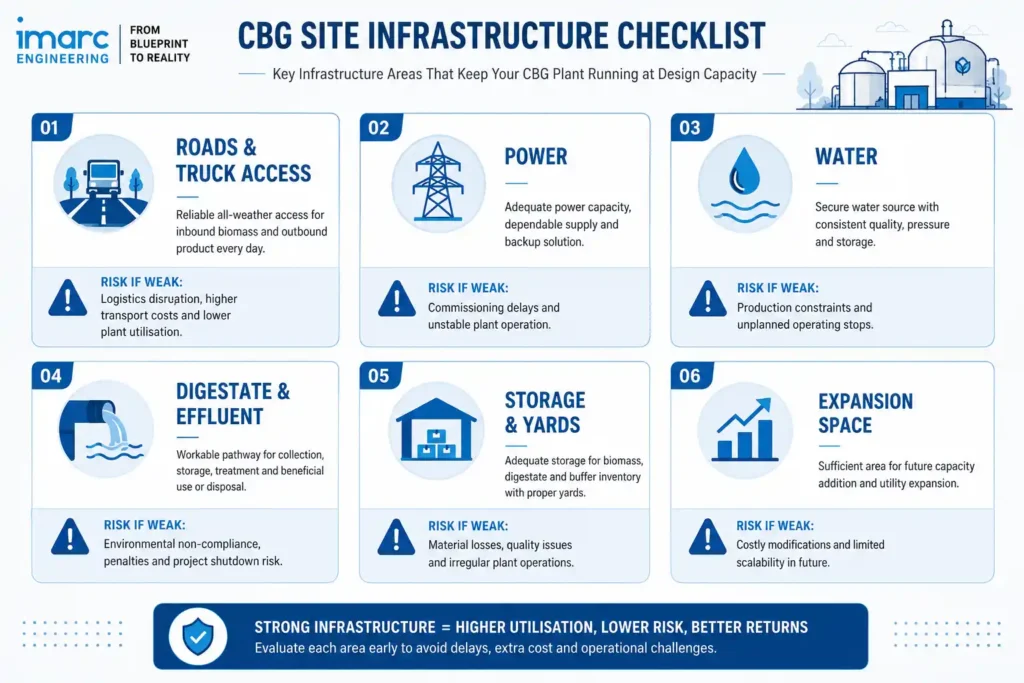
CBG Regulatory Approval and Licensing Support
CBG Regulatory Approval and Licensing Support helps project sponsors identify applicable approvals, map documentation requirements and sequence statutory submissions around land, environmental, factory, fire and utility requirements. The objective is to establish the regulatory pathway before major capital is committed, while allowing project design and execution planning to account for applicable conditions.
How IMARC Engineering Supports Regulatory Approval Planning
IMARC Engineering supports CBG and Bio-CNG project sponsors with regulatory approval and licensing planning aligned with project location, capacity and execution requirements.
- Location- and capacity-specific approval mapping
- Regulatory documentation and submission planning
- Sequencing of critical-path approvals
- Alignment of layout and process assumptions with applicable consent conditions
- Coordination inputs across environmental, statutory and project teams
- Integration of approval timelines into feasibility and project schedules
IMARC Engineering works with investors, developers and industrial clients on CBG / Bio-CNG projects under SATAT and related frameworks across India.
Planning a CBG project in India? Regulatory approval and licensing requirements can be assessed alongside feasibility, site and project planning before major capital is committed: https://www.imarcengineering.com/contact?service=regulatory-approval-and-licensing
Common Mistakes in CBG Approval Planning
- Assuming land allotment or purchase automatically permits construction
- Freezing layout before environmental and CTE pathways are clear
- Treating building plan and fire NOC as post-construction formalities
- Under-estimating lead times for power, water and effluent connections
- Ignoring state-specific or industrial-area conditions attached to the plot
- Starting major CapEx before the approval critical path is mapped
Conclusion
Regulatory approval planning matters for CBG plant projects because clearances sit on the path from land to commissioning — and late discovery is expensive. India’s SATAT target of 5,000 plants and 15 MMT capacity, blending obligations and bioenergy support create real room for investment. Returns still depend on whether each project can clear land-use, environmental, factory, fire and utility requirements on a schedule the financial model can survive.
When approvals are mapped early, sequenced against design and tracked in parallel with engineering, sponsors reduce stop-work risk, redesign cost and holding-time exposure. That discipline is a practical part of protecting CBG project economics.
Through clearance mapping, sequencing support and project-aligned advisory, IMARC Engineering helps CBG sponsors treat regulatory planning as a core project control — not a last-mile formality.
Contact Us:
IMARC Engineering
Phone: +91-120-433-0800
Email: sales@imarcengineering.com
India: C-130, Sector 2, Noida, Uttar Pradesh 201301
LinkedIn: https://www.linkedin.com/showcase/imarc-engineering/
About the Author