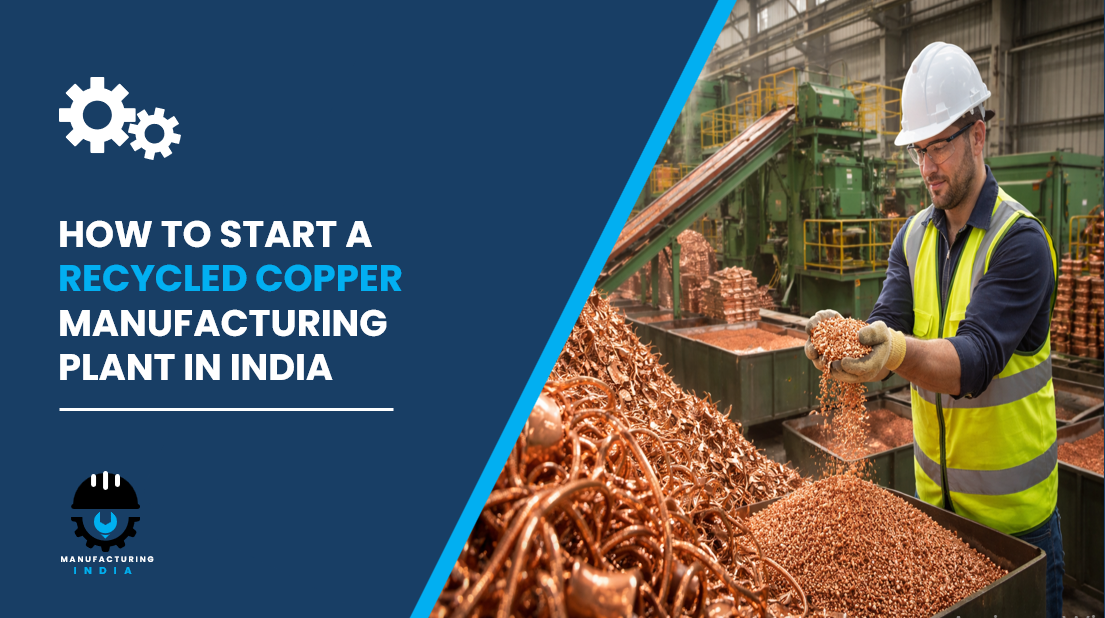
Setting up a recycled copper manufacturing plant in India presents a compelling investment case anchored in the country’s rapidly growing electrical and electronics industry, expanding renewable energy infrastructure, accelerating electric vehicle adoption, and one of the world’s largest and most active copper scrap generation and consumption ecosystems. Recycled copper — produced by melting down scrap copper obtained from discarded electrical wires, old machinery, and electronics — preserves the inherent properties of copper, including high electrical conductivity, thermal conductivity, and corrosion resistance, while requiring significantly less energy to produce than primary copper extracted from ore. This combination of material performance equivalence and substantially lower production cost and carbon footprint makes recycled copper a commercially and environmentally compelling alternative to virgin copper across every major end-use sector.
India’s strategic advantages for this investment are substantial and reinforcing. The country generates significant volumes of copper scrap from its large installed base of electrical infrastructure, industrial machinery, consumer electronics, and construction activity. Growing demand from India’s power transmission, renewable energy, electric vehicle, and construction sectors creates a deep and expanding domestic buyer base. The Make in India initiative, the National Resource Efficiency Policy, and India’s commitments to circular economy principles and carbon emission reduction all create a policy environment that actively favours investment in secondary metal production. Industrial clusters in Gujarat, Maharashtra, Rajasthan, and Tamil Nadu offer established metal processing infrastructure, scrap aggregation networks, and proximity to key buyer industries.
A recycled copper manufacturing plant in India is positioned at the intersection of two of the decade’s most powerful industrial megatrends — the green energy transition and the circular economy — in one of the world’s fastest-growing copper-consuming markets. With the global recycled copper market projected to reach USD 124.98 billion by 2034 at a CAGR of 10.6%, this investment offers strong long-term revenue growth and strategically essential positioning for India-based producers serving the electrical, automotive, construction, and renewable energy sectors.
What is Recycled Copper?
Recycled copper is produced by melting down scrap copper obtained from various sources such as discarded electrical wires, old machinery, and electronics. The recycling process preserves the inherent properties of copper, including high electrical conductivity, thermal conductivity, and corrosion resistance. It is an environmentally sustainable option, as it requires less energy compared to primary copper production and reduces the demand for mining and extraction of copper ores.
Recycled copper is used in a wide range of applications, including electrical wiring, construction, automotive components, and industrial machinery, maintaining the same quality and performance standards as virgin copper. The primary production method spans collection and sorting, shredding and cleaning, melting, refining, casting, and cooling and packaging. The product serves end-use industries including electrical and electronics, construction, automotive, industrial machinery and equipment, renewable energy, and recycling and waste management.
Cost of Setting Up a Recycled Copper Manufacturing Plant in India
The total cost of establishing a recycled copper manufacturing plant in India depends on production capacity, chosen refining technology, plant location, degree of automation, and regulatory compliance requirements.
1. Capital Expenditure (CapEx)
The capital investment required to set up this facility covers several major cost heads. Land and site development — including land registration, boundary development, heavy-duty flooring for scrap handling, fire safety infrastructure, and related site works — forms a substantial portion of total CapEx. Investors should consider locating the unit within metal processing industrial estates or Special Economic Zones (SEZs) in Gujarat (Mundra, Rajkot), Maharashtra (Bhiwandi, Nagpur), or Rajasthan, where established scrap dealer and aggregator networks, proximity to port infrastructure for imported scrap, and state government industrial investment incentives create a favourable operating environment. Access to reliable high-voltage power supply is also a critical site selection criterion given the energy demands of furnace operations.
Civil works and construction costs cover the scrap receiving and sorting yard, shredding hall, furnace and melting building with fume extraction infrastructure, refining area, casting and cooling section, quality control laboratory, finished product storage, effluent and emission treatment systems, and administrative block. Furnace operations require heavy-duty civil foundations, refractory-lined structures, and industrial-grade ventilation and emission control systems that add specification complexity to the civil works scope.
Machinery and equipment represent the largest component of total capital expenditure for this recycled copper manufacturing plant. Key machinery required includes:
- Shredders
- Furnaces (melting and refining)
- Refining equipment
- Casting and extrusion machines
- Cooling systems
- Packaging and storage equipment
- Quality control and testing equipment
Other capital costs include effluent treatment plant (ETP) installation, flue gas and dust emission control systems (bag filters, scrubbers) for furnace operations, pre-operative and commissioning expenses, and any applicable import duties on specialised refining and casting equipment not manufactured domestically.
Request a Sample Report for In-Depth Market Insights: https://www.imarcgroup.com/recycled-copper-manufacturing-plant-project-report/requestsample
2. Operational Expenditure (OpEx)
The operating cost structure of a recycled copper manufacturing plant is overwhelmingly dominated by raw material procurement. Raw material cost — covering copper scrap as the sole primary input, sourced from discarded electrical wires, industrial machinery, electronics, and construction demolition waste — accounts for approximately 85–92% of total OpEx, making copper scrap procurement the single most critical cost and strategic management lever in the entire business. Scrap price management, through diversified sourcing channels — domestic scrap dealers, industrial scrap contracts, and imported scrap via port-adjacent facilities — is the primary driver of plant-level profitability in this high-volume, relatively thin-margin commodity processing model.
Utility costs, covering electricity, water, and fuel required for shredding, furnace melting, refining, and casting operations, account for 5–8% of OpEx — a relatively low share by manufacturing standards, reflecting the significant energy efficiency advantage of copper recycling versus primary smelting. According to the International Energy Agency, wholesale electricity prices in the European Union and the U.S. increased by 30–40% in the first half of 2025 compared to the same period in the previous year, owing to tight global gas markets — further reinforcing the cost competitiveness of energy-efficient recycled copper production relative to virgin copper. Other operating costs include transportation and logistics for scrap procurement and finished copper dispatch, packaging of cast copper products, salaries and wages, maintenance and refractory repairs for furnace equipment, depreciation of fixed assets, and applicable taxes. By the fifth year of operations, total operational costs are projected to increase substantially due to inflation, copper scrap price escalation, rising energy costs, and growing industrial demand dynamics.
3. Plant Capacity
The proposed manufacturing facility is designed with an annual production capacity of 30,000 metric tons, enabling economies of scale while maintaining operational flexibility. Capacity can be customised based on specific investor requirements, available copper scrap catchment volumes in the target sourcing region, and capital availability. Profitability and throughput efficiency improve meaningfully with higher capacity utilisation, and the high fixed-cost base of furnace and refining infrastructure makes maximising production volume a central operational priority.
4. Profit Margins and Financial Projections
The recycled copper manufacturing plant operates in a high-volume, commodity-grade processing segment where margins are characteristically lean but stable. Gross profit margins typically range between 5–12%, and net profit margins are projected in the range of 3–8%, reflecting the dominant share of copper scrap cost in the total cost structure. Revenue scale — driven by processing volume across the 30,000 MT annual capacity — compensates for the thin per-unit margin and delivers absolute returns commensurate with the investment quantum. Key financial indicators including NPV, IRR, payback period, liquidity analysis, and sensitivity analysis are covered comprehensively in the full project report. Recycling helps stabilise the copper supply chain by providing a steady source of copper without the price volatility associated with mining, improving the predictability of the plant’s financial performance over the investment horizon.
Why Set Up a Recycled Copper Manufacturing Plant in India?
Sustainability, Environmental Benefits, and Circular Economy Integration. Recycled copper significantly reduces the environmental impact compared to mining and processing virgin copper — requiring less energy and producing fewer emissions, making it a key component of the circular economy. India’s National Resource Efficiency Policy and growing corporate ESG commitments from industrial buyers are creating strong institutional preference for recycled metal inputs, directly benefiting domestic recycled copper producers.
Cost Efficiency Versus Primary Copper Production. Recycled copper is typically more cost-effective than primary copper due to lower production costs. The process of recycling copper is less energy-intensive than primary smelting, which results in reduced overall costs for manufacturers. Rising energy prices globally — with EU and U.S. wholesale electricity prices up 30–40% in the first half of 2025 according to the International Energy Agency — have further widened the cost competitiveness advantage of copper recycling relative to primary production.
Growing Demand in Green Energy and Electric Vehicles. The increasing demand for renewable energy technologies — wind turbines, solar energy installations, and power transmission infrastructure — has elevated the role of copper in energy infrastructure at an unprecedented pace. Recycled copper plays a crucial role in meeting these growing demands while reducing environmental impact. The growing adoption of electric vehicles in India, which require large amounts of copper for wiring and components, is projected to further boost demand for recycled copper production.
Fluctuating Copper Prices Supporting Scrap-Based Production. Recycling helps stabilise the copper supply chain by providing a steady source of copper without the price volatility associated with mining and primary refining. For industrial buyers in India’s electrical, construction, and automotive sectors who require consistent copper supply and pricing predictability, domestic recycled copper producers offer a strategically valuable alternative to primary copper sourced through global commodity markets.
Active Global Industry Investment. In September 2025, Aurubis AG invested approximately USD 5.9 million in the modernisation of a shaft furnace for sustainable production, while Nexans raised EUR 250 million (~USD 295 million) to construct facilities that process up to 80,000 metric tons of copper scrap per year — reflecting powerful global capital commitment to recycled copper capacity. In December 2024, Glencore formed a multi-year partnership with Cyclic Materials to provide recycled copper produced from electronic scrap — including cars and wind turbines — to Glencore’s Horne smelter and Canadian copper refinery for refining into copper cathodes destined for electric vehicles and renewable energy projects.
Circular Economy Integration Across India’s Key Industries. Recycled copper is an essential part of India’s circular economy agenda, helping industries in the electrical, construction, automotive, and industrial machinery sectors reduce waste, improve resource utilisation, and meet sustainability reporting requirements — creating both commercial demand and institutional preference for India-based recycled copper suppliers.
Manufacturing Process – Step by Step
The recycled copper manufacturing process uses collection and sorting, shredding and cleaning, melting, refining, casting, and cooling and packaging as the primary production method. The process involves multiple unit operations, material handling stages, and quality verification checkpoints throughout.
- Collection and Sorting: Copper scrap from discarded electrical wires, old machinery, electronics, and construction demolition is collected from scrap dealers, industrial clients, and e-waste aggregators, and sorted by copper grade, alloy type, and contamination level to optimise furnace charge composition and output purity.
- Shredding and Cleaning: Sorted copper scrap is fed into shredders to reduce size and increase surface area for efficient melting. Insulation, plastic coatings, and non-metallic contaminants are removed through mechanical separation, air classification, and eddy current separation systems to produce clean copper-rich feedstock.
- Melting: Clean shredded scrap is charged into furnaces where it is melted at high temperatures to produce a homogeneous copper melt. Flux additions are made to facilitate slag separation and remove remaining impurities from the melt bath.
- Refining: The copper melt undergoes refining in refining furnaces to remove dissolved gases, residual impurities, and alloying elements, producing refined copper of the specified grade and purity. Fire refining or electrolytic refining techniques are applied depending on the target product grade and customer specification requirements.
- Casting: Refined copper is cast into semi-finished product forms — including billets, rods, cathodes, ingots, or wire rod — using casting and extrusion machines. Casting parameters are controlled to achieve the required microstructure, surface quality, and dimensional accuracy for downstream processing by electrical, construction, and automotive fabricators.
- Cooling: Cast copper products are cooled through cooling systems using controlled water or air cooling to achieve the required mechanical properties and dimensional stability before handling and inspection.
- Quality Control and Testing: Finished copper products are tested using quality control and testing equipment for electrical conductivity, chemical composition, tensile strength, dimensional accuracy, and surface finish against applicable IS, ASTM, or customer-specific specifications.
- Packaging and Dispatch: Approved copper billets, rods, cathodes, or ingots are packaged and dispatched to electrical cable and wire manufacturers, construction contractors, automotive component suppliers, industrial machinery producers, renewable energy equipment fabricators, and export markets.
Key Applications
The recycled copper manufacturing plant serves multiple high-volume industries with consistent and growing demand for reliable, performance-equivalent copper inputs:
- Electrical and Electronics Industry: Used in the manufacture of electric wires and cables, playing a crucial role in the transmission of electricity through power lines, domestic wiring, and electrical appliances — the single largest application segment for recycled copper.
- Construction Industry: Used in plumbing systems, roofing materials, and electrical wiring installations across residential, commercial, and industrial construction projects.
- Automotive Industry: Used for electrical wiring harnesses, connectors, and components across conventional vehicles and increasingly in electric vehicles requiring higher copper content per unit.
- Renewable Energy Sector: Increasingly used in wind turbines, solar energy installations, and energy storage systems — one of the fastest-growing application segments globally.
- Industrial Machinery and Equipment: Used in machinery components due to its strength, conductivity, and corrosion-resistant properties across manufacturing, processing, and utility equipment.
Leading Manufacturers
The global recycled copper industry is served by several major multinational companies with extensive production capacities and diversified application portfolios. Key players include:
- Aurubis AG
- Kuusakoski Group Oy
- Umicore N.V., LLC
- Pacific Metal Pty Ltd
- Schnitzer Steel Industries, Inc.
- OmniSource
- Commercial Metals Company
Timeline to Start the Plant
- Feasibility study and project report preparation
- Land acquisition and site development
- Regulatory approvals and environmental clearances
- Factory licence and fire safety compliance
- Machinery procurement and installation
- Raw material supplier agreements and supply chain setup
- Trial production and quality testing
- Commercial production launch
Licences and Regulatory Requirements
Starting a recycled copper manufacturing unit in India requires several approvals:
- Business registration (Proprietorship, LLP, or Pvt Ltd)
- Factory Licence under the Factories Act
- Environmental Clearance from State Pollution Control Board
- GST Registration
- Fire Safety NOC
- Hazardous waste management authorisation under the Hazardous and Other Wastes (Management and Transboundary Movement) Rules — applicable to copper scrap processing and furnace residue management
- Air emission compliance certification for furnace flue gas, particulate matter, and heavy metal emissions from melting and refining operations
- Effluent Treatment Plant (ETP) operational clearance
- Occupational Health and Safety compliance
Key Challenges to Consider
Copper Scrap Price Volatility and Supply Availability. Copper scrap — accounting for 85–92% of total OpEx — is priced in close correlation with London Metal Exchange (LME) copper, making the plant’s input cost directly exposed to global commodity market movements. Building a diversified scrap sourcing network across domestic dealers, industrial scrap contracts, e-waste channels, and import options is the primary strategic risk management requirement for this type of plant.
Regulatory Compliance for Hazardous Waste and Emissions. Copper scrap processing — particularly from electronics and cables containing insulation — generates hazardous residues and furnace flue gases containing particulate matter and heavy metals. Meeting the Hazardous Waste Management Rules, State Pollution Control Board emission standards, and Central Pollution Control Board guidelines requires dedicated emission control equipment investment and ongoing environmental monitoring.
High Capital Requirements. Industrial shredders, high-temperature melting and refining furnaces, and casting and extrusion machines with associated refractory lining, fume extraction, and emission control systems constitute significant CapEx commitments requiring careful financial structuring and access to institutional or government-backed metal sector investment support.
Thin Margin Structure Requiring Volume and Efficiency Focus. With gross margins of 5–12% and net margins of 3–8%, profitability in recycled copper manufacturing is fundamentally driven by throughput volume, scrap procurement cost management, and operational efficiency — particularly furnace yield and energy consumption per metric ton of output. Operational excellence and scale are non-negotiable for sustained commercial viability.
Competition. Global players such as Aurubis AG, Umicore N.V., LLC, Schnitzer Steel Industries, Inc., and Commercial Metals Company maintain dominant market positions with established scrap procurement networks and large-scale refining capacity. Indian producers must compete on scrap sourcing proximity, logistics cost efficiency, customer service responsiveness, and domestic supply chain advantages.
Skilled Manpower. Operating high-temperature furnaces, refining systems, and precision casting equipment to international quality standards requires metallurgically trained engineers and process operators — a specialised workforce category that can present recruitment and retention challenges outside established metal processing industrial clusters.
Frequently Asked Questions
1. How much does it cost to set up a recycled copper manufacturing plant in India? Total investment depends on production capacity (30,000 MT annually as baseline), refining technology, location, and automation level. Key cost components include land and site development with heavy-duty infrastructure, machinery (shredders, furnaces, refining equipment, casting and extrusion machines, cooling systems, quality control and testing equipment), emission control systems, ETP, and working capital. A detailed project report provides capacity-specific CapEx and OpEx estimates.
2. Is recycled copper manufacturing profitable in India in 2026? Yes, at adequate scale. The facility demonstrates gross profit margins of 5–12% and net profit margins of 3–8%, with absolute returns driven by high-volume throughput across the 30,000 MT annual capacity. The market’s 10.6% CAGR through 2034 supports long-term revenue growth. Effective copper scrap procurement cost management is the primary profitability lever.
3. What machinery is required for a recycled copper manufacturing plant in India? Key equipment includes shredders, furnaces (melting and refining), refining equipment, casting and extrusion machines, cooling systems, packaging and storage equipment, and quality control and testing equipment, along with industrial fume extraction and emission control systems.
4. What licences and approvals are required to start a recycled copper manufacturing plant in India? Required approvals include business registration, Factory Licence under the Factories Act, Environmental Clearance from the State Pollution Control Board, GST registration, Fire Safety NOC, hazardous waste management authorisation under the Hazardous and Other Wastes Rules, air emission compliance certification for furnace operations, ETP operational clearance, and Occupational Health and Safety certification.
5. What raw materials are needed for recycled copper manufacturing? The sole primary raw material is copper scrap, sourced from discarded electrical wires, old industrial machinery, consumer electronics, automotive components, construction demolition waste, and imported scrap through port-adjacent procurement channels.
6. What are the environmental compliance requirements for a recycled copper manufacturing plant in India? Operators must obtain Environmental Clearance, obtain hazardous waste management authorisation for copper scrap processing and furnace residue disposal, install and operate industrial bag filters and scrubbers to control particulate matter and heavy metal emissions from melting and refining furnace stacks, maintain an operational ETP for process wastewater, and comply with State Pollution Control Board and Central Pollution Control Board emission standards applicable to secondary copper smelting operations.
7. What is the best location to set up a recycled copper manufacturing plant in India? Ideal locations offer access to established copper scrap aggregation and dealer networks, proximity to port infrastructure for imported scrap logistics, reliable high-voltage power supply, and proximity to key buyer industries — electrical cable manufacturers, construction contractors, and automotive component producers. Gujarat (Mundra, Rajkot), Maharashtra (Bhiwandi, Nagpur), Rajasthan, and Tamil Nadu offer strong combinations of scrap availability, industrial infrastructure, and buyer proximity.
8. What is the break-even period for this type of plant in India? Break-even depends on production scale, copper scrap procurement costs, capacity utilisation, and prevailing LME-linked copper market pricing. The high-volume, thin-margin nature of the business makes rapid ramp-up to nameplate capacity utilisation a critical determinant of payback timeline. A detailed feasibility study provides project-specific break-even, NPV, and IRR projections.
9. What government incentives are available for manufacturers in India? Recycled copper manufacturers in India can benefit from capital subsidies under state-level metal and materials processing investment schemes, tax exemptions under state industrial promotion policies, reduced utility tariffs in metal processing industrial estates, export-linked benefits for copper rod and cathode exports, and incentives under the National Resource Efficiency Policy supporting secondary metal production. Make in India and circular economy policy initiatives may provide additional investment support and regulatory facilitation for approved projects.
Key Takeaways for Investors
The recycled copper manufacturing plant opportunity in India is underpinned by structurally accelerating demand from the electrical and electronics, construction, automotive, renewable energy, and industrial machinery sectors — all of which are expanding rapidly with India’s infrastructure build-out, energy transition, and industrial scale-up. While margin profiles are lean at 5–12% gross and 3–8% net, the sheer scale of the market — valued at USD 50.47 billion in 2025 and projected to reach USD 124.98 billion by 2034 at a CAGR of 10.6% — means that high-volume producers operating efficiently against a well-managed scrap procurement base can generate compelling absolute returns. The convergence of rising primary copper energy costs, global circular economy momentum, India’s green energy transition, and exploding EV copper demand — evidenced by major investments from Aurubis AG, Nexans, and Glencore in September and December 2024–2025 — confirms that recycled copper manufacturing is entering a sustained period of demand acceleration and investment inflow. India-based producers who establish scrap procurement scale, operational efficiency, and multi-sector customer relationships early are positioned to capture a disproportionate share of the country’s rapidly growing secondary copper market.
About the Author