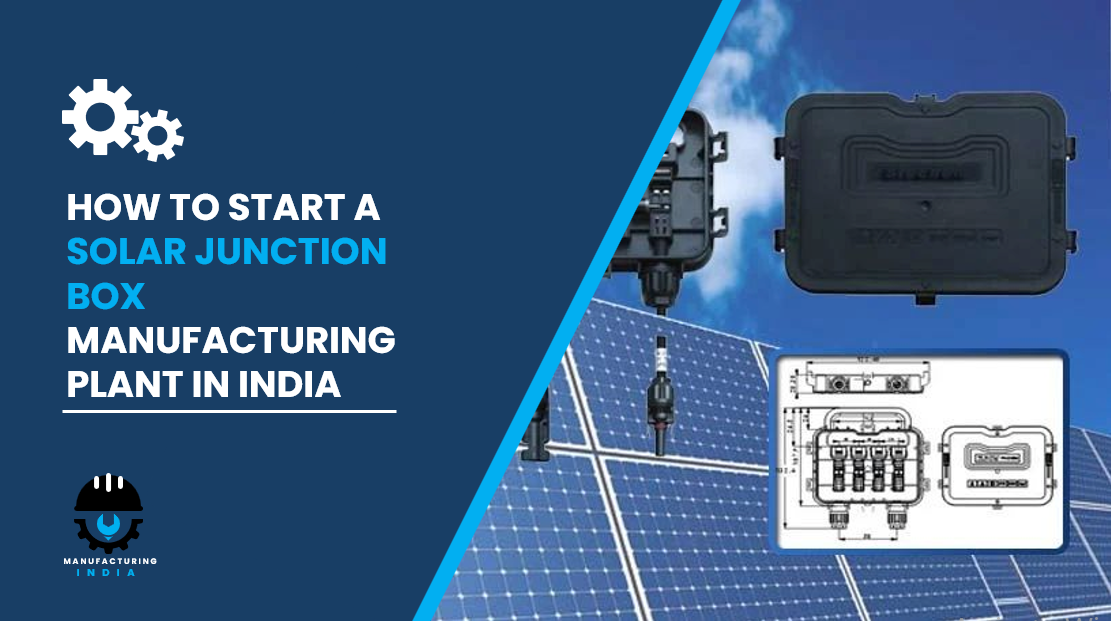
Setting up a solar junction box manufacturing plant in India presents a compelling investment case driven by the country’s explosive solar photovoltaic (PV) deployment, ambitious national renewable energy targets, the rapid growth of both utility-scale solar parks and distributed rooftop systems, and India’s accelerating push to localise the entire solar manufacturing value chain. A solar junction box is an essential electrical component installed on the rear side of every photovoltaic panel, housing terminals, connectors, and bypass diodes that protect the PV module from power loss caused by shading, cell mismatch, or overheating, while providing the weatherproof, insulated enclosure that connects solar cells to external electrical systems. Critically, every solar module manufactured or deployed requires a junction box — creating a stable, structural link between junction box demand and the global solar installation curve that is expanding at record pace.
In the first half of 2025, global solar capacity grew by 380 GW — a 64% increase compared to the 232 GW installed during the same period in 2024 — putting worldwide solar installations on pace for another record-breaking year, according to Ember. India sits at the heart of this expansion, with solar deployment accelerating across Rajasthan, Gujarat, Andhra Pradesh, Tamil Nadu, and Madhya Pradesh through large-scale government tenders, rooftop solar incentive schemes, and renewable energy EPC contractor activity. This scale of domestic solar module manufacturing and installation creates an enormous and rapidly growing captive demand base for junction boxes, giving India-based manufacturers a compelling localisation advantage over import-dependent supply chains. The PLI scheme for solar PV manufacturing and the broader Make in India electronics and energy manufacturing policy framework provide additional investment support.
A solar junction box manufacturing plant in India captures mandatory, per-module demand from one of the world’s fastest-growing solar markets, delivering gross margins of 30–40% and net margins of 15–25% on a product that every PV installation requires. With the global solar junction box market projected to reach USD 3,132.70 million by 2034 at a CAGR of 6.0%, and India’s solar capacity additions accelerating to record pace, this investment offers strong financial returns and a structurally secured demand base for technically capable domestic producers.
What is a Solar Junction Box?
A solar junction box is an essential electrical component installed on the rear side of a photovoltaic panel to connect solar cells with external electrical systems. The system includes terminals and connectors together with bypass diodes, which protect the PV module from power loss caused by shading, cell mismatch, or overheating conditions. The junction box uses protective elements to create a safe system that transmits solar cell electricity in a reliable and efficient manner. Its durable design provides insulation and waterproofing capabilities to withstand rain, dust, and extreme temperature conditions throughout the solar module’s operational lifetime.
Solar junction boxes are essential in residential, commercial, and utility-scale solar installations, supporting long-term system performance and safety. The primary production method spans plastic housing moulding, terminal and diode assembly, soldering and wiring integration, sealing and potting, quality inspection, electrical testing, and final packaging. The product serves end-use industries including solar panel manufacturers, renewable energy EPC contractors, utility-scale solar farms, residential solar installers, and commercial rooftop system providers.
Cost of Setting Up a Solar Junction Box Manufacturing Plant in India
The total cost of establishing a solar junction box manufacturing plant in India depends on production capacity, automation level, plant location, component sourcing strategy, and regulatory compliance requirements.
1. Capital Expenditure (CapEx)
The capital investment required to set up this facility covers several major cost heads. Land and site development — including land registration, boundary development, ESD-controlled flooring for electronics assembly, and related site infrastructure — forms a substantial portion of total CapEx. Investors should consider locating the unit within electronics or solar manufacturing clusters in Gujarat (Surat, Ahmedabad), Rajasthan, Tamil Nadu, or Uttar Pradesh (Noida), where proximity to solar module manufacturers — the primary institutional buyers — reduces logistics costs and improves supply responsiveness. Access to an established plastics and electronic component supplier ecosystem is also a key site selection factor.
Civil works and construction costs cover the injection moulding hall, diode and terminal assembly area, automated assembly line floor, potting and sealing station, electrical testing and quality control laboratory, finished goods storage, and administrative block. Electronics assembly operations require controlled-environment workspaces with ESD protection and consistent temperature and humidity conditions throughout component handling and soldering stages.
Machinery and equipment represent the largest component of total capital expenditure for this solar junction box manufacturing plant. Key machinery required includes:
- Injection moulding machines
- Diode soldering stations
- Automated assembly lines
- Potting and sealing equipment
- Electrical testing systems
- Packaging units
Other capital costs include effluent and waste management systems, ESD protection infrastructure throughout the production floor, pre-operative and commissioning expenses, and any applicable import duties on precision soldering and automated assembly equipment not manufactured domestically.
Request a Sample Report for In-Depth Market Insights: https://www.imarcgroup.com/solar-junction-box-manufacturing-plant-project-report/requestsample
2. Operational Expenditure (OpEx)
The operating cost structure of a solar junction box manufacturing plant is primarily driven by raw material procurement. Raw material cost — covering plastic housing as the dominant input, along with connectors, cables, and diodes — accounts for approximately 70–80% of total OpEx. Plastic housing, as the primary structural and protective component of the junction box, represents the highest-volume and highest-cost input in the bill of materials. Investors should establish long-term supply contracts with polymer and electronic component suppliers to stabilise input costs and ensure production continuity across product generation transitions. Sourcing engineering-grade polymer resins with UV resistance and high-temperature stability from established domestic or regional plastics suppliers can reduce procurement costs relative to fully imported input strategies.
Utility costs, covering electricity for injection moulding, soldering, and testing operations, along with water for cooling, account for 5–10% of OpEx — a relatively low share reflecting the predominantly assembly and moulding nature of solar junction box production. Other operating costs include transportation and logistics for finished junction box dispatch to solar module manufacturers and EPC contractors, packaging materials, salaries and wages for assembly and quality assurance staff, maintenance and calibration of moulding and testing equipment, depreciation of fixed assets, and applicable taxes. By the fifth year of operations, total operational costs are projected to increase substantially due to inflation, polymer and component price escalation, market fluctuations, and growing solar industry demand dynamics.
3. Plant Capacity
The proposed manufacturing facility is designed with an annual production capacity ranging between 1 million and 5 million units, enabling economies of scale while maintaining operational flexibility. Capacity can be customised based on specific investor requirements, target customer mix across solar module manufacturers, EPC contractors, and residential installers, and available capital. Profitability and unit economics improve meaningfully with higher capacity utilisation, and the injection moulding and automated assembly nature of solar junction box production enables efficient capacity scaling with incremental equipment additions.
4. Profit Margins and Financial Projections
The solar junction box manufacturing plant demonstrates strong and attractive profitability relative to most electronics component manufacturing segments. Gross profit margins typically range between 30–40%, supported by stable per-module demand across the entire solar installation market, the value-added nature of precision-moulded and electrically tested junction boxes versus raw material inputs, and the relatively low utility cost structure. Net profit margins are projected in the range of 15–25%. Key financial indicators including NPV, IRR, payback period, liquidity analysis, and sensitivity analysis are covered comprehensively in the full project report. The combination of mandatory per-module demand, India’s record solar installation pace, and the PLI scheme framework provides a highly predictable and growing revenue base for this investment.
Why Set Up a Solar Junction Box Manufacturing Plant in India?
Expanding Solar Installations Creating Mandatory Per-Module Demand. Growth in global and domestic PV capacity directly increases demand for junction boxes, as every solar module manufactured or installed requires one. In the first half of 2025, global solar capacity grew by 380 GW — a 64% increase compared to the same period in 2024 — according to Ember. India’s contribution to this growth, through government tenders, rooftop schemes, and renewable energy EPC activity, creates an enormous and expanding captive domestic buyer base for junction box producers.
Every Solar Module Requires a Junction Box. Unlike many solar BOS (balance-of-system) components that are optional or application-specific, a solar junction box is a mandatory, non-substitutable component fitted to every PV module manufactured. This structural link to module production volumes provides an exceptionally reliable and predictable demand baseline that grows in direct proportion to solar capacity additions — the most rapidly growing energy infrastructure category globally.
Government Renewable Energy Targets Driving Infrastructure Development. National clean energy goals in India — including the target to achieve 500 GW of non-fossil fuel installed power capacity by 2030 — are driving solar infrastructure development at an unprecedented scale. Supportive government policies promoting clean energy adoption, along with the PLI scheme for solar PV manufacturing that incentivises domestic module production, create a deeply favourable policy environment for all solar component manufacturers, including junction box producers.
Active India-Specific Industry Investment and Innovation. In January 2026, RenewSys India introduced its new CONSERV AUGMENSHEET product — a reel-format sheet encapsulant for busbar and junction box insulation in solar modules — designed to reduce lamination bubbles, improve insulation, and support automated production equipment for improved module performance and durability. In May 2025, Raychem RPG launched IP68-certified solar connectors and split-type junction boxes with double-trench bypass diodes, thermal stability, low voltage drop, and 1500 V DC ratings designed for large-scale solar operations — demonstrating that India is now a hub for solar component innovation, not merely assembly.
Export Potential Supported by Strong Global Demand. Strong global demand for certified PV components supports international trade opportunities for India-based solar junction box manufacturers. Indian producers who achieve IEC and UL certifications and establish quality management systems aligned with solar module manufacturer procurement specifications are well-positioned to access export markets in Southeast Asia, the Middle East, and Africa — markets with rapidly growing solar installation pipelines.
Scope for Technological Upgradation and Premium Product Lines. Continual advancements in smart junction boxes, improved diode designs, compact housings, and advanced sealing and heat-dissipation systems enhance product value and enable premium pricing for next-generation solar module applications. Manufacturers that invest in R&D and align with the product roadmaps of major solar module producers can build durable, relationship-based supply positions that are difficult for new entrants to displace.
Manufacturing Process — Step by Step
The solar junction box manufacturing process uses plastic housing moulding, terminal and diode assembly, soldering and wiring integration, sealing and potting, quality inspection, electrical testing, and final packaging as the primary production method. The process involves multiple precision unit operations, material handling stages, and quality verification checkpoints throughout.
- Raw Material Receipt and Inspection: Plastic housing resin (engineering-grade polymer), connectors, cables, and bypass diodes are received, inspected for specification compliance, and staged in ESD-protected storage areas before entering the production line.
- Plastic Housing Moulding: Engineering-grade polymer resin is processed through injection moulding machines to produce the junction box housing, covers, and mounting bases in the required dimensions, with UV resistance and high-temperature stability properties built into the mould design.
- Terminal and Diode Preparation: Bypass diodes and electrical terminals are inspected, sorted, and prepared for assembly. Diodes are selected to match the module’s electrical specifications and bypass protection requirements.
- Diode Soldering: Bypass diodes are soldered onto the terminal assembly using diode soldering stations, with controlled soldering parameters ensuring joint quality, diode orientation, and electrical continuity across all connections.
- Wiring and Terminal Integration: Cables and connectors are attached to the terminal assembly and routed through the housing, with connection points secured and insulated to specification.
- Sealing and Potting: Assembled junction boxes are filled with potting compound using potting and sealing equipment to encapsulate all internal electrical connections, providing moisture ingress protection, vibration resistance, and thermal stability across the operating temperature range. The sealing step delivers the IP-rated waterproofing performance required for outdoor solar module use.
- Quality Inspection: Assembled and potted junction boxes are visually and dimensionally inspected against applicable quality standards, checking housing integrity, connector alignment, cable strain relief, and potting completeness.
- Electrical Testing: Finished junction boxes are subjected to electrical testing using electrical testing systems — including diode forward voltage, reverse breakdown, insulation resistance, and continuity tests — to verify electrical performance against IEC and product specification requirements.
- Final Packaging: Approved junction boxes are labelled, packed in protective packaging, and prepared for dispatch to solar panel manufacturers, renewable energy EPC contractors, utility-scale solar farm developers, residential solar installers, and commercial rooftop system providers.
Key Applications
The solar junction box manufacturing plant serves multiple solar installation categories with mandatory, per-module demand at every scale of deployment:
- Utility-Scale Solar Projects: Installed in large ground-mounted PV power plants requiring high-volume junction box supply with consistent electrical performance and long service life at 1500 V DC ratings.
- Residential Solar Systems: Used in rooftop solar modules for homes across India’s expanding distributed solar installation market.
- Commercial and Industrial Installations: Integrated into rooftop and distributed solar systems for commercial buildings, industrial facilities, and institutional campuses.
- Solar Module Manufacturing: Supplied directly to panel assembly units as a mandatory component in the solar module bill of materials, creating a high-volume, recurring industrial supply relationship.
Leading Manufacturers
The global solar junction box industry is served by several manufacturers with extensive production capacities and diverse product portfolios. Key players include:
- QC Solar
- Alder Enserv
- Taizhou Chuangda Electronic
- Ningbo Jinghua New Energy Technical
- Sun Connect
- Magma Photovoltaics
- Targray
Timeline to Start the Plant
- Feasibility study and project report preparation
- Land acquisition and site development
- Regulatory approvals and environmental clearances
- Factory licence and fire safety compliance
- Machinery procurement and installation
- Raw material supplier agreements and supply chain setup
- Trial production and quality testing
- Commercial production launch
Licences and Regulatory Requirements
Starting a solar junction box manufacturing unit in India requires several approvals:
- Business registration (Proprietorship, LLP, or Pvt Ltd)
- Factory Licence under the Factories Act
- Environmental Clearance from State Pollution Control Board
- GST Registration
- Fire Safety NOC
- Bureau of Indian Standards (BIS) certification — applicable for solar PV component supply under domestic standards for photovoltaic modules and systems
- IEC 61215 and IEC 61730 compliance certification — required for supply to solar module manufacturers meeting international quality standards
- E-waste management compliance under the E-Waste (Management) Rules for electronics manufacturing
- Effluent Treatment Plant (ETP) operational clearance
- Occupational Health and Safety compliance
Key Challenges to Consider
High Capital Requirements. Precision injection moulding machines, automated assembly lines, diode soldering stations, potting and sealing equipment, and comprehensive electrical testing systems constitute a significant CapEx commitment. ESD-protected facility construction adds further investment requirements above standard electronics assembly norms.
Raw Material Price Volatility. Plastic housing resin — accounting for 70–80% of total OpEx — is subject to global petrochemical price cycles and polymer supply-demand dynamics. Bypass diodes and connector pricing are tied to semiconductor and electronics component market conditions. Long-term supply contracts with domestic polymer producers and component distributors are essential cost risk management tools.
Regulatory and Certification Compliance. Meeting IEC 61215 and IEC 61730 module certification standards, BIS certification for solar components supplied domestically, and international quality management system requirements for supply to global solar module manufacturers involves significant certification investment and ongoing compliance management.
Technology and Innovation Pressure. Continual advancements in smart junction boxes, improved diode designs, compact housings, and heat-dissipation technologies — as illustrated by Raychem RPG’s May 2025 launch of IP68-certified connectors and split-type junction boxes with double-trench bypass diodes — require producers to invest continuously in product development and equipment upgrades to remain aligned with next-generation solar module specifications.
Competition. Global players including QC Solar, Taizhou Chuangda Electronic, and Ningbo Jinghua New Energy Technical have established supply relationships with major solar module manufacturers. Domestic producers must achieve international certification, consistent quality, and competitive pricing to displace import-sourced junction boxes in the supply chains of India’s growing module manufacturing base.
Skilled Manpower. Operating precision injection moulding lines, automated diode soldering stations, potting equipment, and electrical testing systems to IEC certification standards requires technically trained electronics manufacturing personnel — a workforce category that can present sourcing and retention challenges outside established electronics industrial clusters.
Frequently Asked Questions
1. How much does it cost to set up a solar junction box manufacturing plant in India? Total investment depends on production capacity (1–5 million units annually), automation level, location, and certification requirements. Key cost components include land and site development with ESD-controlled infrastructure, machinery (injection moulding machines, diode soldering stations, automated assembly lines, potting and sealing equipment, electrical testing systems, and packaging units), component supplier agreements, certification investment, and working capital. A detailed project report provides capacity-specific CapEx and OpEx estimates.
2. Is solar junction box manufacturing profitable in India in 2026? Yes — it is among the more attractive electronics component manufacturing segments. The facility demonstrates gross profit margins of 30–40% and net profit margins of 15–25% under normal operating conditions, supported by mandatory per-module demand that grows directly with India’s record solar installation pace.
3. What machinery is required for a solar junction box manufacturing plant in India? Key equipment includes injection moulding machines, diode soldering stations, automated assembly lines, potting and sealing equipment, electrical testing systems, and packaging units, along with ESD-protected workstations throughout the assembly and testing areas.
4. What licences and approvals are required to start a solar junction box manufacturing plant in India? Required approvals include business registration, Factory Licence under the Factories Act, Environmental Clearance from the State Pollution Control Board, GST registration, BIS certification for solar PV components, IEC 61215 and IEC 61730 certification compliance, E-Waste Management Rule compliance, ETP operational clearance, Fire Safety NOC, and Occupational Health and Safety certification.
5. What raw materials are needed for solar junction box manufacturing? Key raw materials include plastic housing resin (engineering-grade polymer with UV resistance and thermal stability) as the primary input, along with bypass diodes, connectors, and cables that together form the complete electrical and mechanical assembly of the finished junction box.
6. What are the environmental compliance requirements for a solar junction box manufacturing plant in India? Operators must comply with E-Waste (Management) Rules for electronics manufacturing waste management, obtain Environmental Clearance, maintain an operational ETP for process waste streams, comply with State Pollution Control Board guidelines on polymer and chemical waste handling, and implement responsible disposal protocols for soldering and potting process residues.
7. What is the best location to set up a solar junction box manufacturing plant in India? Ideal locations offer proximity to solar module manufacturers — the primary institutional buyers — reliable power supply, established electronics and plastics component supplier networks, and access to electronics manufacturing industrial estates. Gujarat (Ahmedabad, Surat), Rajasthan (Jodhpur, Jaipur), Tamil Nadu (Chennai, Hosur), and Uttar Pradesh (Noida, Greater Noida) are well-positioned given their concentration of solar module manufacturing activity, electronics industry infrastructure, and state investment incentives.
8. What is the break-even period for this type of plant in India? Break-even depends on production scale, raw material procurement costs, capacity utilisation, and the speed of supply relationship development with solar module manufacturers and EPC contractors. The combination of strong margins (30–40% gross) and mandatory per-module demand supports a relatively rapid payback timeline at adequate capacity utilisation. A detailed feasibility study provides project-specific break-even, NPV, and IRR projections.
9. What government incentives are available for manufacturers in India? Solar junction box manufacturers in India can benefit from the PLI scheme for solar PV manufacturing and associated component supply, capital subsidies under state-level electronics and renewable energy manufacturing investment schemes, tax exemptions under state industrial promotion policies, concessional land and utility rates in electronics or solar manufacturing zones, and export-linked benefits for certified junction box products supplied to international solar module manufacturers. Make in India policies specifically support localisation of solar component manufacturing.
Key Takeaways for Investors
The solar junction box manufacturing plant opportunity in India is underpinned by one of the most structurally secure demand bases in the entire solar energy component sector — mandatory, per-module consumption that grows in direct, predictable proportion to solar PV installations, which are expanding at record pace globally and domestically. The financial profile is highly attractive, with gross margins of 30–40% and net margins of 15–25%, supported by relatively low utility costs, engineering-grade product differentiation, and the scale economics achievable across 1–5 million units annually. The global solar junction box market, valued at USD 1,859.60 million in 2025, is projected to reach USD 3,132.70 million by 2034 at a CAGR of 6.0%, confirming a durable decade-long demand growth trajectory. As India’s solar module manufacturing base expands under the PLI scheme, as domestic innovation from companies including RenewSys and Raychem RPG deepens the India-based solar component ecosystem, and as global solar capacity continues its record-breaking installation pace, a domestically manufactured solar junction box positioned within India’s solar supply chain is set for sustained, high-visibility demand growth across every segment of the country’s clean energy transition.
About the Author