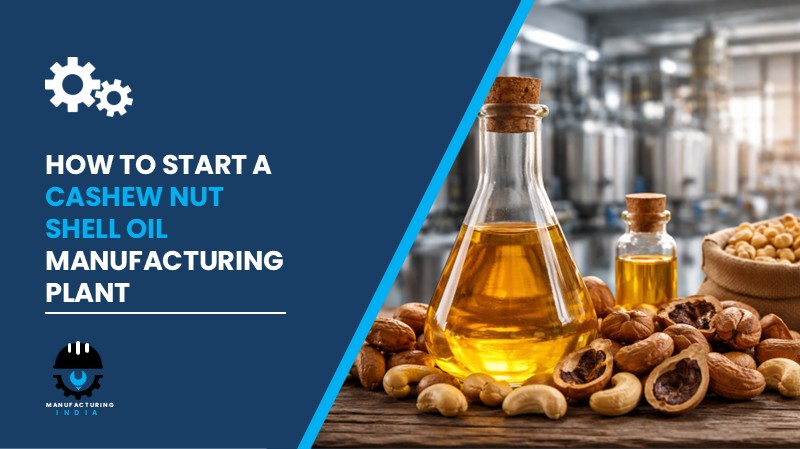
Setting up a cashew nut shell oil manufacturing plant in India presents a compelling investment case driven by the surging demand for industrial lubricants, resins, coatings, adhesives, and chemical intermediates. The rising activity across automotive, construction, and chemical manufacturing sectors is creating consistent and scalable demand for cashew nut shell oil (CNSL), a high-value bio-based industrial product. As India’s industrial base expands and domestic manufacturers seek reliable, locally sourced raw materials with proven performance credentials, CNSL is increasingly positioned as a critical input material across multiple high-growth end-use industries.
India offers a uniquely advantageous environment for this type of investment. With rapid urbanisation, large-scale infrastructure development, and the Government of India’s Make in India initiative actively encouraging domestic chemical and agro-based manufacturing, investors find a policy-backed, cost-competitive ecosystem. Key manufacturing states such as Kerala, Tamil Nadu, Andhra Pradesh, Maharashtra, and Odisha – all major cashew-producing regions – offer direct access to raw cashew nut shells, reducing input logistics costs while enabling competitive pricing. For investors seeking a bio-based industrial product with both domestic and export revenue potential, India represents a strategically sound location for establishing a CNSL production unit.
Establishing a cashew nut shell oil manufacturing plant in India combines policy support through Make in India with cost-competitive access to raw cashew shells, strong demand from automotive, coatings, adhesives, and chemical sectors, and healthy gross profit margins of 45–55%, making the investment financially viable across a range of production capacities with a clear break-even trajectory.
What is Cashew Nut Shell Oil?
Cashew nut shell oil (CNSL) is a bio-based oil derived from the outer shell of cashew nuts, and it is one of the most industrially important by-products of cashew processing. The major components of CNSL are phenolic compounds – specifically anacardic acid, cardanol, and cardol – which are responsible for its wide industrial utility in coatings, friction materials, lubricants, adhesives, and resin production. These phenolic constituents give the oil exceptional thermal stability, water resistance, and chemical reactivity, making it highly suitable for demanding industrial environments.
CNSL exists in two primary forms. Natural CNSL is obtained through hot-pressing or roasting of cashew shells and retains its full phenolic profile. Technical CNSL is further refined for specific industrial consumption and used in more specialised applications. The production process used in a standard manufacturing plant involves collection and sorting of cashew shells, shell drying, roasting or solvent extraction, oil separation, refining, filtration, and packaging. The end-use industries served by CNSL include chemical manufacturing, automotive and brake lining, paints and coatings, and adhesives and resin production, reflecting the broad industrial relevance of this bio-based material. The global trend toward eco-friendly, bio-based alternatives to petroleum-derived oils further reinforces CNSL’s growing demand across industrial sectors.
Cost of Setting Up a Cashew Nut Shell Oil Manufacturing Plant in India
The cost of establishing a cashew nut shell oil plant depends on several variables including production capacity, technology selection, plant location, degree of automation, and regulatory compliance requirements. A thorough understanding of both capital and operational expenditure is essential for building a robust financial plan.
1. Capital Expenditure (CapEx)
Capital investment forms the financial foundation of any CNSL production facility. Land and site development costs include land acquisition charges, boundary development, site grading, and registration expenses. Investors may consider locating the facility within an SEZ or a state-designated industrial estate to benefit from reduced land costs, tax incentives, and better infrastructure connectivity.
Civil works and construction expenses cover the manufacturing shed, laboratory space, raw material storage godowns, finished goods warehouse, effluent treatment area, and administrative block. These must be designed with adequate space for material handling and future capacity expansion.
Machinery and equipment typically represent the largest single component of CapEx in a cashew nut shell oil manufacturing plant. Key machinery required includes:
- Shell crushers
- Oil extractors
- Roasters
- Decanters
- Filters
- Storage tanks
- Packaging equipment
- High-quality, corrosion-resistant machinery
Other capital costs include the effluent treatment plant (ETP), pre-operative expenses, trial production costs, commissioning charges, and applicable import duties on specialised machinery components.
Request a Sample Report for In-Depth Market Insights: https://www.imarcgroup.com/cashew-nut-shell-oil-manufacturing-plant-project-report/requestsample
2. Operational Expenditure (OpEx)
The operating cost structure of a cashew nut shell oil manufacturing plant is primarily driven by raw material consumption. Raw materials – principally cashew nut shells – account for approximately 40–50% of total operating expenses, making supplier contract strategy a critical element of cost management. Long-term agreements with reliable cashew shell suppliers, particularly from key cashew-growing states, help stabilise procurement costs and ensure uninterrupted production.
Utility costs, covering electricity, water, and steam required for the roasting, extraction, and refining stages, constitute approximately 25–30% of OpEx. Other operating costs include transportation and logistics, packaging materials, employee salaries and wages, routine maintenance, depreciation on fixed assets, and applicable taxes. By the fifth year of operations, total operational costs are projected to increase substantially due to inflation, market fluctuations, potential rises in raw material prices, supply chain disruptions, rising consumer demand, and shifts in the global economy.
3. Plant Capacity
The proposed manufacturing facility for a standard CNSL unit is designed with an annual production capacity ranging between 1,000 and 3,000 metric tonnes (MT), enabling economies of scale while maintaining operational flexibility. Investors may customize plant capacity based on their specific capital budget and target market requirements. Profitability improves with higher capacity utilisation, as fixed costs are distributed across a larger production volume, directly improving gross and net margins.
4. Profit Margins and Financial Projections
A cashew nut shell oil manufacturing plant demonstrates healthy profitability potential under normal operating conditions. Gross profit margins typically range between 45–55%, supported by stable industrial demand and high-value applications. Net profit margins for the facility are projected at 20–25% on average over a five-year period. Financial projections covering NPV, IRR, payback period, liquidity analysis, and sensitivity analysis are developed based on realistic assumptions related to capital investment, operating costs, production capacity utilisation, pricing trends, and demand outlook, all of which are detailed in the full project report.
Why Set Up a Cashew Nut Shell Oil Plant in India?
Growing Industrial Demand Across Core Sectors: The cashew nut shell oil market is primarily driven by rising demand from chemical manufacturing, automotive, brake lining, adhesives, coatings, and lubricant sectors. India’s rapidly growing industrial base ensures a consistent and expanding domestic demand for CNSL, reducing dependence on exports and providing captive market support to new producers.
Bio-based and Eco-friendly Product Alignment: CNSL is a responsible, sustainable alternative to petroleum-based oils in industrial applications. As Indian industries and global buyers increasingly prefer eco-friendly raw materials, CNSL producers are well-positioned to benefit from this demand shift across chemical, automotive, and coatings sectors.
High Profit Potential with Favourable Cost Economics: The comparatively low cost of raw cashew shells, combined with CNSL’s high-value industrial applications, results in gross margins of 45–55% and net margins of 20–25%. This financial profile makes the investment viable across different plant capacities.
Policy and Regulatory Tailwinds: India’s Make in India initiative, combined with APEDA-supported agro-industrial export promotion frameworks, creates a favourable regulatory environment for cashew shell oil producers. India’s DGCIS statistics show that in FY2024–25, India exported 971.69 metric tonnes of CNSL generating USD 0.79 million in revenue, with key markets including the UK, Italy, Japan, Korea, and Belgium, confirming strong international demand.
Active Industry Investment and Innovation: In January 2026, MASH Makes’ upgraded CNSL-derived biofuel completed final laboratory testing and met marine fuel performance requirements. In November 2025, the Cashew Nut Association of Cambodia and South Korea’s Institute for Advanced Engineering held discussions backed by Korean government funding for CNSL-based biofuel production, with a pilot project planned for April 2026. These developments signal growing global capital flowing into CNSL-linked industries.
Scalable Production with Diversified Market Applications: CNSL’s applicability across chemical intermediates, automotive friction materials, paints, varnishes, laminates, and adhesives reduces sector-specific revenue risk. The extraction and refining processes can be expanded with moderate additional investment to keep pace with increasing market demand.
Manufacturing Process – Step by Step
The cashew nut shell oil manufacturing process uses roasting or solvent extraction as the primary production method. The complete process flow involves the following steps:
- Collection and Sorting: Raw cashew nut shells are collected, inspected, and sorted to remove foreign matter and undersized shells before processing.
- Shell Drying: Sorted shells are dried to reduce moisture content, which ensures higher oil recovery rates and product quality consistency.
- Roasting or Solvent Extraction: Shells undergo either direct roasting (for natural CNSL) or solvent extraction (for technical CNSL), the primary stage at which oil is released from the phenolic matrix of the shell.
- Oil Separation: The crude oil is separated from the shell residue using decanters and centrifugal separation equipment.
- Refining: The separated crude CNSL undergoes refining to improve purity levels, remove impurities, and adjust phenolic composition for specific industrial end-uses.
- Filtration: Refined oil passes through filtration equipment to achieve the required clarity and particle-free specification.
- Packaging and Dispatch: Finished CNSL is filled into storage tanks, then packaged and dispatched to end-use industries including chemical manufacturers, automotive friction material producers, and coatings and adhesives companies.
Key Applications
Cashew nut shell oil serves a wide range of industrial sectors, with applications spanning chemical production, automotive, coatings, and adhesive manufacturing:
- Chemical Manufacturing Industry: CNSL is the primary ingredient for making phenolic resins, coatings, adhesives, and specialty chemicals.
- Automotive and Brake Lining Industry: CNSL-derived compounds are applied in brake linings, automotive friction materials, and vehicle lubricants.
- Paints and Coatings Sector: CNSL supplies premium, moisture-proof, and heat-proof formulations for industrial coatings and varnishes.
- Adhesives and Resin Production: CNSL is a major input in the formulation of glue, laminates, and polymers.
Leading Manufacturers
The global cashew nut shell oil industry includes several well-established players with extensive production capacities and diversified application portfolios serving sectors such as chemical intermediates, automotive, paints and coatings, adhesives, and lubricants. Key players include:
- Cat Loi Company (Vietnam)
- Fernandes Brothers (India)
- Sri Devi Group (India)
- Kumaraswamy Industries (India)
- Kanco Southwest Enterprises (Kenya)
Timeline to Start the Plant
Establishing a cashew nut shell oil manufacturing plant in India requires a structured, phased implementation approach:
- Feasibility study and project report preparation
- Land acquisition and site development
- Regulatory approvals and environmental clearances
- Factory licence and fire safety compliance
- Machinery procurement and installation
- Raw material supplier agreements and supply chain setup
- Trial production and quality testing
- Commercial production launch
Licences and Regulatory Requirements
Starting a cashew nut shell oil manufacturing unit in India requires several approvals:
- Business registration (Proprietorship, LLP, or Pvt Ltd)
- Factory Licence under the Factories Act
- Environmental Clearance from State Pollution Control Board
- GST Registration
- Fire Safety NOC
- Hazardous/Chemical compliance (relevant given the phenolic compounds and solvents used in extraction)
- Effluent Treatment Plant (ETP) operational clearance
- Occupational Health and Safety compliance
Key Challenges to Consider
High Capital Requirements: Setting up a cashew nut shell oil manufacturing plant involves substantial upfront investment in land, civil works, specialised machinery including shell crushers, oil extractors, roasters, decanters, and filtration equipment, and regulatory compliance infrastructure.
Raw Material Price Volatility: Cashew nut shells, which account for approximately 40–50% of total OpEx, are subject to seasonal availability fluctuations and price variations driven by cashew crop output, export demand, and supply chain disruptions.
Regulatory Compliance: The presence of phenolic compounds such as anacardic acid, cardanol, and cardol in the production process requires stringent environmental compliance, ETP operations, and adherence to chemical handling regulations, which add to ongoing operational costs.
Technology and Innovation Pressure: Advancements in extraction and refining technologies are continuously improving oil recovery rates and product quality, requiring producers to periodically evaluate and upgrade process equipment to remain competitive.
Competition from Established Players: Key global players including Cat Loi Company, Fernandes Brothers, Sri Devi Group, Kumaraswamy Industries, and Kanco Southwest Enterprises have well-established market positions, requiring new entrants to compete on quality, pricing, and customer relationships.
Skilled Manpower: Operating roasting, solvent extraction, refining, and quality control systems requires trained chemical and process engineering personnel, which may be difficult to source and retain in smaller manufacturing locations.
Frequently Asked Questions
1. How much does it cost to set up a cashew nut shell oil manufacturing plant in India?
The total cost depends on plant capacity (1,000–3,000 MT per annum), technology selection, location, automation level, and regulatory compliance. The CapEx covers land and site development, civil works, machinery including shell crushers, oil extractors, roasters, decanters, filters, and storage tanks, along with other capital costs. A detailed cost breakdown is available in the full IMARC project report.
2. Is cashew nut shell oil manufacturing profitable in India in 2026?
Yes. The facility demonstrates healthy profitability with gross profit margins of 45–55% and net profit margins of 20–25%, supported by stable industrial demand from chemical, automotive, coatings, and adhesives sectors.
3. What machinery is required for a cashew nut shell oil plant in India?
Key machinery includes shell crushers, oil extractors, roasters, decanters, filters, storage tanks, packaging equipment, and high-quality corrosion-resistant machinery tailored for phenolic oil handling.
4. What licences and approvals are required to start a cashew nut shell oil plant in India?
Required approvals include business registration, Factory Licence, Environmental Clearance, GST Registration, Fire Safety NOC, chemical compliance certification, ETP clearance, and Occupational Health and Safety compliance.
5. What raw materials are needed for cashew nut shell oil manufacturing?
The primary raw material is cashew nut shells. The key chemical components extracted include anacardic acid, cardanol, and cardol, which form the basis of CNSL’s industrial applications.
6. What are the environmental compliance requirements for a cashew nut shell oil plant in India?
The unit must obtain Environmental Clearance from the State Pollution Control Board, maintain an operational ETP to treat effluents from the extraction and refining process, and comply with chemical handling and emission standards applicable to phenolic compound processing.
7. What is the best location to set up a cashew nut shell oil plant in India?
Locations proximate to cashew-producing states with access to raw cashew shells, reliable infrastructure, transportation networks, and utilities are most suitable. Industrial estates or SEZ locations further enhance cost efficiency and compliance support.
8. What is the break-even period for this type of plant in India?
The break-even period is determined by plant capacity, CapEx level, raw material pricing, and market realisation. The full financial analysis including payback period, NPV, and IRR projections is available in the detailed project report.
9. What government incentives are available for manufacturers in India?
Indian agro-based and chemical manufacturers may benefit from Make in India incentives, APEDA export promotion schemes, state industrial policy subsidies, capital subsidy under MSME schemes, and GST input tax credit mechanisms, depending on the unit’s scale and registration category.
Key Takeaways for Investors
A cashew nut shell oil manufacturing plant in India presents a well-rounded investment opportunity backed by strong and diversified demand from chemical manufacturing, automotive, brake lining, paints and coatings, and adhesives sectors. The financial profile of the facility is viable across plant capacities of 1,000 to 3,000 MT per annum, with gross margins of 45–55% and net margins of 20–25% demonstrating robust return potential. The global cashew nut shell oil market was valued at USD 456.25 million in 2025 and is projected to reach USD 824.79 million by 2034, growing at a CAGR of 6.8% from 2026 to 2034, underscoring the long-term scale of the opportunity. With bio-based industrial materials gaining sustained traction globally as eco-friendly alternatives to petroleum-based inputs, demand for CNSL is structurally supported and expected to remain strong throughout the investment horizon.
About the Author