Setting up a USB cable manufacturing plant in India presents a compelling investment case anchored by the country’s surging consumer electronics market, rapid expansion of data transmission infrastructure, and accelerating adoption of fast-charging technologies. USB cables serve as the foundational connectivity component across consumer electronics, IT & telecommunications, automotive, industrial electronics, data centres, and home appliances – industries that are central to India’s industrial and digital growth story. As smartphone penetration deepens, electric vehicle adoption rises, and data centre construction accelerates, the demand for reliable, high-performance connectivity products is set to expand at a sustained pace.
India brings a unique combination of structural advantages for investors evaluating this segment. Rapid urbanisation, infrastructure investment under national development programmes, and the Make in India initiative collectively lower the barriers to manufacturing entry while strengthening domestic demand. Key manufacturing states such as Gujarat, Maharashtra, and Uttar Pradesh offer established industrial estate ecosystems, reliable utility infrastructure, and proximity to electronics OEM clusters, all of which translate into a strategically sound and cost-competitive production base for a USB cable manufacturing unit.
India’s policy support, cost-competitive manufacturing environment, and robust demand across consumer electronics, automotive, and data centre sectors create a compelling case for USB cable production. With gross profit margins ranging between 25–35% and net margins of 12–18%, the investment offers strong ROI potential with viable break-even timelines across a capacity range of 10 to 50 million units per annum.
What is a USB Cable?
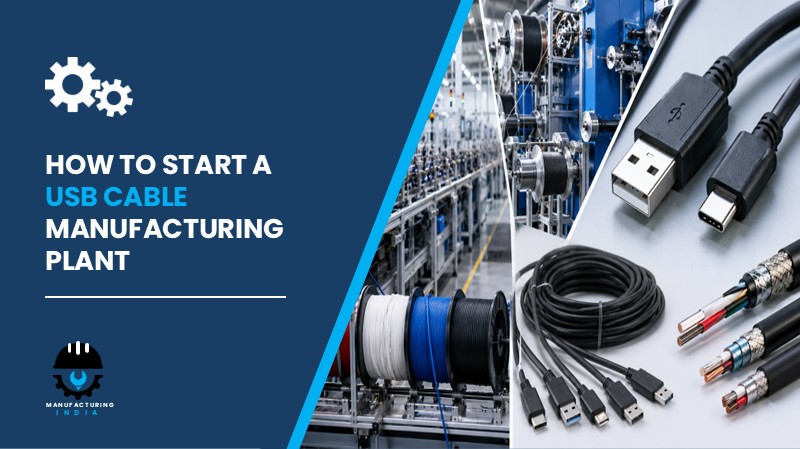
USB cable (Universal Serial Bus cable) refers to a standardized electrical cable used for data transfer and power supply between electronic devices. These cables consist of insulated copper conductors, shielding layers, connectors, and protective outer jackets made from polymers such as PVC or TPE. USB cables support various protocols, including USB 2.0, USB 3.x, and USB-C, enabling high-speed data transmission and efficient charging. They are designed for durability, flexibility, and signal integrity, often incorporating shielding to reduce electromagnetic interference, making them indispensable across a wide range of electronic systems.
The primary production method is copper wire drawing, insulation extrusion, twisting/pairing, shielding, jacketing, connector molding, soldering, and assembly – a multi-step process that produces cables with universal compatibility and high reliability. End-use industries served include consumer electronics, IT & telecommunications, automotive, industrial electronics, data centres, and home appliances, ensuring that the product has diverse demand channels and significant resilience to sector-specific downturns.
Cost of Setting Up a USB Cable Manufacturing Plant in India
The total investment required for a USB cable manufacturing plant depends on plant capacity, technology selected, geographic location, degree of automation, and regulatory compliance requirements. Understanding both capital and operational expenditure in detail is essential for accurate financial planning and investor communication.
1. Capital Expenditure (CapEx)
Machinery costs account for the largest portion of total capital expenditure in a USB cable plant, followed by land and site development. Land and site development covers charges for land registration, boundary development, and related civil preparation, forming a substantial part of the overall investment. Investors may explore options within Special Economic Zones (SEZs) or state-designated industrial estates to benefit from reduced land costs, infrastructure subsidies, and streamlined regulatory processing.
Civil works and construction include the production shed, quality control laboratory, raw material and finished goods storage, and administrative block – all of which must comply with local building codes and factory safety standards.
Key machinery required includes:
- Wire drawing machines
- Stranding machines
- Extrusion lines
- Braiding machines
- Curing ovens
- Spark testers
- Packaging machines
Other capital costs include effluent treatment plant (ETP) setup, pre-operative expenses, commissioning charges, and applicable import duties on equipment not domestically sourced.
Request a Sample Report for In-Depth Market Insights: https://www.imarcgroup.com/usb-cable-manufacturing-plant-project-report/requestsample
2. Operational Expenditure (OpEx)
Raw material cost is the dominant driver of operating expenditure. Copper wire, PVC/TPE insulation, and connectors collectively account for approximately 70–80% of total OpEx, making supplier contract strategy a critical risk management priority. Securing long-term agreements with reliable domestic and international suppliers helps mitigate price volatility and ensures consistent production quality.
Utility costs – covering electricity, water, and steam – represent 10–15% of total OpEx. The remaining cost structure includes transportation, packaging, salaries and wages, maintenance, depreciation, and taxes. By the fifth year of operations, total operational cost is expected to increase substantially due to factors such as inflation, market fluctuations, potential rises in the cost of key materials, supply chain disruptions, rising consumer demand, and shifts in the global economy – all of which must be modelled into the financial plan from the outset.
3. Plant Capacity
The proposed manufacturing facility is designed with an annual production capacity ranging between 10 and 50 million units, enabling economies of scale while maintaining operational flexibility. Capacity can be customized to suit specific investor requirements, and profitability improves progressively with higher capacity utilization rates, making a phased scale-up approach a viable and commercially prudent strategy for new entrants to this segment.
4. Profit Margins and Financial Projections
The USB cable manufacturing plant project demonstrates healthy profitability potential under normal operating conditions. Gross profit margins typically range between 25–35%, supported by stable demand and value-added applications, while net profit margins are projected at 12–18%. Financial projections cover NPV, IRR, payback period, and detailed income and expenditure models across a five-year horizon, including liquidity analysis, profitability analysis, uncertainty analysis, and sensitivity analysis – providing a structured basis for funding discussions and investor decision-making.
Why Set Up a USB Cable Plant in India?
Growing Consumer Electronics Market: The proliferation of smartphones, laptops, and smart devices continues to drive consistent demand for USB cables, making it a stable and scalable manufacturing opportunity. As device ownership broadens across India’s urban and semi-urban populations, the replacement and addition cycle for connectivity products deepens the domestic demand base significantly.
Rapid Adoption of USB-C and Fast Charging: Technological advancements such as USB-C and power delivery standards are increasing replacement cycles and demand for high-performance cables. This transition accelerates unit demand and creates meaningful product differentiation opportunities for manufacturers capable of producing premium, high-specification cables at competitive cost.
Expansion of EV and Automotive Electronics: Modern vehicles increasingly rely on USB connectivity for infotainment and charging systems, creating new demand segments beyond consumer electronics. The global sales of electric cars are on track to surpass 20 million in 2025, accounting for over a quarter of cars sold worldwide, according to the new edition of the IEA’s annual Global EV Outlook – a demand signal directly relevant to India’s rapidly growing electric vehicle market.
Policy and Regulatory Tailwinds: Government initiatives promoting digitalization and electronics manufacturing, especially in emerging economies, are strengthening the market landscape. India’s Make in India framework reduces competitive disadvantage against imported products and directly incentivizes domestic production across the electronics value chain.
Cost-Competitive Manufacturing: India offers lower land acquisition costs, competitive labour rates, and an increasingly organised electronics component supply chain. Proximity to copper suppliers and polymer material producers further reduces raw material logistics expense, enhancing overall margin potential compared to higher-cost manufacturing destinations.
Export and OEM Opportunities: Manufacturers can tap into global supply chains by supplying to OEMs and electronics brands, enhancing revenue potential well beyond domestic sales. This export orientation supports foreign exchange earnings and positions the facility within international procurement networks, reducing dependence on any single end market.
Manufacturing Process – Step by Step
The USB cable manufacturing process uses copper wire drawing, insulation extrusion, twisting/pairing, shielding, jacketing, connector molding, soldering and assembly as the primary production method. Understanding the USB cable manufacturing process in full is essential for plant layout planning, equipment selection, and quality assurance system design. Each stage involves specific unit operations, material handling protocols, and quality checkpoints.
- Copper Wire Drawing: Raw copper is drawn through precision dies to achieve the conductor diameter required for the cable specification, ensuring consistent electrical performance.
- Insulation Extrusion: PVC or TPE insulation is extruded over individual copper conductors to provide electrical isolation and mechanical protection.
- Twisting/Pairing: Insulated conductors are twisted or paired in defined configurations to reduce crosstalk and minimize electromagnetic interference.
- Shielding: A braided or foil shielding layer is applied over the twisted pair assembly to further reduce electromagnetic interference and ensure signal integrity.
- Jacketing: An outer protective jacket of PVC or TPE polymers is extruded over the shielded assembly to provide durability and flexibility in end-use environments.
- Connector Molding: Connector housings are molded and fitted to the cable ends, defining the interface type including USB-C and other USB protocol variants.
- Soldering and Assembly: Conductors are soldered to connector terminals and the full cable assembly is completed to specification.
- Quality Testing: Spark testing and technical performance validation are conducted across each production batch to verify signal integrity, insulation resistance, and compliance with applicable standards.
- Packaging and Dispatch: Finished cables are packaged per customer or retail specifications and dispatched to end-use industries including consumer electronics, automotive, telecommunications, data centres, and home appliances.
Key Applications
USB cables serve a broad range of industries, each with distinct connectivity and power delivery requirements that underpin consistent and diversified demand:
- Automotive: USB charging cables, infotainment system connectivity, and in-vehicle data transfer across passenger vehicles and electric vehicles.
- Electronics: Device charging cables, data synchronization cables, and peripheral connectivity for smartphones, computers, printers, and storage devices.
- Construction: Temporary power connections, device interfacing, and flexible wiring solutions for on-site equipment and systems.
- Telecommunication: High-speed data transmission cables, networking interfaces, and signal connectivity across telecom infrastructure.
Leading Manufacturers
The global USB cable industry is served by several multinational companies with extensive production capacities and diverse application portfolios across consumer electronics, IT & telecommunications, automotive, industrial electronics, data centres, and home appliances. Key players include:
- Amphenol Corporation
- Foxconn Interconnect Technology
- Luxshare Precision Industry Co., Ltd.
- Molex LLC
- TE Connectivity
- Belkin International, Inc.
Timeline to Start the Plant
- Feasibility study and project report preparation
- Land acquisition and site development
- Regulatory approvals and environmental clearances
- Factory licence and fire safety compliance
- Machinery procurement and installation
- Raw material supplier agreements and supply chain setup
- Trial production and quality testing
- Commercial production launch
Licences and Regulatory Requirements
Starting a USB cable manufacturing unit in India requires several approvals:
- Business registration (Proprietorship, LLP, or Pvt Ltd)
- Factory Licence under the Factories Act
- Environmental Clearance from State Pollution Control Board
- GST Registration
- Fire Safety NOC
- Effluent Treatment Plant (ETP) operational clearance
- Occupational Health and Safety compliance
Key Challenges to Consider
High Capital Requirements: Land and site development, civil construction, and machinery procurement – particularly wire drawing machines, extrusion lines, braiding machines, and connector molding equipment – represent a significant upfront capital commitment that requires structured project financing and careful phasing.
Raw Material Price Volatility: Copper wire, PVC/TPE insulation, and connectors are subject to global commodity price movements. Since raw materials account for 70–80% of total OpEx, even moderate price fluctuations have a material impact on margins, making long-term supplier contracts and cost hedging strategies essential.
Regulatory Compliance: Adherence to factory safety norms, environmental clearances, ETP certification, and quality standards adds compliance complexity, particularly for investors new to the Indian regulatory framework who may underestimate approval timelines.
Technology and Innovation Pressure: The transition to USB-C as a universal standard and the evolution of power delivery protocols require manufacturers to invest continuously in tooling, connector molding, and testing infrastructure to remain competitive and specification-compliant.
Competition: The presence of established global players – including Amphenol Corporation, Foxconn Interconnect Technology, Luxshare Precision Industry Co., Ltd., Molex LLC, TE Connectivity, and Belkin International, Inc. – sets a high benchmark on quality, pricing, and delivery reliability that new manufacturers must meet from the outset.
Skilled Manpower: Recruiting and retaining technicians with expertise in wire drawing, extrusion operations, soldering, spark testing, and quality management requires deliberate workforce planning, structured training programmes, and competitive compensation frameworks.
Key Takeaways for Investors
A USB cable manufacturing plant in India represents a well-grounded and timely investment opportunity, anchored by sustained demand from consumer electronics, automotive, IT & telecommunications, industrial electronics, data centres, and home appliances. The project demonstrates strong financial viability across a broad capacity range of 10 to 50 million units per annum, with gross profit margins of 25–35% and net profit margins of 12–18% supporting confident capital deployment at multiple investment scales. The global USB cable market was valued at USD 15.69 Billion in 2025 and is projected to reach USD 31.89 Billion by 2034, exhibiting a CAGR of 8.2% from 2026 to 2034, according to IMARC Group estimates – a growth trajectory that validates the long-term demand sustainability of this investment and the strategic merit of establishing production capacity in India now.
About the Author