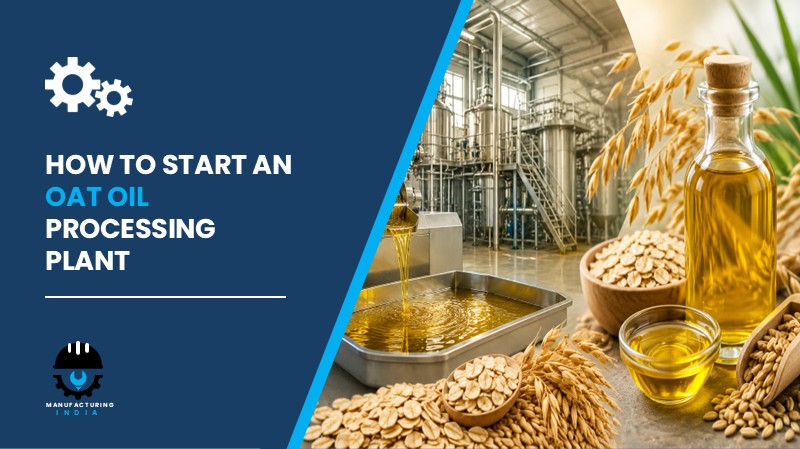
Setting up an oat oil processing plant in India presents a compelling investment case driven by the rapid expansion of food manufacturing, nutraceuticals, cosmetics and personal care, animal nutrition, and pharmaceuticals-all of which rely on oat-derived lipids as a critical functional ingredient. Oat oil’s balanced fatty acid profile, rich in linoleic acid, oleic acid, and palmitic acid, along with bioactive compounds such as tocopherols, phytosterols, and ceramides, make it indispensable to India’s fast-evolving health and wellness economy. Its role in functional food formulations, skin-care actives, and dietary supplements positions it as a high-value ingredient that India’s domestic market is increasingly demanding.
India’s advantages in agri-processing, cost-competitive manufacturing, and robust policy support through initiatives such as Make in India, MSME schemes, and agri-value-chain support programs create a strategically sound environment for oat oil production. States with established food processing corridors and strong logistics infrastructure offer investor-friendly ecosystems for setting up a facility. Rising consumer demand for clean-label, allergen-free, and plant-based ingredients-combined with growing urbanisation and a shift toward preventive health-reinforces India’s position as an ideal base for manufacturing and distributing oat oil across domestic and export markets.
India offers a rare convergence of policy tailwinds, cost-competitive agri-processing infrastructure, and surging demand from food, nutraceutical, and cosmetics sectors, making an oat oil processing plant a financially viable and forward-looking investment. With gross profit margins ranging between 30-45% and a growing global market, this is an opportunity with strong break-even viability and long-term demand sustainability.
What is Oat Oil?
Oat oil is a plant-derived lipid extracted primarily from oat kernels or oat bran and is characterised by a balanced fatty acid profile rich in linoleic acid, oleic acid, and palmitic acid. It also contains bioactive compounds such as tocopherols, phytosterols, and ceramides, which contribute to its oxidative stability and functional benefits. Oat oil exhibits excellent emollient, moisturising, and barrier-repair properties, making it suitable for food, cosmetic, and pharmaceutical applications. Its mild sensory profile, nutritional value, and compatibility with clean-label formulations support its increasing industrial relevance.
The primary production method employed in an oat oil processing plant is a combination of cold pressing, solvent extraction, and winterisation-each stage designed to maximise yield, purity, and stability of the final product. The end-use industries served by oat oil include food manufacturing, nutraceuticals, cosmetics and personal care, animal nutrition, and pharmaceuticals. Applications span edible oils, skin moisturisers, dietary supplements, functional food ingredients, and feed additives.
Cost of Setting Up an Oat Oil Processing Plant in India
The cost of establishing an oat oil processing plant in India depends on several interrelated factors including plant capacity, technology selection, geographic location, level of automation, and compliance with regulatory requirements. A well-structured financial plan covering both capital and operational expenditure is essential for investors to assess viability before committing resources.
1. Capital Expenditure (CapEx)
The total capital investment for this facility encompasses land and site development, civil works, machinery procurement, and other pre-operative costs. For land and site development, investors should evaluate options such as Special Economic Zones (SEZs) and industrial estates, which offer infrastructure benefits and potential tax incentives relevant to food processing units. Civil works costs include construction of the processing shed, quality control laboratory, raw material and finished goods storage, and the administrative block.
Machinery and equipment represent the largest single component of capital expenditure for an oat oil processing plant. Key machinery required includes:
- Debranning systems
- Steamers or conditioners
- Mechanical presses
- Solvent extractors for remaining oil
- Filtration units
- Refining columns
- Deodorisation systems
- Packaging machines
Other capital costs include effluent treatment plant (ETP) installation, pre-operative expenses such as project feasibility studies and regulatory filing fees, commissioning charges, and import duties on specialised equipment not manufactured domestically.
Request a Sample Report for In-Depth Market Insights: https://www.imarcgroup.com/oat-oil-processing-plant-project-report/requestsample
2. Operational Expenditure (OpEx)
The operating cost structure of an oat oil processing plant is primarily driven by raw material consumption. Raw oats-the principal input-accounts for approximately 60-70% of total operating expenses. Investors are advised to negotiate long-term contracts with reliable oat suppliers to mitigate price volatility and ensure consistent supply. Sourcing from agri-processing clusters can further reduce transportation costs and improve supply chain reliability.
Utility costs constitute the next largest operating burden, accounting for 15-20% of OpEx, and include electricity for mechanical pressing and solvent extraction equipment, water for cleaning and conditioning operations, and steam for the conditioning stage. Other operating costs include transportation and logistics for finished goods delivery, packaging materials for food-grade and cosmetic-grade end uses, salaries and wages for production and quality control staff, maintenance and repair of extraction and refining equipment, depreciation on fixed assets, and applicable taxes. By the fifth year of operations, total operational costs are projected to increase substantially owing to inflation, market fluctuations, and potential rises in the cost of raw oats, compounded by supply chain disruptions and rising consumer demand.
3. Plant Capacity
The proposed processing facility is designed with an annual production capacity ranging between 500-1,000 MT, enabling economies of scale while maintaining operational flexibility. Capacity can be customised per individual investor requirements depending on market access, available capital, and target application segments. Profitability improves significantly with higher capacity utilisation, as fixed costs are spread across a larger volume of output, improving per-unit margins and accelerating payback.
4. Profit Margins and Financial Projections
The financial projections for an oat oil processing plant demonstrate healthy profitability under normal operating conditions. Gross profit margins typically range between 30-45%, supported by stable demand and value-added applications in cosmetics, nutraceuticals, and functional foods. Net profit margins are projected in the range of 15-30%. Comprehensive financial analysis covers net present value (NPV), internal rate of return (IRR), payback period, liquidity analysis, sensitivity analysis, and uncertainty analysis-all of which are included in a detailed project report. A clear income and expenditure projection across five operating years provides investors with a robust foundation for funding discussions and financial strategy formulation.
Why Set Up an Oat Oil Plant in India?
Rising Demand for Plant-Based Lipids: Consumer preference for clean-label, allergen-free, and plant-based ingredients has strengthened demand for oat-derived lipids across India’s growing food and wellness sectors. The global shift toward vegan diets, preventive health, and sustainable oils supports long-term demand for oat oil as a critical functional ingredient.
Growth in Natural Cosmetics and Nutraceuticals: The global cosmetics industry is growing at a CAGR of 4.3% and is estimated to reach USD 450 Billion by 2025, according to IBEF. This sector’s expansion directly drives demand for botanical oils such as oat oil, which is prized for its emollient, moisturising, and barrier-repair properties in skin-care formulations and hair products.
Policy and Regulatory Tailwinds: Government initiatives promoting value-added agri-processing, food security, export-oriented food product manufacturing, and domestic nutraceutical production-including food processing incentives, MSME schemes, and agri-value-chain support programs-indirectly boost demand for oat oil processing facilities in India.
Cost-Competitive Manufacturing: India offers a combination of lower land costs, accessible labour, and proximity to raw material sourcing infrastructure that makes it cost-competitive relative to Western markets. The availability of industrial estates and SEZs with ready utilities further reduces setup time and initial capital outlay for investors.
Advancements in Extraction Technology: Advancements in extraction technologies such as supercritical CO₂ and enzyme-assisted processing have improved yield efficiency and product purity. These innovations improve gross margins and product quality, benefiting processors who invest in modern extraction infrastructure.
Local Supply Chain Preference: Food brands, cosmetic manufacturers, and supplement producers increasingly prefer localised, traceable, and dependable ingredient suppliers to ensure quality consistency, shorten lead times, and mitigate raw material volatility-creating sustained opportunities for regional oat oil processors with integrated sourcing and efficient operations.
Manufacturing Process – Step by Step
The oat oil manufacturing process uses cold pressing, solvent extraction, and winterisation as the primary production methods. The multi-step operation involves several unit operations, material handling stages, and quality checkpoints to deliver a finished product that meets food-grade, cosmetic-grade, and nutraceutical-grade specifications.
- Debranning: Raw oats are fed into debranning systems to remove the outer husk and prepare the grain for oil extraction.
- Conditioning: Steamers or conditioners are used to heat and condition the debranned oats, improving cell disruption and oil release.
- Mechanical Pressing: Conditioned oats pass through mechanical presses, which apply physical pressure to extract the primary oil fraction.
- Solvent Extraction: Residual oil remaining after pressing is recovered using solvent extractors, maximising overall yield from the raw material.
- Filtration: Extracted crude oil passes through filtration units to remove solid particulates, impurities, and fine grain debris.
- Refining: The filtered oil is processed through refining columns to remove free fatty acids, pigments, and other undesirable compounds.
- Deodorisation: Deodorisation systems eliminate volatile compounds and off-odours, producing a mild-sensory-profile oil suitable for food and cosmetic end uses.
- Packaging and Dispatch: The finished oat oil is packaged in food-grade or cosmetic-grade containers and dispatched to end-use industries including food manufacturing, nutraceuticals, cosmetics and personal care, animal nutrition, and pharmaceuticals.
Key Applications
Oat oil serves a diverse range of industries, each benefiting from its unique fatty acid profile, bioactive content, and sensory properties.
- Food Manufacturing: Used in edible oil formulations, functional food spreads, and specialty food products requiring natural plant-based lipids.
- Nutraceuticals: Incorporated into dietary supplements and health-focused oil blends owing to its nutritional value and bioactive compounds.
- Cosmetics and Personal Care: Applied in skin-care moisturisers, hair products, and emollient formulations benefiting from its barrier-repair and moisturising properties.
- Animal Nutrition: Used as a feed additive supplying unsaturated fatty acids and functional lipids in animal nutrition products.
- Pharmaceuticals: Utilised as an excipient or active functional component in pharmaceutical preparations requiring mild, plant-derived lipid carriers.
Leading Manufacturers
The global oat oil processing market is served by several multinational companies with extensive production capacities and diverse application portfolios across food, nutraceutical, cosmetics, and pharmaceutical sectors. Key players include:
- Avena Nordic Grain Oy
- Croda International Plc
- Fazer Mills
- DSM-Firmenich
- Naturex (Givaudan)
- Swedish Oat Fiber AB
Timeline to Start the Plant
- Feasibility study and project report preparation
- Land acquisition and site development
- Regulatory approvals and environmental clearances
- Factory licence and fire safety compliance
- Machinery procurement and installation
- Raw material supplier agreements and supply chain setup
- Trial production and quality testing
- Commercial production launch
Licences and Regulatory Requirements
Starting an oat oil processing unit in India requires several approvals:
- Business registration (Proprietorship, LLP, or Pvt Ltd)
- Factory Licence under the Factories Act
- Environmental Clearance from State Pollution Control Board
- GST Registration
- Fire Safety NOC
- Hazardous/Chemical compliance (relevant for solvent extraction operations)
- Effluent Treatment Plant (ETP) operational clearance
- Occupational Health and Safety compliance
Key Challenges to Consider
High Capital Requirements: Setting up an oat oil processing plant involves significant upfront investment across land, civil works, machinery such as mechanical presses, solvent extractors, and deodorisation systems, and pre-operative expenses, which can be a barrier for smaller investors.
Raw Material Price Volatility: The primary raw material, raw oats, accounts for 60-70% of total operating expenses. Price fluctuations driven by seasonal agricultural cycles, supply chain disruptions, or global commodity trends can significantly impact operating margins.
Regulatory Compliance: Food-grade and cosmetic-grade oat oil production requires strict adherence to quality assurance, environmental clearances, ETP operations, and occupational safety standards, all of which demand ongoing investment and specialist oversight.
Technology and Innovation Pressure: Advancements in extraction technologies such as supercritical CO₂ and enzyme-assisted processing require processors to continuously evaluate capital reinvestment in more efficient equipment to maintain yield efficiency and product purity competitiveness.
Competition from Established Players: The global market includes well-resourced competitors such as Croda International Plc, DSM-Firmenich, and Naturex (Givaudan), whose scale and established relationships with cosmetic and nutraceutical brands can present a commercial challenge for new entrants.
Skilled Manpower: Operating extraction, refining, and deodorisation equipment to food-grade and cosmetic-grade standards requires trained technical staff, whose recruitment and retention in semi-urban industrial locations can be challenging.
Frequently Asked Questions
1. How much does it cost to set up an oat oil processing plant in India?
The total setup cost depends on plant capacity, technology selection, location, and automation level. The capital investment covers land and site development, civil works, machinery including debranning systems, mechanical presses, solvent extractors, filtration units, refining columns, and deodorisation systems, as well as pre-operative and commissioning costs.
2. Is oat oil processing profitable in India in 2026?
Yes, an oat oil processing plant demonstrates healthy profitability potential with gross profit margins typically ranging between 30-45% and net profit margins of 15-30%, supported by rising demand from food, nutraceutical, and cosmetics sectors.
3. What machinery is required for an oat oil plant in India?
Key machinery includes debranning systems, steamers or conditioners, mechanical presses, solvent extractors for remaining oil, filtration units, refining columns, deodorisation systems, and packaging machines.
4. What licences and approvals are required to start an oat oil plant in India?
Required approvals include business registration, Factory Licence, Environmental Clearance from the State Pollution Control Board, GST Registration, Fire Safety NOC, ETP operational clearance, chemical/solvent compliance, and Occupational Health and Safety certification.
5. What raw materials are needed for oat oil manufacturing?
The primary raw material required is raw oats, which accounts for approximately 60-70% of total operating expenses. Reliable, long-term supplier contracts are recommended to stabilise pricing and ensure consistent supply.
6. What are the environmental compliance requirements for an oat oil plant in India?
The facility must obtain Environmental Clearance from the State Pollution Control Board, operate a functional Effluent Treatment Plant (ETP), comply with solvent handling and chemical storage regulations, and maintain emission standards throughout operations.
7. What is the best location to set up an oat oil plant in India?
Ideal locations offer proximity to raw oat supply chains, reliable infrastructure including transportation, utilities, and waste management, and compliance with local zoning laws. Industrial estates and SEZs with established food processing infrastructure offer additional benefits.
8. What is the break-even period for this type of plant in India?
The break-even period is determined by capital investment, capacity utilisation, operating costs, and product pricing. A detailed financial analysis including payback period, NPV, and IRR projections is available in the full project feasibility report.
9. What government incentives are available for manufacturers in India?
Government initiatives supporting value-added agri-processing, food processing incentives, MSME schemes, and agri-value-chain support programs are available to oat oil processors, and may reduce effective capital costs or improve access to finance for eligible units.
Key Takeaways for Investors
An oat oil processing plant in India represents a high-value investment opportunity underpinned by sustained demand from food manufacturing, nutraceuticals, cosmetics and personal care, animal nutrition, and pharmaceutical sectors-all of which are growing rapidly in line with India’s health and wellness economy. The project demonstrates financial viability across a range of plant capacities from 500-1,000 MT per annum, with gross profit margins of 30-45% and net margins of 15-30% supporting strong return on investment. The global oat oil market was valued at USD 69.91 Million in 2025 and is projected to reach USD 119.11 Million by 2034, registering a CAGR of 6.1% from 2026 to 2034, indicating a robust and growing addressable market. With rising consumer preference for clean-label, plant-based, and functional ingredients across India and globally, demand sustainability for oat oil over the medium and long term is well-supported by structural megatrends in food, cosmetics, and preventive healthcare.
About the Author