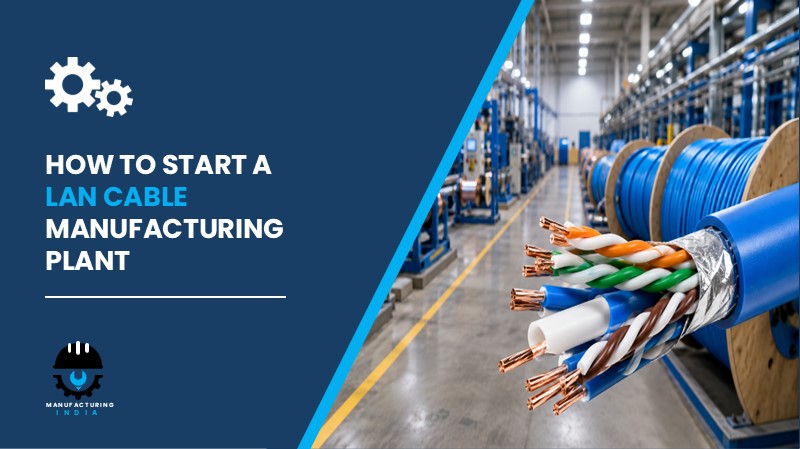
A LAN cable manufacturing plant setup in India presents a compelling investment case for entrepreneurs targeting the country’s expanding digital infrastructure base. Demand is anchored by three core end-use sectors – IT and telecommunications, commercial infrastructure, and data center facilities – all of which depend on structured cabling systems for day-to-day operations. LAN cables function as the physical backbone of enterprise networks, campuses, and residential complexes, carrying the data traffic that powers cloud computing, IoT deployment, smart buildings, and 5G backhaul networks, which makes reliable domestic production capacity a strategic necessity rather than a discretionary industrial pursuit.
India’s underlying digital connectivity push strengthens this opportunity further. The Department of Telecommunications reports that the Indian telecom sector now serves 1.19 billion telephone subscribers with a teledensity of 84.46%, a scale of connectivity that continues to expand broadband penetration, fiber-to-the-home rollouts, and enterprise digitization across the country. As network integrators and OEMs increasingly prefer reliable domestic suppliers to shorten lead times and reduce exposure to copper price volatility, India’s growing base of technologically capable manufacturers is well positioned to capture this localization trend and support a LAN cable manufacturing plant built for long-term demand.
This investment benefits from strong policy-linked demand tailwinds – including nationwide broadband and digital connectivity expansion – combined with gross margins of 20-30% and net margins of 8-15%. With copper wire and other raw materials driving the bulk of operating costs, disciplined procurement and supplier localization are central to achieving durable break-even viability.
What is LAN Cable?
LAN (Local Area Network) cables are structured networking cables used to connect computers, servers, routers, switches, and other communication equipment within a limited geographical area such as offices, data centers, and residential buildings. These cables typically consist of twisted pairs of copper conductors insulated with polyethylene or PVC and enclosed within protective jackets. Common categories include Cat5e, Cat6, Cat6a, and Cat7, each offering different bandwidth capacities and data transmission speeds. LAN cables are engineered to minimize signal interference, crosstalk, and attenuation, ensuring stable and high-speed data communication, while their design enables efficient Power over Ethernet (PoE) support, enhanced durability, and compliance with international standards for networking performance and safety.
The LAN cable manufacturing process is a multi-step operation built around copper wire drawing, annealing, insulation extrusion, pair twisting, cabling, shielding, jacketing, and testing. The finished cables serve IT and telecommunications, commercial infrastructure, and data center facilities as their primary end-use industries.
Cost of Setting Up a LAN Cable Manufacturing Plant in India
The cost of setting up this facility depends on capacity, technology, location, automation level, and regulatory compliance requirements.
1. Capital Expenditure (CapEx)
Capital investment for the plant covers land acquisition, site preparation, and the necessary supporting infrastructure, with total investment scaling according to plant capacity, technology, and location chosen. Civil works cover the construction of the production shed, quality-testing laboratory, raw material and finished goods storage areas, and the administrative block, all arranged to support efficient workflow and safety.
Machinery costs typically represent the largest share of total capital expenditure for a LAN cable manufacturing plant. Key machinery required includes:
- Wire drawing machines
- Annealing units
- Insulation extruders
- Twinners
- Stranding lines
- Sheathing lines
- Spark testers
- Automated coiling and packaging systems
Other capital costs include effluent treatment infrastructure, pre-operative expenses, commissioning costs, and applicable import duties on specialized machinery, all of which round out the total capital investment picture for the facility.
Request a Sample Report for In-Depth Market Insights: https://www.imarcgroup.com/lan-cable-manufacturing-plant-project-report/requestsample
2. Operational Expenditure (OpEx)
Raw material cost dominates the operating expense structure of a LAN cable manufacturing plant, with copper wire, PVC/PE insulation, RJ45 connectors, and jacketing together accounting for approximately 75-85% of total OpEx. Given this concentration, securing long-term supplier contracts is essential to stabilize pricing and mitigate copper price volatility risks while ensuring a consistent supply of materials.
Utility cost, covering electricity, water, and steam requirements, accounts for approximately 5-10% of operating expenditure. Other operating costs for the plant include transportation, packaging, salaries and wages, maintenance and repairs, depreciation, and taxes. By the fifth year of operations, total operational cost is expected to increase substantially due to inflation, market fluctuations, potential rises in the cost of key materials, supply chain disruptions, rising consumer demand, and shifts in the global economy.
3. Plant Capacity
The proposed LAN cable manufacturing plant is designed with an annual production capacity ranging between 100,000-500,000 KM, enabling economies of scale while maintaining operational flexibility. This capacity can be customized according to individual investor requirements, and profitability generally improves as capacity utilization increases.
4. Profit Margins and Financial Projections
The project demonstrates healthy profitability potential under normal operating conditions. Gross profit margins typically range between 20-30%, while net profit margins range between 8-15%, supported by stable demand and value-added applications. A comprehensive financial analysis covering net present value (NPV), internal rate of return (IRR), payback period, liquidity, and sensitivity analysis is essential to fully evaluate the plant’s long-term financial viability.
Why Set Up a LAN Cable Plant in India?
Core Digital Infrastructure Component: LAN cables form the backbone of structured cabling systems, enabling high-speed data communication across enterprises, campuses, and residential complexes. This foundational role ensures durable, non-cyclical baseline demand for the plant.
Growing Entry Barriers Through Standards Compliance: Compliance with international networking standards, flame-retardant norms, and PoE performance requirements creates quality-driven entry barriers that favor technologically capable manufacturers. This dynamic rewards early, standards-compliant investment in a LAN cable manufacturing plant.
Policy and Connectivity Tailwinds: Government initiatives promoting digital connectivity, broadband expansion, and smart city development are indirectly boosting LAN cable consumption. India’s telecom sector already serves 1.19 billion subscribers at a teledensity of 84.46%, underscoring the scale of connectivity infrastructure still being built out.
Alignment with Digital Transformation: Rapid expansion of cloud computing, IoT deployment, smart buildings, and 5G backhaul networks is driving sustained demand for high-performance LAN cables, directly supporting utilization rates at a new plant.
Active Industry Innovation: In July 2023, LS Cable & System released an ultra-slim 10 Gbps (Cat.6A) LAN cable with an external diameter of just 6mm, roughly 20% thinner than the 7.2mm industry average, illustrating the pace of product innovation shaping competitive positioning in this industry.
Supply Chain Localization: Network integrators and OEMs increasingly prefer reliable domestic suppliers to reduce lead times and mitigate copper price volatility risks, favoring locally established production facilities over import-dependent supply chains.
LAN Cable Manufacturing Process – Step by Step
The LAN cable manufacturing process uses copper wire drawing, annealing, insulation extrusion, pair twisting, cabling, shielding, jacketing, and testing as its primary production stages.
- Copper Wire Drawing: Copper rod is drawn through wire drawing machines to achieve the fine conductor diameter required for LAN cable cores.
- Annealing: Drawn copper wire passes through annealing units to restore ductility and electrical conductivity after the drawing process.
- Insulation Extrusion: Insulation extruders coat each conductor with polyethylene or PVC insulation to electrically isolate individual wires.
- Pair Twisting: Insulated conductors are twisted into pairs using twinners to reduce crosstalk and signal interference.
- Cabling/Stranding: Twisted pairs are combined on stranding lines to form the core cable structure.
- Shielding: Shielding layers are applied where required to further protect against electromagnetic interference.
- Jacketing: Sheathing lines apply the outer protective jacket that gives the cable its final durability and safety rating.
- Testing: Finished cable is checked using spark testers to verify insulation integrity and electrical performance before dispatch.
- Packaging and Dispatch: Automated coiling and packaging systems prepare finished LAN cable for dispatch to IT and telecommunications, commercial infrastructure, and data center customers.
Key Applications
LAN cables serve a focused set of digital infrastructure applications across enterprise, data center, and residential settings.
- Enterprise Networking: Structured office cabling systems that connect computers, routers, and switches within commercial premises.
- Data Centers: High-speed data transmission infrastructure supporting hyperscale and enterprise data center operations.
- Residential Broadband: Home networking and fiber-to-the-home connectivity for end consumers.
- IP Surveillance Systems: Structured cabling that supports IP-based surveillance and monitoring installations.
Leading Manufacturers
Leading manufacturers in the global LAN cable industry operate with extensive production capacities and diverse application portfolios, all serving end-use sectors such as IT and telecommunications, commercial infrastructure, and data center facilities. Key players include:
- Prysmian Group
- Nexans
- Belden Inc.
- CommScope
- LS Cable & System
Timeline to Start the Plant
- Feasibility study and project report preparation
- Land acquisition and site development
- Regulatory approvals and environmental clearances
- Factory licence and fire safety compliance
- Machinery procurement and installation
- Raw material supplier agreements and supply chain setup
- Trial production and quality testing
- Commercial production launch
Licences and Regulatory Requirements
Starting a LAN cable manufacturing unit in India requires several approvals:
- Business registration (Proprietorship, LLP, or Pvt Ltd)
- Factory Licence under the Factories Act
- Environmental Clearance from State Pollution Control Board
- GST Registration
- Fire Safety NOC
- Effluent Treatment Plant (ETP) operational clearance
- Occupational Health and Safety compliance
Key Challenges to Consider
High Capital Requirements: Machinery costs account for the largest share of total capital expenditure, making upfront investment a significant barrier for new entrants building a LAN cable manufacturing plant.
Raw Material Price Volatility: Copper wire, which drives 75-85% of operating costs, is subject to global price fluctuations, requiring long-term supplier contracts to protect margins.
Regulatory Compliance: Compliance with international networking standards, flame-retardant norms, and PoE performance requirements demands ongoing investment in quality systems and testing capability.
Technology and Innovation Pressure: Higher category cables are gaining prominence due to superior data transfer speeds and improved shielding performance, and innovations like LS Cable & System’s ultra-slim high-speed cable show how quickly product specifications can shift.
Competition: Established global players including Prysmian Group, Nexans, Belden Inc., CommScope, and LS Cable & System compete on production scale, technology, and distribution reach.
Skilled Manpower: Operating precision machinery such as wire drawing, extrusion, and testing equipment requires a trained technical workforce, adding to operational planning requirements.
Frequently Asked Questions
1. How much does it cost to set up a LAN cable manufacturing plant in India?
Total cost depends on plant capacity, technology, automation level, and location, and is driven primarily by machinery costs along with land and site development expenses.
2. Is LAN cable manufacturing profitable in India in 2026?
Yes, the plant demonstrates healthy profitability potential, with gross profit margins of 20-30% and net profit margins of 8-15% under normal operating conditions.
3. What machinery is required for a LAN cable plant in India?
Key machinery includes wire drawing machines, annealing units, insulation extruders, twinners, stranding lines, sheathing lines, spark testers, and automated coiling and packaging systems.
4. What licences and approvals are required to start a LAN cable plant in India?
Requirements include business registration, a Factory Licence, Environmental Clearance, GST Registration, Fire Safety NOC, ETP operational clearance, and Occupational Health and Safety compliance.
5. What raw materials are needed for LAN cable manufacturing?
The primary raw materials are copper wire, PVC/PE insulation, RJ45 connectors, and jacketing, with copper wire forming the largest cost component.
6. What are the environmental compliance requirements for a LAN cable plant in India?
Plants require Environmental Clearance from the State Pollution Control Board and an operational Effluent Treatment Plant to manage emissions and waste responsibly.
7. What is the best location to set up a LAN cable plant in India?
Site selection should prioritize easy access to raw materials such as copper wire and insulation, proximity to target markets to minimize distribution costs, and robust transportation and utility infrastructure.
8. What is the break-even period for this type of plant in India?
Break-even timing depends on capacity utilization, pricing, and cost structure; a detailed payback period and NPV analysis is used to establish plant-specific break-even projections.
9. What government incentives are available for manufacturers in India?
Government initiatives promoting digital connectivity, broadband expansion, and smart city development indirectly support demand for domestically manufactured LAN cable.
Key Takeaways for Investors
This investment is well positioned to serve sustained demand from IT and telecommunications, commercial infrastructure, and data center facilities as the country’s digital infrastructure continues to expand. Financial viability holds across a wide production range, with the proposed plant capacity of 100,000-500,000 KM annually and gross margins of 20-30% supporting healthy investor returns at multiple scales. The global LAN cable market was valued at USD 18.18 Billion in 2025 and is projected to reach USD 57.42 Billion by 2034, growing at a CAGR of 13.63% from 2026 to 2034, reflecting the structural growth trajectory underpinning this industry. With enterprise digitization, hyperscale data center expansion, and broadband penetration all accelerating, demand for domestically manufactured LAN cable is set to remain durable well beyond the current investment cycle.
About the Author