Mushroom Processing Plant in India
Setting up a mushroom processing plant in India presents a compelling investment case backed by converging demand signals across multiple high-growth sectors. Rising consumer preference for plant-based diets, increasing demand for functional and protein-rich foods, expansion of organised retail, and growing applications in food processing and nutraceutical industries are together driving the market forward. These products serve critical roles across food and beverage, pharmaceutical, foodservice, and processed food industries all expanding rapidly across India’s urban and semi-urban markets.
India’s structural advantages align precisely with the requirements of this type of mushroom plant. Accelerating urbanisation creates growing demand for packaged and value-added food products, while the Make in India initiative provides policy tailwinds for agro-based manufacturing. States such as Maharashtra, Himachal Pradesh, and Uttarakhand have established cultivation ecosystems, while industrial estates in Gujarat and Uttar Pradesh offer cost-effective site options for a new mushroom plant.
This sector represents a strategically sound investment in India, supported by government policy, cost-competitive agro-based manufacturing, and strong demand from food, pharmaceutical, and nutraceutical sectors. With gross profit margins of 35–45% and net margins of 18–28%, the financial case is compelling and break-even is viable across multiple capacity configurations.
What is Mushroom Processing?
Mushrooms are edible fungi cultivated for their nutritional, culinary, and medicinal properties. Common commercial varieties include button, oyster, shiitake, and specialty types. They are rich in protein, dietary fibre, B-vitamins, minerals, and bioactive compounds such as beta-glucans, and are low in fat and calories. Unlike traditional crops, they grow on organic substrates such as composted agricultural waste, making the production system efficient and circular. The short growth cycle and high yield per unit area contribute directly to economic viability. The production method encompasses composting and pasteurisation, spawning, incubation, casing and fruiting, harvesting, sorting and grading, and packaging. End-use industries include food and beverage, retail and supermarket chains, pharmaceutical and nutraceutical manufacturers, the foodservice and hospitality sector, and the processed food industry.
Cost of Setting Up a Mushroom Processing Plant in India
The total investment for a mushroom processing plant depends on capacity, technology, automation level, location, and regulatory compliance. A detailed feasibility study is essential before committing capital.
1. Capital Expenditure (CapEx)
Land and site development covering registration, boundary work, and related infrastructure form a substantial share of total capital outlay. Locating the unit within an SEZ or designated agro-industrial estate can reduce costs and unlock fiscal benefits. Civil works include the processing shed, cold storage, climate-controlled growing chambers, a quality control laboratory, raw material storage, and finished goods warehouse.
Machinery costs account for the largest portion of CapEx for a mushroom processing plant. Key machinery required includes:
- Compost turners
- Climate-controlled growing chambers
- Humidifiers and ventilation systems
- Harvesting tools
- Washing equipment
- Packaging machines
Other capital costs include the effluent treatment plant (ETP), pre-operative expenses, commissioning charges, and import duties where machinery is sourced internationally.
Access the Detailed Feasibility Analysis: https://www.imarcgroup.com/mushroom-processing-plant-project-report/requestsample
2. Operational Expenditure (OpEx)
Raw material cost is the dominant operating expense, with fresh mushrooms, brine (for canned products), and packaging materials accounting for approximately 65–75% of total OpEx. Long-term supplier contracts help mitigate price volatility. Utilities — electricity, water, and climate control energy — account for a further 15–20% of operating costs, reflecting the environmental control requirements of the cultivation process. Other costs include transportation, packaging, salaries, maintenance, depreciation, and taxes. By the fifth year, total operational costs are projected to increase substantially due to inflation, market fluctuations, and rising raw material prices.
3. Plant Capacity
The mushroom plant is designed with an annual production capacity of 2,000–10,000 MT, enabling economies of scale while maintaining operational flexibility. Capacity can be customised to investor requirements and capital availability. A mushroom processing plant at higher utilisation rates consistently delivers better profitability as fixed overheads are distributed across greater output volumes.
4. Profit Margins and Financial Projections
The project demonstrates healthy profitability under normal operating conditions. Gross profit margins range between 35–45%, supported by stable demand and value-added applications, and net profit margins are projected at 18–28%. A full financial analysis — covering NPV, IRR, payback period, gross margin, net margin, and sensitivity analysis — is included in the detailed project report.
Why Set Up a Mushroom Processing Plant in India?
High Nutritional Demand. Growing consumer awareness of protein-rich, plant-based foods supports consistent demand for edible mushrooms. Research cited in the industry indicates that a plant-based diet can reduce greenhouse gas emissions by 15–46%, accelerating adoption and strengthening structural demand.
Expanding Retail and Cold Chain Infrastructure. The expansion of organised retail in India, combined with cold logistics development, is fuelling improved distribution of fresh mushrooms nationally, making value-added packaging formats commercially viable.
Pharmaceutical and Nutraceutical Growth. The nutraceutical sector shows sustained growth in demand for mushroom extracts due to documented health benefits. Medicinal varieties are used in dietary supplements for immune support a segment growing rapidly in India’s health-conscious economy.
Efficient Land and Substrate Use. Cultivation requires limited land and can be conducted in controlled indoor environments. Agricultural residues such as straw can be converted into high-value produce, promoting circular agro-based practices.
Active Industry Investment. The sector is attracting significant capital globally. In July 2025, Giorgi Mushroom Company acquired LF Lambert Spawn Co. to expand distribution networks. In March 2025, Walsh Mushrooms Group invested approximately GBP 10 million on a new farm in Worcestershire, UK, deploying advanced technology, renewable energy, and robotic systems to reduce cost per kilogram.
Export Potential for Specialty Varieties. Rising global demand creates export opportunities from India, particularly for specialty varieties such as shiitake and oyster, providing a buffer against domestic demand fluctuations.
Manufacturing Process Step by Step
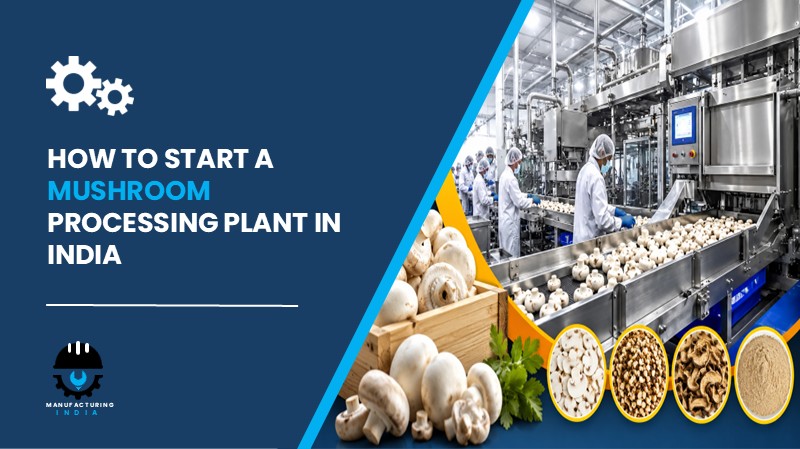
The mushroom processing manufacturing process uses composting and pasteurisation as its foundational production method, followed by a structured sequence of controlled cultivation and post-harvest operations.
- Composting and Pasteurisation: Agricultural residues are composted and thermally pasteurised to create a clean, nutrient-rich growing medium.
- Spawning: Mushroom spawn (mycelium) is inoculated into the prepared substrate under sterile conditions.
- Incubation: Inoculated substrate enters climate-controlled growing chambers where temperature and humidity are regulated for mycelium colonisation.
- Casing and Fruiting: A casing layer is applied; fruiting is triggered by adjusted environmental parameters, initiating pin formation and growth.
- Harvesting: Mature mushrooms are harvested using harvesting tools at the optimal stage for yield and shelf life.
- Washing and Sorting: Product passes through washing equipment and is sorted and graded by size, weight, and quality.
- Packaging and Dispatch: Finished product is packed using packaging machines and dispatched to food and beverage manufacturers, retail chains, pharmaceutical processors, and foodservice operators.
Key Applications
The production unit serves a diverse range of industries, each providing distinct revenue streams for Indian producers.
- Food and Beverage Industry: Used in ready meals, soups, sauces, pizzas, and processed foods for their umami flavour and nutritional value.
- Retail and Supermarket Chains: Fresh packaged product sold in controlled-atmosphere packaging; sliced and pre-cleaned formats enhance consumer convenience.
- Pharmaceutical and Nutraceutical Industry: Medicinal varieties used in dietary supplements for immune support and wellness applications.
- Foodservice and Hospitality Sector: Hotels and restaurants use the product in continental and Asian cuisines owing to flavour versatility.
- Processed Food Industry: Used in dehydrated soup mixes, seasonings, ready-to-eat meals, and plant-based meat alternatives.
Leading Manufacturers
The global sector features several established processors with extensive production capacities and diverse application portfolios. Key players include:
- Bonduelle Group
- Costa Group
- CMP Mushroom
- Drinkwater Mushrooms
- Greenyard
- Monaghan Group
Timeline to Start the Plant
- Feasibility study and project report preparation
- Land acquisition and site development
- Regulatory approvals and environmental clearances
- Factory licence and fire safety compliance
- Machinery procurement and installation
- Raw material supplier agreements and supply chain setup
- Trial production and quality testing
- Commercial production launch
Licences and Regulatory Requirements
Starting a mushroom processing manufacturing unit in India requires several approvals:
- Business registration (Proprietorship, LLP, or Pvt Ltd)
- Factory Licence under the Factories Act
- Environmental Clearance from the State Pollution Control Board
- GST Registration
- Fire Safety NOC
- Effluent Treatment Plant (ETP) operational clearance
- Occupational Health and Safety compliance
Key Challenges to Consider
High Capital Requirements. Initial investment in climate-controlled growing chambers, composting infrastructure, cold storage, and packaging machinery is substantial, making phased deployment and detailed financial planning essential.
Raw Material Price Volatility. Fresh mushrooms, brine, and packaging materials representing 65–75% of total OpEx are subject to seasonal and supply chain-driven fluctuations requiring active procurement management.
Regulatory Compliance. Meeting food safety, environmental, and factory licensing requirements across central and state jurisdictions involves ongoing compliance costs and management attention.
Technology and Innovation Pressure. As demonstrated by Walsh Mushrooms Group’s March 2025 investment in robotic systems, the sector is advancing rapidly, requiring Indian operators to invest in competitive production technology.
Competition from Global Players. Established processors such as Bonduelle Group, Greenyard, and Monaghan Group operate at significant scale, requiring Indian manufacturers to differentiate on cost, freshness, and local supply chain strength.
Skilled Manpower. Operating climate-controlled growing environments and automated packaging systems requires technically trained personnel, making workforce development a key investment.
Frequently Asked Questions
1. How much investment is needed to set up this type of processing unit in India? The total cost depends on capacity (2,000–10,000 MT per annum), automation level, location, and infrastructure. Key components include land, civil works, climate-controlled growing chambers, compost turners, and packaging machines.
2. Is mushroom processing profitable in India in 2026? Yes. The sector offers gross margins of 35–45% and net margins of 18–28%, driven by stable demand from food processing, nutraceutical, and retail sectors.
3. What machinery is required for a mushroom plant in India? Key equipment includes compost turners, climate-controlled growing chambers, humidifiers and ventilation systems, harvesting tools, washing equipment, and packaging machines.
4. What licences and approvals are required to start a mushroom plant in India? Required approvals include business registration, a Factory Licence, Environmental Clearance from the State Pollution Control Board, GST Registration, Fire Safety NOC, ETP clearance, and Occupational Health and Safety compliance.
5. What raw materials are needed for mushroom manufacturing? Primary inputs include fresh mushrooms, brine (for canned products), organic substrates such as straw and agricultural residues for cultivation, and packaging materials.
6. What are the environmental compliance requirements for a mushroom plant in India? The facility must operate an ETP, obtain Environmental Clearance from the State Pollution Control Board, and comply with emission standards and waste management regulations.
7. What is the best location to set up a mushroom plant in India? Ideal locations offer proximity to raw material supply, reliable utilities, cold chain logistics access, and compliance with zoning regulations. States with established agro-industrial infrastructure or SEZ availability are well suited.
8. What is the break-even period for this type of plant in India? Break-even timelines are covered in the project’s financial analysis across payback period, NPV, and IRR scenarios. Higher capacity utilisation accelerates break-even.
9. What government incentives are available for manufacturers in India? Eligible investors may access incentives under Make in India, state-level industrial promotion schemes, capital subsidy programmes for food processing, and benefits available within SEZs and notified industrial estates.
Key Takeaways for Investors
Mushroom processing in India offers a well-rounded investment opportunity anchored by strong multi-sector demand from food and beverage, pharmaceutical and nutraceutical, retail, and processed food industries. The business is financially viable across a range of capacities, with gross margins of 35–45% and net margins of 18–28%. The global market was valued at USD 76.0 billion in 2025 and is projected to reach USD 123.7 billion by 2034 at a CAGR of 5.57%. Rising urbanisation, expanding organised retail, and sustained demand for plant-based and functional food products ensure domestic consumption will continue to underpin the investment case well into the decade ahead.
About the Author