Setting up a graphic card manufacturing plant in India presents a compelling investment case driven by the country’s rapidly expanding technology ecosystem. The rising demand for high-performance computing, gaming, artificial intelligence (AI), cryptocurrency mining, and professional rendering solutions is creating an unprecedented appetite for GPUs across Indian enterprises, research institutions, and consumer markets. As digital adoption accelerates — with nearly 6 billion people online globally by 2025 — the pool of gamers, AI developers, and cloud computing users in India is growing faster than at any previous point in history, making domestic GPU production both strategically timely and commercially viable.
India’s structural advantages make it an ideal location for establishing a graphic card manufacturing plant. Rapid urbanisation, expanding IT infrastructure, the Make in India initiative, and the growth of semiconductor and electronics manufacturing corridors in states such as Gujarat, Maharashtra, and Tamil Nadu collectively create a compelling ecosystem for technology hardware production. Government policy support for electronics manufacturing, coupled with India’s deep talent pool in engineering and electronics, means that investors establishing a graphic card production facility today are positioned to serve both domestic demand and export markets across South and Southeast Asia.
India’s graphic card manufacturing opportunity is underpinned by strong policy tailwinds, cost-competitive production conditions, and surging demand from gaming, AI, and cloud computing sectors. With gross profit margins typically ranging between 25–35% and a global market projected to reach USD 97.21 Billion by 2034, the financial case for establishing a production facility in India is robust and break-even viability is well within reach for investors who plan at adequate scale.
What is a Graphic Card?
A graphic card, which people commonly refer to as a GPU (Graphics Processing Unit), functions as a dedicated electronic circuit that speeds up the process of creating and displaying graphical content. These components serve as fundamental elements that allow computers, gaming systems, workstations, and servers to produce high-definition video output while processing demanding graphic applications. Modern graphic cards use dedicated memory through VRAM, together with advanced cooling systems and multiple processing cores, to perform parallel processing functions.
The product line spans different categories – ranging from entry-level through mid-range to high-end gaming and professional workstation GPUs — that support artificial intelligence, data science, and 3D rendering applications. Graphic cards have become essential for both consumers and enterprises as usage in gaming, virtual reality, cryptocurrency mining, and AI applications has grown. The industry continues to develop energy-efficient, high-performance models that fulfil both environmental standards and computational demands.
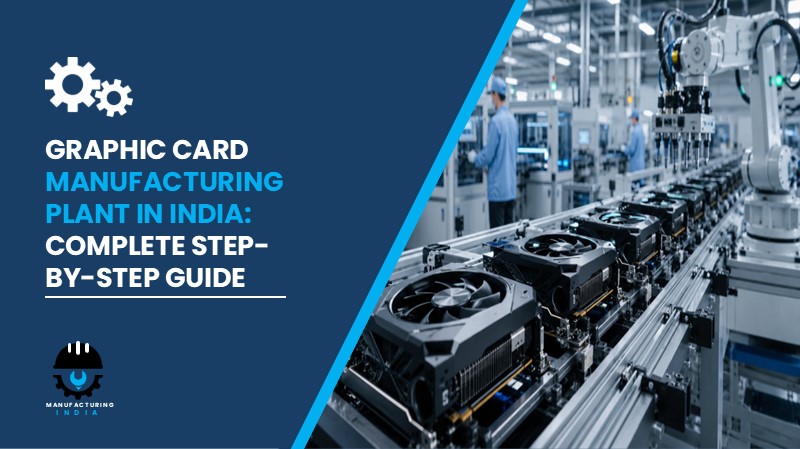
The primary production method is PCB assembly, GPU chip integration, soldering, testing, cooling system installation, firmware programming, and packaging. End-use industries served include gaming PCs, AI and machine learning platforms, cryptocurrency mining rigs, professional rendering workstations, and cloud computing servers.
Cost of Setting Up a Graphic Card Manufacturing Plant in India
The cost of establishing this type of plant depends on plant capacity, technology selection, location, automation level, and regulatory compliance. A structured understanding of both capital and operational expenditure is essential for any investor evaluating this opportunity.
1. Capital Expenditure (CapEx)
Land and Site Development form a foundational cost component, covering land acquisition, boundary development, registration charges, and related infrastructure work. Investors may explore special economic zones (SEZs) and designated electronics manufacturing clusters or industrial estates in Gujarat and Maharashtra to benefit from fiscal incentives and pre-developed infrastructure.
Civil Works and Construction encompass the construction of production sheds, cleanroom areas, quality control laboratories, raw material warehouses, finished goods storage, and administrative blocks. Electronics manufacturing requires controlled environments, and civil investment must reflect the precision standards of GPU production.
Machinery and Equipment represent the largest single component of capital expenditure for a graphic card manufacturing plant in India. Key machinery required includes:
- PCB soldering stations
- Pick-and-place machines
- Reflow ovens
- Cooling system assembly units
- Firmware programming stations
- Testing equipment
Other Capital Costs include effluent treatment plant (ETP) infrastructure, pre-operative expenses, commissioning charges, import duties on specialised machinery, and working capital margin for the initial production cycle.
Request a Sample Report for In-Depth Market Insights: https://www.imarcgroup.com/graphic-card-manufacturing-plant-project-report/requestsample
2. Operational Expenditure (OpEx)
Raw Material Cost is the dominant driver of operational expenditure in graphic card manufacturing, accounting for approximately 80–85% of total OpEx. Core raw materials include the GPU chip, memory (VRAM), PCB, cooler, and capacitors. The GPU chip alone constitutes the largest share of material cost, making long-term supplier contracts and multi-source procurement strategies critical to cost stability and margin protection.
Utility Cost — covering electricity, water, and cooling systems — accounts for approximately 2–5% of OpEx. Electronics manufacturing is energy-intensive, particularly during reflow soldering, testing, and cooling system assembly phases, so proximity to reliable power infrastructure is essential.
Other Operating Costs include transportation, packaging, salaries and wages, maintenance, depreciation, taxes, and other recurring expenses. By the fifth year of operations, total operational costs are projected to increase substantially due to inflation, market fluctuations, and potential rises in the cost of key materials such as GPU chips and VRAM. Additional factors, including supply chain disruptions, rising consumer demand, and shifts in the global economy, are expected to contribute to this escalation.
3. Plant Capacity
The proposed manufacturing facility is designed with an annual production capacity ranging between 5 and 20 million units, enabling economies of scale while maintaining operational flexibility. This capacity range allows investors to enter at a manageable scale and expand progressively as market demand grows. As with most high-technology manufacturing, profitability improves meaningfully with higher capacity utilisation, and investors should aim to ramp to optimal utilisation within the first two to three years.
4. Profit Margins and Financial Projections
The graphic card manufacturing plant demonstrates healthy profitability potential under normal operating conditions. Gross profit margins typically range between 25–35%, supported by stable demand and value-added applications. Net profit margins range between 12–20% on an average basis across the five-year projection period. Investors should evaluate the full suite of financial metrics — including NPV (Net Present Value), IRR (Internal Rate of Return), payback period, and a detailed profit and loss account — before committing capital. A sensitivity analysis covering pricing variability in GPU chips and VRAM is particularly important given raw material concentration risk.
Why Set Up a Graphic Card Plant in India?
Rising Demand for High-Performance Computing. Gamers, enterprises, and research institutions across India increasingly require GPUs for fast, high-quality computing. The country’s expanding IT sector, cloud computing adoption, and AI research ecosystem are creating a sustained, long-term demand base for graphic cards at both consumer and enterprise levels.
Expanding Gaming and Esports Market. Growth in gaming and esports is boosting demand for high-end GPUs with enhanced visual performance. India’s gaming community is one of the fastest-growing in Asia, and the esports industry’s commercialisation is driving purchases of high-performance PC hardware at scale.
AI and Machine Learning Adoption. The AI and machine learning field uses graphic cards to accelerate deep learning and neural network computations. India’s growing community of AI researchers, technology startups, and enterprise digital transformation initiatives represent a significant and expanding demand channel for domestic GPU supply.
Cryptocurrency Mining and Blockchain Growth. Growth in cryptocurrency mining trends and expanding blockchain technologies continue to enhance GPU demand. High-efficiency GPUs enable large-scale mining operations, and India’s blockchain developer and investor community presents a sustained market opportunity.
Active Industry Investment and Innovation. In February 2026, NVIDIA introduced the Resident Evil Requiem GeForce RTX 50 Series Bundle, leveraging DLSS 4, Multi Frame Generation, NVIDIA Reflex, and advanced RT Cores for enhanced performance. Also in February 2026, Intel enabled XeSS 3 Multi-Frame Generation across multiple Intel Arc discrete GPUs and Intel Core Ultra integrated GPUs, extending frame generation support to entry-level hardware. These developments signal continued technology advancement and product proliferation across market segments.
Cost-Competitive Manufacturing Base. India offers competitive land costs, an abundant engineering workforce, and an increasingly mature electronics supply chain. Greater accessibility provided by organised retail channels, e-commerce platforms, and OEM collaborations is improving distribution reach, while Make in India incentives reduce the cost burden for domestic producers relative to importers.
Manufacturing Process – Step by Step
The graphic card manufacturing process uses PCB assembly, GPU chip integration, soldering, testing, cooling system installation, firmware programming, and packaging as the primary production method. The process is a multi-step operation involving several unit operations, material handling stages, and quality checks:
- PCB Preparation: Bare printed circuit boards are inspected, cleaned, and prepared for component placement.
- Pick-and-Place Assembly: Automated pick-and-place machines position GPU chips, memory (VRAM), capacitors, and other components onto the PCB with precision.
- Reflow Soldering: Populated boards pass through reflow ovens, where controlled heating melts solder paste to permanently bond components to the PCB.
- GPU Chip Integration: The GPU chip is mounted and bonded to the PCB, forming the computational core of the graphic card.
- Cooling System Installation: Cooling system assembly units attach heatsinks, fans, or liquid cooling components to manage thermal output under load.
- Firmware Programming: Completed boards pass through firmware programming stations, where software is flashed to configure GPU behaviour, clock speeds, and performance profiles.
- Testing and Quality Assurance: Comprehensive testing equipment validates performance, output quality, and stability across all operational parameters before products are cleared for dispatch.
- Packaging and Dispatch: Finished graphic cards are packaged for retail, OEM, or bulk distribution and dispatched to gaming PC assemblers, AI platform providers, data centres, and professional workstation manufacturers.
Key Applications
Graphic cards manufactured at this type of plant serve a wide range of industries and professional use cases:
- Gaming Industry: High-performance GPUs provide better frame rates and graphical quality to both PC and console-connected gaming environments.
- AI and Machine Learning: Graphic cards accelerate deep learning and neural network computations for researchers and enterprise AI teams.
- Cryptocurrency Mining: High-efficiency GPUs enable large-scale mining operations extracting value from digital currencies.
- Professional Rendering: CAD design studios, animation houses, and video production companies depend on GPUs for speed and rendering accuracy.
- Scientific Computing: Research institutions use GPU-accelerated workstations for simulation, modelling, and data science applications.
- Multimedia and Video Editing: Content creators and media production professionals rely on graphic cards for real-time video editing and rendering performance.
Leading Manufacturers
The global graphic card industry is dominated by a small number of multinational companies with extensive production capacities and diverse application portfolios serving gaming, AI, professional rendering, and consumer PC segments. Key players in the market include:
- NVIDIA Corporation
- Advanced Micro Devices, Inc.
- Intel Corporation
- ASUSTeK Computer Inc.
- Gigabyte Technology Co., Ltd.
Timeline to Start the Plant
Investors planning to establish a graphic card manufacturing plant in India should anticipate the following phases:
- Feasibility study and project report preparation
- Land acquisition and site development
- Regulatory approvals and environmental clearances
- Factory licence and fire safety compliance
- Machinery procurement and installation
- Raw material supplier agreements and supply chain setup
- Trial production and quality testing
- Commercial production launch
Licences and Regulatory Requirements
Starting a graphic card manufacturing unit in India requires several approvals:
- Business registration (Proprietorship, LLP, or Pvt Ltd)
- Factory Licence under the Factories Act
- Environmental Clearance from State Pollution Control Board
- GST Registration
- Fire Safety NOC
- Hazardous and chemical handling compliance for solder materials and electronic waste
- Effluent Treatment Plant (ETP) operational clearance
- Occupational Health and Safety compliance
Key Challenges to Consider
High Capital Requirements. Establishing a graphic card manufacturing plant involves significant upfront investment in precision machinery including PCB soldering stations, pick-and-place machines, and reflow ovens, alongside cleanroom-grade civil infrastructure.
Raw Material Price Volatility. The GPU chip, memory (VRAM), PCB, cooler, and capacitors are globally traded components subject to supply chain disruptions and price fluctuations. The GPU chip alone accounts for 80–85% of OpEx, making price risk management a top operational priority.
Regulatory Compliance. Electronics manufacturing in India involves multiple layers of environmental, safety, and product compliance, including e-waste management regulations and ETP operational requirements.
Technology and Innovation Pressure. The graphic card industry advances rapidly, as evidenced by NVIDIA’s RTX 50 Series launch and Intel’s XeSS 3 Multi-Frame Generation rollout in February 2026. Manufacturers must invest continuously in process and product upgrades to remain competitive.
Competition from Established Players. Global manufacturers such as NVIDIA Corporation, Advanced Micro Devices, ASUSTeK Computer Inc., and Gigabyte Technology Co., Ltd. maintain significant scale advantages, making differentiation through cost efficiency and application focus critical for new entrants.
Skilled Manpower. GPU assembly, firmware programming, and testing require specialised technical skills. Recruiting and retaining qualified electronics engineers, quality technicians, and production staff remains a challenge in a competitive hiring environment.
Frequently Asked Questions
1. How much does it cost to set up a graphic card manufacturing plant in India?
The total setup cost depends on capacity, technology, location, and automation level. It covers land, civil works, machinery such as PCB soldering stations and reflow ovens, and pre-operative expenses. A detailed feasibility study with project-specific CapEx figures is available via IMARC Group’s sample report.
2. Is graphic card manufacturing profitable in India in 2026?
Yes. Gross profit margins typically range between 25–35% and net margins between 12–20%, supported by strong demand from gaming, AI, and cloud computing sectors.
3. What machinery is required for a graphic card plant in India?
Key machinery includes PCB soldering stations, pick-and-place machines, reflow ovens, cooling system assembly units, firmware programming stations, and testing equipment.
4. What licences and approvals are required to start a graphic card plant in India?
Required approvals include business registration, Factory Licence, Environmental Clearance, GST Registration, Fire Safety NOC, ETP clearance, and Occupational Health and Safety compliance.
5. What raw materials are needed for graphic card manufacturing?
Core raw materials include the GPU chip, memory (VRAM), PCB, cooler, and capacitors. The GPU chip is the highest-cost input, accounting for approximately 80–85% of total OpEx.
6. What are the environmental compliance requirements for a graphic card plant in India?
Compliance requirements include Environmental Clearance from the State Pollution Control Board, an operational Effluent Treatment Plant, and e-waste management under applicable hazardous materials regulations.
7. What is the best location to set up a graphic card plant in India?
States with established electronics manufacturing ecosystems, such as Gujarat, Maharashtra, and Tamil Nadu, offer the most favourable combination of infrastructure, supply chain access, and policy incentives.
8. What is the break-even period for this type of plant in India?
The break-even period depends on capacity utilisation, pricing strategy, and cost structure. A detailed payback period analysis, along with NPV and IRR projections, is available in IMARC Group’s full project report.
9. What government incentives are available for manufacturers in India?
The Make in India initiative, Production Linked Incentive (PLI) schemes for electronics, SEZ tax benefits, and state-level capital subsidy programmes are among the key incentives available to graphic card manufacturers setting up in India.
Key Takeaways for Investors
A graphic card manufacturing plant in India represents a high-growth investment opportunity anchored by surging demand from gaming, AI and machine learning platforms, cryptocurrency mining rigs, and cloud computing servers. The financial profile is compelling across a range of plant capacities, with gross margins of 25–35% and net margins of 12–20% providing a strong return baseline for investors who plan at adequate scale and utilisation. The global graphic card market — valued at USD 23.57 Billion in 2025 — is projected to reach USD 97.21 Billion by 2034 at a CAGR of 17.1% from 2026 to 2034, signalling sustained long-term demand that domestic Indian production is well-positioned to serve. With policy support from Make in India, a maturing electronics supply chain, and technology investment accelerating across NVIDIA, AMD, Intel, and their ecosystem partners, demand sustainability for this category of semiconductor hardware is among the strongest in the global electronics manufacturing landscape.
About the Author