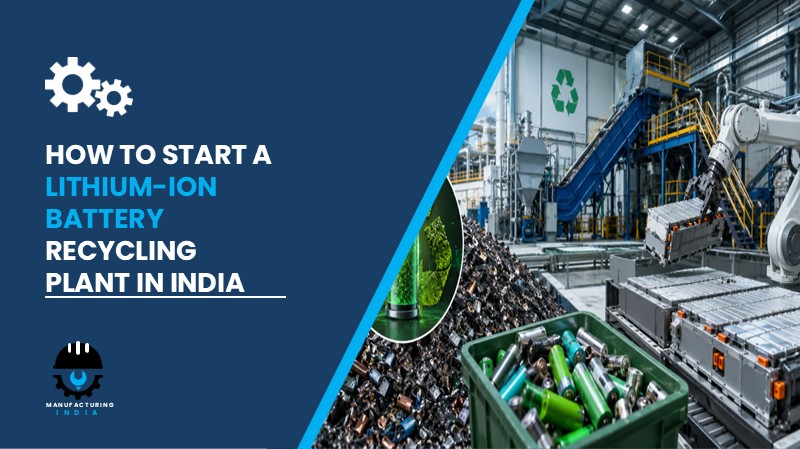
Setting up a lithium-ion battery recycling plant in India presents a compelling investment case of exceptional strategic and commercial importance — one where India’s accelerating electric vehicle adoption, surging consumer electronics consumption, growing regulatory pressure on battery waste management, and the government’s critical minerals self-sufficiency agenda are all converging to create both a policy-mandated and commercially compelling infrastructure requirement for domestic lithium-ion battery recycling capacity at industrial scale. Lithium-ion battery recycling — the systematic process of collecting, dismantling, and treating spent lithium-ion batteries to recover valuable materials such as lithium, cobalt, nickel, manganese, copper, and aluminium for reuse in new battery production — sits at the intersection of India’s clean energy transition, its circular economy ambitions, and its urgent need to reduce dependence on imported critical minerals whose global supply chains are geopolitically concentrated and increasingly constrained. As India’s EV fleet grows, its consumer electronics ownership deepens, and end-of-life batteries begin arriving in volumes that current disposal infrastructure cannot safely manage, the domestic case for building professional, technology-driven, and environmentally compliant lithium-ion battery recycling capacity has never been more urgent or more commercially well-timed.
India’s commitment to this sector is building rapidly. In October 2025, NavPrakriti started operations of a lithium-ion battery recycling plant in Eastern India, marking the expansion of lithium-ion battery recycling capacity in the country — a facility that supports recovery of critical minerals using indigenous technology and strengthens India’s circular economy as EV adoption and battery waste volumes continue to rise. According to the International Energy Association, more than 4 million electric cars were sold in the first quarter of 2025 as sales grew by 35% compared to the first quarter of 2024 — a global EV adoption acceleration that is directly translating into growing future recycling demand as the first generation of mass-market EV batteries approaches end-of-life. India’s Battery Waste Management Rules 2022 and Extended Producer Responsibility (EPR) framework for batteries have created mandatory collection and recycling obligations that generate structured institutional demand for professional battery recycling capacity from battery manufacturers, EV OEMs, and consumer electronics producers seeking EPR compliance partners.
Investing in a lithium-ion battery recycling plant in India today aligns mandatory EPR compliance demand, India’s rapidly growing EV battery waste stream, critical mineral recovery economics, and a global lithium-ion battery market growing from USD 18.99 Billion in 2025 to USD 78.01 Billion by 2034 at a 17.0% CAGR. With gross profit margins of 35–50% and net profit margins of 18–30% at an annual processing capacity of 10,000 MT, the unit economics are among the strongest in the circular economy manufacturing segment — and the investment’s strategic importance to India’s critical mineral supply chain makes it both commercially compelling and nationally essential.
What is Lithium-Ion Battery Recycling?
Lithium-ion battery recycling refers to the systematic process of collecting, dismantling, and treating spent lithium-ion batteries to recover valuable materials such as lithium, cobalt, nickel, manganese, copper, and aluminium for reuse in new battery production. Various recycling approaches available in the market include mechanical separation, hydrometallurgical recovery, direct recycling, and hybrid processes. The recycling process involves mechanical, thermal, and hydrometallurgical or pyrometallurgical treatments to separate active materials while ensuring environmental safety.
Recycling ensures consistent recovery efficiency, reduces dependency on virgin raw materials, and minimises the environmental and safety risks associated with improper battery disposal. These recycling systems are compatible with batteries from electric vehicles, energy storage systems, industrial equipment, and portable electronics. Lithium-ion battery recycling supports large-scale industrial operations as well as regional recycling facilities, ensuring consistent material quality and supply chain stability. The recovered black mass — the mixture of active cathode materials containing lithium, cobalt, nickel, and manganese — is the highest-value output stream from the recycling process, supplying battery material manufacturers with critical mineral feedstocks that reduce dependence on primary mining.
The primary process covers battery collection and sorting, safe discharging and dismantling, mechanical shredding and separation, chemical leaching and metal recovery, purification and refining, and material packaging. End-use industries served include electric vehicle manufacturing, energy storage system providers, consumer electronics, battery manufacturers, and raw material suppliers. Applications span recovery of lithium, cobalt, nickel, and manganese; reuse of active battery materials; sustainable battery manufacturing; circular economy initiatives; and hazardous waste management.
Cost of Setting Up a Lithium-Ion Battery Recycling Plant in India
The cost of establishing a lithium-ion battery recycling plant in India depends on annual processing capacity, recycling technology pathway selection between hydrometallurgical and pyrometallurgical routes, black mass processing capability, geographic location — particularly proximity to EV and electronics waste collection networks — degree of automation, and the comprehensive environmental, safety, and hazardous waste management compliance requirements applicable to battery recycling facilities in India.
1. Capital Expenditure (CapEx)
Land and Site Development forms a foundational component of total capital investment, covering land acquisition charges, site registration, boundary development, hazardous waste containment drainage, and site utilities. The location must offer easy access to key raw materials including spent lithium-ion batteries — black mass preferred — and chemicals for leaching including acids and reductants. Proximity to target markets will help minimise the collection and transportation costs for spent batteries from EV manufacturers, consumer electronics recyclers, and EPR compliance aggregators. The site must have robust infrastructure including reliable transportation, utilities, and waste management systems. Compliance with local zoning laws and environmental regulations applicable to hazardous waste processing facilities must be ensured from the outset. Industrial estates in Gujarat, Maharashtra, Rajasthan, and Telangana with established chemical processing infrastructure offer the most suitable operating environments.
Plant Layout Optimisation is critical for a lithium-ion battery recycling facility — integrating hazardous material intake and storage, thermal pre-treatment or mechanical shredding, chemical hydrometallurgical or pyrometallurgical processing, and precious material packaging in a safely segregated workflow. Separate areas for incoming battery collection and safe discharge, mechanical processing, chemical leaching, metal purification, quality control, recovered material storage, and dispatch must be designated. Space for future capacity expansion must be incorporated to accommodate growing battery waste volumes as India’s EV fleet ages.
Machinery and Equipment represent the largest single component of total CapEx for a lithium-ion battery recycling plant. Essential equipment includes:
- Battery collection and discharging systems
- Dismantling and shredding units
- Mechanical separation systems
- Hydrometallurgical or pyrometallurgical processing equipment
- Filtration and purification systems
- Material drying and packaging machines
- Advanced quality and safety monitoring systems
Other Capital Costs include an effluent treatment plant (ETP) for managing acid-containing leachate and metal-bearing process effluents, thermal off-gas treatment for pyrometallurgical operations, battery electrolyte capture and neutralisation systems, pre-operative expenses, hazardous waste processing facility licensing costs, commissioning charges, and import duties on specialised shredding or hydrometallurgical reactor equipment not available domestically at the required specification.
Request a Sample Report for In-Depth Market Insights: https://www.imarcgroup.com/lithium-ion-battery-recycling-plant-project-report/requestsample
2. Operational Expenditure (OpEx)
Raw Material Cost is the dominant operational expense, accounting for approximately 50–60% of total OpEx. The primary raw materials are spent lithium-ion batteries — with black mass preferred as a pre-processed feed — and chemicals for leaching including acids and reductants. Spent LIBs constitute the feedstock whose quality — expressed as the concentration of recoverable critical minerals including lithium, cobalt, nickel, and manganese — directly determines the recycling facility’s recovery economics and revenue per tonne processed. Building reliable collection networks, EPR compliance partnerships, and battery aggregation relationships with EV manufacturers, consumer electronics OEMs, and industrial operators is the most critical commercial priority for a new battery recycling plant. Leaching chemicals — sulphuric acid, hydrochloric acid, and reducing agents — are consumed in the hydrometallurgical process and must be sourced reliably from domestic chemical producers.
Utility Cost is the second-largest OpEx component, representing approximately 20–25% of total operating expenses — a high utility proportion reflecting the energy intensity of shredding operations, hydrometallurgical or pyrometallurgical processing, solvent extraction, electrowinning, and material drying stages across the complete recovery process chain. Electricity and thermal energy management are critical cost levers for maintaining recycling facility economics within commercially viable parameters.
Other Operating Costs include transportation for spent battery collection from geographically dispersed sources, specialised hazmat-compliant packaging for recovered critical mineral outputs, salaries and wages for chemical engineers and battery safety technicians, routine machinery maintenance including shredder blade replacement and filtration membrane servicing, EPR compliance documentation and audit costs, depreciation on production equipment, and applicable taxes. By the fifth year, the total operational cost is expected to increase substantially due to factors such as inflation, market fluctuations, and potential rises in the cost of key materials. Additional factors, including supply chain disruptions, rising consumer demand, and shifts in the global economy, are expected to contribute to this increase.
3. Plant Capacity
The proposed recycling facility is designed with an annual processing capacity of 10,000 MT of spent batteries, enabling economies of scale while maintaining operational flexibility across battery chemistries — NMC, LFP, NCA, and LCO — from EV, energy storage, industrial, and consumer electronics battery streams. Plant capacity can be customised per investor requirements and scaled through additional shredding capacity and hydrometallurgical processing trains as the domestic battery waste stream grows and EPR collection network volumes expand. Profitability improves with higher throughput utilisation, making secured battery collection partnerships and EPR compliance service agreements a strategic commercial foundation from the facility’s first year of operation.
4. Profit Margins and Financial Projections
The financial projections for a lithium-ion battery recycling plant demonstrate exceptional profitability potential under normal operating conditions. Gross profit margins typically range between 35–50% — reflecting the significant value-added recovery of high-value critical minerals including lithium, cobalt, and nickel from spent battery feedstock whose disposal would otherwise impose environmental liability. Net profit margins are projected at 18–30% — among the strongest in the circular economy and environmental services sector. The project’s financial viability, ROI, profitability, and long-term sustainability are assessed against realistic assumptions related to capital investment, operating costs, processing capacity utilisation, recovered mineral pricing trends, and demand outlook from battery manufacturers, EV OEMs, and raw material suppliers.
Why Set Up a Lithium-Ion Battery Recycling Plant in India?
Rapidly Growing EV Adoption Creating Battery Waste Stream. The lithium-ion battery recycling market is expected to witness strong growth due to the accelerating adoption of electric vehicles and renewable energy systems across global markets. According to the International Energy Agency, more than 4 million electric cars were sold in the first quarter of 2025 as sales grew by 35% compared to the first quarter of 2024. India’s own EV market is accelerating under FAME II incentives and growing consumer preference for electric two-wheelers, three-wheelers, and passenger vehicles — creating a battery waste stream that will grow exponentially as early EV batteries approach their 8–10 year end-of-life horizon.
Battery Waste Management Rules 2022 and EPR Framework Mandating Domestic Recycling. India’s Battery Waste Management Rules 2022 establish mandatory Extended Producer Responsibility obligations for battery manufacturers and importers, requiring them to ensure collection, channelisation, and recycling of end-of-life batteries through CPCB-registered recyclers. This regulatory framework creates structured, compliance-driven institutional demand for professional battery recycling capacity from every EV manufacturer, consumer electronics company, and industrial battery user in India — making EPR compliance service agreements a revenue stream as reliable as any commercial supply contract.
Critical Mineral Recovery Reducing Import Dependence. Recycling enables recovery of critical minerals — lithium, cobalt, nickel, and manganese — reducing dependence on mining and volatile raw material prices for India’s battery manufacturing sector. India currently imports virtually all of its battery critical mineral requirements — a supply chain vulnerability that directly threatens the competitiveness and cost stability of the domestic EV battery manufacturing capacity being developed under the PLI scheme for Advanced Chemistry Cells. Domestic lithium-ion battery recycling creates a secondary critical mineral supply stream that reduces this import dependence and supports the development of a circular, cost-competitive battery supply chain within India.
Active Domestic Investment Confirming Market Momentum. In October 2025, NavPrakriti started operations of a lithium-ion battery recycling plant in Eastern India, supporting recovery of critical minerals using indigenous technology and strengthening India’s circular economy as EV adoption and battery waste volumes continue to rise. In September 2025, American Battery Technology Company and Call2Recycle launched a strategic partnership to expand consumer lithium-ion battery recycling across the U.S., strengthening accessible collection networks and supporting domestic recovery of critical battery minerals through advanced closed-loop processing — a global investment signal that confirms the commercial viability and strategic importance of battery recycling infrastructure investment in both India and international markets.
Circular Economy Positioning as a Strategic Growth Driver. Innovation in direct recycling and closed-loop battery manufacturing is enhancing the economic viability of recycling operations. Manufacturers are increasingly integrating recycled materials into battery production to improve supply chain resilience and sustainability performance. The growing emphasis on circular economy models is positioning lithium-ion battery recycling as a strategic component of the future energy and mobility ecosystem — a positioning that creates long-term customer relationships with battery manufacturers seeking certified recycled critical mineral feedstocks for their own sustainability and ESG reporting.
Rising Volume of End-of-Life Batteries Creating Scalable Feedstock Growth. The increasing penetration of electric vehicles and consumer electronics is creating a strong need for scalable recycling solutions. India’s installed base of lithium-ion batteries — in smartphones, laptops, electric two-wheelers, three-wheelers, and the rapidly growing passenger EV fleet — represents a battery waste stream that is growing annually and will accelerate dramatically over the next 5–10 years as earlier-generation batteries reach end-of-life. Recycling plants established today will benefit from this growing feedstock wave — a structural supply advantage that improves with time rather than diminishing.
Recycling Process — Step by Step
The lithium-ion battery recycling process uses battery collection and sorting, safe discharging and dismantling, mechanical shredding and separation, chemical leaching and metal recovery, purification and refining, and material packaging as the primary processing method. Each stage requires controlled process parameters, rigorous safety management, and quality verification to recover critical mineral outputs meeting the purity and specification requirements of battery material manufacturers and raw material suppliers.
- Battery Collection and Sorting: Spent lithium-ion batteries are collected from EPR compliance aggregators, EV manufacturers, consumer electronics OEMs, industrial operators, and public collection points through battery collection and discharging systems, with incoming batteries sorted by chemistry, format, and condition to determine the optimal processing pathway and anticipated recovery economics for each feedstock batch.
- Safe Discharging: Collected batteries are fully discharged to zero state-of-charge using controlled resistive or regenerative discharge equipment within battery collection and discharging systems, eliminating the thermal runaway and short-circuit risks that represent the primary safety hazard in battery recycling operations before mechanical processing begins.
- Dismantling: Discharged batteries are disassembled using dismantling and shredding units — manually for large-format EV battery packs or mechanically for smaller consumer batteries — to separate modules, cells, current collectors, electrolyte, and casings, with battery management electronics and copper busbars recovered as separate valuable output streams.
- Mechanical Shredding and Separation: Disassembled battery cells are shredded using high-torque industrial shredders within dismantling and shredding units, and the shredded material is processed through mechanical separation systems — including vibrating screens, magnetic separators for current collector metal recovery, and air classification for separator film removal — to produce black mass as the concentrated cathode active material fraction containing lithium, cobalt, nickel, and manganese.
- Hydrometallurgical Processing — Chemical Leaching: Black mass is processed through hydrometallurgical or pyrometallurgical processing equipment where selective leaching with acid solutions dissolves the critical metals from the black mass matrix, with reductant addition enabling efficient dissolution under controlled temperature and pH conditions to achieve high metal extraction efficiency.
- Solvent Extraction and Metal Separation: Leachate containing dissolved lithium, cobalt, nickel, and manganese is processed through selective solvent extraction and ion exchange stages within filtration and purification systems to separate individual metal streams, with cobalt and nickel typically recovered first at higher value, followed by manganese, and finally lithium.
- Purification and Refining: Individual metal solutions are purified through additional hydrometallurgical processing stages including pH precipitation, solvent stripping, and electrowinning within purification systems to produce specification-grade battery precursor materials — including cobalt sulfate, nickel sulfate, manganese sulfate, and lithium carbonate or lithium hydroxide — meeting the purity requirements of battery cathode material manufacturers.
- Material Drying and Packaging: Purified recovered critical mineral products are processed through material drying and packaging machines to achieve the target moisture content, crystal size, and flow properties required for battery material manufacturer customers, then packaged in specification-compliant containers with full batch traceability documentation for dispatch.
- Quality and Safety Monitoring: Throughout every processing stage, advanced quality and safety monitoring systems provide continuous monitoring of battery cell temperatures, off-gas composition, effluent chemistry, and product purity — ensuring process safety, environmental compliance, and recovered material specification adherence across all production operations.
Key Applications
Recovered materials from lithium-ion battery recycling operations in India serve critical supply chain roles across the clean energy and electronics manufacturing ecosystem:
- Consumer Electronics Industry: Smartphones, laptops, and portable device batteries are recycled to recover valuable metals including lithium and cobalt, and to reduce electronic waste volumes that would otherwise create environmental and health hazards if improperly disposed.
- Automotive Sector: Recycling facilities support electric vehicle manufacturers by recovering battery-grade materials — cobalt sulfate, nickel sulfate, lithium carbonate — and reducing raw material procurement costs for new EV battery production through domestic secondary mineral supply.
- Energy Storage Systems: Grid-scale and renewable energy storage operators rely on recycling to manage end-of-life batteries efficiently, maintaining ESG compliance, meeting EPR obligations, and contributing to the circular economy models that institutional energy investors increasingly require.
- Government and Municipal Programs: Public battery collection initiatives under India’s Battery Waste Management Rules depend on professional recycling infrastructure to manage hazardous battery waste responsibly and recover strategic critical minerals for domestic battery manufacturing.
Leading Recyclers
The global lithium-ion battery recycling industry is served by a group of specialist recycling companies and large diversified materials companies with extensive processing capabilities and diverse end-market supply portfolios. Key players in the global market include:
- Li-Cycle Corp.
- Redwood Materials, Inc.
- Umicore
- Glencore
- Ecobat
Timeline to Start the Plant
Establishing a lithium-ion battery recycling plant in India involves a structured multi-phase development sequence. Usually, the timeline can range from 12 to 24 months to start this type of plant, depending on factors like site development, machinery installation, environmental clearances, safety measures, and trial runs. Investors should plan for the following phases:
- Feasibility study and project report preparation
- Land acquisition and site development
- Regulatory approvals and environmental clearances
- Factory licence and fire safety compliance
- Machinery procurement and installation
- Raw material supplier agreements and supply chain setup
- Trial production and quality testing
- Commercial production launch
Licences and Regulatory Requirements
Starting a lithium-ion battery recycling unit in India requires comprehensive approvals spanning business registration, hazardous waste processing, EPR compliance, environmental, and industrial safety domains:
- Business registration (Proprietorship, LLP, or Pvt Ltd)
- Factory Licence under the Factories Act
- Environmental Clearance from the State Pollution Control Board
- GST Registration
- Fire Safety NOC
- Authorisation under the Hazardous and Other Wastes (Management and Transboundary Movement) Rules as a registered hazardous waste recycler, mandatory for processing spent lithium-ion batteries
- Registration with the Central Pollution Control Board (CPCB) as a Battery Waste Management Rules authorised recycler under the Battery Waste Management Rules 2022, enabling the facility to accept EPR-compliant battery waste from manufacturers
- Effluent Treatment Plant (ETP) operational clearance for managing acid-containing leachate and metal-bearing process effluents from hydrometallurgical operations
- Occupational Health and Safety compliance including battery electrolyte exposure monitoring and fire safety measures for lithium battery handling
Key Challenges to Consider
Battery Feedstock Aggregation and Collection Network Development. Building reliable, geographically distributed collection networks for spent lithium-ion batteries — from diverse sources including EV manufacturers, electronics OEMs, industrial operators, and consumer collection points — is the most fundamental operational challenge and commercial priority for a new battery recycling plant. The quality and volume of incoming battery feedstock directly determines both production throughput and critical mineral recovery revenue, making EPR compliance partnership agreements and collection logistics investment as commercially important as process technology selection.
Battery Chemistry and Format Diversity Management. India’s battery waste stream encompasses multiple chemistries — NMC, LFP, NCA, LCO, and variations — across diverse formats from small cylindrical consumer batteries through prismatic automotive cells to large pouch format EV modules. Processing these diverse inputs efficiently requires flexible sorting, discharging, and processing capability, with chemistry-specific optimisation of leaching conditions, solvent extraction parameters, and recovery protocols for each battery type.
High Utility Cost Intensity. Utility costs representing 20–25% of total OpEx — significantly above the average for most manufacturing categories — reflect the energy intensity of shredding, thermal pre-treatment where applicable, hydrometallurgical processing, solvent extraction, electrowinning, and drying operations across the full recycling process chain. Optimising energy consumption through heat recovery, efficient shredder motor management, and competitive industrial electricity tariff negotiation is critical for maintaining facility economics within commercially viable parameters.
Hazardous Waste Regulatory Compliance Complexity. Lithium-ion battery recycling is classified as hazardous waste processing under India’s Hazardous and Other Wastes Rules, requiring comprehensive authorisation from state pollution control boards, CPCB registration as a Battery Waste Management Rules recycler, detailed hazardous waste management plans, and periodic compliance audits. Managing this regulatory complexity requires dedicated environmental compliance expertise and ongoing regulatory engagement.
Critical Mineral Price Volatility Affecting Recovery Revenue. The economics of lithium-ion battery recycling are materially affected by global prices for recovered critical minerals — particularly cobalt, nickel, and lithium — which are subject to significant volatility driven by EV demand forecasts, primary mining supply conditions, and geopolitical factors. Building recovery revenue models that account for mineral price downside scenarios, and developing customer contracts with appropriate price adjustment mechanisms, is essential for financial planning resilience.
Skilled Technical Workforce for Hydrometallurgical Operations. Maintaining consistent critical mineral recovery efficiency, product purity, and process safety across hydrometallurgical leaching, solvent extraction, and purification operations requires trained chemical process engineers, battery safety specialists, and analytical quality control chemists — a technical workforce that requires ongoing investment in recruitment, specialised training, and competitive retention programmes.
Frequently Asked Questions
1. How much does it cost to set up a lithium-ion battery recycling plant in India?
Capital requirements generally include land acquisition, construction, equipment procurement, installation, pre-operative expenses, and initial working capital. Equipment costs — for battery collection and discharging systems, dismantling and shredding units, mechanical separation systems, hydrometallurgical or pyrometallurgical processing equipment, filtration and purification systems, material drying and packaging machines, and advanced quality and safety monitoring systems — represent a significant portion of capital expenditure. The total amount varies with capacity, technology, and location. A detailed project report with full CapEx and OpEx breakdowns is available on request.
2. Is lithium-ion battery recycling profitable in India in 2026?
Yes. The project demonstrates gross profit margins of 35–50% and net profit margins of 18–30% under normal operating conditions — among the strongest in the circular economy sector. India’s Battery Waste Management Rules 2022 creating mandatory EPR demand, NavPrakriti’s October 2025 plant launch confirming domestic commercial viability, and the global lithium-ion battery market’s exceptional 17.0% CAGR growth from USD 18.99 Billion in 2025 to USD 78.01 Billion by 2034 collectively confirm both the regulatory imperative and commercial opportunity for battery recycling investment in India.
3. What machinery is required for a lithium-ion battery recycling plant in India?
Key machinery includes battery collection and discharging systems, dismantling and shredding units, mechanical separation systems, hydrometallurgical or pyrometallurgical processing equipment, filtration and purification systems, material drying and packaging machines, and advanced quality and safety monitoring systems. Industrial shredders and hydrometallurgical processing equipment are the most capital-intensive and technically critical items, determining throughput capacity and critical mineral recovery efficiency.
4. What licences and approvals are required to start a lithium-ion battery recycling plant in India?
Required approvals include business registration, a Factory Licence under the Factories Act, Environmental Clearance from the State Pollution Control Board, GST registration, a Fire Safety NOC, Hazardous Waste authorisation under the Hazardous and Other Wastes Rules, CPCB registration under the Battery Waste Management Rules 2022 as an authorised recycler, ETP operational clearance, and Occupational Health and Safety compliance.
5. What raw materials are needed for lithium-ion battery recycling?
The primary raw materials are spent lithium-ion batteries — with black mass preferred as pre-processed feed — and chemicals for leaching including acids and reductants. Spent LIB feedstock accounts for approximately 50–60% of total operating expenses, making battery collection network development, EPR partnership agreements, and feedstock quality management the most critical operational priorities for the investment.
6. What are the environmental compliance requirements for a lithium-ion battery recycling plant in India? The unit must obtain Environmental Clearance from the State Pollution Control Board, hold Hazardous Waste authorisation under the Hazardous and Other Wastes Rules, operate a certified ETP for managing acid leachate and metal-bearing process effluents, install thermal off-gas treatment for pyrometallurgical operations, implement battery electrolyte capture and neutralisation systems, and maintain continuous monitoring systems for air emissions and wastewater discharge.
7. What is the best location to set up a lithium-ion battery recycling plant in India?
Optimal locations offer proximity to major EV manufacturing clusters and consumer electronics recycling aggregators for feedstock collection, established chemical processing infrastructure for hydrometallurgical operations, reliable high-capacity electricity supply, and regulatory environments experienced with hazardous waste processing. Industrial estates in Gujarat, Maharashtra, Rajasthan, and Telangana with hazardous waste processing infrastructure are among the most strategically relevant options.
8. What is the break-even period for this type of plant in India?
Break-even typically ranges from 3 to 6 years, depending on scale, regulatory compliance costs, feedstock availability, critical mineral pricing, and EPR partnership revenue. Efficient processing, strong collection network development, and export revenue for recovered critical minerals can help accelerate returns. A detailed financial analysis including payback period, NPV, and IRR projections is available via the sample request link.
9. What government incentives are available for manufacturers in India?
Governments may offer incentives such as capital subsidies, tax exemptions, reduced utility tariffs, export benefits, or interest subsidies to promote manufacturing under various national or regional industrial policies. India’s PLI scheme for Advanced Chemistry Cell batteries, Battery Waste Management Rules creating mandatory EPR compliance demand, and government critical minerals self-sufficiency initiatives provide direct commercial and policy support for lithium-ion battery recycling investment in India.
Key Takeaways for Investors
A lithium-ion battery recycling plant in India represents one of the most strategically essential and financially compelling circular economy investments available in the country today — positioned at the intersection of mandatory regulatory compliance under the Battery Waste Management Rules 2022, India’s urgent need to build domestic critical mineral recovery capacity for its EV battery supply chain, and a global lithium-ion battery market growing from USD 18.99 Billion in 2025 to USD 78.01 Billion by 2034 at an exceptional CAGR of 17.0% that will deliver a corresponding exponential growth in battery waste volumes requiring professional recycling infrastructure. The project demonstrates exceptional financial viability at an annual processing capacity of 10,000 MT, with gross profit margins of 35–50% and net profit margins of 18–30% confirming the strongest unit economics of any recycling or environmental services investment category — driven by the high value of recovered critical minerals and the regulatory-mandated institutional demand from EPR-obligated battery manufacturers and EV OEMs. With NavPrakriti’s October 2025 plant launch confirming domestic commercial viability, the IEA confirming 35% global EV sales growth in Q1 2025, and India’s battery EPR framework creating structured collection and recycling obligations that grow proportionally with EV adoption, demand sustainability for India-based lithium-ion battery recycling is structurally robust, regulation-anchored, and commercially extraordinary across the full investment horizon.
About the Author