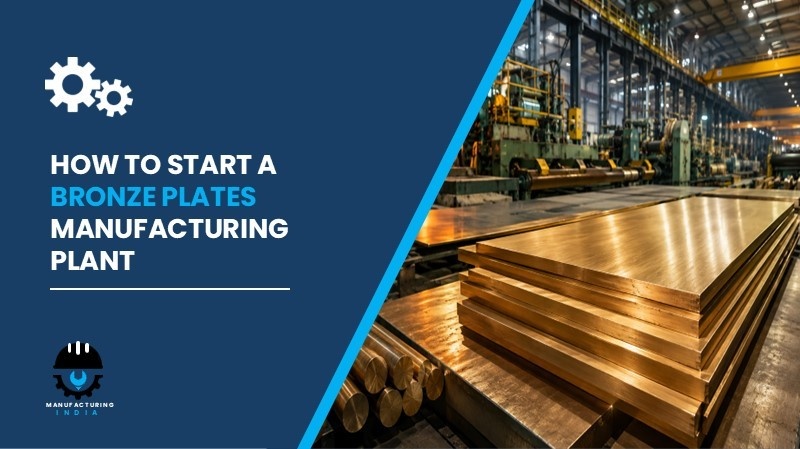
Setting up a bronze plates manufacturing plant in India presents a compelling investment case driven by sustained demand from marine engineering, industrial machinery, construction, and electrical and electronics applications. Bronze plates are valued for their superior corrosion resistance, wear strength, and load-bearing capacity – properties that make them indispensable across heavy engineering, automotive, and infrastructure sectors. As India accelerates its push into large-scale infrastructure development, shipbuilding, and manufacturing expansion, domestic production of this critical alloy product is poised to generate stable, long-term returns.
India’s strategic advantages – an abundant industrial labour pool, rapidly growing urban infrastructure, the Make in India initiative, and PLI-linked industrial programmes – create a favourable environment for establishing a bronze plates unit. Key manufacturing states such as Gujarat and Maharashtra offer access to port connectivity, raw material supply chains, and well-developed industrial estates. Proximity to OEM clusters in the automotive, heavy engineering, and electrical sectors further strengthens the case for local production, reducing lead times and distribution costs for domestic buyers.
Investors evaluating a bronze plates manufacturing plant in India will find the economics compelling: gross profit margins of 15-30% and net profit margins of 8-15% reflect robust demand from marine, construction, and industrial machinery sectors. With government policy support through Make in India, cost-competitive land and labour, and growing supply chain localisation by OEMs and EPC contractors, this plant offers a financially viable and strategically well-timed investment opportunity.
What are Bronze Plates?
Bronze plates are flat-rolled or cast metal products manufactured primarily from copper alloyed with tin, aluminium, silicon, or phosphorus. They exhibit excellent corrosion resistance, high fatigue strength, good thermal conductivity, and superior machinability compared to many ferrous materials. Bronze plates also demonstrate low friction coefficients, making them suitable for bearing, wear, and sliding applications. Their resistance to seawater corrosion and biofouling further enhances their use in marine and offshore environments. Depending on alloy composition, bronze plates can offer enhanced hardness, electrical conductivity, or formability, enabling their adoption across structural, mechanical, and decorative applications.
The primary production method is a multi-stage melting and alloying, casting, hot rolling, cold rolling, annealing, surface finishing, and cutting process. End-use industries served include marine, industrial machinery, construction, electrical and electronics, oil and gas, and aerospace – a broad application base that insulates demand from sector-specific downturns.
Cost of Setting Up a Bronze Plates Manufacturing Plant in India
The total cost of establishing a bronze plates manufacturing plant in India depends on plant capacity, chosen technology, site location, level of automation, and regulatory compliance requirements. Investors must account for both capital expenditure at the outset and recurring operational costs over the project lifecycle.
1. Capital Expenditure (CapEx)
The total capital investment covers land acquisition and site preparation, civil construction, machinery procurement, and other pre-operative costs.
Land and site development – expenses include land registration charges, boundary development, and related infrastructure – a substantial component of overall CapEx. Plants may be established within Special Economic Zones (SEZs) or state-designated industrial estates to benefit from concessional land rates and infrastructure support.
Civil works and construction cost – encompass the production shed, laboratory, raw material storage, finished goods warehouse, and administrative block. These are sized according to the chosen production capacity and workflow layout.
Machinery costs represent the largest share of total capital expenditure. Key machinery required for a bronze plates plant includes:
- Melting furnaces
- Casting machines
- Rolling mills
- Finishing equipment
Other capital costs include the Effluent Treatment Plant (ETP), pre-operative and commissioning expenses, and applicable import duties on specialised equipment.
Request a Sample Report for In-Depth Market Insights: https://www.imarcgroup.com/bronze-plates-manufacturing-plant-project-report/requestsample
2. Operational Expenditure (OpEx)
The operating cost structure of a bronze plates manufacturing plant is primarily driven by raw material consumption.
Raw material cost – covering copper cathodes/ingots, tin ingots, alloy additives, and fluxing agents – accounts for approximately 70-80% of total OpEx. Investors are advised to negotiate long-term contracts with reliable domestic and international suppliers to mitigate price volatility and ensure supply continuity.
Utility cost – including electricity, water, and steam, represent 8-15% of total operating expenses. Given the energy intensity of melting and rolling operations, proximity to reliable grid infrastructure and captive power options can meaningfully reduce this component.
Other operating costs include transportation, packaging, salaries and wages, maintenance, depreciation, and taxes. By the fifth year of operations, total operational costs are projected to increase substantially, driven by inflation, market fluctuations, and potential rises in the cost of key raw materials such as copper cathodes. Supply chain disruptions, rising consumer demand, and shifts in the global economy are additional factors expected to contribute to this increase.
3. Plant Capacity
The proposed manufacturing facility is designed with an annual production capacity ranging between 2,000-5,000 TPA, enabling economies of scale while maintaining operational flexibility. Capacity can be customised to match the investor’s capital availability, target market size, and growth phasing. Profitability improves meaningfully with higher capacity utilisation, as fixed costs – including depreciation, plant overheads, and fixed salaries – are spread over a larger production base.
4. Profit Margins and Financial Projections
The project demonstrates healthy profitability under normal operating conditions. Gross profit margins typically range between 15-30%, supported by stable demand and value-added applications across industrial and architectural segments. Net profit margins range between 8-15%. Full financial projections – covering NPV, IRR, payback period, and a detailed profit and loss account – are available in the complete IMARC Group project report, providing investors with a comprehensive view of long-term financial viability and return on investment.
Why Set Up a Bronze Plates Plant in India?
Critical Industrial and Engineering Material Demand: Bronze plates serve as essential components in automotive structural parts, electronic heat-dissipation assemblies, construction fittings, and telecommunication mounting panels. Their strength, corrosion resistance, and excellent machinability make them a reliable material for structural, mechanical, and precision components – driving consistent industrial procurement.
Marine Transportation and Infrastructure Expansion: The bronze plates market is primarily driven by expansion in marine transportation, offshore infrastructure, and heavy industrial equipment manufacturing. Rising investments in port modernisation, shipbuilding, and coastal infrastructure support sustained demand for corrosion-resistant alloys. The U.S. Marine Transportation System estimated that approximately 2.3 billion tons of domestic and foreign commerce are carried annually on U.S. inland waterways alone – an indicator of global maritime activity and the associated materials demand.
Megatrend Alignment Across Sectors: Growth in infrastructure development, electric mobility, renewable energy projects, industrial automation, and rail and marine sectors is driving steady demand for durable, corrosion-resistant metal plates. Bronze continues to be preferred in applications requiring long service life, low maintenance, and resistance to harsh operating environments – all of which align with India’s infrastructure modernisation agenda.
Policy and Regulatory Tailwinds: Government-led investments in transportation infrastructure, renewable power, shipbuilding, defence, smart cities, and domestic manufacturing initiatives – including Make in India and PLI-linked industrial programmes – indirectly support rising demand for bronze plates in both public and private sector projects. These policies create a favourable regulatory and fiscal environment for new manufacturing entrants.
Active Industry Investment: In October 2024, Wieland Group expanded its global footprint by acquiring Morgan Bronze Products, a precision machined parts manufacturer, and Italian heat exchanger maker Onda – strengthening its bronze and alloy manufacturing capabilities and broadening its engineered product offerings. Such consolidation signals growing institutional confidence in the long-term demand trajectory for bronze products.
Supply Chain Localisation Preference: OEMs, EPC contractors, and fabrication units increasingly prioritise local, dependable suppliers to reduce lead times, manage raw material price volatility, ensure traceability, and maintain consistent quality. This trend creates strong opportunities for regional bronze plate manufacturers with efficient production and sourcing capabilities.
Manufacturing Process – Step by Step
The bronze plates manufacturing process uses melting and alloying, casting, hot rolling, cold rolling, annealing, surface finishing, and cutting as the primary production method. The process involves multiple unit operations, material handling stages, and quality checks:
- Melting and Alloying: Copper cathodes/ingots, tin ingots, alloy additives, and fluxing agents are charged into melting furnaces. The melt is held at controlled temperatures and alloy composition is verified before casting.
- Casting: The molten bronze is transferred to casting machines to produce slabs or billets of uniform cross-section. Cooling and solidification parameters are controlled to minimise internal defects.
- Hot Rolling: Cast slabs are passed through rolling mills at elevated temperatures to reduce thickness and improve grain structure, enhancing mechanical properties.
- Cold Rolling: Further thickness reduction is achieved at room temperature using rolling mills, improving dimensional accuracy and surface finish.
- Annealing: Rolled plates are subjected to controlled heat treatment to relieve internal stresses and restore ductility, ensuring formability for downstream applications.
- Surface Finishing: Finishing equipment is used to achieve required surface quality, flatness, and dimensional tolerances as per customer and application specifications.
- Cutting and Dispatch: Finished plates are cut to size, inspected against quality assurance criteria, packaged, and dispatched to end-use industries including marine, construction, automotive, and electrical sectors.
Key Applications
Bronze plates serve a broad range of industries, with each sector leveraging distinct material properties:
- Marine: Ship propellers, fittings, and offshore structural components requiring seawater corrosion resistance and biofouling protection.
- Industrial Machinery: Heavy-duty bearings, bushings, and wear-resistant components for high-load mechanical applications.
- Construction: Decorative architectural plates, corrosion-resistant fittings, facades, cladding, and load-distribution elements.
- Automotive: Structural reinforcement plates, wear-resistant components, and vibration-damping elements.
- Electrical and Electronics: Heat-dissipation plates, shielding components, and precision mounting parts.
- Oil and Gas: Wear plates and corrosion-resistant components for upstream and downstream equipment.
- Aerospace: Precision structural and mechanical components requiring high fatigue strength and dimensional accuracy.
- Telecommunication: Equipment mounting plates, shielding panels, and structural support components.
- Historical and Artistic: Monument repair, decorative facades, and artistic foundry castings.
Leading Manufacturers
The global bronze plates industry is served by several multinational companies with extensive production capacities and diverse application portfolios. Key players in the global market include:
- Wieland Group
- KME Group
- Aviva Metals
- Morgan Bronze Products
- National Bronze Manufacturing
These companies serve end-use sectors including marine, industrial machinery, construction, electrical and electronics, oil and gas, and aerospace – providing a benchmark for quality, certification standards, and product range that domestic Indian manufacturers can target in their positioning strategy.
Timeline to Start the Plant
- Feasibility study and project report preparation
- Land acquisition and site development
- Regulatory approvals and environmental clearances
- Factory licence and fire safety compliance
- Machinery procurement and installation
- Raw material supplier agreements and supply chain setup
- Trial production and quality testing
- Commercial production launch
Licences and Regulatory Requirements
Starting a bronze plates manufacturing unit in India requires several approvals:
- Business registration (Proprietorship, LLP, or Pvt Ltd)
- Factory Licence under the Factories Act
- Environmental Clearance from State Pollution Control Board
- GST Registration
- Fire Safety NOC
- Hazardous/Chemical compliance (relevant given molten metal handling and alloy additive use)
- Effluent Treatment Plant (ETP) operational clearance
- Occupational Health and Safety compliance
Key Challenges to Consider
High Capital Requirements: Machinery costs – particularly melting furnaces, casting machines, and rolling mills – account for the largest share of CapEx, creating a meaningful entry barrier that necessitates careful financial planning and phased investment.
Raw Material Price Volatility: Copper cathodes/ingots, the primary raw material, account for 70-80% of total operating costs. Copper is a globally traded commodity with significant price fluctuations, making long-term supply contracts and hedging strategies essential for margin protection.
Regulatory Compliance: Bronze plate production involves high-temperature melting, hazardous chemical handling, and effluent generation, requiring robust ETP systems, occupational health protocols, and ongoing environmental compliance – adding to both CapEx and OpEx.
Technology and Innovation Pressure: Strict control over alloy composition, melting and casting processes, rolling tolerances, surface finish, and quality certifications is required. OEM qualification cycles and application-specific standards create ongoing technological demands for consistent and quality-focused manufacturers.
Competition from Global Players: Established global manufacturers such as Wieland Group and KME Group have significant scale, application portfolios, and OEM relationships, creating competitive pressure on pricing and quality benchmarks for new domestic entrants.
Skilled Manpower: Operating melting furnaces, rolling mills, and finishing equipment requires trained metallurgists and machine operators. Attracting and retaining skilled personnel in non-metro industrial locations can be a persistent operational challenge.
Frequently Asked Questions
1. How much does it cost to set up a bronze plates manufacturing plant in India?
The total setup cost depends on plant capacity, technology choice, site location, and automation level. CapEx covers land, civil construction, machinery (melting furnaces, casting machines, rolling mills, and finishing equipment), and pre-operative expenses. A detailed breakdown is available in the IMARC Group project report upon sample request.
2. Is bronze plates manufacturing profitable in India in 2026?
Yes. The project demonstrates gross profit margins of 15-30% and net profit margins of 8-15% under normal operating conditions, supported by stable industrial demand, value-added applications, and a growing preference for locally sourced alloy materials.
3. What machinery is required for a bronze plates plant in India?
Key machinery includes melting furnaces, casting machines, rolling mills, and finishing equipment. All machinery must comply with industry standards for safety, efficiency, and reliability.
4. What licences and approvals are required to start a bronze plates plant in India?
Required approvals include business registration, a Factory Licence under the Factories Act, Environmental Clearance from the State Pollution Control Board, GST Registration, Fire Safety NOC, chemical/hazardous material compliance, ETP clearance, and occupational health and safety compliance.
5. What raw materials are needed for bronze plates manufacturing?
The primary raw materials are copper cathodes/ingots, tin ingots, alloy additives, and fluxing agents. Copper cathodes alone account for approximately 70-80% of total operating costs.
6. What are the environmental compliance requirements for a bronze plates plant in India?
An operational Effluent Treatment Plant (ETP) is mandatory, along with Environmental Clearance from the State Pollution Control Board. Advanced monitoring systems to detect process deviations and compliance with emission standards are also required.
7. What is the best location to set up a bronze plates plant in India?
Ideal locations offer proximity to raw material suppliers (copper and tin), access to robust transportation infrastructure, reliable utilities, and availability of skilled labour. Industrial estates and SEZs in Gujarat and Maharashtra are well-suited given their port connectivity and established manufacturing ecosystems.
8. What is the break-even period for this type of plant in India?
The payback period depends on plant capacity, utilisation rates, and operational efficiency. Full financial analysis including break-even projections is covered in the IMARC Group detailed project report.
9. What government incentives are available for manufacturers in India?
Manufacturers can benefit from the Make in India initiative, PLI-linked industrial programmes, SEZ incentives, state-level industrial promotion schemes, and capital subsidy programmes offered by various state investment promotion bodies.
Key Takeaways for Investors
A bronze plates manufacturing plant in India offers a well-grounded investment opportunity, with demand anchored in marine engineering, industrial machinery, construction, automotive, electrical and electronics, oil and gas, and aerospace sectors – all of which are growing in India’s expanding industrial economy. The financial profile is attractive across plant capacities, with gross margins of 15-30% and net margins of 8-15%, underpinned by value-added applications and stable end-market demand. Asia Pacific accounts for approximately 39.0% of the overall global bronze plates market, underlining the region’s – and India’s – strategic positioning in this industry. With increasing supply chain localisation, government infrastructure investment, and rising OEM preference for domestic sourcing, demand sustainability for quality bronze plate producers in India is well-supported over the medium to long term.
About the Author