Setting up a flow battery manufacturing plant in India presents a compelling investment case driven by the country’s accelerating renewable energy transition, rising demand for grid-scale energy storage, and the rapid expansion of electric vehicle (EV) charging infrastructure, telecommunications backup power, and industrial off-grid power solutions. Flow batteries are electrochemical energy storage devices that store energy in liquid electrolytes pumped through a membrane-separated cell system – a design that offers longer cycle life, improved safety, scalability, and the ability to store energy for extended periods without degradation. As India aggressively pursues its target of 500 GW of non-fossil fuel capacity by 2030, as announced by the Ministry of New and Renewable Energy (MNRE), technologies like flow batteries are becoming crucial for grid stabilisation, renewable integration, and peak shaving – creating a structurally expanding and policy-backed demand base for domestic production capacity.
India’s structural advantages make this investment strategically compelling. The country’s vast solar and wind energy pipeline requires large-scale, durable storage solutions to smooth out the intermittency of renewable generation – a requirement that flow batteries address more effectively than conventional lithium-ion systems for long-duration applications. The rapid growth of India’s EV charging network, telecommunications infrastructure, data centre sector, and industrial manufacturing base is simultaneously generating multi-sector demand for reliable energy storage. With the global flow battery market valued at USD 603.56 million in 2025 and projected to reach USD 3,832.72 million by 2034 at an exceptional CAGR of 22.8%, and with India’s MNRE policy environment actively incentivising energy storage investment, a flow battery manufacturing plant in India is positioned at the intersection of one of the fastest-growing global clean energy technology markets and one of the world’s most ambitious renewable energy deployment programmes.
India’s 500 GW renewable energy target by 2030, the country’s rapidly expanding EV charging and telecommunications infrastructure, and a global flow battery market growing at 22.8% CAGR make a flow battery manufacturing plant a high-growth, policy-supported, and financially compelling investment opportunity. With gross margins of 35–45% and net margins of 15–25% across an annual capacity of 100–1,000 MWh, the return profile is strong and the long-term demand outlook structurally durable.
What is a Flow Battery?
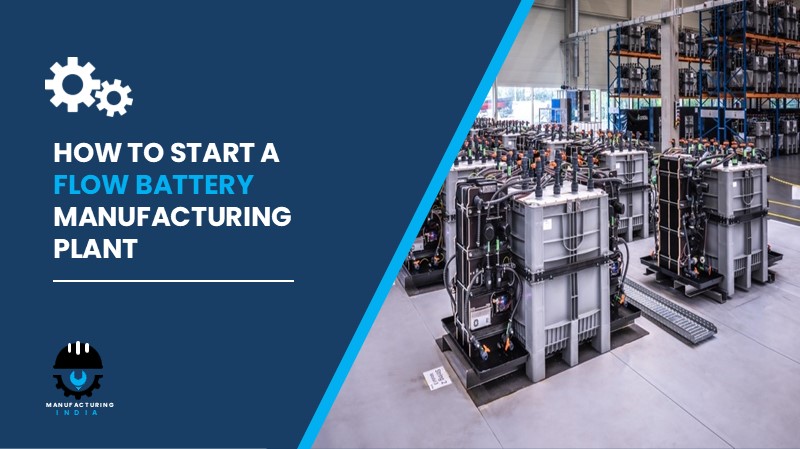
A flow battery is an energy storage device that generates electricity through the electrochemical reactions of two liquid electrolytes separated by a membrane. Unlike traditional batteries, which store energy in solid electrodes, flow batteries store energy in liquid form and use electrolytes that are pumped through the system. This design allows for larger energy capacity and the ability to scale storage as needed – a fundamental advantage over conventional battery technologies for grid-scale and long-duration applications.
Flow batteries are known for their long cycle life, rechargeability, scalability, and safety. They use non-toxic, abundant materials and are less harmful to the environment compared to traditional lead-acid or lithium-ion batteries. Key types include vanadium redox flow batteries and all-vanadium flow batteries, which are among the most commercially deployed configurations globally. Flow batteries are suitable for grid energy storage, renewable integration, EV charging stations, backup power systems, and microgrids – a broad and diversified application base that ensures multiple revenue channels for domestic producers.
The primary production method is electrolyte production, electrode manufacturing, membrane production, cell assembly, system integration, and packaging – a multi-stage, precision-controlled manufacturing process. End-use industries served include energy and utilities, transportation, telecommunications, industrial applications, and residential and commercial customers.
Cost of Setting Up a Flow Battery Manufacturing Plant in India
The cost of establishing this facility depends on capacity, technology selection, plant location, degree of automation, and regulatory compliance requirements.
1. Capital Expenditure (CapEx)
Total capital investment for a flow battery manufacturing plant in India covers land acquisition, site preparation, civil construction, process machinery, and pre-operative expenses. The cost of land and site development – including charges for land registration, boundary development, and other related expenses – forms a substantial part of the overall investment. This allocation ensures a solid foundation for safe and efficient plant operations. Investors can reduce land acquisition costs by locating the unit in an industrial estate, electronics manufacturing cluster, Special Economic Zone (SEZ), or an energy technology park, which also provide shared utility infrastructure and potential state-level fiscal incentives aligned with India’s clean energy manufacturing push.
Civil works and construction encompass the main electrolyte production and cell assembly building, raw material storage areas for vanadium electrolyte, membranes, stack components, and tanks, a quality control laboratory, a finished goods warehouse, and an administrative block. Given that the facility handles specialised electrochemical materials and corrosive vanadium electrolyte, civil and structural infrastructure must incorporate chemical-resistant flooring, appropriate ventilation, and secondary containment for electrolyte storage.
Machinery costs account for the largest portion of total capital expenditure. Key machinery required includes:
- Electrolyte mixing equipment
- Flow cell assemblers
- Pumps and piping systems
- Battery management systems
Other capital costs include the effluent treatment plant (ETP), advanced process monitoring and leak detection systems, pre-operative expenses, trial production costs, and commissioning charges. Where specialised flow cell assembly or battery management system equipment is imported, applicable customs duties must be incorporated into the CapEx plan.
Request a Sample Report for In-Depth Market Insights: https://www.imarcgroup.com/flow-battery-manufacturing-plant-project-report/requestsample
2. Operational Expenditure (OpEx)
The operating cost structure of a flow battery manufacturing plant is primarily driven by raw material consumption, particularly vanadium electrolyte, which accounts for approximately 60–70% of total operating expenses (OpEx). Membranes, stack components, and tanks are the secondary raw material inputs. Securing long-term supply agreements with reliable vanadium electrolyte producers and minimising transportation costs through proximity to raw material supply chains are the most critical cost management measures for protecting operating margins. Other raw material inputs include bauxite, graphite, and specialised polymers for components such as bipolar plates and membranes.
Utility costs – comprising electricity for electrolyte mixing equipment, pumps, cell assembly systems, and process monitoring, as well as water – account for 10–15% of total OpEx. Other ongoing operating costs include transportation, packaging, salaries and wages, depreciation, taxes, equipment repairs and maintenance, quality control, and other miscellaneous expenses.
By the fifth year of operations, the total operational cost is expected to increase substantially due to factors such as inflation, market fluctuations, and potential rises in the cost of key materials. Additional factors including supply chain disruptions, rising consumer demand, and shifts in the global economy are expected to contribute to this increase.
3. Plant Capacity
The proposed manufacturing facility is designed with an annual production capacity ranging between 100 MWh and 1,000 MWh, enabling economies of scale while maintaining operational flexibility. Capacity can be customised per investor requirements based on target energy utility, industrial, or telecommunications markets, available capital, and chosen flow battery chemistry. Profitability improves materially with higher capacity utilisation, making off-take agreements with renewable energy developers, grid operators, EV charging network operators, and industrial power consumers a commercial priority from the commissioning stage.
4. Profit Margins and Financial Projections
The project demonstrates healthy profitability potential under normal operating conditions. Gross profit margins typically range between 35–45%, supported by stable demand and value-added applications. Net profit margins range between 15–25%. A comprehensive financial model covering NPV (net present value), IRR (internal rate of return), payback period, liquidity analysis, uncertainty analysis, sensitivity analysis, and a full five-year profit and loss account provides investors with a rigorous analytical framework for assessing financial viability and long-term sustainability across different capacity and pricing scenarios. Break-even in a flow battery manufacturing business typically ranges from 5 to 8 years, depending on scale, regulatory compliance costs, raw material pricing, and market demand.
Why Set Up a Flow Battery Plant in India?
India’s 500 GW Renewable Energy Target Driving Storage Demand. According to the Ministry of New and Renewable Energy (MNRE), India is achieving rapid progress in renewable energy development and is targeting 500 GW of non-fossil fuel capacity by 2030. As the government pursues this ambitious goal, technologies like flow batteries are crucial for grid stabilisation, integration of solar and wind renewables, and peak shaving – creating a large, policy-backed, and government-priority demand channel for domestic flow battery producers.
Exceptional Global Market Growth at 22.8% CAGR. The flow battery market was valued at USD 603.56 million in 2025 and is projected to reach USD 3,832.72 million by 2034, growing at a CAGR of 22.8% from 2026 to 2034 according to IMARC Group estimates. This growth rate is among the highest in the broader energy storage technology landscape, reflecting the accelerating global and domestic transition away from fossil fuels and toward scalable, long-duration electrochemical storage solutions.
Sustainability and Environmental Advantage Over Conventional Batteries. Flow batteries use non-toxic, abundant materials like vanadium and are less harmful to the environment compared to traditional lead-acid or lithium-ion batteries. As India’s environmental regulations tighten and as corporations and utilities commit to ESG targets and sustainable procurement, the environmental profile of flow batteries – combined with their long cycle life and rechargeability – is becoming an increasingly compelling differentiator in institutional procurement decisions.
Growing EV Charging Infrastructure Demand. Flow batteries are being integrated into EV charging stations, offering a solution for storing energy generated from renewable sources for efficient and fast EV charging. India’s rapidly expanding EV charging network – supported by government incentives and OEM investment – is creating a growing captive application for scalable, safe energy storage that flow batteries are well-positioned to serve at both standalone charging stations and grid-connected depot charging facilities.
Telecommunications and Industrial Backup Power. Flow batteries are used as backup power systems in the telecommunications sector, ensuring that communication services remain operational during power outages. India’s extensive and still-expanding telecommunications tower network – one of the world’s largest – and the country’s growing data centre and industrial manufacturing base collectively represent a large, recurring institutional demand channel for reliable, long-life backup power storage systems.
Active Global Investment Confirming Market Momentum. In February 2026, Uniper signed a conditional supply contract of 5 GWh with CMBlu Energy for its organic flow batteries, targeting large-scale deployment of sustainable storage solutions as an alternative to conventional lithium-ion batteries. In September 2025, BESSt developed a redox flow battery employing zinc-polyiodide materials offering an energy density of 320 Wh/L – a cost-effective and eco-friendly energy storage solution that demonstrates the rapid pace of technology innovation within the global flow battery sector, validating long-term commercial confidence in this energy storage category.
Manufacturing Process – Step by Step
The flow battery manufacturing process uses electrolyte production, electrode manufacturing, membrane production, cell assembly, system integration, and packaging as the primary production method. Each stage is precision-controlled to ensure electrochemical performance, cycle life compliance, and system-level reliability standards required by grid-scale energy utility, EV charging, and industrial backup power customers.
- Raw Material Receipt and Inspection: Vanadium electrolyte, membranes, stack components, tanks, graphite, bauxite, and specialised polymers are received at the facility and subjected to incoming quality checks for specification compliance, purity, and dimensional accuracy before entering the production line.
- Electrolyte Production: Vanadium electrolyte chemicals are formulated to the required concentration and oxidation state specifications using electrolyte mixing equipment. Purity, viscosity, and electrochemical performance parameters are monitored and verified before the electrolyte is approved for use in cell assembly.
- Electrode and Membrane Manufacturing: Electrode materials are coated and assembled, and ion-exchange membranes are prepared and quality-checked for ion permeability, chemical stability, and dimensional integrity – both components being critical to the electrochemical efficiency and cycle life of the finished flow battery cell.
- Cell Stack Assembly: Individual flow battery cells are built with precision sealing using flow cell assemblers. Cell stacks are assembled by layering electrodes, membranes, and bipolar plates in the correct sequence and orientation, with uniform compression and leak-free sealing verified at each assembly stage.
- Electrolyte Tank Fabrication and Testing: Electrolyte tanks are fabricated from chemical-resistant materials, assembled using pumps and piping systems, and subjected to leak testing and integrity verification before integration into the complete flow battery system.
- System Integration: Pumps, sensors, piping, and battery management systems are integrated into the complete flow battery system. The battery management system (BMS) is configured and tested to ensure safe and efficient operation across all charge-discharge cycles and operating conditions.
- Performance Testing and Quality Inspection: Integrated flow battery systems are filled with vanadium electrolyte and subjected to full performance testing – including capacity verification, round-trip efficiency measurement, and cycle life validation – before release for dispatch.
- Packaging and Dispatch: Approved flow battery systems are packaged for distribution and dispatched to end-use customers across energy and utilities, transportation and EV charging, telecommunications, industrial applications, and residential and commercial energy storage sectors.
Key Applications
The flow battery manufacturing plant serves a diverse and strategically critical range of end-use sectors across India’s energy and industrial economy.
- Energy and Utilities: Flow batteries are used to store energy from renewable sources like solar and wind, enabling utilities to smooth out the intermittency of renewable generation and provide grid stabilisation, peak shaving, and frequency regulation services at the utility scale.
- Transportation and EV Charging: Integrated into EV charging stations to store renewable energy for efficient and fast charging, flow batteries support India’s expanding EV charging infrastructure with safe, long-cycle storage solutions that minimise grid impact during peak demand periods.
- Telecommunications: Used as backup power systems in the telecommunications sector to ensure communication services remain operational during power outages – a large and recurring demand channel within India’s extensive mobile and broadband tower network.
- Industrial and Commercial Applications: Flow batteries provide off-grid power solutions for industries with high energy demands, including energy storage and backup for manufacturing plants, data centres, and other industrial operations requiring continuous and reliable power supply.
- Grid-Scale Energy Storage: Deployed in large-scale grid storage projects for renewable integration, frequency regulation, and peak demand management – the primary application driving the fastest-growing segment of global flow battery demand.
- Microgrids and Backup Power Systems: Applied in microgrids for remote locations, critical infrastructure, and community energy independence applications, where scalability, safety, and long cycle life make flow batteries the preferred storage technology over conventional alternatives.
Leading Manufacturers
The global flow battery industry is served by several established manufacturers with extensive production capacities and diverse application portfolios. Key players operating in this market include:
- CellCube Energy Storage GmbH
- Elestor
- ESS Tech, Inc.
- Invinity Energy Systems
- Jena Flow Batteries GmbH
- Largo Inc.
- Primus Power
All of these manufacturers serve end-use sectors including energy and utilities, transportation, telecommunications, industrial applications, and residential and commercial customers – the same segments that a domestic Indian flow battery manufacturing plant can target as local demand accelerates under India’s renewable energy and energy storage policy framework.
Timeline to Start the Plant
Investors should plan for a structured pre-production and commissioning phase covering the following key stages:
- Feasibility study and project report preparation
- Land acquisition and site development
- Regulatory approvals and environmental clearances
- Factory licence and fire safety compliance
- Machinery procurement and installation
- Raw material supplier agreements and supply chain setup
- Trial production and quality testing
- Commercial production launch
The timeline to start a flow battery manufacturing plant typically ranges from 18 to 48 months, depending on factors such as site development, machinery installation, environmental clearances, safety measures, and trial runs.
Licences and Regulatory Requirements
Starting a flow battery manufacturing unit in India requires several approvals:
- Business registration (Proprietorship, LLP, or Private Limited Company)
- Factory Licence under the Factories Act
- Environmental Clearance from the State Pollution Control Board
- GST Registration
- Fire Safety NOC
- Hazardous chemical compliance for storage and handling of vanadium electrolyte and specialised polymer materials
- Effluent Treatment Plant (ETP) operational clearance
- Occupational Health and Safety compliance
Key Challenges to Consider
High Capital Requirements. Establishing a fully equipped flow battery manufacturing plant – with electrolyte mixing equipment, flow cell assemblers, pump and piping systems, battery management systems, and an ETP – at the 100–1,000 MWh annual capacity range requires significant upfront capital investment. Access to clean energy manufacturing incentives, MSME credit-linked subsidy schemes, and state government investment promotion grants can help bridge funding requirements for promoters entering this emerging technology manufacturing segment.
Raw Material Price Volatility. Vanadium electrolyte – accounting for 60–70% of total OpEx – is subject to price fluctuations linked to global vanadium mining output, Chinese supply dynamics, and specialty chemical production cycles. Long-term procurement contracts with reliable vanadium electrolyte suppliers and a diversified sourcing strategy are the primary risk mitigation measures for managing this dominant cost driver.
Regulatory Compliance. Flow battery manufacturing facilities handle vanadium electrolyte, which is a corrosive and environmentally regulated substance requiring compliance with India’s Hazardous Chemicals Rules for storage and handling. Advanced monitoring systems must be installed to detect leaks or process deviations, and effluent treatment systems must comply with applicable emission and discharge standards. Dedicated environmental, health, and safety management resources are a non-negotiable operational requirement.
Technological Advancement Pressure. The global flow battery sector is seeing rapid technology innovation – as demonstrated by BESSt’s September 2025 zinc-polyiodide redox flow battery achieving 320 Wh/L energy density. Domestic producers must invest in R&D and process improvement to remain competitive as global technology benchmarks for energy density, round-trip efficiency, and system cost continue to advance.
Competition from Global Players. Established international manufacturers – including Invinity Energy Systems, ESS Tech Inc., Largo Inc., Primus Power, CellCube Energy Storage GmbH, Elestor, and Jena Flow Batteries GmbH – set high benchmarks for system performance, reliability, and commercial track record. Indian manufacturers must compete through local supply reliability, cost competitiveness versus imports, India-specific system sizing, and preferential positioning in government-backed energy storage tenders.
Skilled Manpower. Operating electrolyte mixing equipment, flow cell assemblers, battery management system integration lines, and performance testing rigs requires trained electrochemical engineers, process operators, and quality assurance personnel. Recruiting, training, and retaining qualified technical staff in this specialised and rapidly evolving field is a recurring operational challenge in India’s emerging energy storage manufacturing ecosystem.
Frequently Asked Questions
1. How much does it cost to set up a flow battery manufacturing plant in India?
Total setup cost depends on plant capacity, location, technology selection, and automation level. Key cost components include land and site development, civil construction, machinery (electrolyte mixing equipment, flow cell assemblers, pumps and piping systems, battery management systems), and pre-operative expenses. A detailed feasibility study is recommended to generate accurate project-specific cost estimates.
2. Is flow battery manufacturing profitable in India in 2026?
Yes. The project delivers strong financial performance, with gross margins of 35–45% and net profit margins of 15–25% under normal operating conditions. The global flow battery market is projected to grow from USD 603.56 million in 2025 to USD 3,832.72 million by 2034 at a CAGR of 22.8% according to IMARC Group, and India’s 500 GW renewable energy target and rapidly expanding energy storage policy framework position domestic producers at the centre of this global growth story.
3. What machinery is required for a flow battery plant in India?
Essential equipment includes electrolyte mixing equipment, flow cell assemblers, pumps and piping systems, and battery management systems.
4. What licences and approvals are required to start a flow battery plant in India?
Required approvals include business registration, Factory Licence, Environmental Clearance from the State Pollution Control Board, GST Registration, Fire Safety NOC, hazardous chemical compliance for vanadium electrolyte handling, ETP operational clearance, and Occupational Health and Safety compliance.
5. What raw materials are needed for flow battery manufacturing?
Primary raw materials are vanadium electrolyte, membranes, stack components, and tanks. Additional materials include vanadium, bauxite, graphite, and specialised polymers for components such as bipolar plates and membranes. Vanadium electrolyte is the dominant cost driver, accounting for 60–70% of total operating expenses.
6. What are the environmental compliance requirements for a flow battery plant in India?
The facility must obtain Environmental Clearance from the State Pollution Control Board, operate an approved ETP, and comply with the Hazardous Chemicals Rules for vanadium electrolyte storage and handling. Advanced monitoring systems must be installed to detect leaks or deviations in the process, and regular effluent monitoring and safety audit documentation are mandatory throughout operations.
7. What is the best location to set up a flow battery plant in India?
Locations offering access to vanadium electrolyte and specialised polymer raw material supply chains, reliable industrial-grade utilities, and proximity to renewable energy development corridors, telecommunications infrastructure, and industrial manufacturing clusters are preferred. States such as Rajasthan, Gujarat, and Tamil Nadu – with large solar and wind energy pipelines and established industrial infrastructure – are strong candidates for plant location.
8. What is the break-even period for this type of plant in India?
Break-even in a flow battery manufacturing business typically ranges from 5 to 8 years, depending on scale, regulatory compliance costs, raw material pricing, and market demand. Efficient manufacturing and export opportunities can help accelerate returns.
9. What government incentives are available for manufacturers in India?
Flow battery manufacturers in India can access incentives under India’s National Energy Storage Mission, Production Linked Incentive (PLI) schemes for advanced chemistry cell (ACC) battery storage, MNRE energy storage deployment programmes, MSME credit-linked capital subsidy schemes, and state government investment promotion subsidies. Export promotion incentives and SEZ benefits are also available for producers targeting export supply to global renewable energy markets.
Key Takeaways for Investors
A flow battery manufacturing plant in India offers a high-growth and policy-aligned investment opportunity anchored by the country’s ambitious 500 GW renewable energy target by 2030, the rapid expansion of EV charging infrastructure and telecommunications backup power networks, and growing industrial demand for off-grid and microgrid energy storage solutions. The project is financially viable across the 100–1,000 MWh annual capacity range, with gross margins of 35–45% and net margins of 15–25% providing a strong return framework for investors at multiple capital scales. According to IMARC Group estimates, the global flow battery market is set to grow from USD 603.56 million in 2025 to USD 3,832.72 million by 2034 at a CAGR of 22.8% – one of the highest growth rates across all energy technology sectors – confirming that the global commercial and policy momentum behind long-duration, scalable electrochemical storage is both structural and durable. With India’s MNRE actively driving renewable energy integration and energy storage adoption, and with global industry players committing to gigawatt-hour scale flow battery supply contracts as recently as February 2026, the long-term demand outlook for domestically produced flow batteries is among the most compelling in India’s entire manufacturing investment landscape.
About the Author