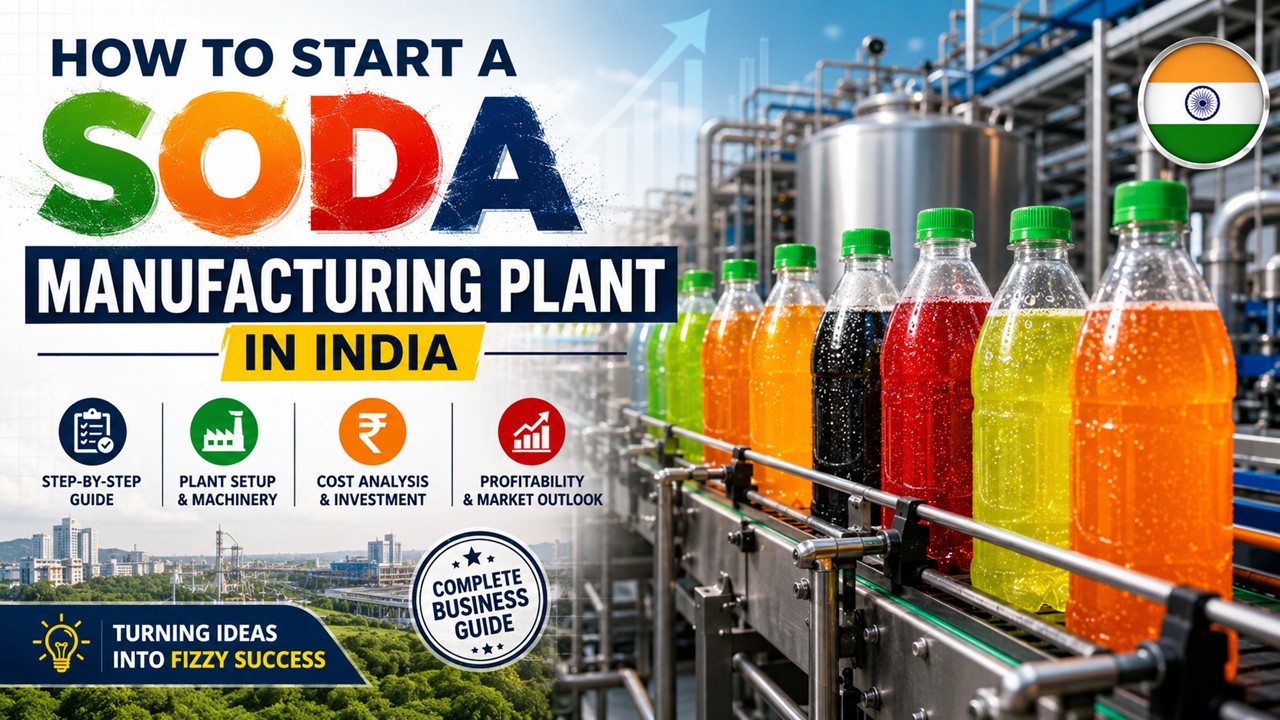
Soda Manufacturing Plant Setup in India
Setting up a soda manufacturing plant in India presents a compelling investment case, driven by the product’s nature as a high-volume everyday consumer product serving daily refreshment needs across both urban and rural markets. The market is further propelled by rapid urbanization, a growing young population, and the expansion of quick-service restaurants and organized retail, all of which make carbonated soft drinks a mass-market FMCG product with steady, repeat demand. Additionally, rising environmental concerns are pushing major brands toward sustainable packaging solutions, adding another dynamic layer to the industry’s evolution.
India’s advantages significantly boost the viability of a soda manufacturing plant. The government’s support for food processing industries and incentives for domestic manufacturing under the Make in India initiative encourage beverage production and supply chain development. Furthermore, as soda beverages are bulky and sensitive to transportation costs, setting up regional bottling units close to consumption centers in key manufacturing states like Gujarat and Maharashtra allows producers to benefit from faster distribution and lower logistics costs. This localized approach is strategically sound, allowing investors to adapt flavors to regional preferences and capitalize on the growing Indian market.
India’s soda manufacturing sector is supported by strong policy tailwinds like Make in India and offers a cost-competitive production advantage. With projected gross margins of 35-45% and growing demand from retail, hospitality, and food service sectors, a well-planned plant can achieve a viable break-even point, making it a resilient investment in the FMCG space.
What is Soda?
Soda, also known as pop or soft drink, is a non-alcoholic beverage containing carbonated water, a sweetener, and flavoring. It is characterized by its fizzy, bubbly nature, which is achieved by dissolving carbon dioxide gas in the liquid. Sweeteners used typically include sugar, high-fructose corn syrup, or artificial sweeteners, while phosphoric acid or citric acid provides a tangy flavor profile. Popular examples of soda include global brands like Coca-Cola, Pepsi, and Sprite.
The primary production process used in a soda manufacturing plant is a multi-step operation involving ingredient mixing, carbonation, pasteurization, and automated bottling. The end-use industries for soda are diverse and include beverage production, hospitality, retail, food service, vending, and event catering. Key applications range from soft drink bottling and fountain syrup production to carbonated beverage dispensing, canned soda lines, and flavored seltzer manufacturing.
Cost of Setting Up a Soda Manufacturing Plant in India
The total cost of setting up a soda manufacturing plant in India is highly dependent on several factors, including plant capacity, choice of technology, geographic location, level of automation, and the cost of regulatory compliance. A detailed financial analysis is essential to understand the capital and operational expenditures involved.
1. Capital Expenditure (CapEx)
Capital expenditure for a soda manufacturing plant forms a substantial part of the overall investment and includes several key components.
- Land and Site Development: This is a significant cost that includes land acquisition, site preparation, registration charges, boundary development, and other related expenses. Choosing a location within an SEZ or industrial estate can offer infrastructure benefits and potential tax incentives, though it may come at a premium.
- Civil Works and Construction: These costs cover the construction of the production shed, quality control laboratory, raw material and finished goods storage warehouses, and an administrative block.
- Machinery and Equipment: Key machinery required for a soda manufacturing plant includes:
- Water treatment systems
- Mixing tanks
- Carbonation units
- Syrup storage vessels
- Bottle and can fillers
- Capping and sealing machines
- Labeling systems
- Automated packaging lines
- Other Capital Costs: This category also includes expenses for an Effluent Treatment Plant (ETP), pre-operative expenses, commissioning costs, and import duties if any machinery is sourced from outside India.
Request a Sample Report for In-Depth Market Insights: https://www.imarcgroup.com/soda-manufacturing-plant-project-report/requestsample
2. Operational Expenditure (OpEx)
The operational costs of a soda manufacturing plant are ongoing and must be carefully managed to ensure profitability.
- Raw Material Cost: This is the largest component of OpEx, accounting for approximately 60-70% of total operating expenses. The key raw materials required include carbonated water, sugar/high-fructose corn syrup (HFCS), flavors, carbon dioxide (CO₂), and acidulants. Securing long-term contracts with reliable suppliers is a key strategy to mitigate price volatility and ensure consistent production quality.
- Utility Cost: Utilities, including electricity, water, and steam, represent another 15-20% of operating expenses.
- Other Operating Costs: These include ongoing expenses for transportation, packaging, salaries and wages for manpower, regular plant maintenance, depreciation on assets, and various taxes.
- 5-Year Cost Increase Projection: According to the project report, operational costs are expected to increase substantially by the fifth year of operation. This increase is driven by factors such as inflation, market fluctuations, potential rises in the cost of key raw materials, supply chain disruptions, and shifts in the global economy.
3. Plant Capacity
The proposed manufacturing facility in the report is designed with an annual production capacity ranging between 50 to 200 Million liters. This scale is intended to enable economies of scale while maintaining operational flexibility. It is important to note that plant capacity can be customized based on investor requirements and market demand. Profitability generally improves with higher capacity utilisation, as fixed costs are spread over a larger output.
4. Profit Margins and Financial Projections
A soda manufacturing plant demonstrates healthy profitability potential. The financial analysis includes typical metrics such as Net Present Value (NPV), Internal Rate of Return (IRR), and payback period to assess project viability. The project’s profit margins are as follows:
- Gross Profit Margin: Typically ranges between 35-45%.
- Net Profit Margin: Typically ranges between 18-25%.
Why Set Up a Soda Plant in India?
- High-Volume Everyday Consumer Product: Carbonated soft drinks are among the most widely consumed beverages globally, serving daily refreshment needs across urban and rural markets. This positions soda as a mass-market FMCG product with steady, repeat demand across retail, restaurants, events, and vending channels.
- Megatrend Alignment: Rapid urbanization, a growing young population, expanding quick-service restaurants, food delivery platforms, and organized retail are driving continuous growth in ready-to-drink beverages. Flavored sodas, low-sugar variants, and premium craft sodas are also seeing strong consumer interest, providing opportunities for product differentiation.
- Policy and Regulatory Tailwinds: Government support for food processing industries, cold-chain logistics expansion, and incentives for domestic manufacturing under programs such as Make in India actively encourage beverage production, packaging innovation, and supply chain development within the country.
- Cost-Competitive Manufacturing: Soda beverages are bulky and sensitive to transportation costs. This encourages regional bottling and manufacturing units close to consumption centers. Local producers benefit from faster distribution, fresher supply, lower logistics costs, and the ability to adapt flavors to regional consumer preferences.
- Active Industry Investment: The sector continues to see significant M&A activity. In April 2025, the Competition Commission of India (CCI) cleared Kandhari Global Beverages Pvt Ltd’s offer to buy Coca-Cola’s bottling business in north Gujarat and Diu for around ₹2,000 crore, indicating strong investor interest and consolidation in the Indian market.
Manufacturing Process — Step by Step
The soda manufacturing process uses ingredient mixing, carbonation, pasteurization, and automated bottling as the primary production method. The key steps involved in the process flow are:
- Water Treatment: Raw water is treated and purified to meet the high quality standards required for beverage production, using water treatment systems.
- Ingredient Mixing & Syrup Preparation: Sweeteners (sugar/HFCS), flavors, and acidulants are precisely mixed in mixing tanks to create a concentrated syrup.
- Carbonation: The treated water is chilled and then saturated with carbon dioxide (CO₂) gas under pressure in carbonation units to achieve the desired fizzy, bubbly nature.
- Proportioning & Blending: The carbonated water and the prepared syrup are carefully blended in a specific ratio in syrup storage vessels to create the final soda beverage.
- Filling & Capping: The finished soda is then filled into bottles or cans using bottle and can fillers, after which the containers are immediately sealed with capping and sealing machines to preserve carbonation and hygiene.
- Labeling & Packaging: The sealed containers pass through labeling systems for branding and are then organized into packs using automated packaging lines, ready for dispatch.
Key Applications
The soda produced is utilized across a wide range of industries, serving various commercial and retail needs.
- Beverage Production: Used for carbonated soft drink preparation, carbonation systems, and syrup mixing lines.
- Processing Equipment: Integrated into filling machines, conveyors, and automated bottling/canning systems.
- Quality Control: Essential for testing of carbonation levels, flavor consistency, and product safety standards.
- Packaging and Distribution: Used for bottling, canning, labeling, and preparation for transport and retail sale.
Leading Manufacturers
The global soda industry features several multinational companies with extensive production capacities and diverse application portfolios. According to the source page, leading manufacturers in the global soda industry include:
- The Coca-Cola Company
- PepsiCo, Inc.
- Keurig Dr Pepper Inc.
- Suntory Beverage & Food Limited
- Britvic plc
Timeline to Start the Plant
The timeline to start operations at a soda manufacturing plant in India can be broken down into the following sequential phases:
- Feasibility study and project report preparation
- Land acquisition and site development
- Regulatory approvals and environmental clearances
- Factory licence and fire safety compliance
- Machinery procurement and installation
- Raw material supplier agreements and supply chain setup
- Trial production and quality testing
- Commercial production launch
Licences and Regulatory Requirements
Starting a soda manufacturing unit in India requires several approvals to ensure legal and safe operations:
- Business registration (Proprietorship, LLP, or Pvt Ltd)
- Factory Licence under the Factories Act
- Environmental Clearance from State Pollution Control Board
- GST Registration
- Fire Safety NOC
- Effluent Treatment Plant (ETP) operational clearance
- Occupational Health and Safety compliance
Key Challenges to Consider
- High Capital Requirements: Establishing a manufacturing facility requires significant upfront capital investment in land, civil works, and high-quality, corrosion-resistant machinery tailored for soda production.
- Raw Material Price Volatility: Raw materials, particularly sugar and HFCS, account for a major portion of operating costs (60-70%), making the business susceptible to price fluctuations in commodity markets.
- Regulatory Compliance: Navigating the complex regulatory landscape, including environmental clearances, factory licences, and food safety standards, requires dedicated effort and expertise.
- Competition: The market is dominated by well-established global players such as The Coca-Cola Company and PepsiCo, Inc., which present significant competition for new entrants.
- Skilled Manpower: The plant requires skilled personnel to operate sophisticated machinery, maintain quality assurance systems, and manage efficient production workflows.
Frequently Asked Questions
- How much does it cost to set up a soda manufacturing plant in India?
The total cost depends on capacity, technology, and location, with significant capital expenditure required for land, civil works, and machinery such as water treatment systems and automated bottling lines. - Is soda manufacturing profitable in India in 2026?
Yes, the project demonstrates healthy profitability potential, with gross profit margins typically ranging between 35-45% and net profit margins between 18-25%, supported by stable demand. - What machinery is required for a soda plant in India?
Essential equipment includes water treatment systems, mixing tanks, carbonation units, syrup storage vessels, bottle and can fillers, capping machines, labeling systems, and automated packaging lines. - What licences and approvals are required to start a soda plant in India?
Key approvals include a Factory Licence, Environmental Clearance from the State Pollution Control Board, GST Registration, and Fire Safety NOC, among others. - What raw materials are needed for soda manufacturing?
The primary raw materials required are carbonated water, sugar/HFCS, flavors, carbon dioxide, and acidulants. - What are the environmental compliance requirements for a soda plant in India?
Plants must install effluent treatment systems (ETP) to minimize environmental impact, ensure compliance with emission standards, and secure an operational clearance from the State Pollution Control Board. - What is the best location to set up a soda plant in India?
The best locations are those offering easy access to key raw materials and target markets. States like Gujarat and Maharashtra are preferred due to robust infrastructure, but proximity to consumption centers is key to minimizing distribution costs. - What is the break-even period for this type of plant in India?
A detailed financial analysis, including break-even points, is crucial for securing funding. The break-even period depends on factors like capital investment, operating costs, and production capacity utilisation. - What government incentives are available for manufacturers in India?
The government offers support for food processing industries and incentives for domestic manufacturing under programs such as Make in India, which encourage beverage production and supply chain development.
Key Takeaways for Investors
The opportunity to set up a soda manufacturing plant in India is underpinned by robust demand from the beverage production, hospitality, retail, and food service sectors. Financial viability is supported by healthy projected gross margins of 35-45% and net margins of 18-25% across plant capacities of 50 to 200 million liters. According to the Ministry of Food Processing, India’s non-alcoholic beverages market was valued at USD 30,846.6 Million in 2023 and is projected to reach USD 64,248.9 Million by 2033, growing at a CAGR of 7.66%. This strong growth trajectory, combined with evolving consumer interest in innovative and health-conscious products, indicates a forward-looking and resilient market for soda manufacturers in India.
About the Author