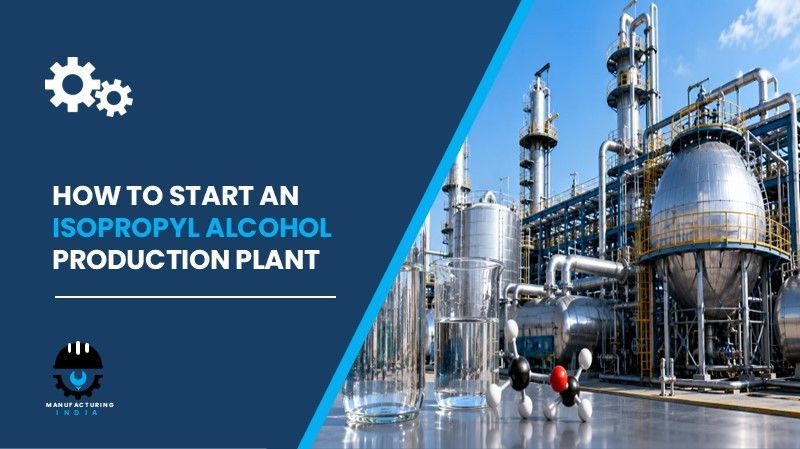
Setting up an isopropyl alcohol production plant in India presents a compelling investment case driven by accelerating demand across pharmaceuticals, electronics, personal care, paints and coatings, printing, automotive, adhesives, and industrial chemicals. Isopropyl alcohol (IPA) functions simultaneously as a solvent, disinfectant, cleaning agent, extraction agent, and chemical intermediate – properties that make it indispensable across manufacturing sectors experiencing strong growth momentum in India. As domestic pharmaceutical output scales and electronics fabrication capacity expands, the need for high-purity IPA is intensifying across the value chain.
India’s structural advantages make it a strategically sound destination for this production. The country’s expanding urbanisation, large-scale infrastructure investments, and the Make in India initiative collectively support chemical manufacturing at competitive cost structures. States such as Gujarat and Maharashtra, with established petrochemical clusters, access to propylene feedstock, and robust logistics networks, are natural candidates for locating a large-scale IPA facility. As Asia holds a dominant market share exceeding 40% in the global IPA market, Indian producers are well-positioned to supply both domestic demand and regional export markets.
Establishing an isopropyl alcohol production plant in India combines policy-backed cost competitiveness with a structurally growing demand base spanning pharmaceuticals, semiconductors, and personal care. With gross margins ranging from 15-25% and a break-even horizon of three to five years, the investment case across plant capacities remains financially viable and strategically sound.
What is Isopropyl Alcohol?
Isopropyl alcohol (IPA), also referred to as isopropanol or 2-propanol, is a clear, volatile, flammable organic chemical widely used as an industrial solvent and disinfectant. It carries a sharp smell, boils above 82.5°C, and is highly miscible with water, ethanol, ether, and most other organic solvents. Key characteristics include high solvency for oils, greases, and resins; a fast evaporation rate; antimicrobial and antiseptic properties; excellent cleaning and degreasing ability; relatively low toxicity compared to alternative solvents; and the availability of high-purity grades suited for electronics and pharmaceuticals.
IPA is produced through two established routes: direct or indirect hydration of propylene derived from the petroleum refining process, or acetone hydrogenation, depending on the raw materials available to the manufacturer. The primary production method is the propylene hydration process, available in both direct and indirect configurations. End-use industries served include pharmaceuticals, personal care, electronics, chemicals, paints and coatings, automotive, printing, and adhesives – a broad industrial base that provides demand resilience across economic cycles.
Cost of Setting Up an Isopropyl Alcohol Production Plant in India
The total cost of establishing an isopropyl alcohol production plant in India depends on multiple variables including plant capacity, technology selection, location, degree of automation, and regulatory compliance requirements. A detailed feasibility study is essential to arrive at project-specific cost estimates.
1. Capital Expenditure (CapEx)
Machinery costs account for the largest portion of total capital expenditure in an IPA production plant. Land acquisition and site development – including charges for land registration, boundary development, and related expenditure – form a substantial portion of total CapEx and provide the operational foundation for safe plant functioning. For investors seeking cost advantages, locating the facility within a Special Economic Zone (SEZ) or a notified industrial estate in petrochemical-rich states can significantly reduce land and utility costs.
Civil works cover construction of the main production shed, quality control laboratory, raw material storage structures, finished goods warehousing, administrative block, and safety infrastructure. Beyond civil works, other capital costs include the effluent treatment plant (ETP), pre-operative expenses, commissioning charges, and import duties where applicable on specialised process equipment.
Key machinery required for an isopropyl alcohol production plant includes:
- Reactors for propylene hydration (direct and indirect configurations)
- Distillation columns for separation and purification
- Catalyst beds and catalyst handling systems
- Filtration systems
- Storage tanks for feedstock, intermediates, and finished IPA
- Cooling systems
- Safety systems (fire suppression, vapour control, grounding infrastructure)
- Molecular sieve or rectification units for high-purity grades
- Automated packaging and filling stations
- Boilers, cooling towers, and compressed air systems (utility block)
Request a Sample Report for In-Depth Market Insights: https://www.imarcgroup.com/isopropyl-alcohol-manufacturing-plant-project-report/requestsample
2. Operational Expenditure (OpEx)
Raw material cost dominates the operating cost structure of an IPA plant, accounting for 65-75% of total OpEx, making raw material price fluctuations the single most significant cost factor in the business. Primary raw materials include propylene (a petroleum by-product), acetone, water, and sulfuric acid (used as a catalyst in indirect hydration), along with supported catalysts for direct hydration and high-purity water. Investors should establish long-term supplier contracts to hedge against propylene price volatility, which is directly linked to crude oil market movements.
Utility costs – covering electricity for machinery operation, water for cooling and processing, steam for heating, and compressed air systems – account for 10-15% of total OpEx. Additional operating costs include transportation (road tankers, rail tankers, or sea containers depending on destination), packaging materials (200-litre steel or plastic drums, HDPE containers, intermediate bulk containers, or ISO tankers for large-scale transport), salaries and wages across production, maintenance, quality control, administration and management functions, along with maintenance charges, depreciation, and applicable taxes. By the fifth year of operations, total operational cost is expected to increase substantially due to inflation, market fluctuations, potential raw material price rises, supply chain disruptions, and shifts in global economic conditions.
3. Plant Capacity
A large-scale isopropyl alcohol plant typically operates at a capacity of 50,000-100,000 Tonnes Per Annum (TPA). Capacity can be customised based on investor requirements – smaller capacities suit entry-level investments while larger configurations optimise unit economics. As with most process chemical plants, profitability improves meaningfully with higher capacity utilisation, as fixed costs are spread over a greater production volume.
4. Profit Margins and Financial Projections
A comprehensive financial analysis for an IPA production plant covers liquidity assessment, profitability ratios, payback period calculation, net present value (NPV) determination, internal rate of return (IRR) analysis, uncertainty and sensitivity analysis, and overall economic feasibility. Based on IMARC Group’s project economics framework, a typical isopropyl alcohol plant achieves a gross margin of 15-25% and a net margin of 8-15%. Break-even in this type of plant typically ranges from three to five years, with high product demand capable of shortening the recovery period. Profitability further improves with capacity expansion and operational scale.
Why Set Up an Isopropyl Alcohol Plant in India?
Pharmaceutical Sector Demand: The pharmaceutical industry remains the largest consumer of IPA owing to its use in disinfectants, sanitizers, topical formulations, and solvent applications. India is a leading global generic drug manufacturer, and rising domestic healthcare spending is directly expanding the addressable market for pharmaceutical-grade IPA.
Electronics and Semiconductor Expansion: High-purity IPA is critical for wafer cleaning, LCD panel production, and precision component manufacturing. With semiconductor investments rising globally and India actively building electronics manufacturing capacity, demand for ultra-pure IPA continues to grow, opening a premium-grade production opportunity for Indian manufacturers.
Personal Care and Hygiene Growth: Rising demand across personal care products – including sanitizers, cosmetics, and topical formulations – is contributing to IPA market expansion. Post-pandemic hygiene awareness has structurally elevated baseline demand for IPA-containing consumer goods in India’s large and growing domestic market.
Policy and Regulatory Tailwinds: The Make in India initiative and government industrial policy support domestic chemical manufacturing through capital subsidies, tax exemptions, reduced utility tariffs, export benefits, and interest subsidies under various national and regional industrial schemes. These incentives meaningfully reduce the effective cost of establishing a new IPA production unit.
Cost-Competitive Manufacturing: India offers competitive land costs, lower labour costs relative to developed markets, and an established petrochemical supply chain – particularly in Gujarat – that provides ready access to propylene feedstock and industrial utilities. These structural advantages translate directly into lower CapEx and OpEx compared to greenfield investments in Western markets.
Active Industry Investment: In March 2025, ExxonMobil announced plans to begin producing 99.999% ultra-pure isopropyl alcohol at its Baton Rouge facility by 2027, targeting semiconductor industry demand – demonstrating the premium value of high-purity IPA production. In September 2025, LCY Chemical Corp. launched LCY Advanced Formulations, including electronic-grade isopropyl alcohol (EIPA) designed for semiconductor advanced packaging, offering high precision and improved yield for AI and next-generation display applications. These developments highlight the growing global premium on quality IPA production, a standard Indian manufacturers can increasingly meet.
Production Process – Step by Step
The isopropyl alcohol production process uses propylene hydration as the primary production method, available through direct and indirect routes depending on feedstock and catalyst availability.
- Propylene Preparation: Propylene feedstock is purified to remove moisture, sulfur compounds, and other contaminants to ensure efficient downstream reactions.
- Hydration (Direct or Indirect Route): In the direct method, propylene reacts with water over a catalyst; in the indirect route, it reacts with sulfuric acid to form intermediates that convert to isopropanol.
- Hydrolysis (Indirect Route Only): Isopropyl sulfate formed in the indirect route is hydrolyzed with water, yielding crude isopropanol and regenerating sulfuric acid.
- Separation and Dehydration: Crude IPA undergoes phase separation and dehydration to remove excess water and by-products before final purification.
- Fractional Distillation: Distillation columns separate IPA into various purity levels by removing light and heavy impurities.
- Purification / Rectification: Advanced rectification or molecular sieve units refine IPA to high-purity specifications required for pharmaceuticals and electronics.
- Quality Testing: The final product is tested for purity, moisture content, acidity, and volatile impurities to meet regulatory standards.
- Packaging and Filling: IPA is filled into drums, IBCs, or tankers under controlled conditions, then dispatched to end-use industries including pharmaceuticals, electronics, personal care, paints and coatings, automotive, printing, and adhesives.
Key Applications
Isopropyl alcohol serves a broad spectrum of industries, functioning across solvent, disinfectant, cleaning, extraction, and chemical intermediate roles:
- Pharmaceuticals: Used in disinfectants, sanitizers, topical formulations, and as a pharmaceutical-grade solvent.
- Electronics: Applied as a cleaning and degreasing agent for wafers, LCD panels, and precision electronic components; ultra-pure grades required for semiconductor manufacturing.
- Personal Care and Cosmetics: Used as a solvent and antiseptic carrier in cosmetics, skin care, and hygiene products.
- Chemicals: Functions as a chemical intermediate and extraction agent in downstream chemical processes.
- Paints and Coatings: Used as an industrial solvent for resin dissolution and coating formulations.
- Automotive: Applied in cleaning, degreasing, and surface preparation processes within automotive assembly.
- Printing: Used as a solvent in printing inks and as a cleaning agent for printing equipment.
- Adhesives: Functions as a solvent carrier in adhesive formulations across industrial and consumer applications.
Leading Manufacturers
The global IPA market is served by several multinational chemical companies with extensive production capacities and diversified application portfolios. Key players in the global isopropyl alcohol industry include:
- Linde Gas
- Ecolab
- Dow Chemical
- ReAgent Chemicals Ltd.
- LyondellBasell Industries
- Mistral Industrial Chemicals
- INEOS Corporation
- Royal Dutch Shell
- ExxonMobil Corporation
Timeline to Start the Plant
- Feasibility study and project report preparation
- Land acquisition and site development
- Regulatory approvals and environmental clearances
- Factory licence and fire safety compliance
- Machinery procurement and installation
- Raw material supplier agreements and supply chain setup
- Trial production and quality testing
- Commercial production launch
Licences and Regulatory Requirements
Starting an isopropyl alcohol production unit in India requires several approvals:
- Business registration (Proprietorship, LLP, or Pvt Ltd)
- Factory Licence under the Factories Act
- Environmental Clearance from State Pollution Control Board
- GST Registration
- Fire Safety NOC
- Hazardous and Chemical compliance (applicable given IPA’s classification as a flammable chemical)
- Effluent Treatment Plant (ETP) operational clearance
- Occupational Health and Safety compliance
Key Challenges to Consider
High Capital Requirements: Establishing a large-scale isopropyl alcohol production plant with a capacity of 50,000-100,000 TPA involves significant upfront investment across land, civil works, machinery, utilities, and working capital, creating a substantial financial barrier to entry for smaller investors.
Raw Material Price Volatility: Propylene, the primary feedstock for IPA production, is a petroleum derivative whose price is directly linked to crude oil markets. Since raw materials account for 65-75% of total OpEx, fluctuations in propylene prices can materially impact production costs and margins.
Regulatory Compliance: IPA is classified as a flammable liquid, requiring compliance with hazardous chemical regulations, fire safety standards, and effluent treatment requirements. Securing all environmental and factory clearances in India can extend project timelines and add compliance costs.
Technology and Innovation Pressure: The industry is evolving toward more efficient and sustainable catalysts for IPA production – as demonstrated by BASF’s launch of Ni3354E and ChromiumfreeCu0560E catalyst series at the EPCA conference – and Indian manufacturers must track and adopt process improvements to remain competitive on cost and product quality.
Competition: The global IPA market is dominated by large multinationals including Dow Chemical, ExxonMobil Corporation, INEOS Corporation, LyondellBasell Industries, and ReAgent Chemicals Ltd., all of which bring economies of scale, established supply chains, and brand equity that new Indian entrants must compete against.
Skilled Manpower: Operating hydration reactors, distillation columns, and high-purity purification systems requires trained chemical engineers and process technicians. Sourcing and retaining skilled manpower for specialised IPA production roles remains a persistent operational challenge.
Frequently Asked Questions
1. How much does it cost to set up an isopropyl alcohol production plant in India?
The total cost depends on plant capacity, technology, location, and automation level. Capital costs include land, civil works, machinery, utilities, and pre-operative expenses. A large-scale plant of 50,000-100,000 TPA involves significant investment; the IMARC project report provides detailed CapEx breakdowns.
2. Is isopropyl alcohol production profitable in India in 2026?
Yes. A typical IPA plant achieves a gross margin of 15-25% and a net margin of 8-15%, with profitability improving at higher capacity utilisation. Strong demand across pharmaceuticals, electronics, and personal care supports sustained revenue generation.
3. What machinery is required for an isopropyl alcohol plant in India?
Key equipment includes hydration reactors, distillation columns, catalyst beds, filtration systems, storage tanks, cooling systems, molecular sieve or rectification units for high-purity grades, automated filling stations, and utility systems including boilers and cooling towers.
4. What licences and approvals are required to start an isopropyl alcohol plant in India?
Required approvals include business registration, Factory Licence, Environmental Clearance from the State Pollution Control Board, GST Registration, Fire Safety NOC, hazardous chemical compliance, ETP operational clearance, and Occupational Health and Safety compliance.
5. What raw materials are needed for isopropyl alcohol production?
Primary raw materials include propylene (a petroleum by-product), acetone, water, and sulfuric acid (for indirect hydration) or supported catalysts (for direct hydration), along with high-purity water and steam as process utilities.
6. What are the environmental compliance requirements for an isopropyl alcohol plant in India?
Given IPA’s classification as a flammable and volatile chemical, plants require Environmental Clearance, an operational ETP for effluent management, off-gas treatment systems, vapour control infrastructure, spill containment measures, and periodic compliance reporting to the State Pollution Control Board.
7. What is the best location to set up an isopropyl alcohol plant in India?
States with established petrochemical infrastructure – particularly Gujarat and Maharashtra – offer proximity to propylene feedstock suppliers, developed logistics networks, industrial estate options, and port access for import/export, making them preferred locations for IPA production.
8. What is the break-even period for this type of plant in India?
Break-even for an isopropyl alcohol production plant in India typically ranges from three to five years, depending on capital investment, raw material costs, market demand, and operational efficiency. High product demand can shorten the recovery period.
9. What government incentives are available for manufacturers in India?
Governments offer incentives such as capital subsidies, tax exemptions, reduced utility tariffs, export benefits, and interest subsidies under national and regional industrial policies. The Make in India initiative and SEZ frameworks provide additional cost and regulatory advantages for chemical manufacturers.
Key Takeaways for Investors
An isopropyl alcohol production plant in India offers a well-diversified investment backed by structural demand from pharmaceuticals, electronics, personal care, paints and coatings, and industrial chemicals – sectors with long-term growth trajectories in the Indian market. The investment demonstrates financial viability across plant capacities, with gross margins of 15-25% and net margins of 8-15% providing a robust return profile relative to comparable chemical manufacturing ventures. According to IMARC Group, the global IPA market was valued at USD 4.96 billion in 2025 and is projected to reach USD 6.64 billion by 2034, growing at a CAGR of 3.30% from 2026 to 2034 – with Asia maintaining the dominant share exceeding 40%. With Asia-led demand growth, India’s cost-competitive manufacturing environment, and active global investment from companies such as ExxonMobil and LCY Chemical Corp. validating the premium value of high-purity IPA, demand sustainability for well-positioned Indian producers remains strong through the decade.
About the Author