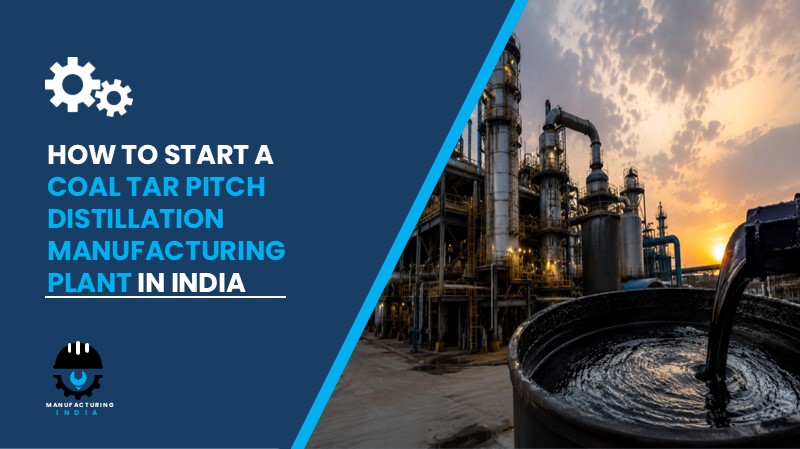
Setting up a coal tar pitch distillation manufacturing plant in India presents a compelling investment case. The aluminum, graphite, steel, cement, and chemical industries each rely on coal tar pitch as a critical binding and impregnation material for anodes, electrodes, carbon blocks, and refractory products. Rapid infrastructure development, electric vehicle adoption, and industrial expansion are driving upstream demand for high-performance carbon materials to new highs.
India’s strategic advantages make it a compelling base for pitch production. The Make in India initiative, sustained infrastructure investment, and rapid urbanisation create a robust downstream ecosystem for domestic producers. Industrial states such as Gujarat, Maharashtra, and Andhra Pradesh offer proximity to steel and aluminum clusters, port connectivity, and access to Special Economic Zones (SEZs) — reducing logistics costs and accelerating project timelines.
India’s pitch production sector benefits from strong policy tailwinds under Make in India, cost-competitive manufacturing conditions, and sustained demand from aluminum smelting, graphite electrode production, and infrastructure construction. With gross profit margins of 25–35% and annual capacity of 50,000–100,000 MT, a well-structured coal tar pitch distillation manufacturing plant in India offers credible break-even viability and strong long-term investment returns.
What is Coal Tar Pitch Distillation?
This industrial process involves the thermal processing of coal tar — a byproduct of coke oven operations — to separate it into commercially valuable fractions. The process involves heating coal tar in distillation units to extract light oils, middle oils, heavy oils, and a solid pitch residue. The final product is a black, viscous material distinguished by high carbon content, excellent binding qualities, and strong chemical resistance, making it indispensable in high-temperature industrial environments. The process also recovers valuable co-products including naphthalene, phenol, and cresols.
The coal tar pitch distillation manufacturing process uses distillation, filtration, blending, and storage as the primary production method. Product variants are tailored by adjusting softening point and purity levels. End-use industries include aluminum, graphite, steel, cement, and chemicals — sectors central to India’s industrial economy.
Cost of Setting Up a Coal Tar Pitch Distillation Manufacturing Plant in India
The total investment depends on plant capacity, technology, location, automation, and regulatory requirements. Both capital expenditure (CapEx) and operational expenditure (OpEx) must be evaluated comprehensively.
1. Capital Expenditure (CapEx)
Land and site development form a foundational cost. An SEZ or established industrial estate provides fiscal incentives and streamlined clearances. Civil works include the production shed, laboratory, storage, and administrative block — with heated containment required for coal tar storage.
Machinery and equipment represent the largest CapEx component. Key machinery required includes:
- Feedstock pre-treatment units
- Atmospheric or vacuum distillation columns
- Condensers
- Fractionation towers
- Pitch cooling and solidification systems
- Flue gas treatment scrubbers
- Drumming or pelletizing machines for final product packaging
Other capital costs include effluent treatment plant (ETP) installation, pre-operative expenses, commissioning charges, and import duties on specialised equipment where applicable.
Request a Sample Report for In-Depth Market Insights: https://www.imarcgroup.com/coal-tar-pitch-distillation-manufacturing-plant-project-report/requestsample
2. Operational Expenditure (OpEx)
Raw material cost is the dominant operating expense, accounting for approximately 80–85% of total OpEx. The primary input is crude coal tar from coke oven operations. Securing long-term supplier contracts with integrated steel producers is recommended to stabilise input costs and ensure continuity of supply. Utility costs — electricity, water, and steam — account for a further 10–15% of OpEx. Other costs cover transportation, packaging, salaries, maintenance, depreciation, and taxes. By year five, total costs are projected to rise substantially due to inflation and supply chain adjustments.
3. Plant Capacity
The proposed facility is designed for 50,000–100,000 MT/year, enabling economies of scale. Capacity can be customised per investor requirements, and profitability improves with higher utilisation rates.
4. Profit Margins and Financial Projections
The plant demonstrates healthy profitability under normal operating conditions, with gross profit margins of 25–35% and net profit margins of 10–15%. Full financial projections — including NPV, IRR, payback period, and income-expenditure statements — are in the detailed project report, along with sensitivity analysis for stress-testing the investment case.
Why Set Up a Coal Tar Pitch Distillation Plant in India?
Critical Input for Core Industries. Pitch is a vital raw material for aluminum smelting, graphite electrodes, carbon anodes, and steel carbon products — all scaling rapidly in India. Domestic production reduces import dependency and strengthens supply chain resilience.
Alignment with Global Megatrends. Growth in electric vehicles, renewable energy, and power grids drives sustained demand for anodes, electrodes, and specialty carbon materials — all relying on pitch as a primary binder.
Policy and Regulatory Tailwinds. Government spending on infrastructure, railways, and aluminum capacity expansion reinforces downstream demand. Make in India directly supports domestic pitch production and reduces import dependency.
Cost-Competitive Manufacturing. Competitive land costs, a large industrial labour pool, and an established supply chain anchored by integrated steel plants — which generate crude coal tar as a byproduct — create meaningful cost advantages.
Active Industry Investment. In January 2025, Rain Carbon Inc. announced a new two-phase coal tar pitch distillation plant in the Andhra Pradesh Special Economic Zone (APSEZ), targeting the graphite, battery, and aluminum markets. In December 2025, Himadri Speciality Chemical Ltd completed its first liquid pitch export — 3,600 tonnes to the Middle East — from New Mangalore Port, demonstrating India’s growing global relevance.
Local Supply Chain Preference. Aluminum smelters and carbon product manufacturers increasingly prefer nearby, reliable pitch suppliers for quality consistency and ESG compliance — creating structural advantages for regionally located production units.
Manufacturing Process – Step by Step
The coal tar pitch distillation manufacturing process uses distillation, filtration, blending, and storage as the primary production method. Each stage involves precise temperature control and quality monitoring.
- Feedstock Pre-Treatment: Crude coal tar is pre-treated to remove particulate matter and moisture.
- Atmospheric or Vacuum Distillation: Coal tar is heated in distillation columns to progressively separate it into light oils, middle oils, and heavy oils.
- Condensation and Fractionation: Vapour fractions are condensed and refined in fractionation towers to achieve required purity specifications.
- Pitch Cooling and Solidification: Residual pitch is processed through cooling and solidification systems to reach the required physical form.
- Flue Gas Treatment: Emissions are processed through flue gas treatment scrubbers to meet environmental discharge standards.
- Filtration and Blending: The pitch is filtered and blended to achieve consistent softening point and quinoline-insoluble content.
- Packaging and Dispatch: Final product is packed via drumming or pelletizing machines and dispatched to downstream customers.
Key Applications
The product serves a diverse set of industries with technically demanding requirements.
- Aluminum and Steel Industry: Binder and impregnation pitch for anodes, electrodes, and cathodes.
- Carbon and Graphite Products: Raw material for carbon blocks, graphite electrodes, and specialty carbon materials.
- Refractories and Foundry: Binder for refractory bricks and foundry molds requiring high-temperature stability.
- Road Construction and Waterproofing: Applied in protective coatings, corrosion-resistant layers, and waterproofing compounds for infrastructure projects.
Leading Manufacturers
Leading global producers span the aluminum, graphite, steel, cement, and chemical sectors. Key players include:
- Koch Industries
- Indian Oil Corporation (IOC)
- Reliance Industries
- ArcelorMittal
- Mitsubishi Chemical Corporation
Timeline to Start the Plant
- Feasibility study and project report preparation
- Land acquisition and site development
- Regulatory approvals and environmental clearances
- Factory licence and fire safety compliance
- Machinery procurement and installation
- Raw material supplier agreements and supply chain setup
- Trial production and quality testing
- Commercial production launch
Licences and Regulatory Requirements
Starting a coal tar pitch distillation manufacturing plant requires several central and state approvals:
- Business registration (Proprietorship, LLP, or Pvt Ltd)
- Factory Licence under the Factories Act
- Environmental Clearance from State Pollution Control Board
- GST Registration
- Fire Safety NOC
- Hazardous/chemical handling compliance
- Effluent Treatment Plant (ETP) operational clearance
- Occupational Health and Safety compliance
Key Challenges to Consider
Investing in a coal tar pitch distillation manufacturing plant carries risks that every operator must plan for. High Capital Requirements. The plant demands significant upfront investment in land, civil works, and specialised equipment, making thorough financial planning and access to project financing essential.
Raw Material Price Volatility. Crude coal tar, at 80–85% of OpEx, is tied to steel sector cycles. Long-term supplier contracts are critical to protect margins.
Regulatory Compliance. Coal tar distillation products are hazardous materials under Indian environmental regulations. Maintaining environmental clearances, ETP operational certificates, and pollution control consents requires sustained compliance investment.
Technology and Process Control. Strict control over softening point, impurity levels, and quinoline-insoluble content requires analytical instrumentation and robust quality systems.
Competition. Large producers including Indian Oil Corporation (IOC), Reliance Industries, and Rain Carbon Inc. are active in India. New entrants must differentiate on quality consistency, reliability, and pricing.
Skilled Manpower. Chemical engineers and process technicians with coal tar chemistry expertise are essential, making skilled workforce retention an ongoing challenge.
Frequently Asked Questions
1. How much does it cost to set up a coal tar pitch distillation plant in India?
Setup cost varies by capacity (50,000–100,000 MT/year), technology, and location. Full CapEx details are in the IMARC project report.
2. Is pitch manufacturing profitable in India in 2026?
Yes — gross margins of 25–35% and net margins of 10–15% are achievable under normal conditions.
3. What machinery is required for this type of plant in India?
Feedstock pre-treatment units, atmospheric or vacuum distillation columns, condensers, fractionation towers, pitch cooling and solidification systems, flue gas treatment scrubbers, and drumming or pelletizing machines.
4. What licences are required to start this plant in India?
Business registration, Factory Licence, Environmental Clearance, GST Registration, Fire Safety NOC, hazardous chemical compliance, ETP clearance, and OHS compliance.
5. What raw materials are needed for pitch manufacturing?
Crude coal tar from coke oven operations is the primary input. Specialised heated storage is also required.
6. What are the environmental requirements for this type of plant?
Environmental Clearance, ETP operation, flue gas treatment scrubbers, and hazardous material handling compliance under State Pollution Control Board guidelines.
7. What is the best location in India for this type of plant?
Andhra Pradesh (APSEZ), Odisha, Gujarat, and Maharashtra offer proximity to steel and aluminum clusters, strong raw material access, and established industrial infrastructure.
8. What is the break-even period for this type of plant?
Break-even depends on capacity and utilisation rates. Full payback period, NPV, and IRR analysis is in the detailed feasibility report.
9. What government incentives are available?
Make in India incentives, SEZ fiscal benefits, and state-level industrial promotion subsidies in Andhra Pradesh, Gujarat, Maharashtra, and Odisha.
Key Takeaways for Investors
This type of manufacturing facility in India represents a strategically sound investment underpinned by robust demand from aluminum, graphite, steel, cement, and chemical industries — all in structural growth phases. The unit demonstrates financial viability at 50,000–100,000 MT/year capacity, with gross margins of 25–35% and net margins of 10–15%. The Asia-Pacific region accounts for over 50% of global market share for this product, and recent investments by Rain Carbon Inc. and Himadri Speciality Chemical Ltd confirm India’s growing strategic role. With Make in India policy support, rising supply chain localisation demand, and a deepening domestic industrial customer base, long-term demand sustainability for a well-positioned pitch production facility in India is well-supported.
About the Author