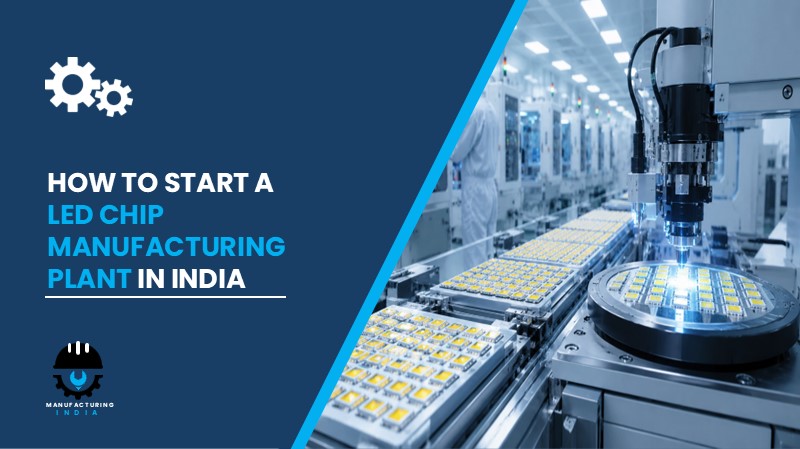
Setting up an LED chip manufacturing plant in India presents a compelling investment case driven by the country’s rapidly expanding lighting, consumer electronics, automotive, and display and signage industries. LED chips — the foundational semiconductor components that power everything from residential lighting to digital billboards — are at the heart of India’s accelerating energy transition. As urbanisation intensifies and infrastructure projects multiply across the country, demand for high-efficiency LED-based solutions continues to climb, creating a structurally strong and sustained market for domestic LED chip production.
India’s strategic advantages make it an ideal base for an LED chip manufacturing plant. The country offers cost-competitive land and labour, a growing domestic semiconductor ecosystem aligned with the Make in India initiative, and a consumer electronics market that the National Committee on Consumer Electronics & Durables projects will become the fourth-largest in the world by FY27, with revenues of approximately USD 32.65 billion (INR 3 lakh crore) by FY29, driven by rising incomes, rural demand, and consumer finance accessibility. Manufacturing hubs in states such as Gujarat, Maharashtra, Uttar Pradesh, and Tamil Nadu provide ready access to industrial estates, reliable utilities, and skilled technical labour — all critical inputs for this precision-manufacturing sector.
India’s LED chip manufacturing opportunity combines powerful policy tailwinds under Make in India, a cost-competitive production environment, and surging demand from lighting, automotive, consumer electronics, and display sectors. With gross margins of 40–50% and net profit margins of 15–20%, an LED chip plant in India offers a financially viable and long-term sustainable investment for entrepreneurs and institutional investors alike.
What is an LED Chip?
LED chips are semiconductor light-emitting devices that generate visible or infrared light through electroluminescence when an electric current passes through a p-n junction. They are typically fabricated using compound semiconductors such as gallium nitride (GaN), gallium arsenide (GaAs), or indium gallium nitride (InGaN). LED chips offer high luminous efficiency, long operational life, low heat generation, and reduced power consumption compared to conventional light sources. Their compact size enables integration into lighting systems, display panels, automotive lighting, and electronic devices. LED chips also exhibit fast switching capability, colour tunability, and high reliability under varying operating conditions.
The primary production method is a multi-stage process that includes epitaxial wafer growth, photolithography and etching, doping and metallization, and chip dicing and inspection. Each of these stages demands precision-controlled environments and specialised equipment. LED chips serve end-use industries including lighting and illumination, consumer electronics, automotive, display and signage, and industrial and commercial infrastructure.
Cost of Setting Up an LED Chip Manufacturing Plant in India
The total cost of establishing an LED chip manufacturing plant in India depends on plant capacity, technology selection, location, degree of automation, and regulatory compliance requirements. Investors should account for both capital expenditure (CapEx) and operational expenditure (OpEx) to arrive at a realistic project economics picture.
1. Capital Expenditure (CapEx)
Land and Site Development represents a significant portion of total CapEx. Investors may consider locating the facility within a Special Economic Zone (SEZ) or a government-notified industrial estate to benefit from duty exemptions and streamlined regulatory processes. Land registration, boundary development, levelling, and site preparation charges all form part of this cost head.
Civil Works and Construction covers the clean-room manufacturing shed — essential for semiconductor fabrication — along with quality control and testing laboratories, raw material and finished goods storage, utility blocks, and an administrative building. Given the sensitivity of LED chip production to contamination, clean-room infrastructure constitutes a notable proportion of civil costs.
Machinery and Equipment accounts for the largest share of total capital expenditure. Key machinery required includes:
- Metal-organic chemical vapour deposition (MOCVD) reactors
- Photolithography equipment
- Etching and deposition systems
- Wafer dicing machines
Other Capital Costs include effluent treatment plant (ETP) setup, pre-operative expenses, commissioning charges, and import duties on specialised equipment procured from overseas.
Request a Sample Report for In-Depth Market Insights: https://www.imarcgroup.com/led-chip-manufacturing-plant-project-report/requestsample
2. Operational Expenditure (OpEx)
Raw Material Cost is the dominant driver of OpEx, accounting for approximately 40–50% of total operating expenses. Key raw materials required include sapphire/GaN substrates, MO (metal-organic) sources, photoresist, process gases, and gold wires. Given the price sensitivity of these inputs — particularly sapphire/GaN substrates — investors should negotiate long-term supply contracts with reliable domestic and international vendors to stabilise procurement costs and ensure supply continuity.
Utility Cost is the second-largest OpEx component, representing 30–35% of total operating expenses. An LED chip facility is highly energy-intensive, requiring a continuous and reliable supply of electricity for MOCVD reactors and cleanroom systems, along with water and process gases. Proximity to industrial utility grids and water treatment infrastructure is therefore a key site selection criterion.
Other Operating Costs include transportation and outbound logistics, packaging, salaries and wages for technical and non-technical staff, maintenance, depreciation on machinery and civil assets, and applicable taxes. By the fifth year of operations, total operational costs are projected to increase substantially due to inflation, market fluctuations, potential rises in the cost of key materials, supply chain disruptions, and shifts in global semiconductor economics.
3. Plant Capacity
The proposed manufacturing facility is designed with a monthly production capacity ranging between 50–100 million chips, enabling economies of scale while maintaining operational flexibility. Capacity can be customised based on individual investor requirements, market positioning, and available capital. As a general principle across manufacturing sectors, profitability improves significantly with higher capacity utilisation, making ramp-up planning a critical element of the investment strategy.
4. Profit Margins and Financial Projections
The LED chip manufacturing project demonstrates healthy profitability potential under normal operating conditions. Gross profit margins typically range between 40–50%, supported by stable demand and value-added applications across multiple end-use sectors. Net profit margins average 15–20%. Financial projections for a proposed LED chip plant encompass NPV (net present value), IRR (internal rate of return), payback period analysis, liquidity analysis, and sensitivity and uncertainty analysis — all of which are detailed in IMARC Group’s comprehensive feasibility report. These projections are developed based on realistic assumptions related to capital investment, operating costs, production capacity utilisation, pricing trends, and demand outlook.
Why Set Up an LED Chip Plant in India?
Energy Efficiency and Sustainability Demand. LED chips support global energy-saving initiatives by enabling lighting solutions with significantly lower power consumption and reduced carbon emissions. Government programmes for energy conservation and increased efficiency are actively propelling the adoption of LED-based solutions across residential, commercial, and industrial segments in India, creating a durable domestic demand base for chip manufacturers.
Expanding Consumer Electronics Market. India’s appliance and consumer electronics market is projected by the National Committee on Consumer Electronics & Durables to become the fourth-largest globally by FY27, reaching revenues of approximately USD 32.65 billion (INR 3 lakh crore) by FY29, driven by rising incomes, rural demand, and consumer finance accessibility. This growth in the consumer electronics and high-resolution display industry is projected to increase the demand for LED chips used in smartphones, televisions, laptops, and wearable devices.
Policy and Regulatory Tailwinds. Government regulations promoting energy-efficient lighting and phasing out incandescent bulbs indirectly drive LED chip demand. The Make in India initiative supports domestic semiconductor and electronics manufacturing through incentives, infrastructure development, and eased investment norms, making the policy environment increasingly conducive for LED chip plant setup in India.
Cost-Competitive Manufacturing. India offers cost-competitive land, labour, and supply chain infrastructure relative to established LED chip manufacturing geographies. Proximity to a large and growing domestic market further reduces distribution costs for manufacturers serving India’s lighting and electronics sectors.
Active Industry Investment. Global investment in the LED chip segment continues to accelerate. In December 2025, TCL Technology’s subsidiary TCL CSOT acquired an 80% stake in LED chip maker Prima for CNY 490 million (approximately USD 70 million), marking its formal entry into the LED chip segment as part of a strategy to build a vertically integrated supply chain from LED chips to mini/micro LED displays. In August 2025, China’s LED and lithium battery supplier Azure invested USD 83.9 million to build a new LED chip packaging plant in Malaysia, aimed at enhancing overseas capacity and reducing trade-related risks, with a planned output of 700 million units per month. These developments signal strong global conviction in the sector’s growth trajectory.
Scalability and Long-Term Demand. LED chip manufacturing benefits from scalable production and long-term growth linked to urbanisation, smart infrastructure development, and electrification — all macro trends firmly embedded in India’s economic trajectory over the next decade.
Manufacturing Process – Step by Step
The LED chip manufacturing process uses epitaxial wafer growth, photolithography and etching, doping and metallization, and chip dicing and inspection as the primary production method. Each stage is a precision-controlled unit operation performed in cleanroom conditions.
- Epitaxial Wafer Growth: Compound semiconductor layers — using materials such as GaN, GaAs, or InGaN — are grown on the substrate (sapphire/GaN) using MOCVD reactors. MO sources and process gases are fed into the reactor chamber under tightly controlled temperature and pressure conditions to deposit thin crystalline layers.
- Photolithography: The coated wafer is exposed to UV light through a photomask using photolithography equipment to define the chip’s circuit patterns. Photoresist is applied to the wafer surface and selectively exposed to transfer the pattern.
- Etching and Deposition: Etching and deposition systems remove unwanted material and deposit additional functional layers. This stage defines the p-n junction architecture critical to LED light emission.
- Doping and Metallization: Controlled introduction of dopants modifies the electrical properties of semiconductor layers. Metallization — including the application of gold wires — establishes electrical contacts on the chip.
- Chip Dicing and Inspection: Wafer dicing machines cut the processed wafer into individual LED chips. Each chip undergoes rigorous quality assurance including technical tests for concentration, purity, luminous efficiency, and stability before being packaged and dispatched to end-use industries including lighting, automotive, consumer electronics, and display manufacturers.
Key Applications
LED chips serve a broad range of industries across India and globally, with demand concentrated in sectors requiring high efficiency, long operational life, and design flexibility.
- Lighting Industry: Used in residential, commercial, and industrial lighting fixtures due to high efficiency, long lifespan, and reduced energy consumption.
- Consumer Electronics Industry: Applied in smartphones, televisions, laptops, and wearable devices for display backlighting and indicator lighting.
- Automotive Industry: Used in headlamps, daytime running lights, brake lights, and interior lighting systems, supporting design flexibility and energy efficiency.
- Display and Signage Industry: Integrated into LED displays, digital billboards, and video walls for high brightness, colour accuracy, and durability.
- Industrial and Commercial Applications: Used in machine indicators, control panels, and industrial lighting systems requiring reliability and low maintenance.
Leading Manufacturers
The global LED chip market is served by several multinational companies with extensive production capacities and diverse application portfolios. Key players in the global LED chip industry include:
- AVA Technologies, Inc.
- Bright LED Electronics Corporation
- Wolfspeed
- Bridgelux, Inc.
- Hitachi Cable, Ltd.
- Dowa Electronics Materials Co., Ltd.
These companies serve end-use sectors including lighting and illumination, consumer electronics, automotive, display and signage, and industrial and commercial infrastructure.
Timeline to Start the Plant
Establishing an LED chip manufacturing plant in India requires careful sequencing of activities across multiple phases. A realistic project timeline covers the following stages:
- Feasibility study and project report preparation
- Land acquisition and site development
- Regulatory approvals and environmental clearances
- Factory licence and fire safety compliance
- Machinery procurement and installation
- Raw material supplier agreements and supply chain setup
- Trial production and quality testing
- Commercial production launch
Licences and Regulatory Requirements
Starting an LED chip manufacturing unit in India requires several approvals:
- Business registration (Proprietorship, LLP, or Pvt Ltd)
- Factory Licence under the Factories Act
- Environmental Clearance from State Pollution Control Board
- GST Registration
- Fire Safety NOC
- Hazardous and Chemical compliance (relevant given process gases and chemical inputs used in semiconductor fabrication)
- Effluent Treatment Plant (ETP) operational clearance
- Occupational Health and Safety compliance
Key Challenges to Consider
High Capital Requirements. Setting up an LED chip plant demands significant upfront investment in cleanroom infrastructure, specialised MOCVD reactors, photolithography equipment, and etching and deposition systems. Securing adequate project funding and phased capital deployment is essential to managing initial financial pressure.
Raw Material Price Volatility. The cost of key inputs — particularly sapphire/GaN substrates, MO sources, photoresist, process gases, and gold wires — is subject to global supply chain fluctuations and geopolitical dynamics. Long-term supplier contracts and diversified sourcing strategies are critical risk mitigation tools.
Regulatory Compliance. The LED chip manufacturing process involves hazardous chemicals, process gases, and wastewater requiring ETP treatment. Navigating India’s multi-agency regulatory framework — covering environmental clearances, factory licences, and chemical handling norms — demands expert legal and compliance support.
Technology and Innovation Pressure. Continuous improvements in chip efficiency, brightness, and miniaturisation create pressure for ongoing R&D investment and process upgradation. Investors must plan for technology refresh cycles to remain competitive and capture value-added market segments.
Competition. The global LED chip market is served by established players including Wolfspeed, Bridgelux, Inc., Hitachi Cable, Ltd., and Dowa Electronics Materials Co., Ltd. Domestic manufacturers will need to compete on quality, pricing, and supply reliability to secure offtake agreements with Indian end-users.
Skilled Manpower. LED chip fabrication requires highly skilled process engineers, cleanroom technicians, and quality assurance specialists. Building and retaining this talent base — particularly in cleanroom operations and MOCVD process management — is a key operational challenge for new entrants.
Frequently Asked Questions
1. How much does it cost to set up an LED chip manufacturing plant in India?
The total setup cost depends on plant capacity, technology choice, location, and automation level. Key cost heads include land, cleanroom civil works, MOCVD reactors, photolithography equipment, etching and deposition systems, wafer dicing machines, and pre-operative expenses. A detailed CapEx and OpEx breakdown is available in the IMARC Group feasibility report.
2. Is LED chip manufacturing profitable in India in 2026?
Yes. The facility is projected to deliver gross margins of 40–50% and net profit margins of 15–20% under normal operating conditions. Stable demand across lighting, automotive, consumer electronics, and display sectors supports revenue visibility for well-positioned plants.
3. What machinery is required for an LED chip plant in India?
Essential equipment includes metal-organic chemical vapour deposition (MOCVD) reactors, photolithography equipment, etching and deposition systems, and wafer dicing machines.
4. What licences and approvals are required to start an LED chip plant in India?
Required approvals include business registration, Factory Licence under the Factories Act, Environmental Clearance from the State Pollution Control Board, GST Registration, Fire Safety NOC, hazardous chemical compliance, ETP operational clearance, and Occupational Health and Safety compliance.
5. What raw materials are needed for LED chip manufacturing?
Key raw materials include sapphire/GaN substrates, MO (metal-organic) sources, photoresist, process gases, and gold wires.
6. What are the environmental compliance requirements for an LED chip plant in India?
An LED chip manufacturing unit must obtain Environmental Clearance from the State Pollution Control Board, operate a functional Effluent Treatment Plant, comply with hazardous chemical handling norms, and meet emission standards applicable to semiconductor fabrication facilities.
7. What is the best location to set up an LED chip plant in India?
Ideal locations offer proximity to raw material suppliers, reliable utilities (especially uninterrupted power supply), skilled technical labour, and access to transportation networks. Industrial estates and SEZs in Gujarat, Maharashtra, Tamil Nadu, and Uttar Pradesh are strong candidates, subject to site-specific analysis.
8. What is the break-even period for this type of plant in India?
The break-even period is determined by plant capacity, capacity utilisation ramp-up, pricing, and operating cost management. Financial projections including payback period, NPV, and IRR analysis are covered in the IMARC Group detailed project report.
9. What government incentives are available for manufacturers in India?
Investors may benefit from the Make in India initiative, production-linked incentive (PLI) schemes for electronics and semiconductors, SEZ benefits including duty exemptions, state-level industrial subsidies, and energy efficiency grants relevant to the LED sector.
Key Takeaways for Investors
The LED chip manufacturing plant opportunity in India is underpinned by surging demand from lighting and illumination, consumer electronics, automotive, display and signage, and industrial and commercial infrastructure sectors — all of which are growing rapidly in the Indian market. The facility is financially viable across a range of plant capacities, with gross margins of 40–50% and net profit margins of 15–20% providing a strong return profile for investors who manage CapEx and raw material costs effectively. The global LED chip market was valued at USD 34.60 billion in 2025 and is projected to reach USD 86.39 billion by 2034, exhibiting a CAGR of 10.7% from 2026 to 2034, according to IMARC Group estimates. With urbanisation, smart infrastructure development, and electrification firmly embedded in India’s long-term economic trajectory, demand for LED chips is structurally positioned to grow for decades — making this a compelling and durable investment proposition for entrepreneurs and institutional investors entering the semiconductor manufacturing space.
About the Author