India’s Manufacturing Facility Construction Is Entering Its Highest-Investment Phase in Decades
India’s industrial construction pipeline is at a scale that has no precedent in the country’s manufacturing history. In FY 2024-25, manufacturing FDI reached USD 19.04 billion, an 18% increase year-on-year, according to India Briefing’s 2025 Manufacturing Tracker. Between April 2014 and March 2025, the manufacturing sector attracted USD 184.15 billion in cumulative FDI equity inflows. The National Infrastructure Pipeline carries a total outlay of Rs. 111 lakh crore, of which a substantial share is flowing into industrial corridors, utility infrastructure, and manufacturing zones.
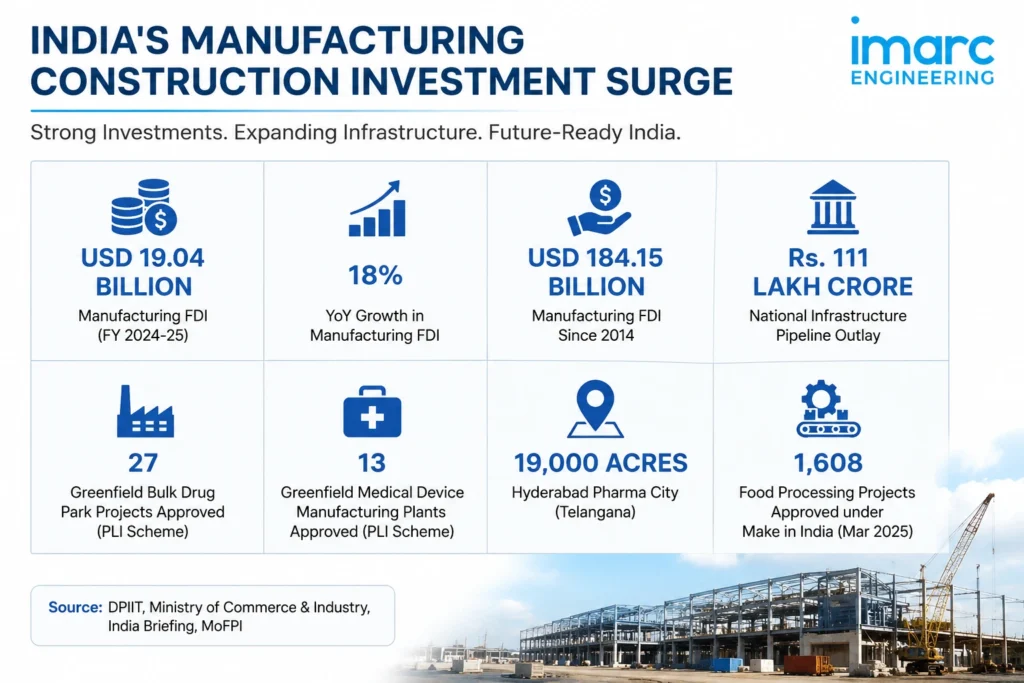
The facility construction activity this investment is generating is visible across every major sector. In pharmaceuticals, Gland Pharma has committed Rs. 400 crore to expand its Hyderabad facility, and the government approved 27 greenfield bulk drug park projects and 13 greenfield medical device manufacturing plants under the PLI scheme in March 2024. Hyderabad Pharma City, spanning 19,000 acres in Telangana, is a USD 3.57 billion project requiring the construction and commissioning of hundreds of individual units. In chemicals, FDI between April 2000 and March 2024 reached USD 22.146 billion, with new capacity investment accelerating across Dahej, Ankleshwar, and Vapi. In food processing, the Ministry of Food Processing Industries approved 1,608 projects under Make in India in March 2025 while increasing its FY 2024-25 budget by 30.19%.
Each of these projects requires a manufacturing facility to be built correctly, on time, and to regulatory standards. That is what construction management services exist to deliver.
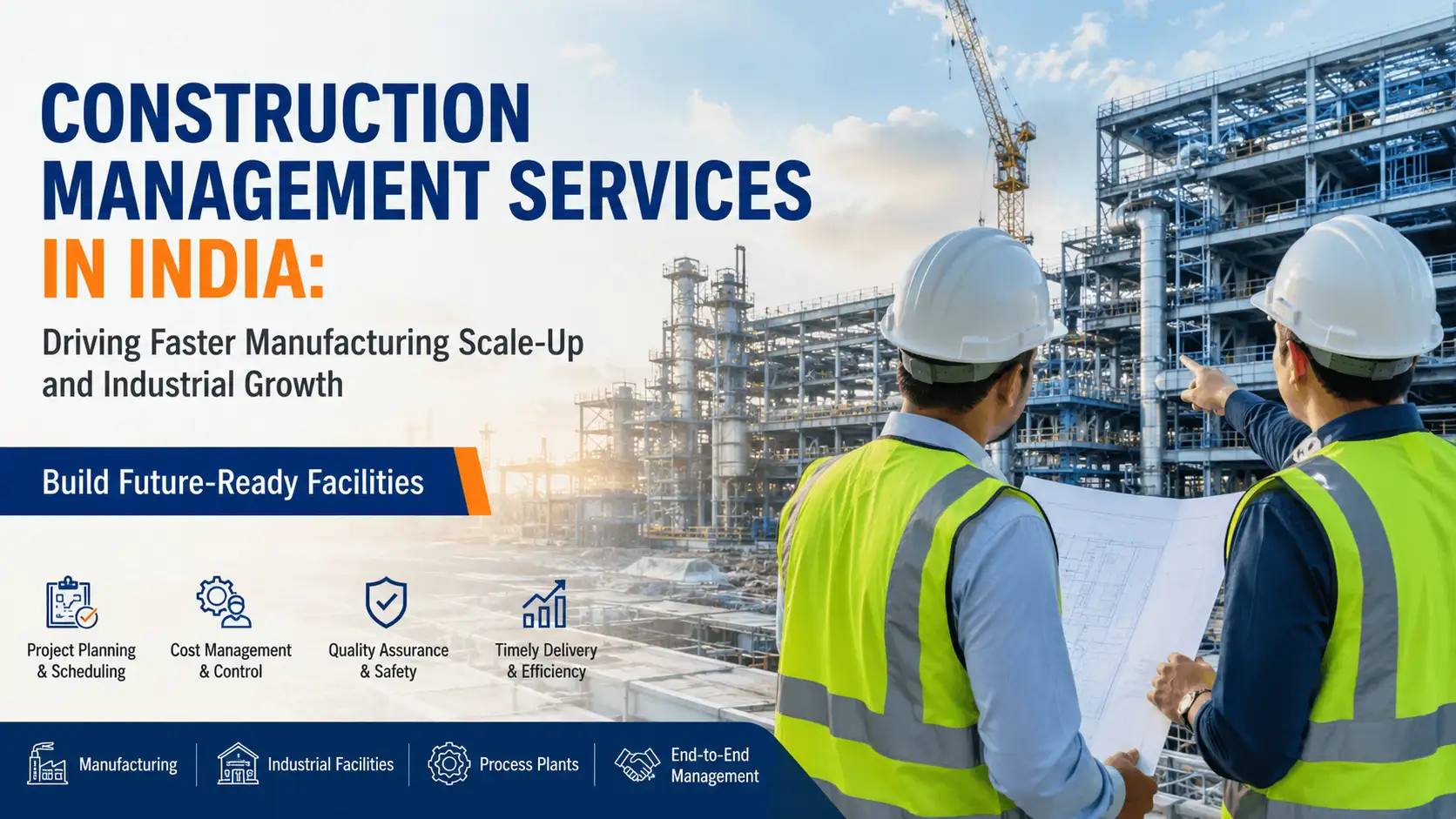
IMARC Engineering provides construction management services for manufacturing facility projects across India — acting as the owner’s independent representative across all construction phases, from pre-construction planning through commissioning. This article draws on that work to explain what professional construction management covers, where the critical risks lie, and why the quality of construction oversight determines whether manufacturing investment delivers its intended return.
Why Manufacturing Construction Projects Carry Risks That General Construction Does Not
Manufacturing facility construction in India operates under a multi-layered regulatory and technical framework that commercial construction projects do not face. The National Building Code 2016 governs structural design, but pharmaceutical, food, and chemical facilities layer additional requirements: cleanroom performance specifications, GMP-compliant surface finishes, IBR-registered pressure systems, PESO-compliant hazardous zone management, and CDSCO or FSSAI facility licensing milestones tied directly to how the building is constructed, not just how it is designed.
The BOCW Act requires welfare and safety provisions for construction workers throughout the project. Factory Act approvals must be secured before structural work and before occupancy. CPCB and state PCB consent conditions impose construction-phase environmental obligations that, if missed, create compliance gaps delaying final operating consents.
When multiple contractors work simultaneously across civil, MEP, utilities, cleanroom, and equipment packages, interface management becomes the critical risk. A clash between services and structural elements discovered during commissioning costs far more to resolve than if it had been identified earlier. An HVAC installation sequence that does not account for cleanroom validation dependencies can push a pharmaceutical facility’s production start date back by several months.
A McKinsey analysis of large capital project performance found that an average industrial construction project runs 20 months behind schedule and 80% over its original cost estimate. According to a PMI Pulse of the Profession report, fewer than 60% of industrial construction projects globally are completed on time, and fewer than 55% are delivered within budget. These outcomes reflect structural weaknesses in how manufacturing construction is managed: insufficient front-end planning, inadequate contractor supervision, poor interface coordination, and reactive variation management.
Why Demand for Professional Construction Management Is Rising Across India in 2026
India’s manufacturing construction environment has changed structurally over the last five years, creating conditions where professional construction management is no longer optional for large facility projects:
- Revised Schedule M requirements under CDSCO have made construction documentation and quality records a formal part of pharmaceutical facility licensing
- IFC Performance Standards and Equator Principles now require independent construction monitoring and ESG reporting as conditions of project finance draw-down
- Multi-package programmes involving civil, MEP, cleanroom, utilities, and process equipment contractors have increased in complexity, making independent interface management a project-critical function
- Statutory approvals across Factory Act, CPCB, IBR, PESO, and FSSAI now run concurrently, requiring dedicated tracking to prevent delays from pushing back commissioning milestones
- Owner organisations increasingly lack in-house construction expertise for infrequent large projects, while EPC contractors create conflicts of interest that only an independent owner’s representative can resolve
Why Professional Construction Management Has Become Essential for Indian Manufacturers
Manufacturers increasingly recognise that construction management cannot be absorbed within existing operations teams. It requires dedicated expertise across project controls, engineering coordination, contractor management, quality assurance, statutory approvals, and commissioning planning throughout a programme running 18 to 36 months.
Research from Deloitte on capital project performance found that projects with professional construction management frameworks achieve on-time, on-budget delivery rates approximately 35% higher than those managed informally. An owner’s representative with no ties to contractors or suppliers ensures all inspections, cost evaluations, and performance assessments are conducted solely in the owner’s interest.
Successful industrial construction management requires:
- Detailed project execution planning before contractor mobilisation
- Multi-contractor coordination with interface management across civil, MEP, utilities, and process packages
- Construction quality assurance aligned to IS codes, BIS standards, GMP, and sector-specific regulatory requirements
- Variation management capturing all changes at source with claims evaluated before approval
- Commissioning planning integrated with construction phasing from the earliest stages
Construction Management Across Key Manufacturing Sectors in India
Pharmaceuticals and Nutraceuticals
The pharmaceutical construction pipeline across Baddi, Ahmedabad, and Aurangabad demands programme management integrating cleanroom HVAC commissioning dependencies, IBR autoclave inspection scheduling, and CDSCO licensing milestones. A single construction non-conformance during a regulatory inspection can delay facility qualification by 6 to 18 months. Schedule M surveillance, IQ documentation management, and lender-aligned monthly reporting are all essential to the construction management scope in this sector.
Food Processing and Dairy
The 1,608 projects approved under Make in India reflect an accelerating construction cycle across Punjab, Maharashtra, and Karnataka. FSSAI hygienic design programme management embedded in civil supervision, cold chain interface management, and Factory Act and fire NOC coordination are requirements that general construction managers are not positioned to handle.
Chemicals and Specialty Chemicals
Chemical plant construction across Dahej, Ankleshwar, and Vapi involves IBR pressure vessel and steam system inspection sequencing, PESO-compliant hazardous zone management adjacent to operating facilities, and CPCB environmental clearance compliance monitoring throughout the build. Variation management in this sector carries safety consequences as well as financial ones, making independent cost control particularly important.
Medical Devices and Diagnostics
State medical device parks in Andhra Pradesh, Telangana, Tamil Nadu, and Uttar Pradesh are generating sustained construction activity. ISO 13485-aligned cleanroom programme management, CDSCO Class B and C licence milestone coordination, and precision equipment installation interface management define the requirements in this sector.
Industrial and Engineering Products
Factory Act structural inspection coordination, crane lift safety management, heavy equipment installation sequencing, and lender monthly progress reporting define the construction management requirements for heavy manufacturing facilities in MIDC, GIDC, SIDCO, and RIICO industrial areas.
IMARC Engineering’s Construction Management Framework
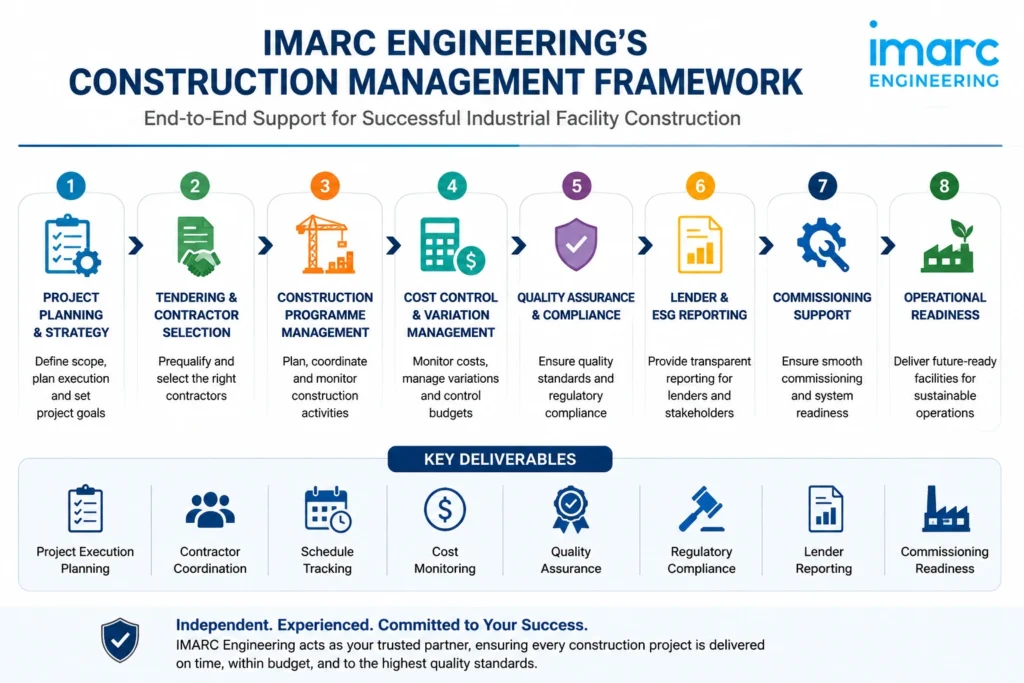
How IMARC Engineering Supports Industrial Construction Projects in India
IMARC Engineering acts solely as the owner’s representative across all construction phases, with no affiliations to contractors or suppliers.
Pre-Construction Planning and Strategy
- Project execution plan development
- Contractor tendering and prequalification
- Baseline schedule incorporating statutory milestones
- Contracting strategy and procurement plan development
Multi-Contractor Coordination and Programme Management
- Interface register management across civil, MEP, and process packages
- Weekly site reviews against defined completion criteria
- Critical path monitoring with delay quantification and recovery tracking
- Statutory approval tracker linked to programme milestones
Cost Control and Variation Management
- Cost baseline established at contract award by work package
- Monthly cost reports covering actual spend, commitments, variations, and forecast final cost
- Variation claims evaluated against contract scope before approval
- Cash flow forecasting aligned to project finance draw-down schedules
Quality Assurance and Regulatory Compliance
- Inspection and test plan aligned to IS codes, BIS standards, and sector-specific regulatory requirements
- Material verification before use, structural testing per IS 456
- GMP and FSSAI-compliant finish and drainage inspection records
- Quality dossier compiled for CDSCO and FSSAI licensing submissions
Lender and ESG Reporting
- Monthly progress reports to independent engineer formats
- ESG reporting covering safety metrics, BOCW compliance, and CPCB environmental monitoring
- Environmental and Social Monitoring Reports under IFC Performance Standard 2
- Cost-to-complete assessments structured to lender standards
Construction Management Determines Whether Manufacturing Investment Delivers Its Return
With manufacturing FDI at USD 19.04 billion in FY 2024-25 and facility construction projects active across pharmaceuticals, chemicals, food processing, medical devices, and heavy engineering, the quality of construction management will determine whether this capital creates productive, compliant operations on schedule, or absorbs years of delays and crores in avoidable overruns.
Professional construction management that combines owner’s representative independence, manufacturing-specific engineering knowledge, statutory approval expertise, and lender-grade reporting is not a support function. It is the primary mechanism through which investment commitments are converted into operational manufacturing capability.
IMARC Engineering supports manufacturers throughout the construction project lifecycle, helping organisations build future-ready industrial facilities with the schedule discipline, quality assurance, and regulatory alignment that India’s evolving manufacturing environment demands.
Consult to the Our Team: https://www.imarcengineering.com/contact?service=construction-management-services
Contact Us:
IMARC Engineering
Phone: +91-120-433-0800
Email: sales@imarcengineering.com
India: C-130, Sector 2, Noida, Uttar Pradesh 201301
LinkedIn: https://www.linkedin.com/showcase/imarc-engineering/
About the Author