Setting up a razor manufacturing plant in India presents a compelling investment case driven by the increased awareness of personal grooming, the growing grooming expenses of both men and women, rapid urbanisation, and the increasing use of disposable and cartridge razors in previously untapped markets. Razors are a daily-use personal care consumable with consistently strong demand across all consumer demographics – from mass-market disposables used in homes and institutions to premium cartridge systems deployed in the salon and hospitality sectors. As India’s urban population expands and disposable incomes rise, both the volume and value of razor consumption are growing steadily, creating a large and commercially validated domestic market for manufacturers. The global razor market was valued at USD 13.03 billion in 2025 and is expected to reach USD 16.50 billion by 2034, exhibiting a CAGR of 2.7% from 2026 to 2034 according to IMARC Group estimates.
India’s structural advantages make this investment strategically compelling. UN data highlighted sustained urban population growth at regional levels, with city residents increasing by 1.25 billion between 2000 and 2025 – with India, China, Nigeria, Pakistan, and the United States together adding over 500 million urban residents. This rapid urbanisation supports razor market growth by boosting grooming awareness, disposable incomes, and demand for convenient personal care products. Unbranded razors and cartridges are being accepted very fast in developing countries like India because of their combination of low price and ease of use, while the growing middle and upper-income segment is concentrating on premium, skin-friendly, and sustainable shaving products. The Government of India’s Make in India initiative and the rapid expansion of FMCG distribution through modern retail and e-commerce channels provide domestic manufacturers with the infrastructure and policy support needed to build a highly competitive razor manufacturing plant in India.
India’s rapid urbanisation, rising grooming awareness across both men and women, growing FMCG distribution reach, and a global razor market growing from USD 13.03 billion in 2025 to USD 16.50 billion by 2034 make a razor manufacturing plant a financially exceptional and structurally well-supported investment. With gross margins of 50–60% and net margins of 20–30% across an annual capacity of 50–80 million units, the project delivers one of the strongest return profiles in India’s consumer goods manufacturing landscape.
What is a Razor?
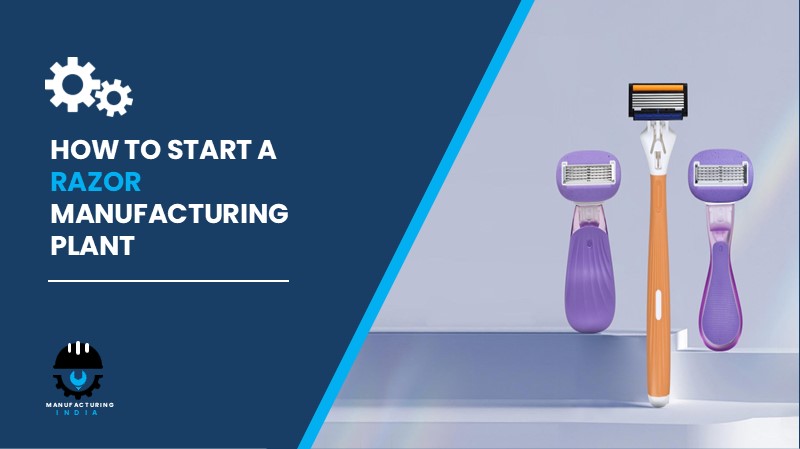
Razors are personal grooming instruments that remove hair through shaving. They usually have a very sharp metal blade protected by a handle, and come in many types – including disposable razors, cartridge razors, safety razors, and straight razors. Razor producers of the 21st century use the finest materials for the blades, with advanced coatings such as chromium or PTFE applied to keep blades sharp, resistant to rust, and longer-lasting.
The handles are made from various materials including plastics, rubberised polymers, or metal alloys to give the user good grip, comfort, and control during shaving. Razors are extensively used in men’s grooming, women’s grooming, and professional barbering. The reasons for their wide acceptance are low prices, ease of use, hygiene factors, and compatibility with the daily grooming routines in both developed and developing countries. The introduction of new blade coating technologies, the creation of ergonomic handle designs, and the use of multi-blade configurations are also contributing to market growth by enabling manufacturers to set higher price points and differentiate their products.
The primary production method is blade strip cutting and hardening, blade grinding and honing, coating and polishing, handle moulding and assembly, blade-handle integration, inspection, sterilisation, and packaging – a multi-stage precision manufacturing process. End-use industries served include the personal care and grooming industry, barbering and salon services, the hospitality and travel amenities sector, and the retail consumer goods segment.
Cost of Setting Up a Razor Manufacturing Plant in India
The cost of establishing this facility depends on capacity, technology selection, plant location, degree of automation, and regulatory compliance requirements.
1. Capital Expenditure (CapEx)
Total capital investment for a razor manufacturing plant in India covers land acquisition, site preparation, civil construction, machinery, and pre-operative expenses. The cost of land and site development – including charges for land registration, boundary development, and other related expenses – forms a substantial part of the overall investment. This allocation ensures a solid foundation for safe and efficient plant operations. Investors can reduce land acquisition costs by locating the unit in an industrial estate, consumer goods manufacturing cluster, or Special Economic Zone (SEZ), which also provide shared utility infrastructure and potential state-level fiscal incentives aligned with India’s FMCG and personal care manufacturing push.
Civil works and construction encompass the main blade manufacturing and assembly production building, raw material storage areas for stainless steel strips, plastic for handles, lubricating strips, and packaging materials, a quality control laboratory, a finished goods warehouse, and an administrative block. Given that razor manufacturing involves precision blade stamping, heat treatment, and chrome or PTFE coating operations, civil infrastructure must incorporate appropriate ventilation, surface treatment chemical containment, and fire safety provisions for heat treatment operations.
Machinery costs account for the largest portion of total capital expenditure. Key machinery required includes:
- Blade stamping presses
- Heat treatment furnaces
- Grinding machines
- Coating systems
- Injection moulding units
- Automated assembly lines
- Inspection systems
Other capital costs include the effluent treatment plant (ETP), advanced process monitoring systems, pre-operative expenses, trial production costs, and commissioning charges. All machinery must be high-quality and corrosion-resistant, tailored for razor production, and must comply with industry standards for safety, efficiency, and reliability.
Request a Sample Report for In-Depth Market Insights: https://www.imarcgroup.com/razor-manufacturing-plant-project-report/requestsample
2. Operational Expenditure (OpEx)
The operating cost structure of a razor manufacturing plant is primarily driven by raw material consumption, particularly stainless steel strips, which account for approximately 40–50% of total operating expenses (OpEx). Plastic for handles, lubricating strips, and packaging are the secondary raw material inputs. Securing long-term supply agreements with reliable domestic stainless steel strip producers and plastic compounders is essential to mitigate price volatility, minimise transportation costs, and ensure consistent production quality. Sustainability and supply chain risks must be assessed, and long-term contracts should be negotiated to stabilise pricing and ensure a steady supply.
Utility costs – comprising electricity for blade stamping presses, heat treatment furnaces, grinding machines, coating systems, injection moulding units, and automated assembly lines, as well as water – account for 10–15% of total OpEx. Other ongoing operating costs include transportation, packaging, salaries and wages, depreciation, taxes, equipment repairs and maintenance, and other miscellaneous expenses.
In the first year of operations, the operating cost for the razor manufacturing plant is projected to be significant, covering raw materials, utilities, depreciation, taxes, packing, transportation, and repairs and maintenance. By the fifth year, the total operational cost is expected to increase substantially due to factors such as inflation, market fluctuations, and potential rises in the cost of key materials. Additional factors, including supply chain disruptions, rising consumer demand, and shifts in the global economy, are expected to contribute to this increase.
3. Plant Capacity
The proposed manufacturing facility is designed with an annual production capacity ranging between 50 million and 80 million units, enabling economies of scale while maintaining operational flexibility. Capacity can be customised per investor requirements based on target consumer, professional, or institutional market segments, available capital, and chosen automation level. Razor production is highly suited to automation for mass production, guaranteeing the highest quality at the best price in the market and ensuring profitability improves materially with higher capacity utilisation.
4. Profit Margins and Financial Projections
The project demonstrates exceptional profitability potential under normal operating conditions. Gross profit margins typically range between 50–60% – among the highest in India’s consumer goods manufacturing segment – supported by stable demand and value-added applications. Net profit margins range between 20–30%. A comprehensive financial model covering NPV (net present value), IRR (internal rate of return), payback period, liquidity analysis, uncertainty analysis, sensitivity analysis, and a full five-year profit and loss account provides investors with a rigorous analytical framework for assessing financial viability and long-term sustainability across different capacity and pricing scenarios.
Why Set Up a Razor Plant in India?
Consistent Consumer Demand Across All Demographics. Razors are a product with frequent consumption across all consumer demographics, and demand is always stable even during economic downturns. The personal grooming industry generates recurring purchases – particularly for disposable razors and cartridge refills – that create a predictable, high-frequency revenue base for domestic manufacturers regardless of broader economic cycles.
Rapid Urbanisation Driving Grooming Awareness and Spend. UN data highlighted sustained urban population growth at regional levels, with city residents increasing by 1.25 billion between 2000 and 2025 – with India, China, Nigeria, Pakistan, and the United States together adding over 500 million urban residents. This rapid urbanisation supports razor market growth by boosting grooming awareness, disposable incomes, and demand for convenient personal care products, directly expanding the addressable consumer base for Indian razor manufacturers in both metro and tier-2 city markets.
Technological Advancement Creating Premium Product Opportunities. The developments in blade coatings, ergonomics, and multiple-blade capabilities have opened new avenues for manufacturers to set higher prices and differentiate their products. The introduction of new blade coating technologies using chromium or PTFE, the creation of ergonomic handle designs, and the use of multi-blade configurations are all contributing to improved user experience and repeat purchase behaviour – enabling domestic manufacturers to pursue both mass-market volume and premium-tier value simultaneously.
Scalable Automated Production Model Supporting Margin Expansion. Razor production is highly suited to being automated for mass production, guaranteeing the highest quality product at the best price in the market. The combination of high automation compatibility, a 50–80 million unit annual capacity range, and gross margins of 50–60% creates a manufacturing model where margin expansion is directly linked to capacity utilisation – incentivising domestic producers to rapidly build distribution reach and institutional supply relationships.
Strong FMCG Distribution Network Accelerating Market Access. The establishment of retail and online channels has facilitated an easy way for products to reach the market, resulting in consumers making repeat purchases. E-commerce platforms have played a big role in enhancing the availability of products and brand visibility, making it possible for manufacturers to access a larger number of consumers – particularly in India’s tier-2 and tier-3 cities where traditional retail infrastructure is still developing but e-commerce penetration is growing rapidly.
Active Global Industry Developments Confirming Innovation Momentum. In May 2025, Esquire-Harry’s unveiled Harry’s Plus, a next-generation razor system marking the brand’s most significant launch after a decade of research, development, and engineering. The razor integrates a pivoting cartridge, five German-engineered blades, an aloe lubricating strip, and a metal handle, supported by capital investment at the Eisfeld, Germany factory, producing millions annually. Also in May 2025, BIC introduced the BIC Flex 5 Sensitive razor targeting men with sensitive skin, addressing survey findings among 1,250 users aged 16 to 45 where 87% reported irritation and 40% noted sensitivity – featuring five lasting blades, a lubricating strip, a 40-degree pivoting head, and durability delivering 13 shaves. These launches confirm that the global razor category is actively investing in product innovation and consumer insight-driven differentiation.
Manufacturing Process – Step by Step
The razor manufacturing process uses blade strip cutting and hardening, blade grinding and honing, coating and polishing, handle moulding and assembly, blade-handle integration, inspection, sterilisation, and packaging as the primary production method. Each stage is precision-controlled to ensure blade sharpness, coating integrity, handle ergonomics, and full compliance with the hygiene and safety standards required by personal care, professional barbering, and institutional customers.
- Raw Material Receipt and Inspection: Stainless steel strips, plastic for handles, lubricating strips, and packaging materials are received at the facility and subjected to incoming quality checks for steel grade specification, thickness tolerance, plastic compound grade, and dimensional compliance before entering the production line.
- Blade Strip Cutting: Stainless steel strip coils are fed through blade stamping presses to cut and stamp individual blade blanks to the precise dimensions required for the target razor blade specification – disposable, cartridge, safety, or straight razor blade geometry.
- Blade Hardening: Stamped blade blanks are processed through heat treatment furnaces under controlled temperature and atmosphere conditions to develop the hardness, toughness, and springback properties required for reliable shaving performance and edge retention.
- Blade Grinding and Honing: Heat-treated blade blanks are processed through grinding machines to form and refine the blade edge geometry – including edge angle, edge sharpness, and surface finish – to the precision tolerances required for comfortable and effective shaving performance.
- Coating and Polishing: Ground blades are processed through coating systems where chromium, PTFE, or other advanced blade coatings are applied to the blade edge and surfaces. These coatings improve sharpness, reduce friction, resist corrosion, and extend blade service life – directly enabling premium pricing and consumer satisfaction outcomes.
- Handle Moulding and Assembly: Razor handles are produced from plastic, rubberised polymers, or metal alloys using injection moulding units, forming ergonomically designed handles that provide grip, comfort, and control. Where metal or rubberised polymer handles are specified, appropriate moulding or over-moulding processes are applied.
- Blade-Handle Integration: Coated blades and lubricating strips are integrated with the moulded handles on automated assembly lines, assembling the complete razor unit in the required cartridge, disposable, safety, or straight razor configuration with the specified number of blades.
- Inspection and Sterilisation: Assembled razors are evaluated on inspection systems for dimensional compliance, blade sharpness, coating quality, and assembly integrity. Sterilisation processes are applied as required to achieve the hygiene standards required for direct skin-contact consumer products.
- Packaging and Dispatch: Approved razors are packed into retail packaging or bulk institutional packs and dispatched to end-use customers across the personal care and grooming industry, barbering and salon services, the hospitality and travel amenities sector, and retail and FMCG distribution channels.
Key Applications
The razor manufacturing plant serves a diverse and commercially significant range of end-use sectors across India’s personal care and grooming economy.
- Personal Grooming Industry: Precision razors are indispensable products used daily by both men and women – guaranteeing flawless shaving, cleanliness, and skin comfort across mass-market and premium consumer segments.
- Barbering and Salon Services: Professional-grade razors support clean finishes, shaping, and styling services while maintaining hygiene standards in commercial grooming settings – a consistent institutional procurement channel for domestic razor manufacturers.
- Hospitality and Travel Amenities: Disposable razors are generally provided in hotel, airline, and travel kit supplies to provide guest comfort and comply with hygiene regulations – a recurring institutional demand channel aligned with India’s rapidly expanding hospitality sector.
- Retail and FMCG Distribution: Razor brands targeting the general market are made available through supermarkets, pharmacies, and online shopping, creating large-scale consumer access and repeat purchase cycles – the largest volume channel for domestic razor manufacturers.
- Men’s Shaving and Women’s Hair Removal: The two primary consumer application segments, each requiring product design differentiation in blade count, handle geometry, lubricating strip formulation, and aesthetic finish to meet distinct gender-specific grooming needs and price point expectations.
- Institutional Hygiene Products: Razors supplied to hospitals, clinics, and institutional care settings where single-use disposables are required for safe and hygienic patient care – a stable government and institutional procurement channel.
Leading Manufacturers
The global razor industry is served by several established multinational manufacturers with extensive production capacities and diverse application portfolios. Key players operating in this market include:
- BIC USA Inc.
- Dollar Shave Club Inc. (Unilever plc)
- Dorco Co. Ltd.
- Edgewell Personal Care Company
- Harry’s Inc.
All of these manufacturers serve end-use sectors including personal care, professional grooming, hospitality, and mass retail – the same markets that a domestic Indian razor manufacturing plant can target at competitive landed cost advantage through locally manufactured stainless steel blade and plastic handle integration.
Timeline to Start the Plant
Investors should plan for a structured pre-production and commissioning phase covering the following key stages:
- Feasibility study and project report preparation
- Land acquisition and site development
- Regulatory approvals and environmental clearances
- Factory licence and fire safety compliance
- Machinery procurement and installation
- Raw material supplier agreements and supply chain setup
- Trial production and quality testing
- Commercial production launch
Licences and Regulatory Requirements
Starting a razor manufacturing unit in India requires several approvals:
- Business registration (Proprietorship, LLP, or Private Limited Company)
- Factory Licence under the Factories Act
- Environmental Clearance from the State Pollution Control Board
- GST Registration
- Fire Safety NOC
- Hazardous chemical compliance for storage and handling of blade coating chemicals including chromium and PTFE compounds
- Effluent Treatment Plant (ETP) operational clearance
- Occupational Health and Safety compliance
Key Challenges to Consider
High Capital Requirements. Establishing a fully equipped razor manufacturing plant – with blade stamping presses, heat treatment furnaces, grinding machines, coating systems, injection moulding units, automated assembly lines, and inspection systems – at the 50–80 million unit annual capacity range requires significant upfront capital investment. Access to MSME credit-linked subsidy schemes, consumer goods manufacturing cluster support, and state government investment promotion grants can help bridge funding requirements.
Raw Material Price Volatility. Stainless steel strips – accounting for 40–50% of total OpEx – are directly linked to global steel commodity cycles and domestic steel price movements. Plastic compound prices are linked to petrochemical feedstock markets. Long-term procurement contracts with reliable domestic stainless steel and plastic suppliers are the primary risk mitigation strategies for managing input cost variability and protecting the plant’s exceptional 50–60% gross margin profile.
Regulatory Compliance. Razor manufacturing involves the use and storage of blade coating chemicals including chromium and PTFE compounds, which are subject to hazardous chemical regulations. Effluent treatment for coating process wastewater, heat treatment furnace emission management, and factory safety documentation are mandatory environmental compliance requirements. Advanced monitoring systems must be installed to detect deviations in the coating or heat treatment process throughout operations.
Technology and Innovation Pressure. The global razor market is actively innovating in blade sharpness, lubricating strip formulations, multi-blade configurations, and ergonomic handle design – as evidenced by both the Harry’s Plus and BIC Flex 5 Sensitive launches in May 2025. Indian manufacturers must invest continuously in product development and consumer-insight-driven design to remain competitive with premium international products in the growing mid-to-premium domestic market segment.
Competition from Global Players. Established multinational manufacturers – including BIC USA Inc., Dollar Shave Club Inc. (Unilever plc), Dorco Co. Ltd., Edgewell Personal Care Company, and Harry’s Inc. – hold strong brand equity and distribution positions globally. Indian domestic manufacturers must compete through competitive pricing for mass-market disposables, local manufacturing cost advantages, and the ability to rapidly customise product variants for India-specific skin type, grooming preference, and price point requirements.
Skilled Manpower. Operating blade stamping presses, heat treatment furnaces, grinding machines, coating systems, and automated assembly lines in a precision consumer goods manufacturing environment requires trained metalworking technicians, coating process operators, and quality assurance personnel. Recruiting, training, and retaining qualified production staff – particularly for blade edge geometry control and coating process management – is a recurring operational challenge in India’s competitive consumer goods manufacturing labour market.
Frequently Asked Questions
1. How much does it cost to set up a razor manufacturing plant in India?
Total setup cost depends on plant capacity, location, technology selection, and automation level. Key cost components include land and site development, civil construction, machinery (blade stamping presses, heat treatment furnaces, grinding machines, coating systems, injection moulding units, automated assembly lines, inspection systems), and pre-operative expenses. A detailed feasibility study is recommended to generate accurate project-specific cost estimates.
2. Is razor manufacturing profitable in India in 2026?
Yes. The project delivers exceptional financial performance, with gross margins of 50–60% and net profit margins of 20–30% under normal operating conditions – among the highest returns in India’s consumer goods manufacturing space. The global razor market was valued at USD 13.03 billion in 2025 and is projected to reach USD 16.50 billion by 2034 at a CAGR of 2.7% according to IMARC Group, with India’s urbanisation surge and rising grooming awareness creating strong domestic demand growth.
3. What machinery is required for a razor plant in India?
Essential equipment includes blade stamping presses, heat treatment furnaces, grinding machines, coating systems, injection moulding units, automated assembly lines, and inspection systems.
4. What licences and approvals are required to start a razor plant in India?
Required approvals include business registration, Factory Licence, Environmental Clearance from the State Pollution Control Board, GST Registration, Fire Safety NOC, hazardous chemical compliance for blade coating chemicals including chromium and PTFE compounds, ETP operational clearance, and Occupational Health and Safety compliance.
5. What raw materials are needed for razor manufacturing?
The primary raw materials are stainless steel strips, plastic for handles, lubricating strips, and packaging. Stainless steel strips are the dominant cost driver, accounting for 40–50% of total operating expenses, and must be sourced from suppliers meeting the steel grade specification and thickness tolerances required for precision razor blade production.
6. What are the environmental compliance requirements for a razor plant in India?
The facility must obtain Environmental Clearance from the State Pollution Control Board, operate an approved ETP for coating process wastewater management, and comply with hazardous chemical regulations for chromium and PTFE coating chemical handling. Advanced monitoring systems must be installed to detect leaks or deviations, and regular effluent monitoring and safety audit documentation are mandatory throughout operations.
7. What is the best location to set up a razor plant in India?
The location must offer easy access to key raw materials such as stainless steel strips, plastic for handles, lubricating strips, and packaging, while proximity to target markets minimises distribution costs. The site must have robust infrastructure including reliable transportation, utilities, and waste management systems. States such as Maharashtra, Gujarat, Tamil Nadu, and Uttar Pradesh – which combine strong steel and plastic raw material supply chains with FMCG distribution infrastructure – are strong candidates for plant location.
8. What is the break-even period for this type of plant in India?
The break-even period depends on plant capacity, total capital investment, product selling price across disposable and cartridge segments, and capacity utilisation rate. A comprehensive financial analysis covering NPV, IRR, payback period, and uncertainty and sensitivity analysis is the most reliable method for generating project-specific break-even timelines.
9. What government incentives are available for manufacturers in India?
Razor manufacturers in India can access MSME credit-linked capital subsidy schemes, state government investment promotion subsidies in consumer goods and FMCG manufacturing zones, and export promotion incentives administered by the Ministry of Commerce and Industry for qualifying personal care product exporters. Access to modern retail and e-commerce distribution channels – which have played a big role in enhancing product availability and brand visibility – provides domestic manufacturers with market access infrastructure without proportional physical distribution investment.
Key Takeaways for Investors
A razor manufacturing plant in India offers an exceptional investment opportunity anchored by consistent consumer demand across the personal care and grooming industry, barbering and salon services, the hospitality and travel amenities sector, and retail and FMCG distribution – a broad and recession-resilient set of end-use channels. The project is financially outstanding across the 50–80 million unit annual capacity range, with gross margins of 50–60% and net margins of 20–30% representing among the strongest return profiles available in India’s consumer goods manufacturing landscape. According to IMARC Group estimates, the global razor market is set to grow from USD 13.03 billion in 2025 to USD 16.50 billion by 2034 at a CAGR of 2.7%, and India’s urbanisation trajectory – with city residents globally increasing by 1.25 billion between 2000 and 2025, including India as a leading contributor – is directly expanding the domestic base of grooming-aware, disposable-income-driven consumers that underpins long-term razor consumption growth. With global brand leaders investing actively in product innovation – as confirmed by Harry’s Plus and BIC Flex 5 Sensitive launches in May 2025 – and with e-commerce and modern retail platforms dramatically expanding domestic market access, the long-term demand sustainability for domestically produced razors is structurally sound and commercially compelling across all investment planning horizons.
About the Author