Introduction
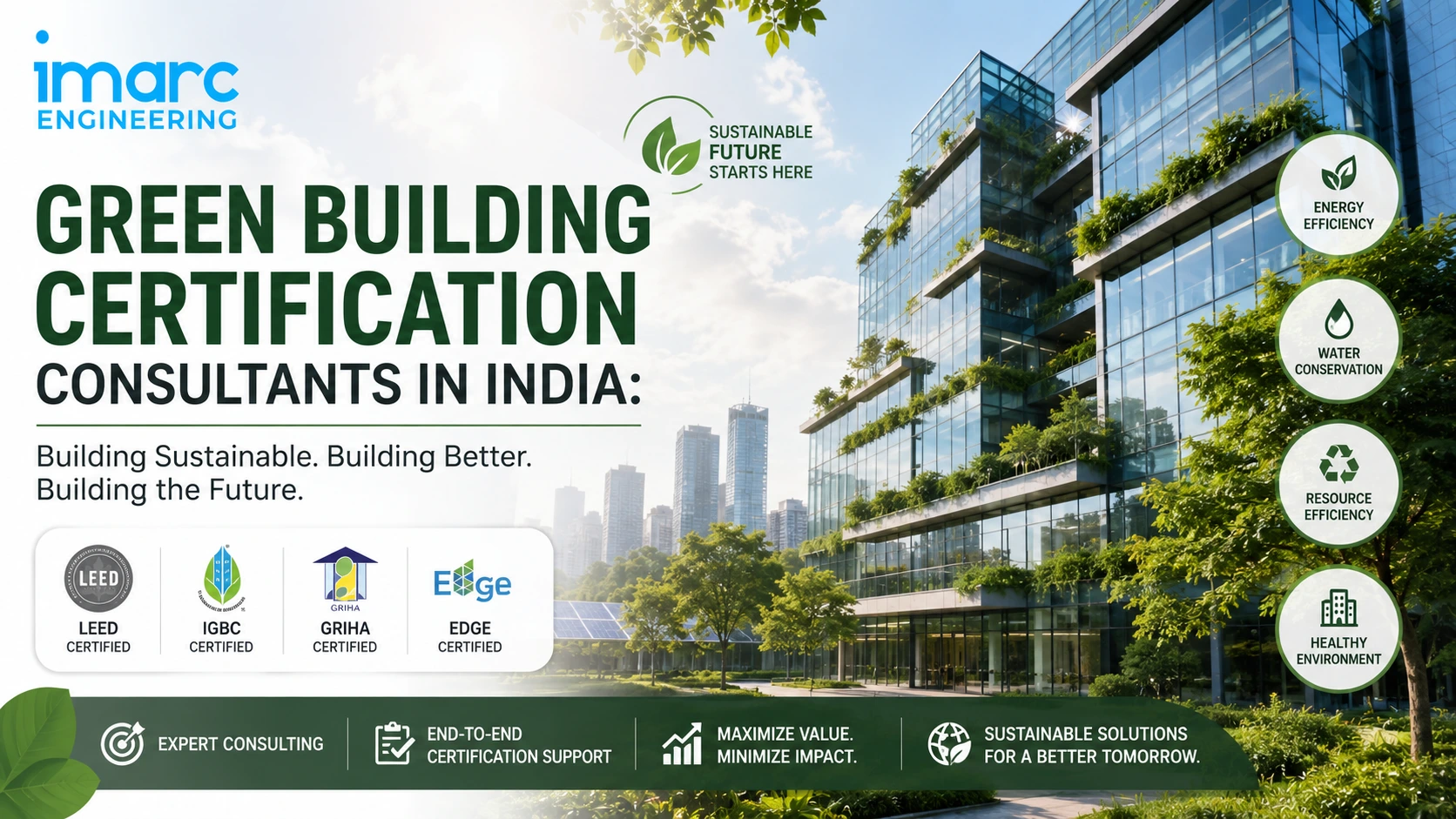
India’s built environment is undergoing a fundamental shift. Driven by rising energy costs, tightening environmental regulations, ESG disclosure requirements, and growing demand from multinational occupiers and institutional investors, green building certification has moved from an aspirational sustainability goal to a core development decision.
Across commercial, industrial, warehousing, and manufacturing asset classes, LEED and IGBC certifications are increasingly being written into lease requirements, financing covenants, and supply chain compliance frameworks. For developers and facility owners, this shift means that green building certification is no longer a reputational exercise. It is a commercial decision with direct implications for asset valuation, occupancy rates, financing access, and long-term operating costs.
IMARC Engineering supports real estate developers, industrial facility owners, EPC contractors, and infrastructure investors across India to achieve LEED and IGBC certification through end-to-end technical support, from feasibility assessment and energy modelling through to documentation management and post-certification performance monitoring.
Why Green Building Certification Is Becoming Essential for Developers in India
Rising Investor ESG Expectations
Institutional investors allocating capital to Indian real estate and industrial infrastructure now routinely assess environmental performance as part of due diligence. Green building certification consultants in India provide the documented, third-party verified evidence of sustainability performance that ESG-focused investors require. Uncertified assets face growing valuation discounts in portfolio assessments and reduced access to sustainability-linked financing instruments.
Increasing Energy Costs
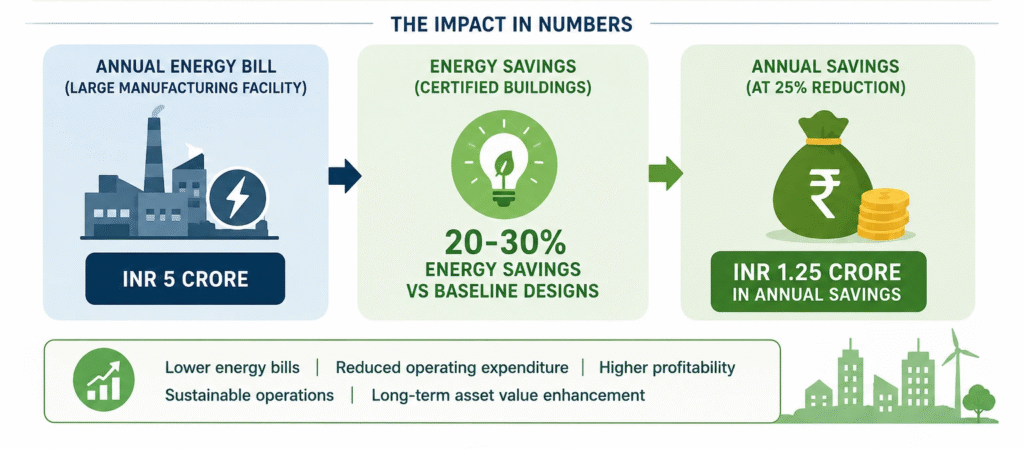
Industrial and commercial energy costs in India have risen consistently, making building energy efficiency a direct operational cost lever. Certified buildings achieving 20-30% energy savings relative to baseline designs generate measurable reductions in operating expenditure across the asset lifecycle. For a large manufacturing facility with an annual energy bill of INR 5 crore, a 25% reduction represents INR 1.25 crore in annual savings.
Growing Occupier Demand for Sustainable Buildings
Multinational corporations establishing manufacturing, logistics, and office operations in India increasingly mandate green-certified facilities as part of their global real estate and supply chain sustainability policies. Developers without certified assets risk losing tenants to competitors who have made the certification investment.
Export Market and Supply Chain Sustainability Requirements
Indian manufacturers supplying to global automotive, pharmaceutical, and consumer goods brands are facing facility-level sustainability requirements embedded in vendor qualification frameworks. Green building certification for production and warehousing facilities provides independent verification of environmental performance that satisfies international supply chain audits.
Regulatory Alignment with ECBC and Energy Efficiency Standards
The Energy Conservation Building Code (ECBC) sets mandatory energy performance requirements for commercial buildings above specified floor areas. LEED and IGBC certification pathways align closely with ECBC compliance requirements, allowing developers to meet regulatory obligations while simultaneously earning certification credits that strengthen asset marketability.
How IMARC Engineering Helps Developers Achieve Green Building Certification
Green Building Feasibility Assessment
Every engagement begins with a structured feasibility assessment that establishes the optimal certification pathway for the specific project. This covers LEED versus IGBC selection based on project type, location, and ownership structure; target rating strategy aligned with developer objectives; and cost-benefit evaluation quantifying certification investment against projected energy savings, asset value uplift, and financing benefits. This upfront assessment prevents misaligned certification strategies that result in cost overruns and missed rating targets.
Certification Strategy Development
Following feasibility assessment, a credit-by-credit certification strategy is developed that maps the most achievable and highest-value credits for the project. The strategy defines the sustainability roadmap, assigns credit responsibilities across the design and construction team, and establishes the rating optimization approach. Projects that begin credit planning during schematic design consistently achieve higher ratings at lower cost than those initiating certification planning during construction.
Whole Building Energy Modelling
Energy credits represent among the highest-value credits under both LEED and IGBC frameworks and require advanced simulation expertise to achieve. IMARC Engineering’s energy modelling covers:
- Building envelope optimization including wall, roof, and glazing system performance
- HVAC system selection and optimization against energy performance baselines
- Lighting system design for energy efficiency and occupant comfort
- Renewable energy integration assessment for solar and other on-site generation options
ECBC Compliance Assessment
ECBC compliance assessments cover building envelope thermal performance, HVAC system efficiency ratings, lighting power density compliance, and water heating system standards. ECBC compliance is both a regulatory requirement and an integrated component of LEED and IGBC energy credit pathways, and both are managed simultaneously to avoid duplication of effort and documentation.
Water Efficiency Modelling
Water efficiency modelling identifies reduction opportunities through fixture efficiency optimization, process water reuse assessment, rainwater harvesting system design, and landscaping water demand reduction strategies. Projects implementing these recommendations consistently achieve 30-50% reductions in potable water consumption relative to baseline designs.
Documentation Management
IMARC Engineering manages the complete documentation workflow including credit-by-credit preparation, submission package assembly, coordination with USGBC and IGBC reviewers, and response management for technical queries. Documentation gaps and submission errors are among the most common causes of certification delays in projects managed without specialist support.
Construction Phase Support
Certification credits earned at the design stage can be lost during construction without active monitoring. Construction phase support covers waste management planning, sustainable procurement verification, and commissioning support to ensure installed systems perform to design specifications. This is particularly critical for projects pursuing LEED Gold and Platinum ratings, where credit margins are narrow.
Post-Certification Performance Management
Engagement extends beyond certification approval to include operational performance monitoring, LEED Operations and Maintenance support, IGBC Operational Performance compliance, and ESG reporting integration. Post-certification support ensures operational savings projected at the design stage are realized and certification status is maintained through recertification cycles.
Drive Green Building Excellence with IMARC Engineering: https://www.imarcengineering.com/contact?service=green-building-certification-support
Industries Supported by Green Building Certification Consultants
Manufacturing Facilities
Manufacturing plants face specific certification challenges around process energy consumption, industrial water use, waste management, and indoor air quality in production environments. IMARC Engineering’s manufacturing certification experience addresses these sector-specific requirements within LEED and IGBC frameworks.
Pharmaceutical Plants
Pharmaceutical facilities require precise environmental control systems that must simultaneously meet GMP requirements and certification energy performance standards. Balancing cleanroom air change requirements with HVAC energy efficiency credits demands specialist modelling expertise.
Warehousing and Logistics Infrastructure
India’s rapidly expanding warehousing sector is seeing growing demand for green-certified facilities from e-commerce, FMCG, and third-party logistics operators. Certification for large-footprint, single-storey warehouses requires focused strategies around roof insulation, lighting efficiency, and water management.
Commercial Office Developments
Commercial offices benefit from the full breadth of LEED and IGBC credit frameworks, with particular value in energy, water, indoor environmental quality, and materials categories. Certified office developments in India’s major commercial markets command measurable rental and valuation premiums.
Hospitality and Healthcare Facilities
Hotels and hospitals carry high energy and water intensities that make certification both challenging and high-value. IMARC Engineering’s modelling expertise addresses the complex building systems typical of these asset types.
Industrial Parks and SEZs
Multi-tenant industrial parks and Special Economic Zones benefit from master-level certification strategies that establish common infrastructure standards and shared sustainability systems applicable across tenant units.
Common Challenges Developers Face Without Green Building Certification Consultants
Poor Credit Planning
Without systematic credit planning from project inception, developers frequently discover mid-construction that targeted credits are unachievable due to design decisions already locked in. Retrofitting design changes to recover lost credits at the construction stage costs significantly more than early-stage planning.
Energy Modelling Errors
Inaccurate energy models result in inflated credit claims that fail technical review, requiring remodelling and resubmission. Modelling errors that overestimate energy savings by 10-15% are common in projects without specialist simulation expertise and can result in rating downgrades that affect asset value and tenant terms.
ECBC Compliance Gaps
Facilities that treat ECBC compliance and certification as separate workstreams duplicate effort, create documentation inconsistencies, and risk compliance gaps that trigger regulatory issues independent of certification outcomes.
Documentation Delays
Incomplete or incorrectly formatted documentation submissions are a primary cause of certification timeline delays. Projects without dedicated documentation management experience review cycles that extend timelines by 3-6 months and increase consultant costs.
Missed Certification Opportunities
Design features that could generate certification credits often go unrecognised without specialist review. Rainwater harvesting systems, reflective roofing, and daylight optimization strategies that are cost-effective at the design stage are frequently omitted and later identified as missed credit opportunities.
Costly Design Modifications During Construction
The most expensive certification failures occur when compliance gaps are identified during construction rather than design. Structural and MEP modifications required to meet credit requirements during construction carry cost premiums of 40-80% over equivalent design-stage interventions.
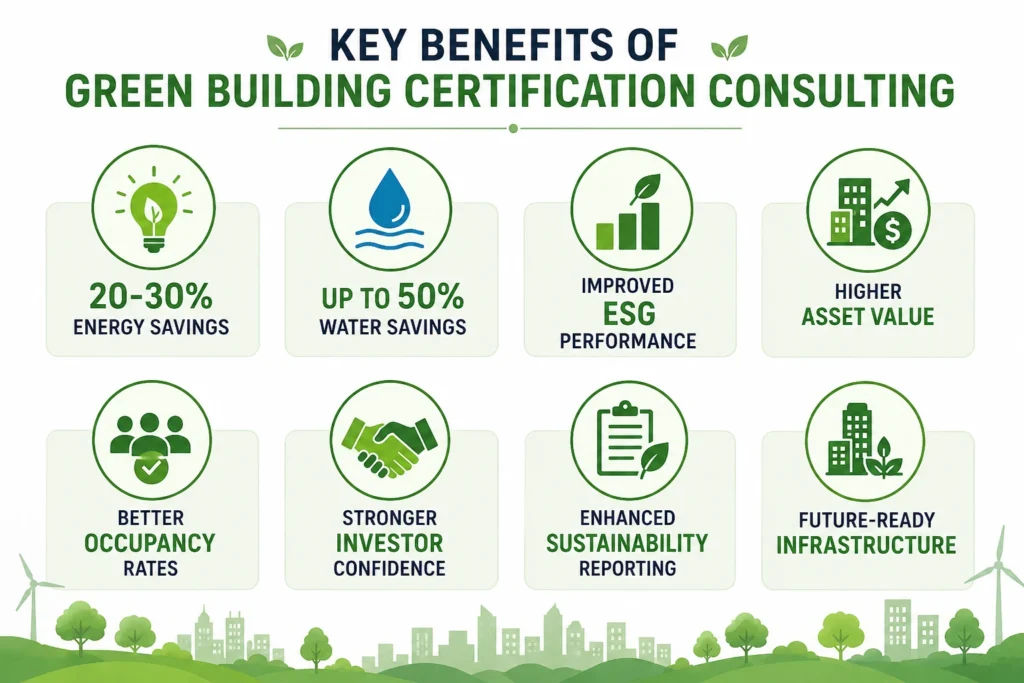
Key Benefits of Green Building Certification Consulting
Why Demand for Green Building Certification Consultants Is Increasing in 2026
Several converging forces are driving accelerating demand for Green Building Certification Services in India through 2026 and beyond.
ESG-driven investment decisions are reshaping capital allocation across real estate and industrial infrastructure. Fund managers and institutional investors applying ESG filters to Indian asset portfolios increasingly treat green building certification as a minimum qualification criterion rather than a differentiator. Assets without certification face growing financing constraints as this trend matures.
Green financing instruments are expanding rapidly. Sustainability-linked loans, green bonds, and development finance institution funding structures now routinely include green building certification as an eligibility or pricing condition. Indian developers accessing these instruments find that certification investment generates direct financing cost savings.
BRSR reporting requirements for listed companies now mandate quantified disclosures on energy consumption, water use, and waste management across owned and leased facilities. Green-certified assets simplify BRSR compliance and strengthen the quality of sustainability disclosures that influence investor ratings and analyst assessments.
Net-zero commitments adopted by large Indian corporates are driving demand for certified facilities across their owned and leased real estate portfolios. Occupiers with 2030 and 2035 net-zero targets are actively prioritising certified buildings in their facility strategies, creating sustained commercial demand that rewards developers who have invested in certification.
The expansion of sustainable industrial and logistics infrastructure is creating new certification demand across tier-2 and tier-3 industrial corridors. As global manufacturers relocate or expand supply chains into India, green-certified production and storage facilities are increasingly required by international parent companies applying global real estate standards to Indian operations.
Contact Us:
IMARC Engineering
Phone: +91-120-433-0800
Email: sales@imarcengineering.com
India: C-130, Sector 2, Noida, Uttar Pradesh 201301
LinkedIn: https://www.linkedin.com/showcase/imarc-engineering/
About the Author