Titanium Nitride Production Plant in India
Setting up a titanium nitride production plant in India presents a compelling investment case at a time when the country’s precision machining and cutting tools industry is modernising rapidly, its semiconductor fabrication ambitions are scaling under the India Semiconductor Mission, its medical device manufacturing sector is expanding, and its aerospace and defence production base is deepening with indigenous manufacturing priorities. Titanium nitride (TiN) — the refractory ceramic compound made of nitrogen and titanium, well-known for its remarkable metallic gold appearance, exceptional wear resistance, and outstanding chemical stability — is one of the most technically versatile advanced materials in the industrial coatings landscape, serving simultaneously as a protective hard coating for cutting tools, a conductive diffusion barrier in semiconductor devices, a biocompatible coating for medical implants, and a decorative finish for consumer and aerospace components. As India’s manufacturing sector embraces precision machining, its semiconductor fabrication capacity expands, and its medical device and aerospace industries mature, the domestic requirement for reliably produced, high-purity titanium nitride coatings and materials is growing into a commercially significant advanced materials investment opportunity.
India’s positioning for titanium nitride production is strengthening across multiple high-growth sectors simultaneously. According to industrial reports, APAC holds the largest share, accounting for about 35.0% of the global titanium nitride market — a regional dominance reflecting the concentration of precision manufacturing, electronics, and semiconductor fabrication activity across Asia that India is an increasingly significant participant in. The global semiconductor manufacturing sector is expected to generate more than USD 1 trillion in revenue annually by 2030 according to SEMI estimates, with major capacity increases already taking place in 2025 and 2026 — a trajectory that directly drives demand for titanium nitride as a diffusion barrier material in advanced integrated circuit manufacturing, including the chip fabrication capacity that India’s own semiconductor mission is actively developing. Industrial estates in Gujarat, Maharashtra, and Karnataka offer the specialised vacuum deposition infrastructure, titanium tetrachloride supply chain access, and precision engineering workforce that a titanium nitride production facility requires.
Investing in a titanium nitride production plant in India today aligns the country’s expanding precision machining, semiconductor fabrication, medical device, and aerospace manufacturing sectors with APAC’s dominant 35.0% global market share and a global semiconductor industry targeting USD 1 trillion in annual revenue by 2030. With gross profit margins of 30–40% and net profit margins of 18–26% at an annual production capacity of 1,000 MT, the unit economics are highly attractive, and the investment’s multi-sector advanced materials positioning supports strong, technically defensible long-term returns.
What is Titanium Nitride?
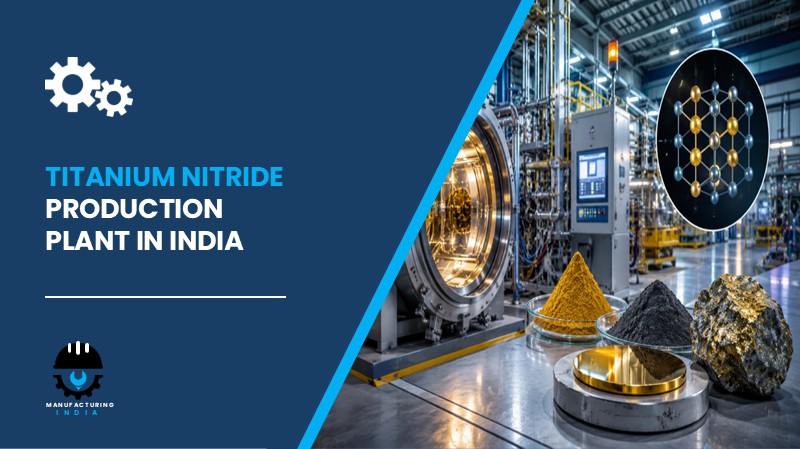
Titanium nitride (TiN) is a refractory ceramic compound made of nitrogen and titanium that is well-known for its remarkable metallic gold look, wear resistance, and chemical stability. Titanium nitridation, chemical vapour deposition (CVD), and physical vapour deposition (PVD) are the main methods used to produce it. Titanium nitride is widely utilised as a protective coating to increase corrosion resistance, lower friction, and improve surface hardness on cutting tools, moulds, dies, and precision components.
It is also used in medical implants, decorative coatings, aerospace parts, and microelectronics as a conductive layer and diffusion barrier in semiconductor devices. Titanium nitride continues to be a vital advanced material in the industrial, electronics, healthcare, and high-performance engineering sectors due to its exceptional mechanical and electrical qualities. Its combination of extreme hardness, thermal stability, electrical conductivity, and biocompatibility makes it uniquely suited to applications that span from extending the cutting life of industrial tooling to enabling the reliable operation of nanometre-scale transistor structures in advanced semiconductor devices — a breadth of technical application that few advanced ceramic materials can match.
The primary production process covers chemical vapour deposition (CVD), physical vapour deposition (PVD), reactive sputtering, and direct nitridation of titanium powder at high temperatures, followed by purification, classification, and packaging. End-use industries served include machining and cutting tools, semiconductors and electronics, medical devices, automotive, aerospace and defence, and decorative coatings. Applications span conductive thin films, wear-resistant coatings, biomedical implant coatings, diffusion barriers in integrated circuits, ornamental finishes, and high-temperature engineering components.
Cost of Setting Up a Titanium Nitride Production Plant in India
The cost of establishing a titanium nitride production plant in India depends on production capacity, process technology selection between CVD, PVD, reactive sputtering, and direct nitridation routes, target application grade between cutting tool coating, semiconductor-grade, and biomedical-grade titanium nitride, geographic location, degree of automation, and the quality compliance requirements applicable to titanium nitride supplied to industrial, electronics, medical, and aerospace customers.
1. Capital Expenditure (CapEx)
Land and Site Development forms a foundational component of total capital investment, covering land acquisition charges, site registration, and site utilities. The location must offer easy access to key raw materials such as titanium tetrachloride, nitrogen gas, and hydrogen. Proximity to target markets — particularly India’s precision tooling clusters, electronics manufacturing zones, and medical device hubs — will help minimise distribution costs. The site must have robust infrastructure, including reliable transportation, utilities, and waste management systems. Compliance with local zoning laws and environmental regulations must also be ensured.
Plant Layout Optimisation is critical for a titanium nitride production facility integrating high-temperature nitridation, vacuum deposition chambers, and precision powder processing operations. The layout should be optimised to enhance workflow efficiency, safety, and minimise material handling. Separate areas for raw material storage, production, quality control, and finished goods storage must be designated. Space for future expansion should be incorporated to accommodate business growth as semiconductor and medical device customer qualification volumes develop.
Machinery and Equipment represent the largest single component of total CapEx for a titanium nitride production plant. Essential equipment includes:
- Nitridation furnaces
- Chemical vapour deposition (CVD) systems
- Physical vapour deposition (PVD) chambers
- Reactive sputtering units
- Vacuum pumps
- Gas handling and purification systems
- Powder processing equipment
- Particle classification units
- Process monitoring and control systems
- Material handling equipment
- Packaging systems
- Emission control units
Other Capital Costs include effluent treatment systems to minimise environmental impact and ensure compliance with emission standards, pre-operative expenses, semiconductor and medical-grade quality certification costs, commissioning charges, and import duties on specialised CVD/PVD deposition systems or reactive sputtering equipment not available domestically at the required specification.
Request a Sample Report for In-Depth Market Insights: https://www.imarcgroup.com/titanium-nitride-manufacturing-plant-project-report/requestsample
2. Operational Expenditure (OpEx)
Raw Material Cost is the dominant operational expense, accounting for approximately 50–60% of total OpEx. The primary raw materials are titanium tetrachloride, nitrogen gas, and hydrogen. Titanium tetrachloride — as the primary titanium feedstock consumed in CVD-route titanium nitride production — drives the majority of raw material cost. Nitrogen gas serves as the nitriding agent across all production routes, while hydrogen is consumed as a reducing agent in chemical vapour deposition reactions. Reliable suppliers must be secured for all three raw materials to ensure consistent production quality, with long-term contracts negotiated to stabilise pricing and ensure a steady supply.
Utility Cost is the second-largest OpEx component, representing approximately 14–18% of total operating expenses — a relatively elevated proportion reflecting the energy intensity of high-temperature nitridation furnace operation, vacuum pump systems for CVD and PVD chambers, and reactive sputtering power requirements. Electricity for vacuum generation and high-temperature process heating constitutes the primary utility input requiring careful site infrastructure planning.
Other Operating Costs include transportation and distribution to cutting tool manufacturers, semiconductor fabrication facilities, medical device producers, automotive and aerospace component manufacturers, and decorative coating applicators, specialised packaging materials, salaries and wages for materials scientists and process engineers, routine machinery maintenance, depreciation on production equipment, and applicable taxes. By the fifth year, the total operational cost is expected to increase substantially due to factors such as inflation, market fluctuations, and potential rises in the cost of key materials. Additional factors, including supply chain disruptions, rising consumer demand, and shifts in the global economy, are expected to contribute to this increase.
3. Plant Capacity
The proposed production facility for titanium nitride is designed with an annual production capacity of 1,000 MT, enabling economies of scale while maintaining operational flexibility across multiple application grades — cutting tool and industrial coating grades, semiconductor diffusion barrier grades, and biomedical implant coating grades. Plant capacity can be customised per investor requirements and phased in line with secured customer qualification approvals across the machining and cutting tools, semiconductors and electronics, medical devices, automotive, and aerospace and defence end-use sectors.
4. Profit Margins and Financial Projections
The financial projections for a titanium nitride production plant demonstrate healthy profitability potential under normal operating conditions. Gross profit margins typically range between 30–40%, supported by stable demand and value-added applications across precision machining, electronics, medical, and aerospace sectors. Net profit margins are projected at 18–26% — among the strongest financial performance profiles in the advanced materials and ceramic coatings segment. A comprehensive financial analysis covering NPV, IRR, payback period, and five-year projections is essential before committing capital, with projections developed based on realistic assumptions related to capital investment, operating costs, production capacity utilisation, pricing trends, and demand outlook.
Why Set Up a Titanium Nitride Plant in India?
Growing Need for Advanced Cutting Tools. TiN-coated tooling solutions are becoming more and more popular due to increased industrial automation and precise machining. India’s expanding manufacturing sector — across automotive, general engineering, and precision components — is driving systematic adoption of TiN-coated drills, milling cutters, inserts, and dies that extend tool life and improve cutting performance, creating sustained domestic demand for titanium nitride coating capability.
Growth in Semiconductor Manufacturing. The need for diffusion barriers and titanium nitride thin films is being supported by increased investments in advanced chip production. The global semiconductor manufacturing sector is expected to generate more than USD 1 trillion in revenue annually by 2030 according to SEMI estimates, with major capacity increases already taking place in 2025 and 2026. India’s own India Semiconductor Mission and growing chip fabrication ambitions create a direct domestic demand pathway for titanium nitride as a critical thin-film material in integrated circuit manufacturing.
Growing Use in Medical Applications. Opportunities for biocompatible TiN coatings are growing due to the expansion of orthopedic implants and surgical tools. India’s expanding medical device manufacturing sector and growing healthcare infrastructure are driving demand for biocompatible coating technologies that improve corrosion resistance and reduce wear in surgical equipment and implants.
Growing Aerospace and Automotive Production. The market is still expanding due to the need for wear-resistant, high-performance components. India’s expanding automotive manufacturing base and growing indigenous aerospace and defence production are creating sustained demand for titanium nitride’s wear-resistant, high-performance coating properties across critical components.
Superior Material Performance Driving Technology Adoption. TiN is essential in cutting-edge technical applications due to its remarkable hardness, thermal stability, and corrosion resistance. This combination of properties — unmatched by most alternative hard coating materials — ensures titanium nitride’s continued relevance and growing adoption as India’s manufacturing, electronics, and healthcare sectors modernise and demand higher-performance materials.
Ongoing Technological Advancement Confirming Innovation Momentum. In May 2026, a study published in Materials Chemistry and Physics investigated the development of advanced titanium nitride (TiN)-based coatings with enhanced microstructural and functional properties for high-performance engineering applications. The study demonstrated that the hardness, wear resistance, adhesion strength, and surface integrity of TiN films were greatly enhanced by optimising coating architecture and deposition parameters. Under challenging operating conditions, the improved coatings demonstrated higher tribological performance — confirming titanium nitride’s ongoing technological development and its increasing significance in cutting tools, automotive parts, aerospace systems, and precision manufacturing applications where dependability and durability are crucial performance requirements.
Production Process — Step by Step
The titanium nitride production process uses chemical vapour deposition (CVD), physical vapour deposition (PVD), reactive sputtering, and direct nitridation of titanium powder at high temperatures as the primary production methods, followed by purification, classification, and packaging. Each stage requires precisely controlled temperature, gas composition, and deposition parameters to produce titanium nitride meeting the purity, particle size, and coating performance specifications required by industrial, electronics, medical, and aerospace customers.
- Raw Material Preparation: Titanium tetrachloride, nitrogen gas, and hydrogen are received from certified suppliers, quality-checked for purity, and prepared for controlled feed into the production process appropriate to the selected technology route.
- Direct Nitridation: Titanium powder is processed through nitridation furnaces at high temperatures under controlled nitrogen atmosphere, where titanium reacts directly with nitrogen gas to form titanium nitride powder of the target stoichiometry and particle characteristics.
- Chemical Vapour Deposition (CVD): Titanium tetrachloride vapour is reacted with nitrogen and hydrogen gas in CVD systems at controlled temperature and pressure, depositing a titanium nitride thin film or coating onto the target substrate through gas-phase chemical reaction.
- Physical Vapour Deposition (PVD) and Reactive Sputtering: Titanium metal is vaporised in PVD chambers or reactive sputtering units under vacuum conditions using vacuum pumps, with the titanium vapour reacting with nitrogen gas introduced into the chamber to deposit a titanium nitride coating onto cutting tools, components, or substrates with precisely controlled thickness and adhesion characteristics.
- Gas Handling and Purification: Process gases are managed through gas handling and purification systems to ensure the purity levels required for consistent, defect-free titanium nitride deposition across all production routes.
- Powder Processing and Classification: Where titanium nitride powder is the target product, material is processed through powder processing equipment and particle classification units to achieve the target particle size distribution for the intended application.
- Process Monitoring: Throughout production, process monitoring and control systems track temperature, pressure, gas composition, and deposition rate to ensure consistent product quality and specification compliance across production batches.
- Quality Testing: Finished titanium nitride — whether powder, coating, or thin film — undergoes comprehensive quality testing covering composition, hardness, adhesion strength, thickness uniformity, and surface integrity, verifying compliance with customer or industry specification requirements.
- Packaging and Dispatch: Specification-compliant titanium nitride products are packaged using packaging systems and material handling equipment, with emission control units managing process off-gases, before dispatch to cutting tool manufacturers, semiconductor fabrication facilities, medical device producers, and aerospace and automotive component manufacturers.
Key Applications
Titanium nitride produced in India serves a commercially diverse and technically demanding range of applications across multiple high-value industrial sectors:
- Metalworking and Cutting Tools: Often used as a hard coating for drills, milling cutters, inserts, and dies to increase wear resistance and prolong tool life across India’s expanding precision manufacturing sector.
- Electronics and Semiconductors: Used in integrated circuits and microelectronic devices as an electrode material, conductive layer, and diffusion barrier — a critical application as India’s semiconductor fabrication capacity expands.
- Medical Devices and Implants: Used as a biocompatible coating to improve corrosion resistance and lessen wear in surgical equipment and implants across India’s growing medical device manufacturing industry.
- Aerospace and Decorative Coatings: Used in consumer goods and aerospace components because of their excellent endurance and gold-like appearance, serving both functional and ornamental finishing requirements.
Leading Producers
The global titanium nitride industry is served by a group of specialist advanced materials companies with diverse production capabilities across industrial, electronics, medical, and aerospace application segments. Key players in the global market include:
- Bunty LLC
- Hunan Huawei Jingcheng Material Technology Co., Ltd.
Timeline to Start the Plant
Establishing a titanium nitride production plant in India involves a structured multi-phase development sequence. Investors should plan for the following phases:
- Feasibility study and project report preparation
- Land acquisition and site development
- Regulatory approvals and environmental clearances
- Factory licence and fire safety compliance
- Machinery procurement and installation
- Raw material supplier agreements and supply chain setup
- Trial production and quality testing
- Commercial production launch
Licences and Regulatory Requirements
Starting a titanium nitride production unit in India requires several approvals spanning business registration, chemical safety, environmental, and advanced materials compliance domains:
- Business registration (Proprietorship, LLP, or Pvt Ltd)
- Factory Licence under the Factories Act
- Environmental Clearance from the State Pollution Control Board
- GST Registration
- Fire Safety NOC
- Hazardous/Chemical compliance under the Manufacture, Storage and Import of Hazardous Chemical (MSIHC) Rules applicable to titanium tetrachloride and hydrogen gas handling
- Effluent treatment systems operational clearance to minimise environmental impact and ensure compliance with emission standards
- Occupational Health and Safety compliance including gas safety and high-temperature process operator safety measures
Key Challenges to Consider
Titanium Tetrachloride Price Volatility and Supply Management. Titanium tetrachloride accounts for approximately 50–60% of total OpEx, with pricing tied to global titanium feedstock markets. Reliable suppliers must be secured for raw materials like titanium tetrachloride, nitrogen gas, and hydrogen to ensure consistent production quality, with long-term contracts negotiated to stabilise pricing and ensure a steady supply, and transportation costs minimised by selecting nearby suppliers where possible.
Multi-Technology Process Complexity. Operating across CVD, PVD, reactive sputtering, and direct nitridation routes simultaneously — each serving different application grades and customer specifications — requires significant technical expertise, diverse equipment investment, and process engineering capability spanning gas-phase chemistry, vacuum technology, and high-temperature powder metallurgy.
Customer Qualification Cycles Across Diverse Sectors. Supplying titanium nitride to semiconductor fabrication facilities, medical device manufacturers, and aerospace component producers requires passage through rigorous technical qualification processes specific to each sector’s regulatory and performance standards, requiring sustained pre-revenue investment in application engineering and certification.
Competition from Established Global Producers. The competitive landscape includes established specialist producers including Bunty LLC and Hunan Huawei Jingcheng Material Technology Co., Ltd., alongside numerous regional coating service providers. New Indian producers must differentiate through technical capability across multiple deposition technologies, application-specific expertise, and the supply chain advantages that domestic production provides to India’s growing precision manufacturing and electronics sectors.
High-Temperature and Vacuum Process Safety Management. Nitridation furnaces operating at high temperatures and CVD/PVD systems operating under vacuum with reactive gases including hydrogen require comprehensive process safety management, emission control, and operator training to manage the combined thermal, vacuum, and gas-handling hazards inherent to titanium nitride production.
Skilled Technical Workforce for Advanced Materials Production. Maintaining consistent titanium nitride quality across multiple deposition technologies requires materials scientists, vacuum process engineers, and quality control specialists — a highly specialised technical workforce requiring ongoing investment in recruitment, training, and retention.
Frequently Asked Questions
1. How much does it cost to set up a titanium nitride production plant in India?
The total capital investment depends on plant capacity, technology, and location. Equipment costs — for nitridation furnaces, CVD systems, PVD chambers, reactive sputtering units, vacuum pumps, gas handling and purification systems, powder processing equipment, and particle classification units — represent a significant portion of capital expenditure. A detailed project report with full CapEx and OpEx breakdowns is available on request.
2. Is titanium nitride production profitable in India in 2026?
Yes. The project demonstrates gross profit margins of 30–40% and net profit margins of 18–26% under normal operating conditions, supported by growing demand from cutting tools, semiconductor manufacturing, medical devices, and aerospace sectors. APAC’s dominant 35.0% global market share and the semiconductor industry’s projected USD 1 trillion annual revenue by 2030 confirm the robust regional and sectoral demand foundation.
3. What machinery is required for a titanium nitride production plant in India?
Key machinery includes nitridation furnaces, chemical vapour deposition (CVD) systems, physical vapour deposition (PVD) chambers, reactive sputtering units, vacuum pumps, gas handling and purification systems, powder processing equipment, particle classification units, process monitoring and control systems, material handling equipment, packaging systems, and emission control units.
4. What licences and approvals are required to start a titanium nitride production plant in India?
Required approvals include business registration, a Factory Licence under the Factories Act, Environmental Clearance from the State Pollution Control Board, GST registration, a Fire Safety NOC, MSIHC Rules compliance for titanium tetrachloride and hydrogen gas handling, effluent treatment systems operational clearance, and Occupational Health and Safety compliance.
5. What raw materials are needed for titanium nitride production?
The primary raw materials are titanium tetrachloride, nitrogen gas, and hydrogen. Titanium tetrachloride accounts for approximately 50–60% of total operating expenses, making titanium tetrachloride procurement strategy and supplier relationship management the most critical cost management levers for the investment.
6. What are the environmental compliance requirements for a titanium nitride production plant in India?
The unit must obtain Environmental Clearance from the State Pollution Control Board, operate effluent treatment systems to minimise environmental impact and ensure compliance with emission standards, install advanced monitoring systems to detect leaks or deviations in the process, and implement emission control units for process off-gases.
7. What is the best location to set up a titanium nitride production plant in India?
Optimal locations offer easy access to titanium tetrachloride and industrial gas supply, proximity to precision tooling, electronics, and medical device manufacturing clusters, reliable utilities, and robust transportation infrastructure. Industrial estates in Gujarat, Maharashtra, and Karnataka are among the most strategically relevant options.
8. What is the break-even period for this type of plant in India?
The break-even period depends on plant capacity, capacity utilisation rate, raw material pricing trends, and demand conditions across cutting tools, semiconductor, medical, and aerospace customer segments. A detailed financial analysis including payback period, NPV, and IRR projections is included in the full project report, available via the sample request link.
9. What government incentives are available for manufacturers in India?
Governments may offer incentives such as capital subsidies, tax exemptions, reduced utility tariffs, export benefits, or interest subsidies to promote production under various national or regional industrial policies. The India Semiconductor Mission, PLI schemes for electronics and advanced materials, and state-level advanced materials manufacturing incentives provide financial and regulatory support for titanium nitride production investments.
Key Takeaways for Investors
A titanium nitride production plant in India represents a commercially compelling investment in a technically versatile advanced ceramic material that serves India’s most dynamically growing precision manufacturing, semiconductor, medical device, and aerospace sectors simultaneously. The project demonstrates strong financial viability at an annual production capacity of 1,000 MT, with gross profit margins of 30–40% and net profit margins of 18–26% confirming highly attractive unit economics driven by the significant value-added transformation of titanium tetrachloride and nitrogen feedstocks into a precisely characterised, multi-application advanced material. With APAC holding the largest global market share at approximately 35.0%, the semiconductor manufacturing sector projected to exceed USD 1 trillion in annual revenue by 2030, and ongoing technological advancement in coating architecture confirmed by May 2026 research demonstrating enhanced hardness, wear resistance, and tribological performance, demand sustainability for India-based titanium nitride production is structurally robust and commercially compelling across the full investment horizon, particularly as India’s semiconductor mission, precision manufacturing modernisation, and medical device sector expansion all converge to create a multi-sector demand foundation of exceptional breadth and durability.
About the Author