Introduction
India’s manufacturing sector is undergoing one of its most significant transformations in decades. With the government targeting a manufacturing contribution of 25% to GDP under the Make in India initiative, and with Production Linked Incentive (PLI) schemes unlocking over Rs. 1.97 lakh crore in approved investments across 14 sectors, the demand for structured, reliable technology transfer services in India has never been stronger. Foreign direct investment into the manufacturing sector crossed USD 21 billion in a single fiscal year, bringing with it proprietary technologies, global process standards, and the urgent need for systematic transfer of that knowledge to Indian operations.
For industrial project developers, EPC firms, and manufacturing companies looking to acquire, adapt, and commercialize new technologies, end-to-end technology transfer consulting is no longer optional. It is a core project execution requirement.
What Are End-to-End Technology Transfer Solutions?
Technology transfer, in the industrial context, is the structured process of moving a proven technology from its original owner into a new operating environment where it can be adapted, scaled, and commercially deployed. Technology transfer consulting covers every phase of this lifecycle, from initial due diligence through to commissioned commercial production.
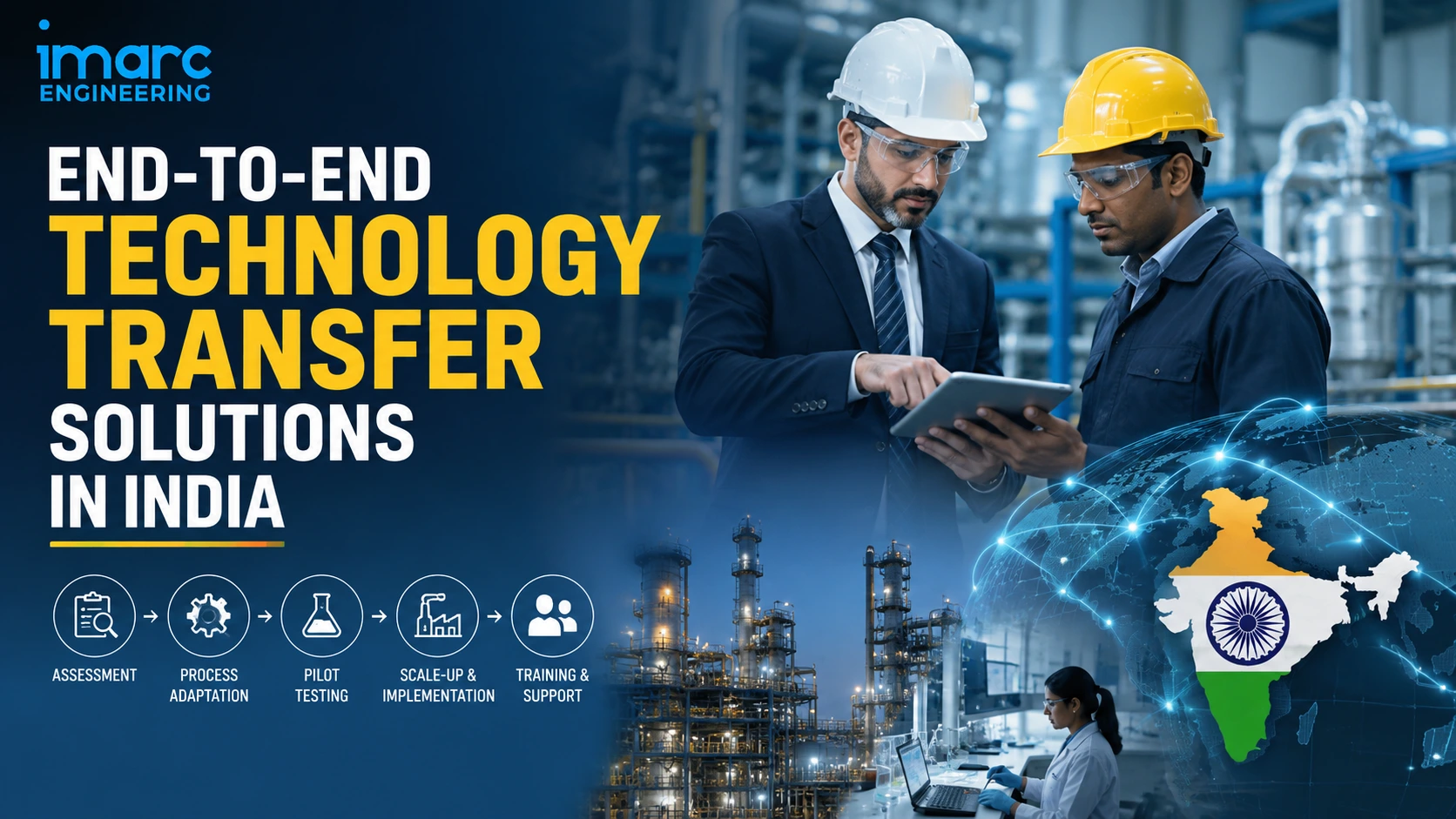
The complete lifecycle covers the following stages:
- Technology assessment and commercial viability screening
- Feasibility analysis covering infrastructure, raw materials, and regulatory fit
- Licensing and IP transfer with structured legal support
- Process engineering adaptation for Indian operating conditions
- Pilot plant validation to confirm process performance before scale-up
- Commercial scale-up with full plant design and production targeting
- Workforce training and production commissioning
Each phase builds on the previous one, and gaps between stages are where most industrial technology transfer failures originate.
Why Technology Transfer Is Critical for Industrial Projects in India
The difference between a structured Technology Transfer approach and an unmanaged one is measurable across every dimension of project performance.
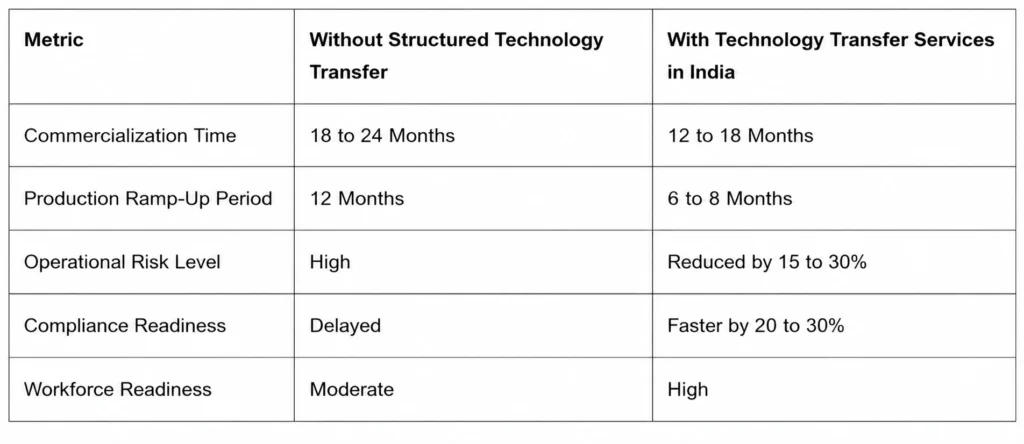
Companies that engage dedicated Industrial technology transfer partners report project timelines shortened by 20 to 35%. Operational cost deviations, among the most damaging outcomes of poorly adapted processes, are reduced by 15 to 30% through upfront engineering work. First-pass product quality rates improve significantly, and the frequency of production stoppages during commissioning drops when process validation is handled systematically before capital is committed.
Key Components of Successful Technology Transfer
Technology Due Diligence
Before any licensing agreement is signed, a rigorous due diligence process must evaluate the following:
- Technical maturity and scalability of the technology
- Existing patent landscape and freedom-to-operate status
- Regulatory approval status in the country of origin and in India
- Compatibility with Indian infrastructure, utilities, and raw material supply
Skipping this step is the single most common cause of failure in industrial technology acquisition projects.
Intellectual Property and Licensing Support
Industrial licensing agreements involve royalty structures, sub-licensing rights, field-of-use restrictions, and technology improvement clauses. A capable technology transfer consulting partner negotiates terms that protect the recipient’s long-term commercial interests while satisfying the licensor’s IP requirements, reducing the risk of disputes that delay project execution.
Engineering and Process Adaptation
Technologies developed in Germany, Japan, or the United States are calibrated for specific feedstocks, ambient conditions, and utility specifications. Indian plants operate with different grid voltages, water quality profiles, and raw material grades. Process adaptation engineering ensures the technology delivers its specified output under Indian conditions. This is where Industrial technology transfer adds disproportionate value, translating a foreign process specification into a plant design that works from day one.
Pilot Plant Validation
Pilot trials are non-negotiable for complex chemical, pharmaceutical, or specialty materials processes. A 50 to 100-litre pilot batch may reveal scaling challenges that, if unaddressed, translate into costly failures at 50,000-litre commercial scale. Structured pilot validation reduces the risk of post-commissioning process failures by an estimated 25 to 45% in high-complexity manufacturing environments.
Knowledge Transfer and Workforce Training
A technology performs only as well as the team operating it. Effective workforce training programmes under technology transfer solutions typically cover:
- Process principles and critical operating parameters
- Equipment operation, startup, and shutdown procedures
- Quality control protocols and in-process testing methods
- Safety, emergency response, and environmental compliance procedures
Structured training ensures the receiving organisation can sustain and improve upon the transferred technology without long-term dependency on the licensor.
Real-World Applications of Technology Transfer in Indian Industry
Specialty Chemicals: A specialty chemical manufacturer transferring a European continuous-flow reaction process to a new greenfield facility in Gujarat faces significant process adaptation requirements. Feed gas composition, ambient humidity, and utility water quality all differ from European norms. A structured technology transfer solutions programme handles process parameter recalibration, equipment resizing, and pilot validation before plant construction begins, cutting the risk of post-commissioning yield losses that typically run 15 to 25% in unmanaged transfers.
EV Battery Manufacturing: An EV battery manufacturer licensing advanced chemistry cell technology from a South Korean developer needs more than equipment supply. The electrode coating formulations, electrolyte specifications, and formation cycling protocols must be transferred, validated under Indian manufacturing conditions, and documented for regulatory submission under PLI scheme performance benchmarks. End-to-end Industrial technology transfer support covers the full technical and compliance pathway from licensor lab to commercial cell production.
Pharmaceuticals: A pharmaceutical company transferring an API manufacturing process from a European innovator to a CDSCO-approved Indian facility must demonstrate analytical method equivalence, equipment qualification, and process validation before commercial supply can begin. technology transfer services in India that cover regulatory documentation alongside engineering adaptation reduce the compliance timeline by 20 to 30%, directly accelerating revenue generation from the transferred asset.
Technology Transfer Applications Across Industries
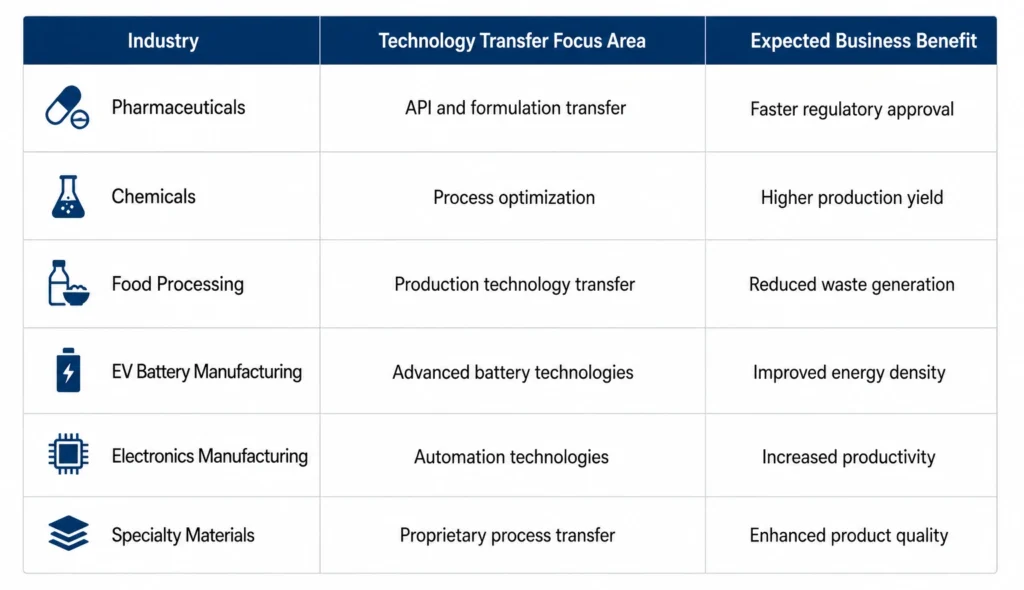
India’s pharmaceutical sector, supplying over 20% of global generic medicines by volume, relies heavily on structured technology transfer solutions to meet both domestic and export market quality standards. The EV battery space, supported by PLI scheme incentives of Rs. 18,100 crore for advanced chemistry cells, is one of the fastest-growing areas for Manufacturing technology transfer in India today.
Challenges in Technology Transfer Projects and How to Overcome Them
Industrial technology transfer projects face five recurring challenge categories, each requiring a targeted response:
- IP Protection: Technology owners are reluctant to transfer core process IP without legal safeguards. Structured licensing agreements with defined IP boundaries, audit provisions, and improvement-ownership clauses resolve most friction at the negotiation stage rather than in post-transfer disputes.
- Process Scalability: Technologies that perform at pilot scale encounter yield losses or equipment performance gaps at commercial scale. Scale-up engineering informed by rigorous pilot data is the primary mitigation and a core component of effective technology transfer consulting.
- Workforce Skill Gaps: A McKinsey study found over 60% of manufacturing companies in emerging markets cite skill gaps as a top barrier to technology adoption. Tiered training programmes built around the specific transferred process directly address this gap.
- Regulatory Compliance: For pharmaceutical, chemical, and food processing sectors, compliance requires process validation, equipment qualification, and analytical method transfer documentation. Technology Transfer Services in India with embedded regulatory expertise reduce compliance timelines by 20 to 30%.
- Technology Adaptation Risks: Incompatibility between the original process design and Indian operating conditions is the leading cause of post-transfer underperformance. Front-end engineering adaptation, completed before capital commitment, eliminates the majority of these risks.
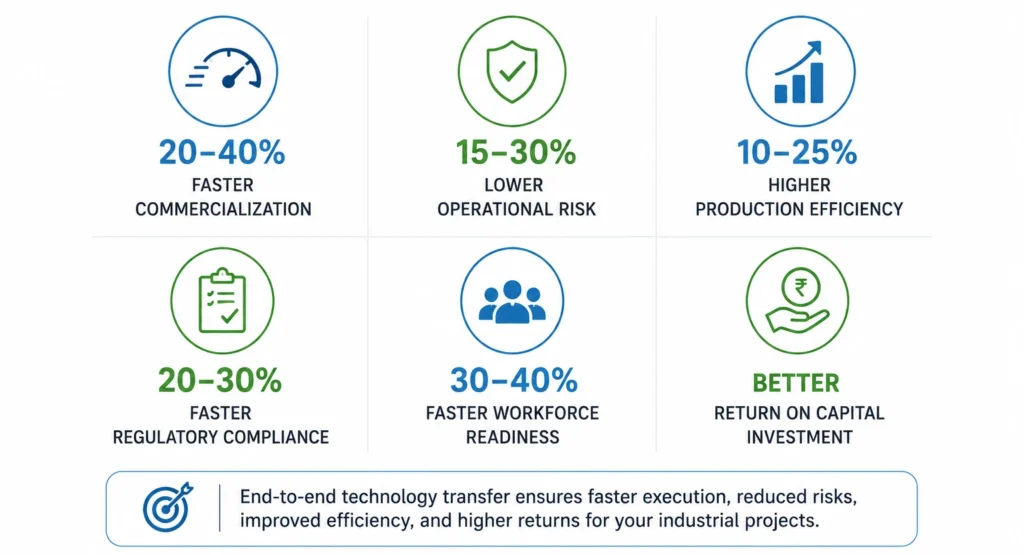
Top Benefits of End-to-End Technology Transfer Services
Selecting the Right Technology Transfer Partner in India
Evaluating a technology transfer partner in India requires scrutiny across several dimensions. Decision-makers should assess the following criteria before shortlisting:
- Industry-specific expertise in regulated or technically complex manufacturing sectors
- Engineering capabilities spanning process design, equipment selection, plant layout, and utilities
- Current, sector-specific regulatory knowledge covering CDSCO, MoEFCC, CPCB, BEE, and PESO requirements
- Demonstrated project management experience across multi-phase Industrial technology transfer programmes
- Pilot plant and commercial scale-up execution capability
- Post-transfer support covering troubleshooting, optimisation, and workforce refresher training
Post-transfer support capability in particular determines whether the transferred technology achieves its long-term commercial potential, or plateaus below its specified performance parameters.
Future Outlook for Technology Transfer in India
India’s Manufacturing technology transfer landscape is being reshaped by several converging forces. Industry 4.0 adoption is driving demand for AI-enabled process monitoring, digital twin validation, and smart factory integration, all of which require structured technology transfer solutions rather than simple equipment procurement. Key growth areas shaping demand for Industrial technology transfer include:
- The India Semiconductor Mission, with a government outlay of Rs. 76,000 crore, creating demand for specialised technology transfer services in India covering fabrication, assembly, testing, and packaging
- The EV manufacturing ecosystem requiring coordinated Manufacturing technology transfer across automobiles, battery cells, and components
- Sustainability-focused manufacturing transitions adding clean process technology to the transfer pipeline at an accelerating rate
- AI-driven smart factory deployments requiring process knowledge transfer alongside technology installation
India’s total manufacturing output is targeted to reach USD 1 trillion by the end of this decade, and systematic Technology Transfer Services in India will be central to achieving it.
How IMARC Engineering Helps with Technology Transfer Services in India
IMARC Engineering provides structured, end-to-end technology transfer services in India to manufacturing companies, industrial project developers, and investors seeking to acquire, adapt, and commercialise proven technologies across the pharmaceutical, chemical, food processing, EV battery, electronics, and specialty materials sectors.
Our capabilities include:
- Technology evaluation and due diligence
- IP and licensing negotiation support
- Process engineering adaptation for Indian conditions
- Pilot plant design and validation
- Commercial scale-up and detailed plant engineering
- Regulatory compliance documentation across CDSCO, MoEFCC, BEE, and sector-specific bodies
- Workforce training and full production commissioning
We act as the technical bridge between the licensor and the Indian operator, ensuring the transferred process performs at specified parameters from the first day of commercial production. Whether you are establishing a greenfield facility around a licensed technology or integrating a new process into an existing plant, IMARC Engineering brings the engineering depth, project management discipline, and regulatory knowledge your technology transfer project demands.
Contact IMARC Engineering today to discuss your requirements and build a project execution roadmap that delivers commercial production readiness on schedule and within budget.
Connect to Our Team: https://www.imarcengineering.com/contact?service=technology-transfer
Contact Us:
IMARC Engineering
Phone: +91-120-433-0800
Email: sales@imarcengineering.com
India: C-130, Sector 2, Noida, Uttar Pradesh 201301LinkedIn: https://www.linkedin.com/showcase/imarc-engineering/
About the Author