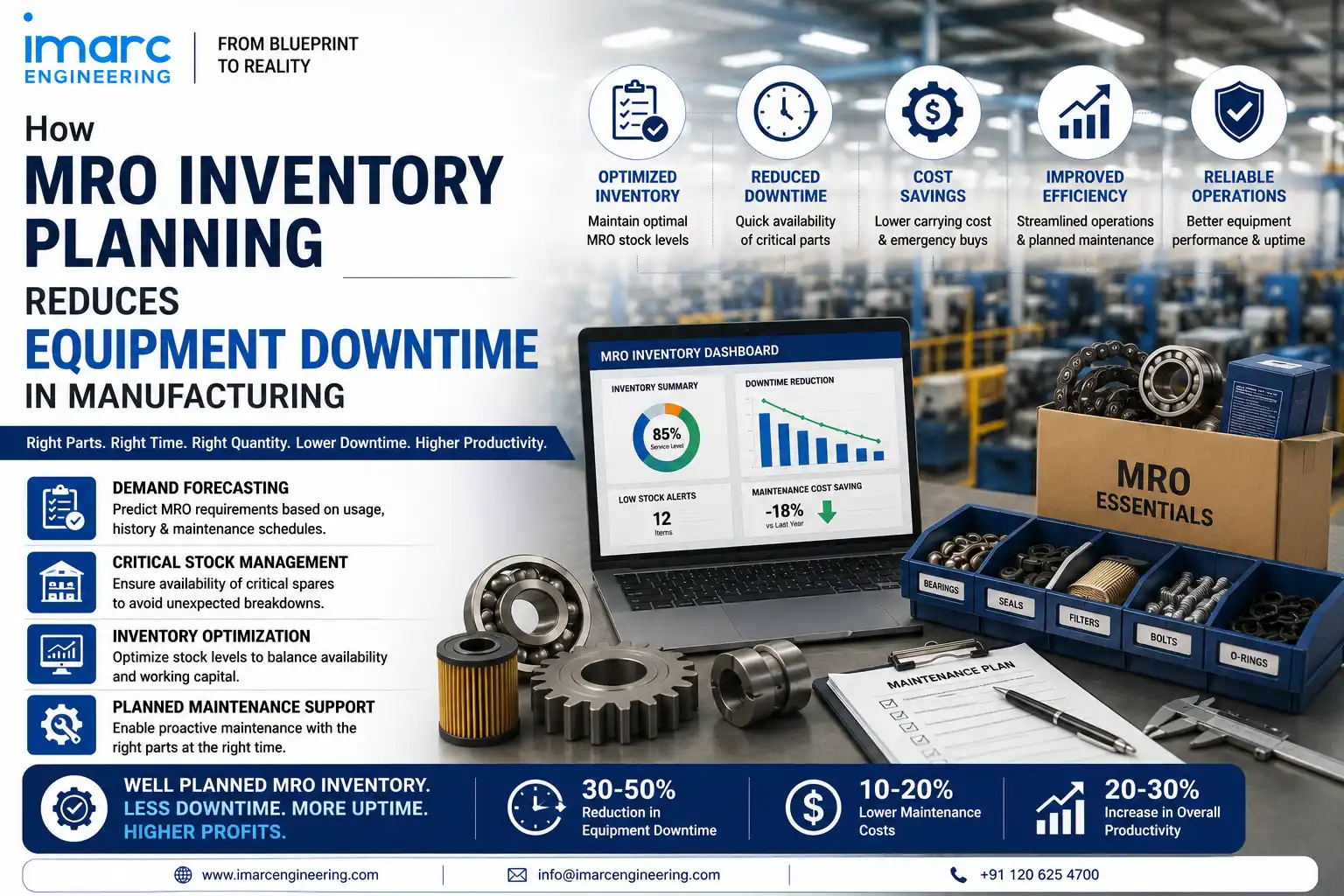
Every minute of equipment downtime reduces production output, increases maintenance costs, and puts delivery commitments at risk. In many cases, the real cause of prolonged downtime is not the equipment failure itself, but the inability to source the right spare part when it is needed. MRO Inventory Planning Services help manufacturers ensure critical spare parts are available at the right time, reducing maintenance delays and improving equipment reliability.
Rather than relying on reactive purchasing after a breakdown occurs, MRO Inventory Planning Services India help manufacturers align spare-parts availability with equipment criticality, maintenance schedules, and supplier lead times. This structured approach enables organizations to reduce unplanned downtime, optimize working capital, and improve overall maintenance efficiency.
Why Equipment Downtime Is a Rising Concern for Indian Manufacturers
Manufacturing Growth Is Raising the Stakes
- Sector expansion: Manufacturing value added grew 9.1% in Q2 FY2025-26, per MOSPI’s quarterly GDP estimates, and now contributes close to 17% of India’s Gross Value Added.
- PLI-linked capacity: Cumulative investment under the Production Linked Incentive scheme has crossed ₹2.16 lakh crore, per PIB — capacity that cannot afford repeated unplanned stoppages.
The Real Cost of Unplanned Downtime
- Frequency: 88% of Indian industrial businesses experience unplanned outages at least once a month, versus a 69% global average (ABB India “Value of Reliability” survey).
- Cost per hour: The typical Indian business loses close to ₹7 million for every hour of unplanned downtime, per the same survey.
- Reactive culture: 19% of Indian businesses surveyed still operate on a run-to-fail maintenance model, with no planned spare-parts buffer.
Logistics and Inventory-Carrying Costs Add Pressure
- National benchmark: India’s logistics cost is estimated at 7.97% of GDP for FY2023-24 under the DPIIT-NCAER assessment, with warehousing and inventory carrying identified as a distinct, trackable cost component.
- Spares are not exempt: Every rupee locked in unplanned or excess spare-parts stock adds directly to this inventory-carrying burden, without guaranteeing that the right part is available when a machine actually fails.
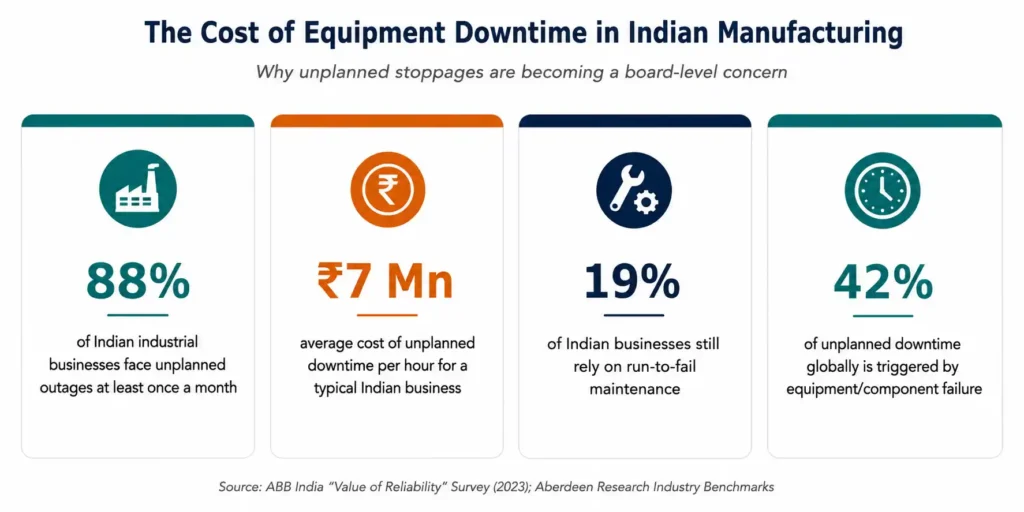
The scale of India’s downtime problem — ABB India survey; Aberdeen Research benchmarks
The Direct Link Between MRO Inventory and Equipment Uptime
- Downtime is a procurement problem in disguise: In most breakdowns, the technical repair takes minutes; sourcing the correct spare part is what extends the stoppage.
- Failure is common, delay is optional: Equipment failures cannot always be prevented, but extended downtime caused by unavailable spare parts can largely be avoided through structured inventory planning.
- Planned inventory removes the wait: When critical spares are stocked against a documented criticality list, the downtime window shrinks to the repair time alone.
Why MRO Inventory Planning Often Fails on the Shop Floor
- No criticality classification — fast-moving and mission-critical spares are stocked the same way as low-impact items, tying up capital in the wrong place.
- Manual, register-based tracking with no automatic reorder trigger, so stockouts are discovered only after a machine has already stopped.
- Vendor lead times are not mapped against reorder points, leaving no buffer for import delays or single-source dependency.
- Spare-parts knowledge sits with individual technicians rather than a documented system, creating risk when staff change.
- Maintenance schedules and inventory systems operate in isolation, so a planned service date does not automatically trigger a parts check.
Key Components of Effective MRO Inventory Planning
1. Criticality Classification
- Ranking every asset by production impact, safety risk, and repair complexity before deciding stock levels.
- Identifying single point-of-failure equipment that must never face a stockout.
2. ABC-VED Analysis
- Classifying spares by consumption value (A/B/C) and essentiality (Vital/Essential/Desirable).
- Directing working capital toward Vital-A items first, rather than spreading it evenly.
3. Min-Max Stock Levels and Reorder Points
- Setting reorder points from actual failure history and vendor lead time, not rule-of-thumb buffers.
- Reviewing levels periodically as equipment ages and failure patterns shift.
4. Vendor-Managed Inventory and Lead-Time Mapping
- Sharing consumption data with OEMs and authorised vendors to shorten replenishment cycles.
- Dual-sourcing critical imported components to reduce single-vendor dependency.
5. CMMS/ERP Integration
- Linking preventive maintenance schedules directly to spare-parts stock, so a service date automatically checks availability.
- Real-time visibility for maintenance planners across multiple plant locations.
6. Periodic Audits and Obsolescence Review
- Physically verifying stock records against shelf inventory at fixed intervals.
- Identifying dead or obsolete stock tied to decommissioned equipment and releasing that capital.
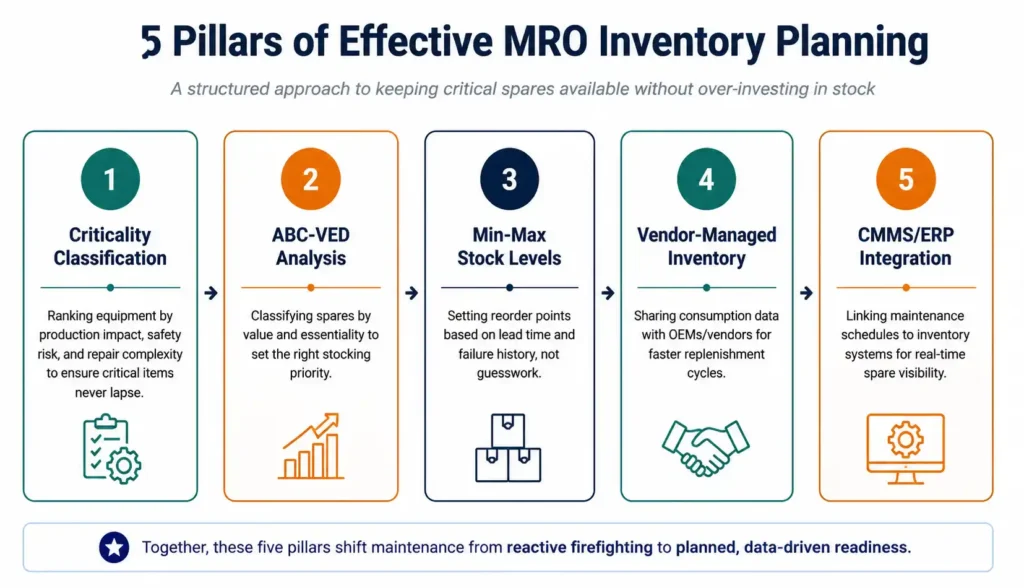
The five pillars that convert reactive spares management into planned MRO inventory readiness
Government Push Toward Structured Maintenance and Inventory Practices
- MSME Sustainable (ZED) Certification, Ministry of MSME: Promotes Lean tools, 5-S, Kaizen, and Total Productive Maintenance among manufacturing MSMEs as part of certification readiness.
- MSME Competitive (Lean) Scheme: Funds up to 80% of consultant fees for MSMEs adopting Lean Manufacturing, Value Stream Mapping, and Just-in-Time practices — tools that directly target inventory and downtime reduction.
- National Logistics Policy and the DPIIT-NCAER framework: Formally recognises inventory carrying cost as a distinct, measurable component of India’s logistics bill, encouraging more disciplined stock planning.
- Make in India / PLI ecosystem: Ties new manufacturing capacity across 14 sectors to reliable, uninterrupted operations — raising the cost of unplanned downtime at scale.
Industries Where MRO Inventory Planning Matters Most
- Automotive components: An industry with turnover of US$80.2 billion in FY2025 and exports of US$22.9 billion, per ACMA, where a single line stoppage cascades into missed OEM delivery schedules.
- Pharmaceuticals: Exports reached US$30.47 billion in FY2025, with India supplying 57% of WHO-prequalified APIs globally — a sector where GMP compliance leaves no room for reactive maintenance.
- Electronics: Exports rose 32.46% in FY2025 to ₹3,31,904 crore, driven by high-precision, high-uptime assembly lines.
- Chemicals and process industries: Continuous-process plants where an unplanned shutdown risks both output loss and safety exposure, making spare-parts readiness a compliance issue as much as an operational one.
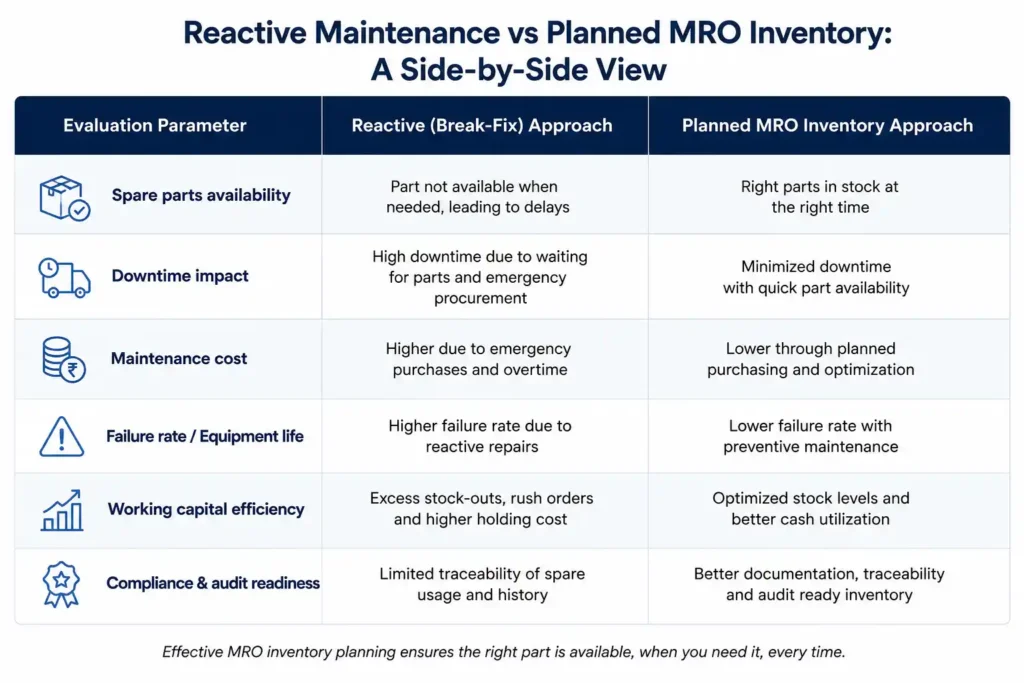
Reactive Maintenance vs Planned MRO Inventory: A Side-by-Side View
How IMARC Engineering Supports MRO Inventory Planning
IMARC Engineering works with manufacturers across India to move spare-parts management from informal, reactive stocking to a documented, criticality-driven system.
- Criticality and spare-parts audit: Mapping every critical asset against production impact and current stocking status before any recommendation is made.
- ABC-VED based stock rationalisation: Identifying where working capital is over-committed and where critical items are under-stocked.
- Reorder framework design: Building min-max levels and CMMS/ERP-linked triggers suited to each plant’s failure history and vendor lead times.
- Vendor lead-time benchmarking: Comparing sourcing timelines across vendors to reduce single-source risk on critical spares.
- Audit-ready documentation: Structured records that support ZED, ISO, and internal governance reviews.
Talk to IMARC Engineering’s MRO Planning Experts: https://www.imarcengineering.com/contact?service=spare-parts-planning-and-inventory-setup
Conclusion
MRO inventory planning is no longer simply a maintenance activity—it has become an important contributor to production reliability, cost control, and operational resilience. By aligning spare-parts availability with equipment criticality, maintenance schedules, and supplier lead times, manufacturers can significantly reduce unplanned downtime while improving inventory efficiency.
A structured MRO inventory strategy enables manufacturers to protect production continuity, optimize working capital, and support long-term manufacturing performance in an increasingly competitive operating environment.
Contact Us:
IMARC Engineering
Phone: +91-120-433-0800
Email: sales@imarcengineering.com
India: C-130, Sector 2, Noida, Uttar Pradesh 201301
LinkedIn: https://www.linkedin.com/showcase/imarc-engineering/
About the Author