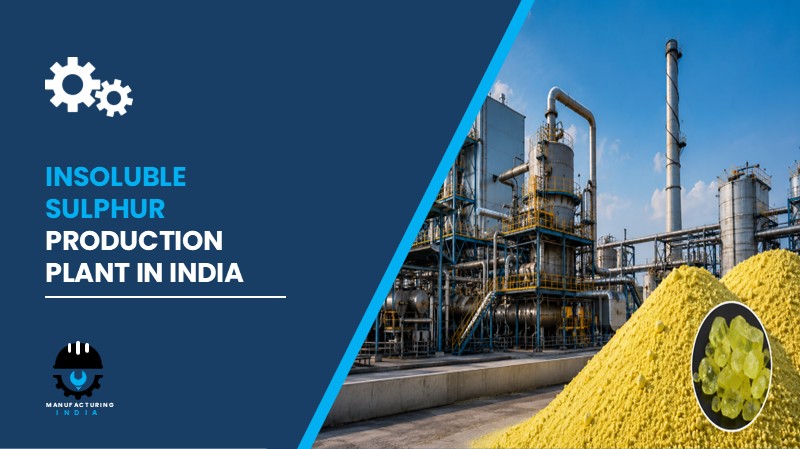
Setting up an insoluble sulphur production plant in India presents a compelling investment case at a time when the country’s tire manufacturing sector is scaling rapidly, its automotive component exports are accelerating to record volumes, its industrial rubber goods manufacturing is deepening, and its retreading and specialty rubber industry is growing with the expanding commercial vehicle fleet. Insoluble sulphur — the specialised polymeric allotrope of elemental sulphur that functions as an anti-blooming vulcanising agent in tire and rubber manufacturing — is one of the most technically indispensable specialty chemical additives in the global rubber industry, valued precisely because it prevents the premature migration of sulphur to the surface of uncured rubber compounds that would degrade adhesion, surface quality, and the curing uniformity of high-performance radial tires and industrial rubber products. As India’s tire manufacturing sector expands with rising vehicle production and replacement demand, and as its rubber goods manufacturing deepens across conveyor belts, hoses, and automotive rubber components, the domestic requirement for specification-grade insoluble sulphur from reliable Indian producers is growing into a commercially sound and technically specialised investment opportunity.
India’s tire and automotive rubber sector data confirms the exceptional growth momentum underlying this opportunity. According to NITI Aayog, India’s current share in globally traded auto components is approximately 3% or USD 20 Billion — a market position that reflects both the scale of existing automotive component manufacturing and the substantial headroom for continued export growth. The April 2026 announcement by Flexsys — one of the world’s leading insoluble sulphur producers — of a price increase of USD 0.75/kg for all insoluble sulphur grades sold in India, citing escalating oil-derived raw material costs, energy costs, and logistics disruptions to Middle East export flows through the Strait of Hormuz, is a direct and quantified signal of the commercial opportunity for domestic Indian insoluble sulphur production. Supply chain disruption to imported insoluble sulphur strengthens the commercial case for local production that tire manufacturers and rubber goods producers can depend on with shorter lead times, reduced logistics cost, and no exposure to geopolitical export flow disruption.
Investing in an insoluble sulphur production plant in India today aligns India’s expanding tire and rubber manufacturing sector, growing auto component exports, and active supply chain localisation imperative — confirmed by Flexsys’s April 2026 USD 0.75/kg India price increase — with a global insoluble sulphur market growing from USD 1.6 Billion in 2025 to USD 2.1 Billion by 2034 at a CAGR of 2.79%. With gross profit margins of 22–30% and net profit margins of 13–19% at an annual production capacity of 15,000 MT, the unit economics are commercially sound and the investment’s critical rubber additive positioning supports defensible long-term returns.
What is Insoluble Sulphur?
Insoluble sulphur is a specialised, polymeric allotrope of elemental sulphur, named for its inability to dissolve in carbon disulphide. Produced through the thermal polymerisation of ordinary sulphur, its long, chain-like molecular structure prevents it from migrating — “blooming” — to the surface of uncured rubber. This unique anti-blooming property makes it an indispensable vulcanising agent in the rubber and tire manufacturing industries.
By remaining evenly dispersed during the mixing and storage phases of rubber compounding, insoluble sulphur significantly improves the durability, heat resistance, and structural adhesion of rubber products. In tire manufacturing specifically, insoluble sulphur’s uniform dispersion is critical for ensuring consistent steel cord to rubber adhesion in radial tire construction — the performance characteristic that defines the structural integrity and service life of high-performance passenger car, truck, and off-road tires. The product is typically supplied as oil-treated granules or powder to improve handling and dispersibility in rubber mixing operations, with the oil treatment preventing reversion of the polymeric allotrope to ordinary soluble sulphur at elevated temperatures.
The primary production process covers insoluble sulphur production through thermal polymerisation, stabilisation, and oil treatment. End-use industries served include tire manufacturing, rubber processing, automotive components, industrial belts and hoses, footwear, and cable sheathing. Applications span vulcanising agent for radial tire production, rubber compounding, heat-resistant rubber goods, anti-blooming rubber blends, and high-performance elastomer systems.
Cost of Setting Up an Insoluble Sulphur Production Plant in India
The cost of establishing an insoluble sulphur production plant in India depends on production capacity, thermal polymerisation technology selection and quenching system design, product grade mix across different insoluble sulphur content percentages and oil treatment specifications, geographic location — particularly proximity to elemental sulphur supply and tire manufacturer customers — degree of automation, and the quality compliance requirements applicable to insoluble sulphur supplied to tire OEM and rubber goods manufacturer customers.
1. Capital Expenditure (CapEx)
Land and Site Development forms a foundational component of total capital investment, covering land acquisition charges, site registration, boundary development, sulphur storage containment drainage, and site utilities. The location must offer easy access to key raw materials such as elemental sulphur and liquid nitrogen as the quenching medium. Proximity to target markets — particularly India’s major tire manufacturing clusters in Chennai (Apollo, MRF, TVS), Pune, Baroda, and Gurgaon — minimises distribution costs on specialty chemical products with defined shelf stability requirements. The site must have robust infrastructure including reliable transportation, utilities, and waste management systems. Compliance with local zoning laws and environmental regulations must be ensured. Chemical industrial estates in Gujarat and Maharashtra offer proximity to both elemental sulphur supply chains from petrochemical and refinery operations and tire manufacturing customer clusters in western India.
Plant Layout Optimisation is critical for an insoluble sulphur production facility — integrating sulphur melting and filtration, high-temperature polymerisation reactors operating above 160°C, rapid quenching systems using liquid nitrogen or cold water, drying and oil treatment operations, and packaging in a safely segregated workflow. Separate areas for elemental sulphur storage with fire safety provisions, sulphur melting and filtration, polymerisation reactor bays, quenching and dewatering areas, drying chambers, oil treatment and blending, quality control laboratory, finished product storage, and dispatch must be designated. Space for future capacity expansion should be incorporated to accommodate growing tire manufacturer demand.
Machinery and Equipment represent the largest single component of total CapEx for an insoluble sulphur production plant. Essential equipment includes:
- Sulphur melting tanks
- Filtration units
- Polymerisation reactors
- Quenching systems
- Drying chambers
- Flaking or prilling machines
- Packaging lines
Other Capital Costs include an effluent treatment plant (ETP) to minimise environmental impact and ensure compliance with emission standards for sulphur-containing process effluents and liquid nitrogen discharge, sulphur dioxide scrubbing systems for thermal polymerisation operations, pre-operative expenses, tire industry quality certification costs, commissioning charges, and any import duties on specialised quenching system components or automated packaging line equipment not available domestically.
Request a Sample Report for In-Depth Market Insights: https://www.imarcgroup.com/n-heptane-manufacturing-plant-project-report/requestsample
2. Operational Expenditure (OpEx)
Raw Material Cost is the dominant operational expense, accounting for approximately 55–65% of total OpEx. The primary raw materials are elemental sulphur and liquid nitrogen as the quenching medium. Elemental sulphur — consumed in the largest volumes as the feedstock converted to the polymeric insoluble allotrope through thermal polymerisation — drives the vast majority of raw material cost. India’s domestic elemental sulphur supply from petroleum refinery desulphurisation operations and imported sulphur provides a cost-competitive and reliable procurement base. Liquid nitrogen serves as the quenching medium in the rapid cooling step that locks the polymeric sulphur allotrope in its insoluble form, preventing reversion to ordinary rhombic sulphur during cooling. Long-term contracts with reliable elemental sulphur and industrial gas suppliers must be negotiated to stabilise pricing and ensure steady supply.
Utility Cost is the second-largest OpEx component, representing approximately 10–14% of total operating expenses, covering electricity and fuel for sulphur melting tanks, polymerisation reactor heating to the high temperatures required for sulphur polymerisation, liquid nitrogen generation or procurement for quenching, drying chamber operations, and general plant services. Managing the energy intensity of sulphur melting and high-temperature polymerisation through heat recovery and efficient reactor operation is an important lever for improving facility economics.
Other Operating Costs include transportation and distribution to tire manufacturers, rubber compounding companies, conveyor belt and hose producers, automotive rubber component manufacturers, footwear producers, and cable sheathing manufacturers, oil-treated sulphur drum and bag packaging materials, salaries and wages for chemical process engineers and quality control analysts, routine machinery maintenance including polymerisation reactor servicing and quenching system calibration, depreciation on production equipment, and applicable taxes. By the fifth year, the total operational cost is expected to increase substantially due to factors such as inflation, market fluctuations, and potential rises in the cost of key materials. Additional factors, including supply chain disruptions, rising consumer demand, and shifts in the global economy, are expected to contribute to this increase.
3. Plant Capacity
The proposed production facility is designed with an annual production capacity of 15,000 MT, enabling economies of scale while maintaining operational flexibility across multiple insoluble sulphur grades — standard grades for tire body rubber compounds, high-stability grades for passenger car radial belt compounds, and premium low-reversion grades for demanding performance tire and industrial rubber applications. Plant capacity can be customised per investor requirements and phased in line with tire manufacturer qualification approvals and supply contract volumes. Profitability improves with higher capacity utilisation, making secured supply agreements with major tire manufacturers a strategic commercial foundation from the earliest stages of production.
4. Profit Margins and Financial Projections
The financial projections for an insoluble sulphur production plant demonstrate commercially sound profitability potential under normal operating conditions. Gross profit margins typically range between 22–30%, supported by stable demand and value-added applications across tire manufacturing, rubber processing, and industrial rubber goods segments. Net profit margins are projected at 13–19% — commercially attractive returns reflecting the meaningful technical value-added conversion of elemental sulphur into a precisely stabilised, oil-treated specialty chemical that commands a significant premium over commodity sulphur pricing. A comprehensive financial analysis covering NPV (net present value), IRR (internal rate of return), payback period, gross margin progression, and net margin development across a five-year horizon is essential before committing capital.
Why Set Up an Insoluble Sulphur Production Plant in India?
Critical Rubber Industry Additive with Structural Demand from India’s Tire Sector. Insoluble sulphur is an essential vulcanising agent used in the production of radial tires, automotive rubber components, industrial belts, hoses, and other high-performance rubber products — making it a vital material for tire durability, heat resistance, and manufacturing efficiency. India’s tire manufacturing sector — served by major producers including MRF, Apollo, CEAT, JK Tyre, Birla Tyres, and Goodyear India — constitutes a large and growing domestic customer base for insoluble sulphur that is structurally tied to India’s expanding vehicle fleet and replacement tire market.
Supply Chain Disruption Creating Immediate Commercial Opportunity for Domestic Production. In April 2026, Flexsys announced a price increase of USD 0.75/kg for all insoluble sulphur grades sold in India, citing the continued escalation of oil-derived raw materials, energy, and logistics costs driven by significant disruptions to Middle East export flows through the Strait of Hormuz. This announcement — from one of the world’s largest insoluble sulphur producers specifically referencing India — is a direct, real-time commercial signal that domestic Indian production is needed to reduce import dependence, stabilise prices, and insulate tire manufacturers from geopolitical supply chain disruptions.
Megatrend Alignment with Rising Vehicle Production and Tire Replacement Demand. Rising vehicle production, increasing tire replacement demand, expansion of electric mobility, and growth in industrial machinery are driving sustained consumption of high-performance tires and rubber goods, thereby supporting long-term demand for insoluble sulphur globally. India’s vehicle parc growth, radialization of tire manufacturing toward high-performance radial construction, and expanding commercial vehicle fleet collectively create a domestic insoluble sulphur demand trajectory that is both large in volume and structurally growing across the investment horizon.
India’s Auto Component Export Share Confirming Sector Scale. According to NITI Aayog, India’s current share in globally traded auto components is approximately 3% or USD 20 Billion — a market scale that confirms the size and commercial depth of India’s automotive manufacturing ecosystem that produces the tires, rubber hoses, seals, and belts that collectively consume insoluble sulphur as a critical processing chemical. The 19% automobile export growth in FY25 reported by IBEF further confirms the expanding scale of Indian automotive manufacturing activity that drives domestic specialty chemical consumption.
Asia-Pacific Market Leadership and Supply Chain Localisation Trend. Asia-Pacific is expected to remain a major consumption and production hub for insoluble sulphur due to strong automotive, tire, and rubber processing activity in the region. Tire manufacturers are increasingly seeking dependable regional suppliers to reduce procurement risks, ensure product consistency, and improve supply security — creating commercial opportunities for local insoluble sulphur manufacturers with strong quality systems and reliable production capabilities that can serve the Indian market with shorter delivery times, no import duty exposure, and full domestic regulatory compliance.
Policy and Infrastructure Investment Supporting Rubber Industry Growth. Government investments in transportation infrastructure — highways, expressways, and rural roads — industrial development, automotive manufacturing, and domestic chemical production initiatives are indirectly strengthening demand for tire and rubber products, creating favourable conditions for insoluble sulphur producers. India’s continued investment in road infrastructure drives vehicle utilisation and replacement tire consumption, creating a sustained structural demand environment for specialty tire chemicals that supports long-term production economics.
Production Process — Step by Step
The insoluble sulphur production process uses sulphur melting, filtration, thermal polymerisation, quenching, dewatering, drying, stabilisation, and oil treatment as the primary production method. Each stage requires precisely controlled temperature profiles, quench rate management, and quality verification to produce insoluble sulphur with the target insoluble content percentage, thermal stability, and dispersibility characteristics required by tire manufacturer and rubber goods customer specifications.
- Elemental Sulphur Receipt and Storage: Feed-grade elemental sulphur is received from refinery desulphurisation operations or import sources, quality-checked for purity and contaminant levels, and transferred to sulphur storage with appropriate fire safety provisions and containment for the highly flammable elemental sulphur feedstock.
- Sulphur Melting: Elemental sulphur is melted in sulphur melting tanks at controlled temperatures — typically 120–140°C — to produce a mobile liquid sulphur melt of the target viscosity for filtration and subsequent polymerisation reactor feed.
- Filtration: Molten sulphur is passed through filtration units to remove insoluble impurities — ash, carbon, and mineral contaminants — that would affect the purity and colour specifications of the finished insoluble sulphur product.
- Thermal Polymerisation: Filtered liquid sulphur is heated in polymerisation reactors to the polymerisation temperature range — typically above 160°C and often above 200°C — where the ordinary S₈ ring molecules open and link to form long-chain polymeric sulphur (Sμ), which is the insoluble polymeric allotrope targeted by the process. Polymerisation temperature, time, and reactor conditions are precisely controlled to achieve the target degree of polymerisation and insoluble sulphur content.
- Rapid Quenching: Polymerised sulphur melt is rapidly quenched using quenching systems — involving immersion in cold water, liquid nitrogen spray, or other rapid cooling media — to freeze the polymeric chain structure and prevent reversion to the thermodynamically stable S₈ ring form that would occur during slow cooling. The quench rate is the most critical process parameter determining the insoluble sulphur content and stability of the finished product.
- Dewatering and Size Reduction: Quenched insoluble sulphur is dewatered through filtration and mechanical separation, then processed through size reduction equipment to produce the particle size distribution required for subsequent drying and oil treatment operations.
- Drying: Dewatered insoluble sulphur is processed through drying chambers at controlled temperatures — carefully maintained below the reversion temperature threshold — to reduce moisture content to specification levels while preserving the polymeric allotrope structure.
- Stabilisation and Oil Treatment: Dried insoluble sulphur is treated with stabiliser additives to improve thermal stability — reducing reversion rate at rubber processing temperatures — and blended with process oil in oil treatment operations to produce the oil-treated grade that improves handling, reduces dust generation, and improves dispersibility in rubber mixing operations.
- Flaking or Prilling: Stabilised, oil-treated insoluble sulphur is processed through flaking or prilling machines to produce the commercial particle form — flakes or pastilles — specified by tire manufacturer and rubber goods producer customers for their compound mixing equipment.
- Quality Control Testing: Finished insoluble sulphur undergoes comprehensive quality testing covering insoluble sulphur content by carbon disulphide extraction, thermal stability by reversion test, oil content, moisture content, ash content, and particle size distribution, verifying compliance with tire industry specifications before packaging.
- Packaging: Specification-compliant insoluble sulphur is filled into moisture-resistant sealed bags or drums using packaging lines and dispatched to tire manufacturers, rubber compounding companies, automotive rubber component producers, conveyor belt and hose manufacturers, footwear producers, and cable sheathing manufacturers.
Key Applications
Insoluble sulphur produced in India serves a commercially important and structurally growing range of rubber vulcanisation applications across tire and industrial rubber manufacturing:
- Tire Manufacturing: Functions as the preferred vulcanising agent in radial tire production — improving heat resistance, preventing premature vulcanisation during mixing and storage, and enhancing steel cord to rubber adhesion that defines radial tire structural integrity.
- Rubber Goods: Used in conveyor belts, hoses, seals, gaskets, and industrial rubber products requiring controlled vulcanisation and uniform crosslink distribution for consistent mechanical properties and service life.
- Automotive Components: Applied in rubber parts such as bushings, mounts, vibration dampers, and other moulded components where consistent cure and adhesion to metal substrates are critical.
- Retreaded Tires and Specialty Rubber Products: Supports uniform cross-linking and improved performance in retread tires, rubber compounds, and specialty elastomer applications where insoluble sulphur’s anti-blooming property is critical for surface quality and adhesion.
Leading Producers
The global insoluble sulphur industry is served by a group of specialty chemical companies with extensive production capabilities and diverse application portfolios across tire and industrial rubber segments. Key players in the global market include:
- Nynas AB
- China Sunsine Chemical Holdings Ltd.
- Henan Kailun Chemical Co., Ltd.
- Lions Industries S.r.l.
- Grupa Azoty
Timeline to Start the Plant
Establishing an insoluble sulphur production plant in India involves a structured multi-phase development sequence. Investors should plan for the following phases:
- Feasibility study and project report preparation
- Land acquisition and site development
- Regulatory approvals and environmental clearances
- Factory licence and fire safety compliance
- Machinery procurement and installation
- Raw material supplier agreements and supply chain setup
- Trial production and quality testing
- Commercial production launch
Licences and Regulatory Requirements
Starting an insoluble sulphur production unit in India requires several approvals spanning business registration, flammable material safety, environmental, and industrial compliance domains:
- Business registration (Proprietorship, LLP, or Pvt Ltd)
- Factory Licence under the Factories Act
- Environmental Clearance from the State Pollution Control Board
- GST Registration
- Fire Safety NOC — particularly important given the highly flammable nature of elemental sulphur in storage and the hot sulphur melt processing operations throughout the production sequence
- Hazardous/Chemical compliance under the Manufacture, Storage and Import of Hazardous Chemical (MSIHC) Rules applicable to elemental sulphur and liquid nitrogen handling at industrial scale
- Effluent Treatment Plant (ETP) operational clearance to minimise environmental impact and ensure compliance with emission standards for sulphur-containing process effluents
- Occupational Health and Safety compliance including sulphur dust explosion risk management and sulphur dioxide monitoring for reactor area worker safety
Key Challenges to Consider
Elemental Sulphur Price Volatility and Supply Chain Management. Elemental sulphur accounts for approximately 55–65% of total OpEx, with pricing tied to global petroleum refinery desulphurisation economics, import logistics, and seasonal supply availability from refinery operations. While elemental sulphur has historically been among the more affordable industrial chemicals, price movements driven by crude oil processing volumes, desulphurisation capacity changes, and import logistics disruptions — as highlighted by Flexsys’s April 2026 India price increase citing Middle East supply flow disruptions — can affect the production economics of all insoluble sulphur producers, making procurement strategy and supplier diversification a key operational priority.
Critical Thermal Polymerisation Process Control. Achieving consistent insoluble sulphur content — typically 90–95% insoluble content for commercial grades — requires precise control of polymerisation temperature, residence time, and rapid quenching rate. Even minor deviations in quench timing or temperature can result in higher-than-specification reversion to soluble sulphur, generating off-specification product that must be reprocessed. This process control sensitivity requires experienced chemical engineers, calibrated instrumentation, and documented standard operating procedures across every production run.
Thermal Stability and Reversion Management in Storage and Distribution. Insoluble sulphur reverts progressively to ordinary soluble sulphur when stored above its reversion threshold temperature — a stability challenge that requires careful temperature management throughout warehousing and distribution, proper oil treatment application during production, and stabiliser additive optimisation to maximise the product’s shelf stability between production and end-use at the tire manufacturer. Managing this product stability challenge adds operational complexity that must be addressed through robust quality management across the entire supply chain.
Tire Manufacturer Qualification Cycles and Technical Approval Requirements. Supplying insoluble sulphur to major tire manufacturers requires passage through technical approval processes verifying insoluble content, thermal stability, dispersibility in rubber mixing, and consistency across multiple production lots. These qualification cycles — particularly at global tire OEMs with standardised global raw material specifications — require dedicated quality systems documentation, technical application support, and patience through multi-month approval timelines before commercial supply volumes are confirmed.
Competition from Established Global and Chinese Producers. The competitive landscape includes established global specialty producers including Flexsys, Nynas AB, and Grupa Azoty, alongside significant Chinese producers including China Sunsine Chemical Holdings Ltd. and Henan Kailun Chemical Co. New Indian producers must compete through domestic supply chain advantages, import cost elimination, delivery reliability, and the supply security benefits that geographically proximate production provides to tire manufacturers seeking to reduce their dependence on import sources subject to geopolitical disruption — as evidenced by Flexsys’s April 2026 price increase citing Middle East export flow disruptions.
Sulphur Fire and Explosion Safety Management. Elemental sulphur is a highly flammable material that can form explosive dust-air mixtures and burns with production of sulphur dioxide — a toxic gas. Managing sulphur storage fire risk, dust explosion prevention across handling and processing operations, and sulphur dioxide monitoring around reactor operations requires comprehensive fire safety and industrial hygiene management systems that represent ongoing capital and operational investment in worker and facility safety.
Frequently Asked Questions
1. How much does it cost to set up an insoluble sulphur production plant in India?
Capital requirements generally include land acquisition, construction, equipment procurement, installation, pre-operative expenses, and initial working capital. Equipment costs — for sulphur melting tanks, filtration units, polymerisation reactors, quenching systems, drying chambers, flaking or prilling machines, and packaging lines — represent a significant portion of capital expenditure. The total amount varies with capacity, technology, and location. A detailed project report with full CapEx and OpEx breakdowns is available on request.
2. Is insoluble sulphur production profitable in India in 2026?
Yes. The project demonstrates gross profit margins of 22–30% and net profit margins of 13–19% under normal operating conditions, supported by stable demand from India’s expanding tire manufacturing sector and industrial rubber goods producers. Flexsys’s April 2026 USD 0.75/kg India price increase for all insoluble sulphur grades directly confirms the import pricing premium that domestic Indian production can compete against with significant cost and supply reliability advantages.
3. What machinery is required for an insoluble sulphur production plant in India?
Key machinery includes sulphur melting tanks, filtration units, polymerisation reactors, quenching systems, drying chambers, flaking or prilling machines, and packaging lines. Polymerisation reactors and quenching systems are the most technically critical equipment items, as they together determine the insoluble sulphur content, thermal stability, and product quality that define commercial grade specification compliance.
4. What licences and approvals are required to start an insoluble sulphur production plant in India?
Required approvals include business registration, a Factory Licence under the Factories Act, Environmental Clearance from the State Pollution Control Board, GST registration, a Fire Safety NOC for flammable sulphur storage and processing, MSIHC Rules compliance for elemental sulphur and liquid nitrogen handling, ETP operational clearance, and Occupational Health and Safety compliance including sulphur dust explosion risk management.
5. What raw materials are needed for insoluble sulphur production?
The primary raw materials are elemental sulphur and liquid nitrogen as the quenching medium. Elemental sulphur accounts for approximately 55–65% of total operating expenses, making sulphur procurement strategy, supplier relationships with domestic refinery desulphurisation operations and import sources, and sulphur price risk management the most critical cost management levers for the investment.
6. What are the environmental compliance requirements for an insoluble sulphur production plant in India?
The unit must obtain Environmental Clearance from the State Pollution Control Board, operate a certified ETP to minimise environmental impact and ensure compliance with emission standards for sulphur-containing process effluents, install sulphur dioxide scrubbing systems for reactor area emissions, implement sulphur dust containment and explosion prevention systems, and maintain monitoring systems for air quality and wastewater discharge in line with applicable state pollution control standards.
7. What is the best location to set up an insoluble sulphur production plant in India?
Optimal locations offer proximity to elemental sulphur supply from domestic petroleum refineries or import port terminals, reliable utilities including industrial gas supply for liquid nitrogen quenching, and logistics connectivity to major tire manufacturing clusters in Chennai, Pune, Baroda, and Gurgaon. Chemical industrial estates in Gujarat and Maharashtra offer the most commercially advantaged combination of raw material proximity and tire manufacturer customer access.
8. What is the break-even period for this type of plant in India?
The break-even period depends on plant capacity, tier manufacturer qualification timelines, capacity utilisation rate, elemental sulphur pricing trends, and demand conditions across tire and industrial rubber customer segments. A detailed financial analysis including payback period, NPV, and IRR projections is included in the full project report, available via the sample request link.
9. What government incentives are available for manufacturers in India?
The Make in India initiative, specialty chemical manufacturing incentives, state-level chemical industry promotion policies in Gujarat and Maharashtra, and export promotion benefits for specialty rubber chemicals provide financial and regulatory support for insoluble sulphur production investments. Capital subsidies, power tariff concessions, and duty drawback schemes for exported specialty chemicals may be applicable depending on the chosen plant location and production profile.
Key Takeaways for Investors
An insoluble sulphur production plant in India represents a commercially well-positioned investment in a technically specialised rubber industry additive that sits at the absolute core of tire vulcanisation chemistry — an indispensable ingredient for every radial tire and high-performance rubber goods product manufactured in India’s expanding automotive supply chain. The project demonstrates financial viability at an annual production capacity of 15,000 MT, with gross profit margins of 22–30% and net profit margins of 13–19% confirming commercially sound unit economics supported by the meaningful technical value-added conversion of commodity elemental sulphur into a precisely polymerised, stabilised, and oil-treated specialty chemical that commands a significant price premium in India’s tire and rubber market. The global insoluble sulphur market, valued at USD 1.6 Billion in 2025, is projected to reach USD 2.1 Billion by 2034 growing at a CAGR of 2.79%, with India’s tire manufacturing sector — backed by NITI Aayog’s confirmation of USD 20 Billion in auto component exports — and the April 2026 Flexsys India price increase of USD 0.75/kg signalling both strong domestic demand and the supply chain vulnerability of import dependence that domestic Indian production directly addresses. With Asia-Pacific expected to remain the dominant consumption and production hub for insoluble sulphur, tire manufacturer supply chain localisation preferences growing stronger, and India’s vehicle fleet and replacement tire demand expanding structurally, demand sustainability for India-based insoluble sulphur production is structurally robust, commercially well-timed, and strategically compelling across the full investment horizon.
About the Author