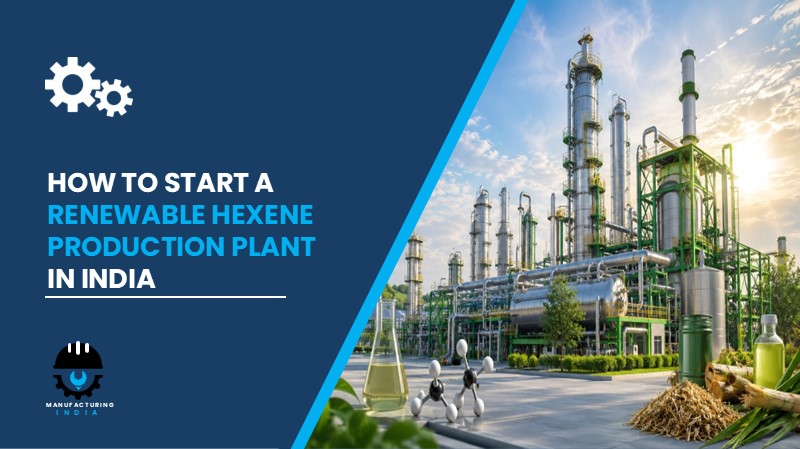
Setting up a renewable hexene production plant in India presents a compelling investment case driven by surging demand across renewable fuels, sustainable chemicals, bioplastics, automotive, aerospace, and green energy storage sectors. As industries worldwide accelerate decarbonisation commitments, bio-hexene — a six-carbon alkene synthesised from renewable feedstocks — has emerged as a critical green building block for polyethylene production, synthetic lubricants, surfactants, and specialty chemical value chains. India, with its rapidly expanding petrochemical and bio-based chemical sector, stands at the cusp of a significant opportunity in renewable alpha-olefin production.
India’s structural advantages make a renewable hexene production plant in India a strategically sound proposition. The government’s target of reducing the country’s carbon footprint by 30–35% by 2030 (IEA Bioenergy) is catalysing investment in sustainable chemical production through policy support, green procurement mandates, and Make in India incentives. Industrial states such as Gujarat, Maharashtra, and Uttar Pradesh offer established chemical clusters, reliable utility infrastructure, and proximity to biomass and bio-ethanol supply chains — all critical to the economics of this production.
India’s decarbonisation policy framework, cost-competitive production ecosystem, and rising domestic demand from packaging, plastics, and aviation sectors create a well-supported investment case for renewable hexene production. Plants operating at scale can achieve gross profit margins of 22–30% and net margins of 13–19%, with break-even viability supported by stable downstream demand. Investors entering this space now benefit from first-mover advantage in a market where Asia-Pacific already commands approximately 43% of global renewable hexene share.
What is Renewable Hexene?
Renewable hexene, also referred to as bio-hexene, is a sustainable six-carbon alkene (C₆H₁₂) synthesised from biomass sources such as sugars, plant oils, or agricultural waste. Unlike conventional hexene derived from fossil fuels, it is produced through advanced catalytic processing of renewable feedstocks, making it a crucial component in the transition toward a fully circular bio-economy. By directly substituting petroleum-based counterparts, renewable hexene offers chemical and aviation industries a critical pathway to reduce carbon emissions and lower their environmental footprint.
The compound serves as a vital green building block with multiple high-value applications. It is primarily utilised as a comonomer in the production of high-performance plastics such as linear low-density polyethylene (LLDPE) and high-density polyethylene (HDPE). Through oligomerization, it can also be converted into sustainable drop-in replacements for conventional jet fuels and diesel. The production process involves renewable feedstock conversion, syngas or bio-ethylene production, catalytic olefin synthesis and oligomerization, fractionation, purification, and packaging. End-use industries served include renewable fuels, sustainable chemicals, bioplastics, automotive, aerospace, and green energy storage.
Cost of Setting Up a Renewable Hexene Production Plant in India
The total cost of establishing a renewable hexene production plant in India depends on plant capacity, technology selection, geographic location, level of automation, and regulatory compliance requirements. Investors must account for both one-time capital expenditure and ongoing operational expenditure to arrive at a realistic project economics baseline.
1. Capital Expenditure (CapEx)
Capital investment covers multiple cost heads, beginning with land and site development. Sites within SEZ zones or established chemical industrial estates in Gujarat or Maharashtra offer fiscal benefits, pre-developed utilities, and easier regulatory access, reducing overall project timelines. Civil works and construction include the main production shed, quality control laboratory, raw material storage, finished goods warehousing, and the administrative block.
The machinery and equipment budget typically forms the largest portion of total CapEx for a renewable hexene plant. Key machinery required includes:
- Biomass pre-treatment and gasification units (for syngas-based routes)
- Bioethanol dehydration reactors (for ethanol-based routes)
- Syngas conditioning systems
- Ethylene purification units
- Catalytic olefin synthesis and oligomerization reactors
- Distillation and fractionation columns
- Product purification systems
- Storage tanks
- Quality control equipment
- Packaging facilities
Other capital costs include effluent treatment plant (ETP) installation, pre-operative expenses such as project preparation and regulatory filings, commissioning costs, and import duties applicable on specialised catalytic equipment or reactor internals not produced domestically.
Request a Sample Report for In-Depth Market Insights: https://www.imarcgroup.com/renewable-hexene-manufacturing-plant-project-report/requestsample
2. Operational Expenditure (OpEx)
The operating cost structure of a renewable hexene production plant is primarily driven by raw material consumption. Bio-ethanol (or biomass-derived syngas) is the principal feedstock and accounts for approximately 55–65% of total operating expenses. Securing long-term supplier contracts with regional bio-ethanol producers and agricultural waste processors is a recommended strategy to mitigate price volatility and ensure consistent feedstock supply.
Utility costs — covering electricity, process water, and steam — represent 10–14% of total OpEx, making energy efficiency a key operational lever. Other ongoing operating costs include transportation and logistics to downstream customers, primary and secondary packaging, salaries and wages across production, quality, and administrative functions, planned maintenance and equipment repairs, depreciation on fixed assets, and applicable taxes including GST.
By the fifth year of operations, total operational cost is projected to increase substantially due to inflation, market fluctuations, potential rises in the cost of key materials such as bio-ethanol, supply chain disruptions, rising consumer demand, and shifts in the global economy.
3. Plant Capacity
The proposed production facility detailed in industry reports is designed with an annual production capacity of 20,000 MT, enabling economies of scale while maintaining operational flexibility. Capacity can be customised based on investor requirements and target market size. As a general principle, profitability improves significantly with higher capacity utilisation rates, and investors should plan for phased ramp-up from trial production to full commercial throughput.
4. Profit Margins and Financial Projections
A renewable hexene production plant demonstrates healthy profitability potential under normal operating conditions. Gross profit margins typically range between 22–30%, supported by stable demand from polyethylene producers, synthetic lubricant producers, and sustainable aviation fuel value chains. Net profit margins are projected in the range of 13–19%. Full financial analysis covers NPV (Net Present Value), IRR (Internal Rate of Return), payback period, liquidity analysis, profit and loss projections, uncertainty analysis, and sensitivity analysis across price and volume scenarios, providing investors with a comprehensive view of long-term financial viability.
Why Set Up a Renewable Hexene Plant in India?
Strategic Bio-Based Chemical Demand. Renewable hexene serves as an important alpha-olefin intermediate used in polyethylene, synthetic lubricants, surfactants, specialty chemicals, and advanced materials. As chemical producers and polymer producers shift from fossil-based alpha-olefins toward lower-carbon alternatives, India-based producers with integrated feedstock sourcing are well-positioned to capture growing domestic and export demand.
Megatrend Alignment with Sustainability Goals. Growing demand for bio-based plastics, sustainable packaging, low-carbon chemicals, and renewable industrial materials is driving interest in renewable alpha-olefins globally. Corporate decarbonisation targets and brand-owner sustainability commitments continue to support long-term market growth, with Asia-Pacific — already accounting for approximately 43% of global renewable hexene market share — remaining a key demand centre.
Policy and Regulatory Tailwinds. The Government of India targets reducing the country’s carbon footprint by 30–35% by 2030, a commitment that is increasingly being backed by incentives for bio-based chemical production, carbon reduction initiatives, and circular economy programmes. This policy environment strengthens the business case for a renewable hexene production plant and lowers long-term regulatory risk for early investors.
Cost-Competitive Production Base. India offers competitive land costs, affordable skilled and semi-skilled labour, and an expanding domestic bio-ethanol supply chain driven by sugarcane and agricultural residue feedstocks. Industrial estates in Gujarat, Maharashtra, and Uttar Pradesh provide ready infrastructure, reducing project development timelines and upfront utility investment.
Active Industry Investment and Research. In June 2026, a research study published by Chemical Engineering Research and Design investigated the catalytic conversion of 1-hexene over ZSM-5 in a small-scale fixed-bed reactor at 100–550°C. The results provided mechanistic insight into temperature-dependent reaction chemistry of 1-hexene over ZSM-5, offering a basis for optimising catalytic cracking toward target light hydrocarbons — a development that has direct implications for improving process efficiency at production scale.
Local Supply Chain Preference. Chemical producers and downstream processors are increasingly seeking reliable regional sources of renewable raw materials to reduce dependence on fossil-based imports, improve supply security, and meet sustainability targets. This creates a concrete commercial opportunity for India-based producers with efficient production capabilities and proximity to bio-ethanol supply.
Production Process – Step by Step
The renewable hexene production process uses renewable feedstock conversion, syngas or bio-ethylene production, catalytic olefin synthesis and oligomerization, fractionation, purification, and packaging as the primary production method. The process is a multi-step operation involving several unit operations, material handling stages, and quality control checkpoints.
- Feedstock Pre-treatment: Biomass, agricultural waste, or plant oils are received, sorted, and pre-treated. For syngas-based routes, biomass pre-treatment and gasification units convert feedstock into synthesis gas; for ethanol-based routes, bio-ethanol is prepared for dehydration.
- Bio-Ethanol Dehydration / Syngas Production: Bioethanol dehydration reactors convert bio-ethanol into ethylene and water. In syngas-based routes, gasification generates raw syngas, which is then conditioned.
- Syngas Conditioning: Syngas conditioning systems remove impurities, adjust gas composition ratios, and prepare the stream for downstream catalytic conversion.
- Ethylene Purification: Ethylene purification units separate and refine ethylene from the intermediate stream to the required purity specification.
- Catalytic Olefin Synthesis and Oligomerization: Catalytic olefin synthesis and oligomerization reactors convert purified ethylene into hexene through selective catalytic reactions, the core chemical transformation of the process.
- Distillation and Fractionation: Distillation and fractionation columns separate renewable hexene from lighter and heavier co-products, yielding the target six-carbon alpha-olefin at defined purity.
- Product Purification: Product purification systems conduct final removal of trace contaminants to meet industrial-grade or polymer-grade quality standards.
- Quality Control, Storage, and Dispatch: Quality control equipment conducts technical testing and assurance checks. Finished product is stored in storage tanks and then dispatched via packaging facilities to end-use industries including polyethylene producers, synthetic lubricant producers, specialty chemical companies, and sustainable aviation fuel producers.
Key Applications
Renewable hexene serves a diverse range of industries requiring sustainable, high-performance chemical intermediates and polymer feedstocks.
- Polyethylene Production: Used as a comonomer in the production of linear low-density polyethylene (LLDPE) and high-density polyethylene (HDPE) for films, flexible packaging, pipes, and specialty plastics.
- Synthetic Lubricants: Utilised as a feedstock for producing polyalphaolefin (PAO) base oils and high-performance lubricants used in automotive and industrial applications.
- Plasticizers and Specialty Chemicals: Employed in the synthesis of plasticizers, surfactants, and specialty chemical intermediates used across multiple production sectors.
- Detergents and Surfactants: Used in the production of alcohols and surfactants for household, industrial, and personal care formulations.
- Renewable Fuels: Through oligomerization, converted into sustainable drop-in replacements for conventional jet fuels (sustainable aviation fuel) and diesel.
- Bio-Based Lubricants and Solvents: Applied as a polymer feedstock and in the formulation of high-performance solvents and bio-based lubricants.
Leading Producers
The global renewable hexene market features several multinational companies with extensive production capacities and diverse application portfolios serving end-use sectors such as renewable fuels, sustainable chemicals, bioplastics, automotive, aerospace, and green energy storage. Key players in the industry include:
- Chevron Phillips Chemical
- ExxonMobil
- Shell
- INEOS
- SABIC
Timeline to Start the Plant
- Feasibility study and project report preparation
- Land acquisition and site development
- Regulatory approvals and environmental clearances
- Factory licence and fire safety compliance
- Machinery procurement and installation
- Raw material supplier agreements and supply chain setup
- Trial production and quality testing
- Commercial production launch
Licences and Regulatory Requirements
Starting a renewable hexene production unit in India requires several approvals from national and state authorities given the chemical and environmental nature of the production process:
- Business registration (Proprietorship, LLP, or Pvt Ltd)
- Factory Licence under the Factories Act
- Environmental Clearance from State Pollution Control Board
- GST Registration
- Fire Safety NOC
- Hazardous and chemical compliance under applicable rules (relevant given the use of bio-ethanol, syngas, and reactive catalytic systems)
- Effluent Treatment Plant (ETP) operational clearance
- Occupational Health and Safety compliance
Key Challenges to Consider
High Capital Requirements. Establishing a renewable hexene production plant involves significant upfront investment in specialised catalytic reactors, purification systems, and gasification or dehydration equipment. Securing project financing with appropriate debt-to-equity structures is critical.
Raw Material Price Volatility. Bio-ethanol and biomass-derived syngas — the primary feedstocks — are subject to price fluctuations driven by agricultural cycles, government ethanol blending policies, and global commodity markets. Long-term supply contracts and backward integration into feedstock sourcing are recommended mitigation strategies.
Regulatory Compliance. Operating a chemical production facility in India requires adherence to environmental clearance requirements, ETP operational standards, and hazardous chemical handling regulations. Compliance timelines can extend project commissioning schedules if not planned early.
Technology and Innovation Pressure. Ongoing research in catalytic conversion — such as the June 2026 study on 1-hexene conversion over ZSM-5 — indicates that process chemistry is still evolving. Producers must remain aligned with advances in catalytic efficiency and selectivity to stay cost-competitive.
Competition from Global Players. Key global players including Chevron Phillips Chemical, ExxonMobil, Shell, INEOS, and SABIC have established production capabilities and customer relationships. India-based entrants must differentiate through feedstock cost advantage, product purity, and regional supply chain reliability.
Skilled Manpower. Renewable hexene production requires expertise in catalytic process engineering, bio-refinery operations, and chemical quality management — disciplines that are specialised and may require targeted recruitment, training investment, or partnerships with chemical engineering institutions.
Frequently Asked Questions
1. How much does it cost to set up a renewable hexene production plant in India?
The total cost depends on plant capacity, technology, location, and automation level. The investment covers land, civil works, specialised machinery (including catalytic reactors, distillation columns, and purification systems), utilities, ETP, and pre-operative expenses. A detailed cost breakdown is available in IMARC Group’s project report, which can be requested via the sample link above.
2. Is renewable hexene production profitable in India in 2026?
Yes. The production demonstrates healthy profitability with gross profit margins of 22–30% and net profit margins of 13–19% under normal operating conditions, supported by stable demand from polyethylene producers, lubricant producers, and sustainable fuel value chains.
3. What machinery is required for a renewable hexene plant in India?
Key equipment includes biomass pre-treatment and gasification units, bioethanol dehydration reactors, syngas conditioning systems, ethylene purification units, catalytic olefin synthesis and oligomerization reactors, distillation and fractionation columns, product purification systems, storage tanks, quality control equipment, and packaging facilities.
4. What licences and approvals are required to start a renewable hexene plant in India?
Required approvals include business registration, Factory Licence under the Factories Act, Environmental Clearance from the State Pollution Control Board, GST Registration, Fire Safety NOC, hazardous and chemical compliance, ETP operational clearance, and Occupational Health and Safety compliance.
5. What raw materials are needed for renewable hexene production?
The primary raw materials are bio-ethanol (for ethanol-based dehydration routes) or biomass-derived syngas (for gasification-based routes). These renewable feedstocks account for approximately 55–65% of total operating expenses.
6. What are the environmental compliance requirements for a renewable hexene plant in India?
The production unit must obtain Environmental Clearance from the State Pollution Control Board, operate an approved Effluent Treatment Plant (ETP), comply with emission standards for syngas and chemical processing operations, and adhere to hazardous chemical handling regulations under applicable central and state rules.
7. What is the best location to set up a renewable hexene plant in India?
Locations with proximity to bio-ethanol suppliers, established chemical infrastructure, reliable utilities, and good logistics connectivity are preferred. Industrial estates in Gujarat, Maharashtra, and Uttar Pradesh offer established chemical clusters with the infrastructure required for this type of production.
8. What is the break-even period for this type of plant in India?
The break-even period depends on plant capacity, revenue realisation, and operating cost efficiency. Full payback period analysis, NPV, and IRR projections are covered in the detailed feasibility report. Request a sample to access financial projection details.
9. What government incentives are available for producers in India?
Government incentives promoting bio-based chemicals, carbon reduction initiatives, circular economy programmes, and renewable feedstock utilisation are available to support sustainable chemical production. India’s target of reducing its carbon footprint by 30–35% by 2030 is backed by relevant schemes under Make in India, state industrial promotion policies, and bio-energy programmes aligned with IEA Bioenergy frameworks.
Key Takeaways for Investors
A renewable hexene production plant in India offers a well-rounded investment opportunity anchored in demand from polyethylene producers, synthetic lubricant producers, sustainable aviation fuel developers, and specialty chemical producers — all sectors undergoing structural transitions toward bio-based inputs. The production is financially viable across a range of plant capacities, with gross margins of 22–30% and net margins of 13–19% supporting strong project economics even at modest scale. Asia-Pacific already accounts for approximately 43% of global renewable hexene market share, and with India’s decarbonisation policy reinforcing domestic demand for bio-based chemicals, the regional growth trajectory is clearly positive. For investors seeking exposure to the intersection of green chemistry, polymer value chains, and renewable energy feedstocks, the window for establishing a differentiated, cost-competitive position in this market is now.
About the Author