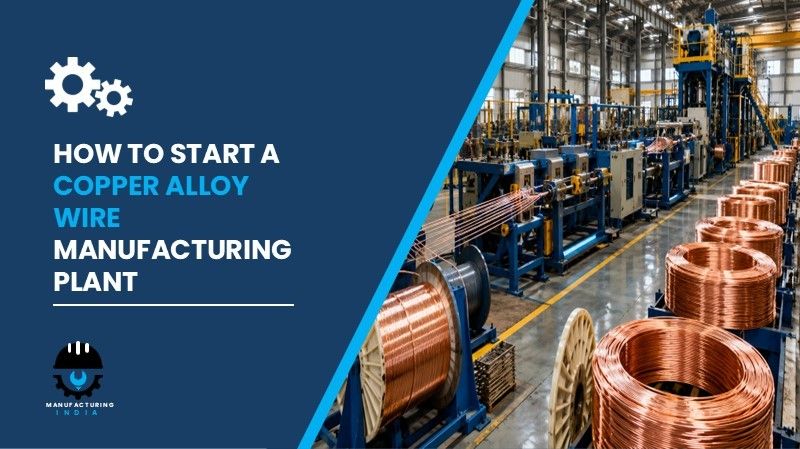
Setting up a copper alloy wire manufacturing plant in India presents a compelling investment case driven by surging demand from automotive, electrical and electronics, construction, renewable energy, industrial machinery, and telecommunication sectors. Copper alloy wires are indispensable conductive materials embedded across India’s fast-growing industrial base – from electric vehicle charging systems and power grid infrastructure to precision electronics and smart building installations. As India accelerates its transition toward high-performance manufacturing, the need for locally produced conductive materials with enhanced mechanical and thermal properties has never been more pronounced.
India’s rapid urbanisation, expanding power infrastructure, and the government’s Make in India initiative create a structurally favourable environment for establishing this type of facility. Industrial manufacturing hubs in states such as Gujarat, Maharashtra, and Tamil Nadu offer access to established supply chains, skilled labour, reliable utilities, and export corridors. With domestic demand growing in step with electrification, EV adoption, and renewable energy deployment, a copper alloy wire manufacturing plant in India is positioned to capture both import-substitution opportunities and export market growth.
India’s policy-backed manufacturing push, cost-competitive operational environment, and multi-sector demand across automotive, electronics, and renewable energy make a copper alloy wire plant a financially viable, strategically sound investment. With gross profit margins ranging between 15-25% and a well-defined production process, this facility offers strong returns with robust demand sustainability across the investment horizon.
What is Copper Alloy Wire?
Copper alloy wire refers to conductive metallic products manufactured by drawing copper blended with alloying elements such as zinc, tin, nickel, or silver. The alloying process enhances mechanical strength, corrosion resistance, and thermal stability while maintaining high electrical conductivity – properties that pure copper alone cannot consistently deliver. These wires offer superior tensile strength, improved wear resistance, and better fatigue performance compared to standard copper wires. They also exhibit excellent formability, solderability, and resistance to oxidation, making them suitable for demanding electrical and mechanical applications.
Depending on alloy composition, copper alloy wires can provide enhanced spring properties, higher temperature endurance, and improved stress relaxation performance – attributes critical for precision and high-reliability components. The production method follows a defined multi-stage sequence: wire rod preparation, hot rolling (if integrated), multi-stage wire drawing, intermediate annealing, surface cleaning, alloy treatment, and spooling and packaging. End-use industries served include automotive, electrical and electronics, construction, industrial machinery, renewable energy, and telecommunication.
Cost of Setting Up a Copper Alloy Wire Manufacturing Plant in India
The cost of establishing a copper alloy wire manufacturing plant in India depends on several interconnected variables including production capacity, technology selection, plant location, degree of automation, and regulatory compliance requirements. A structured cost analysis covering both capital and operational expenditures is essential for accurate project planning.
1. Capital Expenditure (CapEx)
Capital investment for this facility covers multiple components.
Land and site development costs include land registration, boundary development, and site preparation charges – investors may evaluate options within Special Economic Zones (SEZs) or notified industrial estates to benefit from land cost advantages and infrastructure support.
Civil works and construction costs encompass the main production shed, quality control laboratory, raw material storage area, finished goods warehouse, effluent treatment plant structure, and administrative block.
Machinery and equipment represent the single largest component of capital expenditure. Key machinery required includes:
- Melting furnaces
- Continuous casting machines
- Rolling mills
- Wire drawing machinery
- Annealing furnaces
- Stranding and bunching equipment
- Quality testing instruments
Other capital costs include the effluent treatment plant (ETP) installation, pre-operative expenses, commissioning charges, and applicable import duties on specialised machinery components.
Request a Sample Report for In-Depth Market Insights: https://www.imarcgroup.com/copper-alloy-wire-manufacturing-plant-project-report/requestsample
2. Operational Expenditure (OpEx)
The operating cost structure of a copper alloy wire manufacturing plant is heavily front-loaded toward raw material consumption.
Raw material cost – primarily copper cathode along with alloying elements such as tin, zinc, and nickel – accounts for approximately 85-90% of total OpEx. Given copper cathode’s price sensitivity to global commodity cycles, long-term supplier contracts and hedging strategies are strongly advisable to stabilise input costs and protect margins.
Utility cost – covering electricity, water, and steam account for 5-10% of total OpEx. The wire drawing and annealing stages are energy-intensive, making access to reliable and competitively priced power supply a critical site selection criterion for any copper alloy wire plant in India. Other operating costs include transportation and logistics, packaging materials, employee salaries and wages, routine maintenance, depreciation, and applicable taxes. By the fifth year of operations, total operational costs are projected to increase substantially due to inflation, market fluctuations, potential rises in key input material prices, supply chain pressures, and rising consumer demand.
3. Plant Capacity
The proposed manufacturing facility is designed with an annual production capacity ranging between 10,000-50,000 MT, enabling economies of scale while maintaining operational flexibility. This capacity range can be customized per investor requirements depending on target market size, available capital, and phased expansion plans. Profitability improves meaningfully with higher capacity utilisation, making ramp-up planning and market development critical priorities in the early operational years.
4. Profit Margins and Financial Projections
The copper alloy wire manufacturing plant demonstrates healthy profitability potential under normal operating conditions. Gross profit margins typically range between 15-25%, supported by stable multi-sector demand and value-added product applications. Net profit margins range between 5-12%. Detailed financial projections covering NPV (net present value), IRR (internal rate of return), payback period, and a full profit and loss account are developed based on realistic assumptions related to capital investment, operating costs, capacity utilisation, pricing trends, and demand outlook.
Why Set Up a Copper Alloy Wire Plant in India?
High Demand in Electrification and Grid Modernisation: Increasing grid modernisation, EV adoption, and renewable energy deployment across India require high-performance conductive materials with superior mechanical durability and conductivity. Copper alloy wires are a core input in this transition, supporting everything from EV charging cables to grid-connected power systems.
Enhanced Performance Over Pure Copper: Alloying improves tensile strength, corrosion resistance, and fatigue life, enabling application in mechanically and thermally demanding environments. This performance premium supports value-added pricing and healthier margins compared to commodity wire products.
Wide Industrial Integration Reduces Concentration Risk: Copper alloy wires serve the automotive, electrical and electronics, construction, industrial machinery, renewable energy, and telecommunication sectors simultaneously, ensuring diversified revenue streams and reduced dependence on any single end-use industry.
Technological Advancements Drive Differentiation: Continuous innovation in alloy design and precision wire drawing enhances product differentiation and supports value-added manufacturing. This creates a barrier to entry for low-cost commodity producers and positions quality-focused Indian manufacturers advantageously.
Active Global Investment Signals Strong Outlook: In January 2024, Wieland announced plans for a landmark USD 500 million capital investment to re-equip, expand, and modernise its facility in East Alton, Illinois, targeting EV, EV charging infrastructure, and renewable energy applications. In June 2025, International Wire Group (IWG) entered into a definitive agreement to acquire Hussey Copper, a market-leading supplier of copper products used in electrical infrastructure, data centres, power generation, and industrial applications. These large-scale investments confirm the sector’s long-term growth confidence.
Sustainability and Recyclability Alignment: Copper alloys retain full recyclability, aligning with India’s growing emphasis on circular economy practices and ESG compliance. This positions Indian manufacturers well for green procurement preferences from domestic and export customers.
Manufacturing Process – Step by Step
The copper alloy wire manufacturing process uses wire rod preparation, hot rolling (if integrated), multi-stage wire drawing, intermediate annealing, surface cleaning, alloy treatment, and spooling and packaging as its primary production method. The process is a multi-step operation involving several unit operations, material handling stages, and quality checks at each phase.
- Wire Rod Preparation: Copper cathode is combined with alloying elements (tin, zinc, or nickel) and processed into wire rod form as the initial feedstock for downstream drawing operations.
- Hot Rolling (if integrated): Where in-house integration is employed, hot rolling mills shape the alloy billet into rod form prior to cold drawing.
- Multi-Stage Wire Drawing: Wire drawing machinery progressively reduces rod diameter across multiple drawing passes using hardened dies, achieving target wire gauge with controlled dimensional tolerances.
- Intermediate Annealing: Annealing furnaces are used between drawing passes to relieve work-hardening stresses, restore ductility, and maintain consistent mechanical properties in the wire.
- Surface Cleaning: Drawn wire undergoes surface treatment to remove oxides, lubricant residues, and contamination, ensuring clean surfaces for downstream processing or coating.
- Alloy Treatment: Controlled thermal or chemical treatments are applied to achieve specified alloy microstructure, conductivity targets, and performance properties.
- Spooling and Packaging: Finished wire is precision-wound onto spools or reels, inspected against quality standards, and packaged for dispatch to automotive, electronics, construction, renewable energy, and telecommunication end-use industries.
Key Applications
Copper alloy wires serve a broad industrial application base, making the product essential across India’s most dynamic growth sectors.
- Automotive: High-strength electrical wiring, terminals, connectors, and charging system components in conventional and electric vehicles.
- Electronics: Precision lead frames, micro-connectors, switch components, and durable conductive elements for semiconductor packaging and consumer electronics.
- Construction: Corrosion-resistant grounding conductors, bonding systems, and structural electrical fittings for commercial and infrastructure projects.
- Telecommunication: High-performance signal conductors, RF connectors, and data transmission components for network infrastructure.
- Electrical and Electronics (Industrial): Switchgear components, winding wires, grounding systems, and battery cables for industrial power systems.
- Renewable Energy: Transmission cables and connection components for solar, wind, and grid-tied energy generation systems.
Leading Manufacturers
The global copper alloy wire industry is served by a number of multinational manufacturers with extensive production capacities and diversified application portfolios across end-use sectors. Key players in this market include:
- Prysmian Group
- Nexans
- Furukawa Electric Co., Ltd.
- Southwire Company, LLC
- LS Cable & System
- MKM Mansfelder Kupfer
Timeline to Start the Plant
Establishing a copper alloy wire manufacturing plant in India follows a structured development sequence:
- Feasibility study and project report preparation
- Land acquisition and site development
- Regulatory approvals and environmental clearances
- Factory licence and fire safety compliance
- Machinery procurement and installation
- Raw material supplier agreements and supply chain setup
- Trial production and quality testing
- Commercial production launch
Licences and Regulatory Requirements
Starting a copper alloy wire manufacturing unit in India requires several approvals:
- Business registration (Proprietorship, LLP, or Pvt Ltd)
- Factory Licence under the Factories Act
- Environmental Clearance from State Pollution Control Board
- GST Registration
- Fire Safety NOC
- Hazardous/Chemical compliance (applicable for tin, zinc, and nickel handling under MSIHC Rules)
- Effluent Treatment Plant (ETP) operational clearance
- Occupational Health and Safety compliance
Key Challenges to Consider
High Capital Requirements: Establishing a copper alloy wire manufacturing plant demands significant upfront investment in specialised machinery including melting furnaces, continuous casting machines, rolling mills, wire drawing machinery, and annealing furnaces. Securing structured project finance and phasing capital deployment is essential to managing cash flow through the ramp-up period.
Raw Material Price Volatility: Copper cathode – the primary raw material accounting for 85-90% of total OpEx – is subject to global commodity price cycles. Alloying elements including tin, zinc, and nickel add further input cost complexity. Long-term supply contracts and hedging mechanisms are critical risk management tools for this facility.
Regulatory Compliance: Environmental clearances, ETP compliance, chemical handling regulations, and occupational safety requirements add time and cost to plant commissioning. Engaging regulatory specialists early in the project timeline reduces risk of delays.
Technology and Innovation Pressure: Continuous innovation in alloy design and precision wire drawing, as noted on the source page, means manufacturers must invest in ongoing process upgrades to remain competitive on product quality and performance specifications.
Competition from Global Players: The presence of established global manufacturers – including Prysmian Group, Nexans, Furukawa Electric, Southwire, LS Cable & System, and MKM Mansfelder Kupfer – means Indian facilities must compete on quality, lead time, and localisation advantages.
Skilled Manpower: Operating wire drawing machinery, annealing furnaces, and quality testing instruments requires a trained technical workforce. Investment in workforce development and retention programmes is necessary to maintain production efficiency and quality standards.
Frequently Asked Questions
1. How much does it cost to set up a copper alloy wire manufacturing plant in India?
The total cost depends on plant capacity (ranging between 10,000-50,000 MT annually), technology level, location, and automation. The CapEx covers land and site development, civil works, machinery, and other capital costs. A detailed breakdown is available in IMARC Group’s project report.
2. Is copper alloy wire manufacturing profitable in India in 2026?
Yes. The plant demonstrates gross profit margins of 15-25% and net profit margins of 5-12% under normal operating conditions, supported by stable multi-sector demand and value-added applications.
3. What machinery is required for a copper alloy wire plant in India?
Key equipment includes melting furnaces, continuous casting machines, rolling mills, wire drawing machinery, annealing furnaces, stranding and bunching equipment, and quality testing instruments.
4. What licences and approvals are required to start a copper alloy wire plant in India?
Required approvals include business registration, Factory Licence under the Factories Act, Environmental Clearance, GST Registration, Fire Safety NOC, chemical compliance, ETP clearance, and Occupational Health and Safety compliance.
5. What raw materials are needed for copper alloy wire manufacturing?
Primary raw materials are copper cathode and alloying elements including tin, zinc, and nickel. Copper cathode alone accounts for approximately 85-90% of total operating expenses.
6. What are the environmental compliance requirements for a copper alloy wire plant in India?
The facility requires Environmental Clearance from the State Pollution Control Board, an operational ETP, compliance with hazardous/chemical handling regulations (MSIHC Rules), and adherence to emission standards throughout the manufacturing process.
7. What is the best location to set up a copper alloy wire plant in India?
Ideal locations offer proximity to copper cathode and alloying element suppliers, robust transport infrastructure, reliable power and water supply, and access to automotive and electronics manufacturing clusters. Gujarat, Maharashtra, and Tamil Nadu are among the most strategic states for this investment.
8. What is the break-even period for this type of plant in India?
The break-even period depends on plant capacity, utilisation rate, and selling price realisation. A detailed payback period analysis including NPV, IRR, and sensitivity analysis is covered in the IMARC Group project report.
9. What government incentives are available for manufacturers in India?
Indian manufacturers can access incentives under the Make in India initiative, Production Linked Incentive (PLI) schemes applicable to relevant sectors, state-level industrial policies, SEZ benefits, and capital subsidy programmes offered by state investment promotion boards.
Key Takeaways for Investors
A copper alloy wire manufacturing plant in India represents a compelling long-term investment opportunity underpinned by structural demand from the automotive, electrical and electronics, construction, renewable energy, and telecommunication sectors. The facility demonstrates financial viability across a wide capacity range of 10,000-50,000 MT annually, with gross margins of 15-25% and net margins of 5-12% supporting strong return potential across plant scales. The global copper alloy wire market was valued at USD 23.87 billion in 2025 and is projected to reach USD 46.15 billion by 2034 at a CAGR of 7.6% from 2026 to 2034, indicating a long and sustained demand runway. With electrification, EV adoption, renewable energy deployment, and smart infrastructure investment accelerating across India and globally, demand for high-performance copper alloy wire products is structurally positioned for continued growth well beyond the near-term horizon.
About the Author