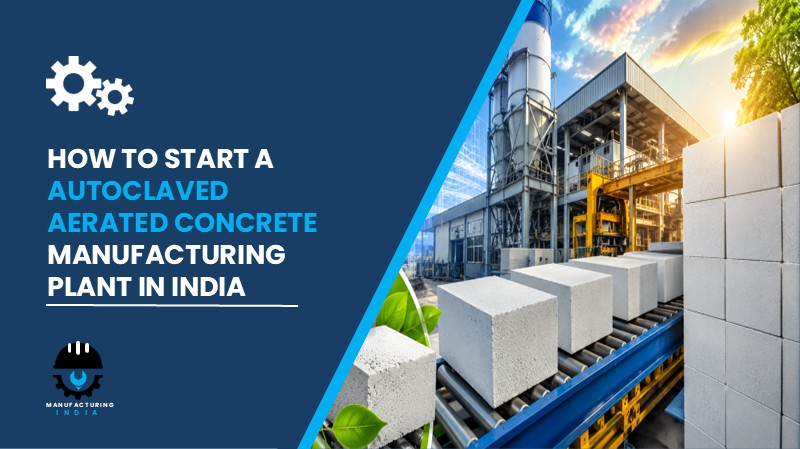
Autoclaved Aerated Concrete Manufacturing Plant in India
Setting up an autoclaved aerated concrete manufacturing plant in India presents a compelling investment case driven by rapid urbanisation, surging demand for lightweight building materials, and the country’s expanding affordable housing programmes. Commercial construction, residential development, industrial infrastructure, modular building, and sustainable architecture are the key industries fuelling demand for this product. As urban centres continue expanding and developers seek faster build cycles, autoclaved aerated concrete valued for its thermal insulation, fire resistance, and structural workability has become essential to contractors and infrastructure planners looking to reduce dead load costs without compromising performance standards.
India’s strategic manufacturing advantages strengthen the investment rationale further. Sustained government infrastructure spending, the Make in India initiative, and ready access to key raw materials including fly ash from thermal power plants all support cost-effective domestic production at scale. Maharashtra where BigBloc Construction completed the phase-II expansion of its Wada facility in October 2024, doubling production to 5 lakh cubic metres per annum and other industrially active states offer well-developed transportation corridors, proximity to construction-sector customers, and reliable utility infrastructure. With competitive land and labour costs alongside a growing local supply chain, establishing a production facility of this type in India delivers both operational efficiency and long-term market access.
India’s combination of urban housing demand, sustainable construction policy support, and cost-competitive production environment makes an autoclaved aerated concrete manufacturing plant in India a financially attractive proposition. Gross margins of 35–45% and net margins of 18–28% confirm strong returns across production scales. With the global market expanding steadily and domestic construction activity at elevated levels, break-even viability is well within reach for disciplined investors.
What is Autoclaved Aerated Concrete?
Autoclaved aerated concrete is a lightweight, precast, cellular concrete building material composed primarily of cement, lime, silica sand or fly ash, water, and a small quantity of aluminum powder as a foaming agent. The reaction between aluminum powder and the alkaline slurry generates hydrogen gas, forming uniformly distributed air pores that give the material its characteristic low density. It is then cured under high-pressure steam in autoclaves, a process that enhances compressive strength and dimensional stability, making the product consistent and reliable for structural use.
The material offers excellent thermal insulation, fire resistance, acoustic performance, and workability. Its reduced dead load allows meaningful savings in steel and foundation costs, directly improving overall project economics for developers. The primary production method is autoclaving, precision cutting, and reinforcement embedding. Product applications span lightweight wall panels, floor and roof slabs, lintels and beams, block units, thermal insulation envelopes, and fire-rated partitions. End-use industries served include commercial construction, residential development, industrial infrastructure, modular building, prefabrication, and sustainable architecture.
Cost of Setting Up an Autoclaved Aerated Concrete Manufacturing Plant in India
The total setup cost depends on plant capacity, technology selection, geographic location, level of automation, and regulatory compliance requirements. A comprehensive financial model covering both capital and operational expenditure is essential for accurate investment planning.
1. Capital Expenditure (CapEx)
Capital expenditure covers all one-time investments required to bring the facility into commercial operation. Land and site development costs include land registration charges, boundary development, and infrastructure preparation. Facilities located within Special Economic Zones (SEZs) or notified industrial estates benefit from reduced land costs, single-window clearances, and applicable fiscal incentives. Civil works encompass the production shed, quality control laboratory, raw material storage yards, and administrative block all configured to support high-throughput, precision-cutting production requirements.
Machinery and equipment represent the largest single component of capital investment. Key machinery required includes:
- Batching and mixing units
- Mold filling stations
- Wire cutting systems
- Autoclaves for high-pressure steam curing
- Demolding and separation lines
- Trimming and shaping stations
- Packaging machines
Other capital costs include the effluent treatment plant (ETP), pre-operative expenses, commissioning charges, and import duties applicable to specialised autoclaving or cutting equipment not yet manufactured domestically.
Request a Sample Report for In-Depth Market Insights: https://www.imarcgroup.com/autoclaved-aerated-concrete-manufacturing-plant-project-report/requestsample
2. Operational Expenditure (OpEx)
Raw material costs dominate operating expenses, accounting for approximately 50–60% of total OpEx. The five key inputs are cement, fly ash, lime, gypsum, and aluminum powder with cement representing the principal cost item. Establishing long-term supplier contracts for these materials is essential to stabilise procurement costs and protect margins against commodity price cycles and regional supply disruptions.
Utility costs covering electricity, water, and steam for autoclave operations account for a further 20–30% of total OpEx, reflecting the energy-intensive nature of high-pressure steam curing. Other recurring costs include transportation, packaging, salaries and wages, maintenance, depreciation, and taxes. By the fifth year of operations, total OpEx is projected to increase substantially due to inflation, market fluctuations, potential rises in the cost of key materials, supply chain disruptions, rising consumer demand, and broader shifts in the global economy all factors that must be incorporated into long-term financial planning.
3. Plant Capacity
The proposed facility is designed for an annual production capacity ranging between 200,000 and 1 million cubic metres, enabling meaningful economies of scale while maintaining operational flexibility. BigBloc Construction’s Wada facility in Maharashtra — which reached 5 lakh cubic metres per annum after its October 2024 phase-II expansion provides a credible domestic production benchmark for investors. Plant capacity can be fully customised per investor requirements and target market size. Profitability improves with higher capacity utilisation, as fixed infrastructure and machinery costs are spread across a larger production output base.
4. Profit Margins and Financial Projections
The project demonstrates healthy profitability potential under normal operating conditions. Gross profit margins typically range between 35–45% and net profit margins between 18–28%, supported by stable construction-sector demand and value-added product applications. A complete financial analysis covering NPV, IRR, payback period, gross margin, net margin, uncertainty analysis, and sensitivity analysis is available in the detailed project report. Break-even timelines are driven by capital investment levels, capacity utilisation rates, and prevailing product pricing in the target market.
Why Set Up an Autoclaved Aerated Concrete Plant in India?
Growing Demand for Sustainable Construction Materials. AAC supports green building initiatives due to its energy efficiency, reduced raw material consumption, and lower embodied energy compared to conventional concrete. Growing environmental regulations and rising awareness of fire safety standards are accelerating its adoption across residential and commercial construction segments in India.
Lightweight Structural Advantages Driving Developer Preference. Low density reduces structural loads, allowing savings in steel and foundation costs that directly improve project economics for developers. Large block sizes and ease of handling accelerate project timelines, reduce labour costs, and minimise material wastage making the product increasingly preferred by cost-focused builders and housing developers across India.
Energy Efficiency and Building Code Compliance. The material delivers excellent thermal insulation, reducing heating and cooling energy demand in buildings and supporting compliance with India’s energy conservation building codes. As India tightens its building energy performance standards for both residential and commercial applications, demand for thermally efficient walling and partition materials is set to grow substantially.
Policy Support and Affordable Housing Programmes. Government initiatives promoting affordable housing and sustainable infrastructure development indirectly stimulate demand for lightweight construction products. The Make in India initiative and policy emphasis on prefabricated and modular construction provide a supportive regulatory environment for domestic manufacturers scaling up operations.
Active Industry Investment. In June 2025, Star Cement Limited launched Star AAC Blocks and Star Block Jointing Mortar, marking a significant step toward innovative and sustainable construction solutions in India. In October 2024, BigBloc Construction completed the phase-II expansion of its Wada, Maharashtra facility, doubling production capacity to 5 lakh cubic metres per annum a clear and direct demonstration of sustained investment momentum in domestic production infrastructure.
Cost-Competitive Manufacturing Base. India’s competitive land and labour costs, proximity to fly ash sources from thermal power plants, and growing domestic supplier base for industrial materials and auxiliary inputs create a structurally advantageous production environment. Local sourcing of utilities, civil services, and auxiliary materials further reduces total cost of ownership for facilities established in India.
Manufacturing Process Step by Step
The autoclaved aerated concrete manufacturing process uses autoclaving, precision cutting, and reinforcement embedding as the primary production method. The autoclaved aerated concrete manufacturing process proceeds through the following key operational stages:
- Raw Material Preparation: Cement, fly ash, lime, gypsum, and aluminum powder are received, inspected, and proportioned per batch formulation requirements.
- Batching and Mixing: Batching and mixing units blend raw materials with water in precise ratios; aluminum powder is added to trigger hydrogen gas generation in the alkaline slurry.
- Mold Filling: The aerated slurry is poured into mold filling stations where gas expansion creates uniformly distributed air pores throughout the mixture.
- Pre-Curing and Setting: Filled molds rest in a controlled environment until the material achieves sufficient green strength to withstand precision cutting without deformation.
- Wire Cutting: Wire cutting systems slice the pre-cured cake into blocks, panels, lintels, or slabs according to product specification and customer requirements.
- Demolding and Separation: Demolding and separation lines remove the cut units from the mold base and arrange them on autoclave trolleys for the curing stage.
- Autoclaving: Autoclaves for high-pressure steam curing subject units to elevated temperature and pressure conditions, developing full mechanical strength and dimensional stability.
- Trimming and Shaping: Trimming and shaping stations perform final finishing operations to ensure dimensional accuracy and required surface quality.
- Quality Testing: Comprehensive technical tests verify compressive strength, thermal insulation performance, fire resistance rating, and dimensional compliance against applicable standards.
- Packaging and Dispatch: Packaging machines prepare finished blocks, panels, and lintels for palletised dispatch to residential, commercial, industrial, and infrastructure customers.
Key Applications
The production facility serves a wide range of construction and infrastructure sectors, each requiring specific performance characteristics from lightweight building materials.
- Residential Construction: Load-bearing and non-load-bearing walls, floor and roof panels, and partition systems for housing development projects.
- Commercial Buildings: Office complexes, retail centres, schools, and hospitals requiring lightweight, thermally efficient, and fire-rated building envelopes.
- Industrial Facilities: Warehouses, factories, and production plants needing lightweight structural solutions that reduce foundation and frame costs.
- Infrastructure Projects: Fire-rated walls, sound barriers, and energy-efficient building systems for public infrastructure and transportation-adjacent facilities.
Leading Manufacturers
The global market is served by several well-established multinational and domestic manufacturers with extensive production capacities and diverse application portfolios. Key players include:
- Xella Group
- H+H International A/S
- ACICO Industries
- SOLBET Sp. z o.o.
- JK Lakshmi Cement Ltd.
- UltraTech Cement Ltd.
Timeline to Start the Plant
- Feasibility study and project report preparation
- Land acquisition and site development
- Regulatory approvals and environmental clearances
- Factory licence and fire safety compliance
- Machinery procurement and installation
- Raw material supplier agreements and supply chain setup
- Trial production and quality testing
- Commercial production launch
Licences and Regulatory Requirements
Starting an autoclaved aerated concrete manufacturing unit in India requires several approvals:
- Business registration (Proprietorship, LLP, or Pvt Ltd)
- Factory Licence under the Factories Act
- Environmental Clearance from State Pollution Control Board
- GST Registration
- Fire Safety NOC
- Effluent Treatment Plant (ETP) operational clearance
- Occupational Health and Safety compliance
Key Challenges to Consider
High Capital Requirements. The facility demands significant upfront investment in autoclaving systems, precision wire-cutting lines, mold infrastructure, and quality control systems — creating a moderately high entry threshold for new investors entering this segment.
Raw Material Price Volatility. Cement, fly ash, lime, gypsum, and aluminum powder collectively accounting for 50–60% of OpEx are subject to commodity price cycles, supply chain disruptions, and regional availability constraints. Long-term procurement contracts with diversified suppliers are essential.
Regulatory Compliance. Production requires Environmental Clearance from the State Pollution Control Board, approved ETP operation for autoclave condensate and process water, and ongoing occupational health and safety compliance all of which demand dedicated infrastructure and management resources.
Technology and Automation Pressure. Technological improvements in autoclaving systems and production automation are continuously raising the efficiency and product quality benchmarks. New entrants must invest in current-generation equipment to remain cost-competitive against established players.
Competition from Established Players. Global and domestic manufacturers including Xella Group, UltraTech Cement Ltd., JK Lakshmi Cement Ltd., and H+H International A/S create competitive pricing pressure, particularly in metropolitan construction markets with high buyer concentration.
Skilled Manpower. Operating precision wire-cutting systems, autoclave controls, and quality management protocols requires trained technical staff skills that remain in constrained supply across many Tier-2 and Tier-3 locations in India.
Frequently Asked Questions
1. How much does it cost to set up an autoclaved aerated concrete manufacturing plant in India? Total setup cost depends on annual capacity (200,000–1 million cu.m.), location, technology, and automation level, covering land, civil works, autoclaves, wire cutting systems, batching units, and pre-operative costs. A detailed CapEx breakdown is available in the full project report.
2. Is autoclaved aerated concrete manufacturing profitable in India in 2026? Yes. The project yields gross profit margins of 35–45% and net margins of 18–28% under normal operating conditions, supported by stable construction-sector demand and value-added applications.
3. What machinery is required for an autoclaved aerated concrete plant in India? Essential equipment includes batching and mixing units, mold filling stations, wire cutting systems, autoclaves for high-pressure steam curing, demolding and separation lines, trimming and shaping stations, and packaging machines.
4. What licences and approvals are required to start an autoclaved aerated concrete plant in India? Required approvals include business registration, Factory Licence, Environmental Clearance from the State Pollution Control Board, GST Registration, Fire Safety NOC, ETP operational clearance, and Occupational Health and Safety compliance.
5. What raw materials are needed for autoclaved aerated concrete manufacturing? The five primary inputs are cement, fly ash, lime, gypsum, and aluminum powder, with cement as the dominant cost item at approximately 50–60% of total operating expenditure.
6. What are the environmental compliance requirements for an autoclaved aerated concrete plant in India? Plants must obtain Environmental Clearance from the State Pollution Control Board, operate an approved ETP for process water and autoclave condensate, and maintain emission monitoring systems in line with applicable regulations.
7. What is the best location to set up an autoclaved aerated concrete plant in India? Locations near fly ash sources, cement suppliers, and active construction markets are optimal. Maharashtra — home to BigBloc Construction’s Wada facility — and states with developed industrial corridors are strategically favourable choices.
8. What is the break-even period for this type of plant in India? Break-even depends on capital investment, utilisation rate, and product pricing. Detailed payback period, NPV, and IRR analysis are provided in the full feasibility report.
9. What government incentives are available for manufacturers in India? Affordable housing programmes, sustainable infrastructure policy, and the Make in India initiative provide direct and indirect support. State-level industrial schemes and SEZ incentives can materially reduce initial capital requirements for new investors.
Key Takeaways for Investors
An autoclaved aerated concrete manufacturing plant in India represents a demand-backed investment opportunity anchored by commercial construction, residential development, industrial infrastructure, and sustainable architecture all sectors experiencing sustained long-term growth across India’s expanding economy. The investment delivers strong financial viability across a 200,000 to 1 million cubic metre annual capacity range, with gross margins of 35–45% and net margins of 18–28% delivering robust returns for investors at multiple production scales. The global autoclaved aerated concrete market was valued at USD 23.39 billion in 2025 and is projected to reach USD 37.42 billion by 2034, at a CAGR of 5.36% from 2026 to 2034 providing a durable and growing global backdrop for domestic production. With accelerating urbanisation, tightening energy conservation building codes, active investment from Star Cement Limited and BigBloc Construction, and growing preference for prefabricated lightweight materials, domestic demand in India is structurally sustained well into the next decade.
About the Author