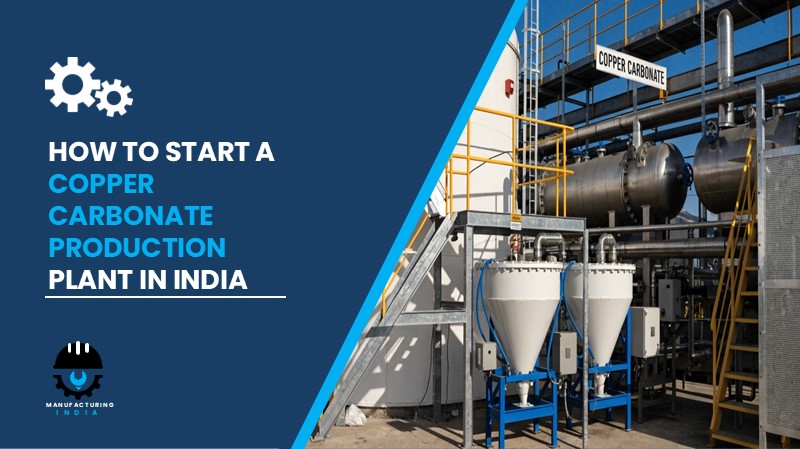
Setting up a copper carbonate production plant in India presents a compelling investment case, driven by robust and diversified demand from agrochemicals, paints and pigments, coatings and ceramics, chemical manufacturing, catalysts and specialty materials, and feed and specialty industrial formulations. As a functional copper source with controlled reactivity and defined copper content, copper carbonate is indispensable to India’s crop protection ecosystem and its fast-expanding specialty chemicals sector. The sustained adoption of safer and more effective inputs in farm output management — where copper carbonate delivers controlled copper ion release for effective disease management while reducing phytotoxicity risks — places this compound at the intersection of agricultural modernisation and industrial chemistry.
India’s structural advantages make it an especially sound production base for copper carbonate. The country’s agricultural sector has expanded by around 40% in terms of output over the past decade and recorded 5.4% year-on-year growth in FY25, according to the India Brand Equity Foundation, reinforcing demand for efficient crop protection inputs. The Make in India initiative, combined with cost-competitive land, labour, and supply chain infrastructure in states such as Gujarat, Maharashtra, and Uttar Pradesh, enables producers to serve both domestic agrochemical formulators and export markets with competitive pricing. Industrial estates and special economic zones further reduce site development costs and ease regulatory clearance timelines.
India’s copper carbonate production opportunity is underpinned by policy support through Make in India, cost-competitive production economics, and diversified demand from agriculture, pigments, and specialty chemicals. With gross margins ranging between 25–35% and a typical break-even window of three to five years, the investment case is viable across a wide range of plant capacities.
What is Copper Carbonate?
Copper carbonate, commercially available predominantly as basic copper carbonate (Cu₂(OH)₂CO₃), is a green to blue-green inorganic compound widely used as a functional copper source across multiple industries. It is characterised by low water solubility, controlled reactivity, and defined copper content, which make it suitable for applications requiring gradual copper ion release. The material is commonly produced as a fine powder with specified particle size distribution, moisture limits, and impurity controls, and it serves as an important precursor for producing other copper salts and oxides.
Key properties that drive industrial adoption include stability, handling safety, and compatibility across a range of formulations. Tighter controls on sulphate, chloride, and trace metal content, alongside controlled percentage copper and particle size distribution, allow producers to differentiate through premium grades suitable for catalysts, pigments, and sensitive specialty formulations. The primary production method is wet precipitation combined with ageing and crystallisation control, solid-liquid separation, washing, drying, milling, and packaging.
End-use industries served by the facility include agricultural and agrochemicals, paints and pigments, coatings and ceramics, chemical manufacturing, catalysts and specialty materials, and feed and specialty industrial formulations.
Cost of Setting Up a Copper Carbonate Production Plant in India
The total cost of establishing a copper carbonate production plant in India depends on plant capacity, technology selection, geographic location, degree of automation, and the extent of regulatory compliance infrastructure required. Both capital expenditure and operational expenditure must be carefully modelled across a five-year horizon to accurately assess project viability.
1. Capital Expenditure (CapEx)
Land and site development form a foundational component of total CapEx, encompassing land registration charges, boundary development, drainage, and access road construction. Investors may consider industrial estate allocations or special economic zones to reduce land acquisition costs and benefit from pre-approved utility connections and environmental clearance frameworks. Civil works and construction costs cover production sheds, a laboratory for quality control, raw material and finished goods storage facilities, and an administrative block designed to support the plant’s workforce and compliance functions.
Machinery and equipment represent the largest single share of capital expenditure. Key machinery required includes:
- Reaction tanks with agitators
- Filtration units (such as filter presses)
- Drying equipment (tray or rotary dryers)
- Storage tanks
- Weighing and packaging systems
- Basic laboratory instruments for quality control
Other capital costs include effluent treatment plant construction, pre-operative expenses such as feasibility studies and project report preparation, commissioning charges, and any applicable import duties on specialised equipment not manufactured domestically.
Request a Sample Report for In-Depth Market Insights: https://www.imarcgroup.com/copper-carbonate-manufacturing-plant-project-report/requestsample
2. Operational Expenditure (OpEx)
Raw material cost is the dominant driver of operating expenditure, accounting for approximately 70–80% of total OpEx. The primary raw materials required are copper sulphate or copper scrap as the copper source, sodium carbonate or sodium bicarbonate as the precipitating agent, and purified water. Investors are advised to negotiate long-term supply contracts with reliable regional suppliers to stabilise input pricing and mitigate exposure to copper commodity price cycles.
Utility costs – covering electricity for agitation and drying operations, process water, and steam — represent approximately 10–15% of total OpEx. Additional operating costs include transportation and outbound logistics, packaging materials, salaries and wages for process operators and quality control staff, scheduled maintenance, depreciation on plant and machinery, and applicable taxes. By the fifth year of operations, total operational cost is projected to increase substantially due to inflation, market fluctuations, and potential rises in the cost of key copper-based raw materials, as well as supply chain disruptions and rising consumer demand.
3. Plant Capacity
The proposed production facility is designed with an annual production capacity ranging between 1,000 and 5,000 MT, enabling economies of scale while maintaining operational flexibility. Capacity can be customised to suit individual investor requirements, and profitability improves meaningfully with higher capacity utilisation rates as fixed costs are spread across a larger volume of output.
4. Profit Margins and Financial Projections
The project demonstrates healthy profitability under normal operating conditions. Gross profit margins typically range between 25–35%, supported by stable demand across agriculture, specialty chemicals, and pigment applications. Net profit margins range between 10–20%. Financial projections for the facility include detailed analysis of net present value (NPV), internal rate of return (IRR), payback period, and a full profit and loss account, along with sensitivity analysis and uncertainty modelling. Break-even in a copper carbonate production business typically ranges from three to five years, depending on production scale, operating costs, raw material pricing, and customer base development across pigments, agriculture, and chemical sectors.
Why Set Up a Copper Carbonate Plant in India?
Sustained Agricultural Demand. India’s agricultural sector has expanded by around 40% in output terms over the past decade, with FY25 recording 5.4% year-on-year growth supported by higher production and rising trade volumes, according to the India Brand Equity Foundation. This sustained farm output growth is reinforcing adoption of copper carbonate as a controlled-release crop protection input, where its low water solubility and gradual copper ion release reduce phytotoxicity while delivering effective fungicidal activity.
Multi-Sector Demand Base. Copper carbonate serves agriculture, pigments and coatings, and chemical intermediates simultaneously, supporting diversified offtake and reducing reliance on any single end-use segment. This structural diversification makes revenue streams more resilient across commodity and industrial cycles, strengthening the investment case for a copper carbonate production plant in India.
Policy and Regulatory Tailwinds. The Make in India initiative and associated government schemes offer capital subsidies, tax exemptions, reduced utility tariffs, export benefits, and interest subsidies to promote domestic production. Industrial estate and SEZ frameworks reduce land acquisition timelines and provide pre-approved environmental and utility infrastructure, accelerating project commissioning.
Cost-Competitive Manufacturing. India offers cost-competitive land, labour, and supply chain infrastructure relative to other major producing regions. Proximity to copper sulphate suppliers and agrochemical formulators in states such as Gujarat and Maharashtra reduces inbound logistics costs and enables efficient outbound distribution to domestic and export markets.
Active Industry Investment. In January 2026, Locksley Resources Limited reported the identification of a high-grade mineralised silver corridor at its Mojave Project in California, with visible copper carbonate mineralisation noted in several samples, suggesting a large hydrothermal system. In June 2025, Military Metals Inc. announced completion of its initial field programme at the MIR copper–zinc–gold property in southeastern British Columbia, identifying rich copper showings and numerous copper carbonate occurrences. These developments reflect growing global interest in copper carbonate supply chains.
Downstream Integration Potential. Manufacturers can integrate forward into copper oxides and other copper salts, capturing additional value and serving broader industrial and agrochemical supply chains. Quality differentiation through tighter impurity controls and controlled particle size distribution also enables premium pricing for catalyst, pigment, and sensitive specialty formulation customers.
Production Process – Step by Step
The copper carbonate production process uses wet precipitation as the primary production method, combined with ageing and crystallisation control to achieve consistent product quality and defined copper content.
- Raw Material Sourcing: Procurement of copper sulphate or copper scrap and sodium carbonate or sodium bicarbonate from qualified suppliers, with quality checks on incoming material purity and moisture content.
- Preparation of Copper Salt Solution: Dissolution of copper sulphate or copper nitrate in purified water in reaction tanks with agitators, with pH and temperature monitoring initiated.
- Reaction with Sodium Carbonate: Addition of the precipitating agent to the copper salt solution under controlled agitation, initiating the precipitation of copper carbonate with ageing and crystallisation control to achieve target particle size and copper content.
- Filtration of Precipitated Copper Carbonate: Separation of the precipitated solid from the mother liquor using filtration units such as filter presses, removing residual solution and soluble impurities.
- Washing to Remove Impurities: Multiple washing cycles to reduce sulphate, chloride, and trace metal content to within specification limits, with wash water managed through the effluent treatment plant.
- Drying of Final Product: Processing of the washed filter cake through tray or rotary dryers to achieve target moisture limits.
- Milling and Particle Size Control: Pulverisation and milling to achieve specified particle size distribution and dispersibility for downstream applications.
- Quality Testing: Analytical testing for copper content, moisture, particle size, purity, and impurity profile against product specification.
- Packaging and Dispatch: Weighing and packaging into specified container formats for dispatch to end-use industries including agricultural formulators, pigment manufacturers, and chemical intermediaries.
Key Applications
Copper carbonate serves a broad industrial and agricultural base, making the production unit’s revenue portfolio structurally diversified across multiple consuming sectors.
- Agriculture and Agrochemicals: Used as a fixed copper source in crop protection formulations where controlled solubility supports sustained copper activity on plant surfaces for fungicidal and algicidal applications.
- Paints, Pigments, Coatings, and Ceramics: Used as a copper-based pigment and intermediate contributing green and blue hues in coatings and inks, and in certain ceramic and glaze applications depending on formulation.
- Chemical Manufacturing: Used as an intermediate and precursor in producing other copper salts, copper oxides, and related copper chemistries across the specialty chemicals sector.
- Catalysts and Specialty Materials: Used as a copper source and precursor in catalyst preparation and specialty material synthesis where copper content and impurity control are critical to product performance.
Leading Producers
The global copper carbonate market is served by several multinational producers with extensive production capacities and diverse application portfolios across agriculture, pigments, and specialty chemicals. Key players in the industry include:
- American Elements
- Merck KGaA
- Sigma-Aldrich Corporation
- Fisher Scientific International, Inc.
- Thermo Fisher Scientific Inc.
- MP Biomedicals, LLC
Timeline to Start the Plant
Establishing a copper carbonate production plant in India typically requires 12 to 18 months from project inception to commercial production launch, depending on plant capacity, equipment sourcing, infrastructure readiness, and regulatory approvals.
- Feasibility study and project report preparation
- Land acquisition and site development
- Regulatory approvals and environmental clearances
- Factory licence and fire safety compliance
- Machinery procurement and installation
- Raw material supplier agreements and supply chain setup
- Trial production and quality testing
- Commercial production launch
Licences and Regulatory Requirements
Starting a copper carbonate production unit in India requires several approvals across business registration, environmental, safety, and operational compliance domains:
- Business registration (Proprietorship, LLP, or Pvt Ltd)
- Factory Licence under the Factories Act
- Environmental Clearance from the State Pollution Control Board
- GST Registration
- Fire Safety NOC
- Hazardous and chemical substance compliance given copper carbonate’s aquatic toxicity profile and EHS handling requirements
- Effluent Treatment Plant (ETP) operational clearance
- Occupational Health and Safety compliance
Key Challenges to Consider
High Capital Requirements. Total capital investment covers land, civil works, machinery including reaction tanks, filtration units, dryers, pulverisers, and packaging systems, as well as ETP and pre-operative expenses, making initial funding arrangement a critical project risk.
Raw Material Price Volatility. Copper sulphate, copper scrap, and sodium carbonate are the primary input materials, and their pricing is subject to global copper commodity cycles, energy cost inflation, and supply chain disruptions, all of which can compress operating margins.
Regulatory Compliance. Given copper carbonate’s aquatic toxicity profile, producers must maintain robust EHS systems, compliant labelling and safety data sheets, and traceable production records to satisfy the State Pollution Control Board, factory inspectorates, and institutional buyer requirements.
Technology and Innovation Pressure. Quality differentiation through tighter impurity controls and particle size management requires investment in analytical instrumentation and process control systems to sustain premium pricing for catalyst and pigment-grade material.
Competition. The global market includes established multinational players such as American Elements, Merck KGaA, Sigma-Aldrich Corporation, Fisher Scientific International, Thermo Fisher Scientific, and MP Biomedicals, requiring Indian producers to compete on quality, responsiveness, and cost structure.
Skilled Manpower. Operating precipitation, filtration, drying, and milling processes to consistent quality standards requires trained chemical process operators and quality control analysts, which can be a constraint in locations outside established chemical production clusters.
Frequently Asked Questions
1. How much does it cost to set up a copper carbonate production plant in India?
Total capital investment depends on plant capacity, technology, and location, covering land acquisition, civil construction, machinery including reaction tanks and dryers, ETP, and pre-operative expenses. The proposed capacity range of 1,000–5,000 MT per annum provides a basis for project-specific cost modelling.
2. Is copper carbonate production profitable in India in 2026?
Yes. Gross profit margins typically range between 25–35% and net profit margins between 10–20% under normal operating conditions, supported by diversified demand from agriculture, pigments, and specialty chemicals.
3. What machinery is required for a copper carbonate plant in India?
Key equipment includes reaction tanks with agitators, filtration units such as filter presses, tray or rotary dryers, storage tanks, pulverisers, weighing and packaging systems, and basic laboratory instruments for quality control.
4. What licences and approvals are required to start a copper carbonate plant in India?
Required approvals include business registration, Factory Licence under the Factories Act, Environmental Clearance from the State Pollution Control Board, GST Registration, Fire Safety NOC, ETP operational clearance, hazardous chemical compliance, and Occupational Health and Safety certification.
5. What raw materials are needed for copper carbonate production?
The primary raw materials are copper sulphate or copper scrap as the copper source, sodium carbonate or sodium bicarbonate as the precipitating agent, and purified water. Stoichiometric balance is essential for consistent quality and yield.
6. What are the environmental compliance requirements for a copper carbonate plant in India?
Given copper carbonate’s aquatic toxicity profile, an operational effluent treatment plant is mandatory, along with State Pollution Control Board environmental clearance, compliant SDS and labelling, and ongoing monitoring of effluent quality against prescribed discharge standards.
7. What is the best location to set up a copper carbonate plant in India?
Optimal sites offer easy access to copper sulphate suppliers and sodium carbonate sources, proximity to agrochemical and specialty chemical end-use markets, reliable utilities, and robust transportation infrastructure. Industrial estates in Gujarat and Maharashtra are typically well-positioned for these criteria.
8. What is the break-even period for this type of plant in India?
Break-even typically ranges from three to five years, depending on production scale, capacity utilisation, operating costs, raw material pricing, and the pace of customer base development across agriculture, pigments, and chemical sectors.
9. What government incentives are available for manufacturers in India?
Governments may offer capital subsidies, tax exemptions, reduced utility tariffs, export benefits, and interest subsidies under national and state industrial policies, including schemes aligned with the Make in India initiative.
Key Takeaways for Investors
A copper carbonate production plant in India represents a well-grounded industrial investment, anchored by diversified demand from agrochemicals, paints and pigments, chemical manufacturing, and catalyst applications that together provide structural revenue resilience. The facility is financially viable across the 1,000–5,000 MT annual capacity range, with gross margins of 25–35% and net margins of 10–20% achievable under normal operating conditions, and a break-even horizon of three to five years. The global copper carbonate market was valued at USD 221.34 million in 2025 and is projected to reach USD 349.30 million by 2034, exhibiting a CAGR of 5.2% from 2026 to 2034, according to IMARC Group estimates, confirming a sustained long-term demand trajectory. With India’s agricultural sector recording 5.4% output growth in FY25 and specialty chemical demand expanding in parallel, the domestic consumption base for copper carbonate is set to deepen meaningfully over the investment horizon.
About the Author