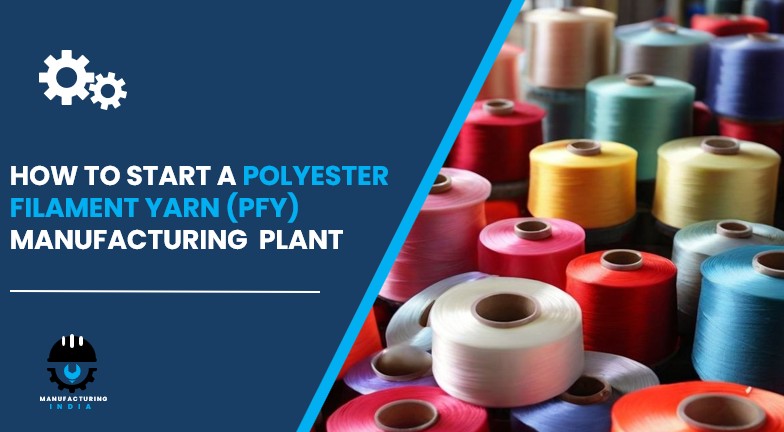
Setting up a polyester filament yarn (PFY) manufacturing plant in India represents a highly attractive investment proposition underpinned by robust and structurally growing demand from the textiles and apparel industry, home furnishings sector, industrial fabrics segment, and technical textiles applications. As global synthetic fibre consumption continues to expand, polyester filament yarns produced through melt spinning, drawing, texturizing, and winding processes occupy an indispensable position across woven and knitted apparel, home furnishings such as curtains and upholstery, industrial applications including tyre cords and conveyor belts, and technical uses such as sewing threads, ropes, and nets. This growth trajectory, combined with expanding end-use sectors including automotive, electronics manufacturing, and export-oriented textile production, creates a highly favourable manufacturing environment for new entrants with robust quality systems and competitive cost structures.
What is Polyester Filament Yarn (PFY)?
Polyester filament yarns consist of continuous synthetic fibres that originate from polymerised esters, including polyethylene terephthalate (PET). The yarns exhibit high tensile strength together with uniform properties, resistance to chemical substances, and thermal stability. They are manufactured through a sequence of melt spinning, drawing, texturizing, and winding operations to produce flat (FDY/POY) and textured (DTY) yarn variants suited to a wide spectrum of apparel, home furnishing, industrial, and technical textile applications.
Polyester filament yarns are commonly utilised in textiles and automotive fabrics, industrial ropes, and composite materials, as they provide durability, flexibility, and protection against wear and environmental damage. Key functional properties include tensile strength, denier uniformity, shrinkage control, dye uptake consistency, and resistance to UV degradation and chemical exposure, all of which are critical for downstream weaving, knitting, and technical fabric conversion processes.
The global polyester filament yarn market is driven by accelerating demand from the textiles and apparel industry, increasing use in home furnishings, and expanding applications in industrial textiles, supported by growth in synthetic fibre consumption worldwide. The global polyester filament yarn (PFY) market size was volumed at 81.78 million Tons in 2025 and is expected to reach 127.72 million Tons by 2034, exhibiting a CAGR of 5.1% from 2026 to 2034.
Cost of Setting Up a Polyester Filament Yarn (PFY) Manufacturing Plant
The total capital investment required to establish a polyester filament yarn manufacturing plant is shaped by several key parameters: annual production capacity (measured in metric tons), product mix complexity (POY, FDY, and DTY yarn variants), automation and spinning line configuration, facility specification, raw material sourcing strategy, technology and machinery investments, and applicable regulatory and quality compliance requirements. Below is a structured breakdown of all major cost components.
1. Capital Expenditure (CapEx)
Total capital investment in a polyester filament yarn manufacturing plant covers the following major heads:
Land and Site Development
This encompasses land acquisition or lease, site preparation, boundary development, and utilities connectivity. Site selection should prioritise proximity to PTA (purified terephthalic acid) and MEG (monoethylene glycol) suppliers and petrochemical feedstock sources to minimise inbound logistics costs. Access to reliable power supply for melt spinning, drawing, and texturizing operations, strong road and logistics infrastructure for both inbound raw materials and outbound finished yarn dispatch to weaving and knitting mills, and availability of a trained technical and quality control workforce are critical site selection criteria. Compliance with industrial zoning regulations, textile manufacturing standards, fire safety regulations, and environmental compliance frameworks governing effluent and emissions from polymerisation and spinning operations must be assessed from project initiation.
Civil Works and Construction
Building costs cover the main production facility including the polymerisation and melt spinning shop, drawing and texturizing section, winding and packaging areas, quality assurance and testing laboratories, finished goods warehousing and dispatch infrastructure, utility infrastructure including power backup, steam generation, chilled water systems, and effluent treatment plant, and administrative blocks. Construction must comply with applicable factory act requirements, electrical and fire safety norms, and quality management system infrastructure standards for international certification compliance.
Machinery and Equipment
Machinery represents the single largest CapEx component. Key equipment required for a polyester filament yarn manufacturing plant includes:
- Polymerisation and Continuous Polymerisation (CP) Plant: Reactors and associated systems for converting PTA and MEG feedstock into molten polyester polymer through esterification and polycondensation reactions
- Melt Spinning Machines: High-speed spinning units with spinnerets for extruding molten polymer into continuous filaments, including quenching and oiling systems for filament conditioning
- Drawing and Texturizing Machines: Draw-texturizing (DTY) machines and partially oriented yarn (POY) and fully drawn yarn (FDY) production lines for achieving target denier, tenacity, and shrinkage specifications
- Winding Machines: Automatic winding units for converting spun and drawn filaments into finished yarn packages suitable for downstream weaving, knitting, and twisting operations
- Quality Control (QC) Instruments: Denier testers, tenacity and elongation testers, shrinkage testers, dye uptake analysers, and uster evenness testers for monitoring yarn quality across production batches
- Material Handling and Warehousing: Automated conveyor systems, bin storage for PTA and MEG, FIFO racking systems, and finished goods palletising and bagging equipment
- Utility Systems: Steam boilers, chilled water plants, compressed air systems, and effluent treatment plants supporting continuous polymerisation and spinning operations
Other Capital Costs
These include pre-operative expenses, commissioning charges, import duties on specialised spinning, drawing, and texturizing equipment, technology licensing and process know-how costs, staff training and competency development, initial raw material and consumable inventory for production commissioning, and regulatory compliance setup including ISO 9001 quality management system establishment and applicable export market certifications.
Request a Sample Report for In-Depth Market Insights: https://www.imarcgroup.com/polyester-filament-yarn-manufacturing-plant-project-report/requestsample
2. Operational Expenditure (OpEx)
Raw materials primarily PTA (purified terephthalic acid) and MEG (monoethylene glycol) constitute the dominant operating cost, typically representing 85-90% of total OpEx. Utility costs, driven primarily by the high energy consumption of continuous polymerisation, melt spinning, and texturizing operations, account for 5-10% of OpEx. Labour, maintenance, quality control, packaging, transportation, and overhead costs constitute the remainder of the operating cost base.
3. Plant Capacity
The proposed polyester filament yarn manufacturing facility is designed with an annual production capacity ranging between 20,000-100,000 MT, enabling economies of scale while maintaining operational flexibility. This capacity range supports a diversified product portfolio of POY, FDY, and DTY yarn variants serving apparel, home furnishings, industrial textiles, and technical textile end-use segments across domestic and export markets.
4. Profit Margins and Financial Projections
The project demonstrates healthy profitability potential under normal operating conditions. Financial projections encompass capital investment, operating costs, capacity utilisation, product mix between POY, FDY, and DTY yarn variants, and forward demand outlook underpinned by global synthetic fibre consumption growth and India’s expanding textile export base. A comprehensive feasibility analysis includes sensitivity analysis, Net Present Value (NPV), Internal Rate of Return (IRR), and Payback Period calculations. Gross profit margins for polyester filament yarn manufacturing typically range from 10-20%, supported by stable demand and value-added applications. Net profit margins of 3-10% are achievable with disciplined cost management, optimal capacity utilisation, and efficient procurement of PTA and MEG feedstock.
Why Set Up a Polyester Filament Yarn (PFY) Manufacturing Plant?
High Demand Across Sectors
Polyester filament yarns serve as key materials which the automotive, textile, and electronics industries use to produce end products with enhanced durability, flexibility, and thermal resistance capabilities. The continuous expansion of apparel and home textile manufacturing globally, combined with growing technical textile applications in automotive seat belts, wiring insulation, and conveyor belts, provides a broad and diversified demand base for PFY manufacturers.
Moderate Entry Barriers
The field requires substantial financial investment to match standard textile production costs, yet established manufacturers gain market superiority through their ability to produce superior goods using specialised spinning techniques and accredited production processes. While capital intensity is significant, the technology is well-established and supported by a global ecosystem of equipment suppliers, providing a clear pathway for new entrants with adequate capitalisation.
Industry Growth Alignment
The worldwide demand for yarns will increase due to rising automotive production, expanding industrial textile markets, and growing electronics manufacturing activities. The shift towards lightweight, durable, and flexible materials in vehicles and industrial applications creates new business opportunities for polyester filament yarn manufacturers positioned to serve these technical textile segments.
Policy and Infrastructure Support
Government programmes that promote textile exports and support automotive production and industrial growth create indirect demand for polyester filament yarn. Strong export performance and rising demand for synthetic textiles are reinforcing growth across India’s yarn and fibre industry, with policy frameworks supporting domestic manufacturing capacity expansion and export competitiveness.
Supply Chain Stability
Local suppliers provide manufacturers with dependable sources of PTA, MEG, and chemical additives which enable manufacturers to maintain continuous production with shorter delivery times. Establishing long-term supply agreements with feedstock producers significantly improves production continuity and cost predictability for PFY manufacturing operations.
Export-Oriented Demand and Asia-Pacific Growth
The Asia-Pacific region is expected to experience the fastest growth as China and India expand their manufacturing capabilities and develop their infrastructure. North America and Europe also experience market growth as the automotive industry modernises, industrial automation increases, and safety regulations become more stringent. Strong export performance and rising demand for synthetic textiles are reinforcing growth across India’s yarn and fibre industry: according to the India Brand Equity Foundation (IBEF), during FY25 (April to August) total textile exports increased by 5.8%, while filament yarn represented 61% of total yarn exports, with polyester filament yarn achieving a market share of 48% within this segment.
Manufacturing Process Overview
The polyester filament yarn manufacturing process transforms PTA and MEG feedstock into finished, quality-tested yarn products through a sequence of polymerisation, spinning, drawing, texturizing, winding, and packaging operations. The key process stages are:
- Raw Material Selection and Procurement: PTA (purified terephthalic acid) and MEG (monoethylene glycol) are procured and verified for quality conformance to specification on receipt. Chemical additives and master batch pigments for colour matching are sourced and inventoried under controlled storage conditions.
- Continuous Polymerisation: PTA and MEG undergo esterification and polycondensation reactions in continuous polymerisation reactors to produce molten polyester polymer of the target intrinsic viscosity and molecular weight for spinning.
- Melt Spinning: Molten polymer is extruded through spinnerets at high speed to form continuous filaments, which are quenched, conditioned with spin finish oils, and wound into partially oriented yarn (POY) packages.
- Drawing and Texturizing: POY is further processed through drawing and draw-texturizing (DTY) machines, or directly spun as fully drawn yarn (FDY), to achieve target denier, tenacity, elongation, and shrinkage specifications appropriate for the intended application.
- Winding: Drawn and textured filaments are wound onto packages using automatic winding machines, producing finished yarn packages ready for downstream weaving, knitting, or twisting operations.
- Quality Assurance and Testing: Finished yarn undergoes denier verification, tenacity and elongation testing, shrinkage testing, dye uptake analysis, and uster evenness testing to confirm compliance with product specifications and customer requirements.
- Packaging: Finished yarn packages are wrapped, labelled, and packed into cartons or bulk packaging for dispatch. Finished goods are warehoused in FIFO-controlled storage and dispatched to textile mills, weaving units, and export customers.
Key Applications of Polyester Filament Yarn
The polyester filament yarn market serves several major end-use segments across apparel, home textiles, industrial, and technical sectors:
- Apparel and Fashion: Used for woven and knitted fabrics in garments, sportswear, and innerwear, where polyester filament yarn provides durability, colour retention, and easy-care properties demanded by global apparel brands.
- Home Textiles: Employed in curtains, upholstery fabrics, bed linens, carpets, and furnishings, where the yarn’s strength, dimensional stability, and resistance to fading support long product life cycles.
- Industrial Textiles: Utilised for tyre cords, conveyor belts, safety fabrics, and reinforcement materials, where high tensile strength and thermal stability are critical for performance under mechanical stress.
- Technical Uses: Used for sewing threads, ropes, nets, and specialty fabrics, including automotive seat belts and wiring insulation applications that require consistent mechanical and thermal properties.
Global Polyester Filament Yarn (PFY) Market Outlook
The global polyester filament yarn (PFY) market size was volumed at 81.78 million Tons in 2025. According to IMARC Group estimates, the market is expected to reach 127.72 million Tons by 2034, exhibiting a CAGR of 5.1% from 2026 to 2034. Globally, the polyester filament yarn market benefits from multiple structural demand drivers:
- Ongoing growth in the automotive, textile, and electronics industries, with adoption increasing as manufacturers produce more wiring harnesses, industrial fabrics, seat belts, and high-performance textiles
- The shift towards lightweight, durable, and flexible materials in vehicles and industrial applications, creating new business opportunities for technical textile yarn supply
- Asia-Pacific region experiencing the fastest growth as China and India expand their manufacturing capabilities and develop their infrastructure
- North America and Europe market growth driven by automotive industry modernisation, increasing industrial automation, and more stringent safety regulations
- Strong export performance and rising demand for synthetic textiles reinforcing growth across India’s yarn and fibre industry, with filament yarn representing 61% of total Indian yarn exports in FY25 (April-August) and PFY holding a 48% share within that segment
- Continued growth in synthetic fibre consumption worldwide supporting sustained volume demand for PTA- and MEG-based polyester filament yarn production
Leading manufacturers in the global polyester filament yarn (PFY) industry include several multinational companies with extensive production capacities and diverse application portfolios. Key players include:
- Reliance Industries Limited
- Hengli Petrochemical Group
- Toray Industries Inc.
- Xin Feng Ming Group
- Alpek S.A.B. de C.V.
- Billion Industrial Co. Ltd.
- IndoRama Synthetics Limited
- Filatex India Limited
- Garden Vareli
- AYM Syntex Limited
- Wellknown Polyester Limited
- Shaoxing Global Chemical Fiber Co. Ltd.
- Grantex Industries Private Limited
- Formosa Synthetics Pvt. Ltd.
- Lealea Group
- Advansa
How to Set Up a Polyester Filament Yarn (PFY) Manufacturing Plant?
Setting up a polyester filament yarn manufacturing plant requires evaluating several key factors, including technological requirements and quality assurance. Some of the critical considerations include:
- Detailed Process Flow: The manufacturing process is a multi-step operation that involves several unit operations, material handling, and quality checks, including unit operations involved, mass balance and raw material requirements, quality assurance criteria, and technical tests.
- Site Selection: The location must offer easy access to key raw materials such as PTA and MEG. Proximity to target markets will help minimise distribution costs. The site must have robust infrastructure, including reliable transportation, utilities, and waste management systems, with compliance to local zoning laws and environmental regulations.
- Plant Layout Optimisation: The layout should be optimised to enhance workflow efficiency, safety, and minimise material handling, with separate areas for raw material storage, production, quality control, and finished goods storage, and space reserved for future expansion.
- Equipment Selection: High-quality, corrosion-resistant machinery tailored for polyester filament yarn production must be selected, including spinning machines, drawing units, texturizing machines, winding machines, and QC instruments, all complying with industry standards for safety, efficiency, and reliability.
- Raw Material Sourcing: Reliable suppliers must be secured for PTA and MEG to ensure consistent production quality, minimising transportation costs by selecting nearby suppliers and negotiating long-term contracts to stabilise pricing and ensure steady supply.
- Safety and Environmental Compliance: Safety protocols must be implemented throughout the manufacturing process, with advanced monitoring systems to detect leaks or deviations, and effluent treatment systems to minimise environmental impact and ensure compliance with emission standards.
- Quality Assurance Systems: A comprehensive quality control system should be established throughout production, using analytical instruments to monitor product concentration, purity, and stability, with documentation maintained for traceability and regulatory compliance.
Licenses and Regulatory Requirements
Establishing a polyester filament yarn manufacturing unit requires a range of approvals and certifications, which may vary by country and jurisdiction, including:
- Business registration and company incorporation under applicable company law
- Factory License under applicable state Factories Act provisions for manufacturing operations
- ISO 9001:2015 Quality Management System Certification for quality management infrastructure compliance
- ISO 14001 Environmental Management System Certification for environmental compliance in polymerisation and spinning operations
- Pollution Control Board Clearances Consent to Establish (CTE) and Consent to Operate (CTO) for manufacturing operations involving chemical processing and effluent treatment
- Export-Import Code (IEC) for international market access
- Trademark and Brand Registration for proprietary branded product launch
- Occupational Health and Safety management compliance (ISO 45001 / Factories Act provisions) for manufacturing worker safety
- Boiler and pressure vessel operating permits for steam generation systems supporting polymerisation and spinning operations
- Hazardous chemical storage and handling permits for PTA, MEG, and other process chemicals
Key Challenges to Consider
Raw Material Price Volatility – PTA and MEG Feedstock
PTA and MEG, derived from petrochemical feedstocks, account for 85-90% of total operating costs, and their prices are directly linked to crude oil and petrochemical price cycles. These raw material price fluctuations can significantly compress gross margins if not actively managed through forward purchasing arrangements, long-term supplier contracts, and process optimisation to improve yield. Effective procurement strategy and raw material cost hedging are critical operational competencies for polyester filament yarn manufacturers.
Technology and Capital Intensity
Continuous polymerisation, melt spinning, drawing, and texturizing equipment represent significant upfront capital investment, and process optimisation requires specialised technical expertise. New product introductions, particularly for technical textile applications, require careful planning around machinery configuration, spinneret design, and process parameter development to meet target denier, tenacity, and shrinkage specifications.
Quality Consistency and Process Control
Producing yarn that consistently meets denier uniformity, tenacity, elongation, shrinkage, and dye uptake requirements across all production batches requires disciplined statistical process control, incoming material quality management, and systematic monitoring of polymerisation and spinning parameters. Any quality lapse can result in rejected shipments, damaged customer relationships, and reputational consequences in a market where downstream weaving and knitting mills require consistent yarn properties.
Competition from Established Regional and Global Players
The polyester filament yarn market features established multinational and regional producers with significant scale advantages, including Reliance Industries, Hengli Petrochemical, Toray Industries, and other large integrated players. New entrants must compete on cost efficiency, quality consistency, and reliability of supply, and effective market positioning must emphasise product quality, technical support to downstream customers, and supply chain reliability to compete with established producers.
Effluent Treatment and Environmental Compliance
Polymerisation and spinning operations generate process effluents and emissions that require dedicated effluent treatment infrastructure and ongoing environmental compliance management. Maintaining environmental clearances and managing effluent treatment plant operations requires sustained capital and operational investment, and any compliance lapse can result in regulatory action that disrupts production continuity.
Frequently Asked Questions (FAQs)
1. How much does it cost to set up a polyester filament yarn (PFY) manufacturing plant?
The total investment depends on plant capacity (20,000-100,000 MT per annum), product mix complexity (POY, FDY, and DTY yarn variants), automation level of spinning and texturizing operations, facility specification, technology investment, and location. Costs cover land, civil construction (polymerisation and spinning shop, drawing and texturizing section, winding and packaging areas, quality laboratory, warehousing, utilities), machinery (continuous polymerisation plant, melt spinning machines, drawing and texturizing machines, winding machines, QC instruments), working capital, and regulatory compliance. A comprehensive feasibility study from IMARC Group provides detailed, capacity-specific cost estimates covering all CapEx and OpEx components.
2. Is polyester filament yarn manufacturing a profitable business in 2026?
Yes. Sustained and structurally growing demand from the textiles and apparel industry, home furnishings sector, industrial textiles, and technical textile applications, combined with gross profit margins of 10-20% and net profit margins of 3-10%, makes polyester filament yarn manufacturing a viable investment opportunity. The continued expansion of global synthetic fibre consumption, alongside India’s growing yarn and fibre export performance, supports stable demand for established producers with disciplined cost management.
3. What machinery and equipment are required for a polyester filament yarn (PFY) manufacturing plant?
Key equipment includes a continuous polymerisation (CP) plant for converting PTA and MEG into molten polyester polymer, high-speed melt spinning machines with spinnerets and quenching systems, drawing and draw-texturizing (DTY) machines, partially oriented yarn (POY) and fully drawn yarn (FDY) production lines, automatic winding machines, and quality control instruments including denier testers, tenacity and elongation testers, shrinkage testers, and uster evenness testers.
4. What licenses and approvals are required?
Required approvals include company registration, Factory License, ISO 9001 quality management certification, ISO 14001 environmental management certification, Pollution Control Board clearances (Consent to Establish and Consent to Operate) for chemical processing and effluent management, Export-Import Code (IEC) for international market access, hazardous chemical storage and handling permits for PTA and MEG, and boiler operating permits for steam generation systems.
5. How long does it take to commission a polyester filament yarn (PFY) manufacturing plant?
Typically, 18-30 months from project initiation to commercial production launch, depending on project scale, facility construction timeline, continuous polymerisation and spinning equipment procurement lead times, drawing and texturizing line installation and commissioning, regulatory approvals, environmental clearances, and process parameter development and qualification with downstream customers.
6. What are the key raw materials for polyester filament yarn manufacturing?
Primary raw materials include PTA (purified terephthalic acid) and MEG (monoethylene glycol) as the principal feedstocks for polymerisation, accounting for 85-90% of operating expenses, along with chemical additives, catalysts, and master batch pigments for colour matching. Packaging materials include yarn package wrapping, labelling materials, and protective carton or bulk packaging for dispatch to weaving, knitting, and export customers.
7. What is the break-even period for a polyester filament yarn (PFY) manufacturing plant?
The break-even period depends on capacity utilisation ramp-up trajectory, product mix between POY, FDY, and DTY variants, operating efficiency, raw material procurement cost management, and distribution channel development pace. Securing long-term supply agreements with weaving and knitting mills, textile exporters, and technical textile manufacturers significantly improves revenue predictability and supports achievement of the break-even point. A comprehensive feasibility analysis including NPV, IRR, and Payback Period calculations is provided in IMARC Group’s detailed project report.
8. What are the main types of polyester filament yarn and their applications?
Primary product categories include Partially Oriented Yarn (POY) used as an intermediate for further drawing and texturizing, Fully Drawn Yarn (FDY) used directly in weaving and knitting for apparel and home textile applications, and Draw-Textured Yarn (DTY) used for textured fabric applications in apparel, home furnishings, and technical textiles. Each category serves distinct market segments with different quality specifications, denier ranges, and price realisation profiles across apparel, home textiles, industrial textiles, and technical uses.
9. What is the global market outlook for polyester filament yarn?
The global polyester filament yarn (PFY) market size was volumed at 81.78 Million Tons in 2025 and is expected to reach 127.72 Million Tons by 2034, exhibiting a CAGR of 5.1% from 2026 to 2034. Growth is driven by rising demand from the textiles and apparel industry, increasing use in home furnishings, and expanding applications in industrial textiles, supported by overall growth in synthetic fibre consumption worldwide, with the Asia-Pacific region expected to experience the fastest growth.
10. How does polyester filament yarn manufacturing compare to other synthetic fibre manufacturing in terms of setup?
Polyester filament yarn manufacturing requires significant capital investment in continuous polymerisation, melt spinning, drawing, and texturizing infrastructure, comparable in scale to other synthetic fibre manufacturing operations such as nylon or viscose. However, the technology is well-established and supported by a global ecosystem of equipment suppliers, providing a clearer technology pathway than newer or less standardised synthetic fibre processes. Vertical integration from PTA/MEG procurement through to finished yarn winding provides cost advantages and supply chain control compared to operations dependent on purchased intermediate yarn.
Key Takeaways for Investors
The polyester filament yarn manufacturing industry represents a structurally stable and growth-aligned investment opportunity positioned at the intersection of global synthetic fibre consumption growth, expanding textile and apparel demand, and rising industrial and technical textile applications. Robust and diversified demand from apparel, home furnishings, industrial textiles, and technical uses provides resilience against single-segment demand volatility and multiple revenue growth pathways. The Asia-Pacific region’s accelerating manufacturing capability expansion, combined with India’s strong export performance in yarn and fibre exports filament yarn representing 61% of total Indian yarn exports in FY25 with PFY holding a 48% share within that segment underscores the structural growth opportunity for new manufacturing capacity. While gross margins of 10-20% and net margins of 3-10% reflect the commodity-influenced nature of PTA- and MEG-based production, disciplined procurement, process optimisation, and a favourable product mix toward higher-value FDY and DTY variants support sustainable profitability. India’s policy support for textile exports, automotive production growth, and industrial development, combined with reliable local supply of PTA and MEG feedstock, create a compelling case for export-oriented polyester filament yarn manufacturing investment.
About the Author