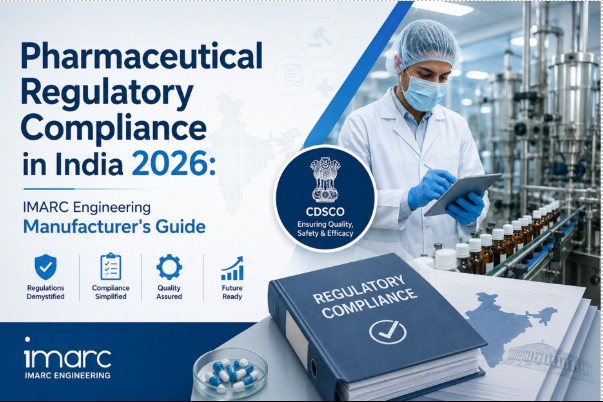
Pharmaceutical Regulatory Compliance in India
India’s pharmaceutical industry is experiencing a period of rapid growth alongside increasing regulatory scrutiny. Pharmaceutical exports reached USD 30.47 billion in FY2025, while the domestic pharmaceutical market is estimated at USD 60.32 billion in 2026 and is projected to reach USD 130 billion by 2030, according to the Economic Survey 2025–26.
However, regulatory compliance has become a critical determinant of market access and sustainable growth. In 2025, the Central Drugs Standard Control Organization (CDSCO) classified 1,879 drug batches as Not of Standard Quality (NSQ), more than double the 877 batches reported in 2024. During the second half of 2025, the U.S. Food and Drug Administration (FDA) issued 73% more warning letters to pharmaceutical manufacturers compared with the same period in 2024. Regulatory authorities also carried out more than 400 enforcement actions against non-compliant Indian manufacturers, including show-cause notices, production suspensions, and licence revocations.
This guide provides pharmaceutical manufacturers, quality leaders, and business decision-makers with a structured overview of India’s regulatory compliance landscape in 2026, current enforcement priorities, government initiatives, and the strategic actions required to maintain market access.
India’s Pharmaceutical Regulatory Framework in 2026
Pharmaceutical regulatory compliance in India is governed by a multi-layered framework comprising domestic GMP standards, international certification requirements, and export market regulations. The principal regulatory bodies and standards applicable to Indian manufacturers are as follows:
- Central Drugs Standard Control Organisation (CDSCO) administers the Drugs and Cosmetics Act and enforces Good Manufacturing Practices (GMP) through Schedule M of the Act. CDSCO also governs drug and medical device approvals, pharmacovigilance, and import licensing.
- Revised Schedule M (2023) is India’s domestic GMP standard, overhauled for the first time in decades to align with WHO-GMP guidelines. Compliance with Revised Schedule M is mandatory for all licensed pharmaceutical manufacturers in India.
- WHO-GMP certification, issued against WHO Technical Report Series standards, is a prerequisite for participation in global procurement programmes including UNICEF, Global Fund, and regulated government tenders across Africa and South Asia.
- US FDA 21 CFR Part 211 governs Current Good Manufacturing Practice for pharmaceutical manufacturers supplying the United States market. FDA compliance is assessed through on-site inspections and enforced through Form 483 observations, Warning Letters, and Import Alerts.
- EU GMP, including the revised Annex 1 (2023) for sterile manufacturing, governs market access to European regulated markets.
Government Policy: Investment, Incentives, and the Compliance Prerequisite
The Government of India has made pharmaceutical manufacturing a strategic national priority, supported by substantial policy interventions.
- Production Linked Incentive (PLI) Scheme – Pharmaceuticals: Since inception through September 2025, the scheme has generated cumulative sales of Rs 3,08,408 crore, including Rs 1,98,509 crore in exports. Actual investment of Rs 40,294 crore has exceeded the targeted Rs 17,275 crore by 133%, demonstrating strong industry participation.
- PLI Scheme – Bulk Drugs and APIs: With a financial outlay of Rs 6,940 crore, the scheme has mobilised Rs 4,763 crore in investment and created domestic production capacity for 26 critical APIs previously imported in significant volumes.
- PRIP Scheme (Promotion of Research and Innovation in Pharma Medtech): Designed to accelerate pharmaceutical and medical technology R&D, this scheme supports transition from generic manufacturing toward higher-value product categories.
- PMBJP (Pradhan Mantri Bhartiya Janaushadhi Pariyojana): Jan Aushadhi Kendras have expanded to 17,610 outlets nationally, strengthening domestic drug distribution infrastructure.
- Pharma Parks and Industrial Clusters: Under the Make in India initiative, dedicated pharmaceutical manufacturing zones are being developed across multiple states to reduce infrastructure barriers for new entrants.
A critical consideration for manufacturers pursuing PLI benefits or regulated market participation is that GMP compliance is a non-negotiable baseline condition for eligibility. India currently supplies 57% of WHO-prequalified APIs globally and meets 55–60% of UNICEF’s vaccine requirements. These positions are sustained by a relatively small proportion of India’s 10,500 manufacturing units , of approximately 8,500 MSME pharmaceutical manufacturers, fewer than 25% currently hold WHO-GMP certification.
Revised Schedule M: Current Compliance Status and Enforcement
The Revised Schedule M represents a structural transformation of India’s domestic GMP requirements, not an incremental update to the previous standard. Key compliance requirements include:
- Pharmaceutical Quality System (PQS) documentation aligned with ICH Q10
- Formal change control and deviation management procedures
- Validated cleaning processes with documented acceptance criteria
- Quality Risk Management framework aligned with ICH Q9
- Enhanced stability study and shelf-life determination requirements
- Upgraded facility infrastructure and equipment qualification (IQ/OQ/PQ)
- Comprehensive Batch Manufacturing Records (BMR) and Annual Product Quality Reviews (PQR)
Compliance Timeline: The deadline for large manufacturers was January 1, 2025. The MSME deadline was extended to December 31, 2025, under G.S.R. 127(E) dated February 11, 2025, conditional on submission of a CAPA plan. As of January 1, 2026, all manufacturers who did not apply for an extension are subject to immediate CDSCO inspections under Revised Schedule M norms.
Notably, only 1,600 to 1,700 MSME units, out of approximately 8,500 formally applied for the extension. This indicates that a substantial proportion of MSME manufacturers are now subject to enforcement action. States including Madhya Pradesh have deployed joint central-state inspection teams specifically to execute Revised Schedule M compliance verification.
US FDA Enforcement Trends: Observations and Implications for Indian Manufacturers
The US FDA formalised the expansion of unannounced inspections at foreign pharmaceutical manufacturing facilities in May 2025, with India and China identified as primary focus markets. This policy eliminates the prior notification advantage that had allowed certain non-compliances to remain concealed.
Between July and December 2025, the FDA issued 327 warning letters — a 73% increase over the same period in 2024. Indian pharmaceutical manufacturers receiving warning letters during this period include:
- Granules India Limited (February 2025): Contamination identified in non-dedicated equipment ducts; inadequate cleaning and maintenance rendering installed filters ineffective.
- Glenmark Pharmaceuticals Limited (July 2025): Manufacturing operations conducted using equipment and air handling units shared with other drug products, creating cross-contamination risk.
- Tentamus India Private Limited (March 2026): Failure to adequately investigate laboratory deviations; documented attempt to remove analytical documents from the quality control laboratory during inspection.
Data integrity is the most consistently cited category of non-compliance in FDA observations issued to Indian manufacturers. Violations include manipulation of electronic records, improper closure of out-of-specification (OOS) investigations, inadequate audit trails, and shared instrument access credentials.
The business consequences of an FDA Import Alert are significant. Affected products are detained at US ports of entry without physical examination. Remediation requires third-party audit, comprehensive corrective action implementation, and successful re-inspection — a process that typically spans 18 to 36 months and carries substantial financial and reputational costs.
How IMARC Engineering Can Support Indian Manufacturers
IMARC Engineering is India’s only EPCM-integrated regulatory compliance partner — combining engineering, project management, and quality systems expertise within a single engagement. For pharmaceutical manufacturers navigating the compliance demands of 2026, this integration eliminates the coordination gap that typically exists between engineering contractors and standalone compliance consultants.
Schedule a consultation with IMARC Engineering’s regulatory experts: https://www.imarcengineering.com/contact?service=regulatory-compliance-services
Regulatory Compliance Checklist for Pharmaceutical Manufacturers in India 2026
The following checklist covers the primary compliance requirements across domestic and international frameworks. Manufacturers assessing their readiness for CDSCO, FDA, or WHO inspections should evaluate their status against each category.
Revised Schedule M / Domestic GMP
- Pharmaceutical Quality System (PQS) documented per ICH Q10
- Site Master File (SMF) current and approved
- Facility layout and cleanroom classification validated
- HVAC and water system (PW/WFI) qualification complete (IQ/OQ/PQ)
- Equipment qualification records complete for all critical equipment
- Cleaning validation completed with documented acceptance criteria
- Change control, deviation management, and CAPA systems operational
- Batch Manufacturing Records (BMR) complete and subject to formal review
- Stability study programme in place per ICH Q1A
- Annual Product Quality Review (PQR) conducted
- Vendor qualification programme documented
WHO-GMP (Export Markets / Global Procurement)
- WHO TRS 986 / TRS 1019 compliance documented
- WHO-format Site Master File prepared
- Annual self-inspection programme with documented findings and CAPA
- Cold chain qualification in place (where applicable)
- Reference samples retained per WHO requirements
US FDA 21 CFR Part 211 (United States Market)
- Data integrity programme implemented (ALCOA+ principles)
- Electronic records and audit trails compliant with 21 CFR Part 11
- Individual user access controls enforced on all instruments and LIMS
- OOS investigation procedure documented and executed in two phases
- Process validation complete (Stage 1, 2, 3)
- Mock FDA inspection conducted within the preceding 12 months
EU GMP / Annex 1 — 2023 Revision (European Market)
- EU GMP Part I and Part II compliance documented
- Contamination Control Strategy (CCS) documented mandatory requirement under Annex 1 (2023)
- Annex 11 (computerised systems) compliance in place
- Qualified Person (QP) release system operational
CDSCO Licensing and Pharmacovigilance
- Manufacturing licence current and valid
- Product approvals (Form 28 / Form 29) in place for all marketed products
- Pharmacovigilance system established and operational
- Adverse Drug Reaction (ADR) reporting to CDSCO active
- Labelling compliant with Schedule D and Drugs and Cosmetics Act
Data Integrity
- Data integrity policy documented and communicated to all relevant personnel
- Audit trail functionality enabled on all analytical and production systems
- Raw data retained and accessible for review
- Periodic internal data integrity audits conducted
- Backup and disaster recovery procedures tested and documented
Quality Management System
- SOPs current, formally approved, and implemented in practice
- Personnel training records current and complete
- Internal audit schedule active — minimum annual frequency
- Quality Risk Management programme aligned with ICH Q9
- Document control system operational
Validation
- Validation Master Plan (VMP) in place and maintained
- Analytical method validation completed per ICH Q2 R2
- Computer System Validation (CSV) conducted per GAMP 5
- Revalidation trigger criteria defined and monitored
Environmental, Health and Safety
- Effluent Treatment Plant (ETP) compliant with CPCB norms
- Hazardous waste disposal records maintained
- ISO 14001 and ISO 45001 — implemented or formal implementation roadmap in place
- Fire safety NOC current
Strategic Considerations for Pharmaceutical Manufacturers in 2026
- For Established Manufacturers: A structured GMP gap assessment against Revised Schedule M, WHO-GMP, and applicable export market standards (FDA 21 CFR, EU GMP) provides the foundation for a prioritised compliance roadmap. Gap assessments identify highest-risk non-compliances before regulatory inspection and enable systematic remediation within a defined timeframe.
- For Exporters: Manufacturers supplying or seeking to supply the US, EU, or regulated African markets must treat data integrity as a systemic quality management priority — not a documentation activity. Investment in training, access controls, audit trail infrastructure, and quality culture development is a prerequisite for sustained export market access.
- For Greenfield Projects: New pharmaceutical manufacturing investments under PLI or independent capital programmes achieve the most cost-effective compliance outcomes when regulatory requirements are incorporated at the engineering design stage. Facility layout, HVAC classification, water system design, and utility qualification all carry direct regulatory implications. Regulatory compliance expertise engaged at the conceptual design phase eliminates the need for costly infrastructure modifications post-commissioning.
- For MSME Manufacturers: With Revised Schedule M now enforceable from January 2026 and state inspection teams actively deployed, the business risk of deferred compliance is significant. Manufacturers that achieve WHO-GMP certification — currently held by fewer than 25% of MSMEs — gain access to global procurement programmes, export incentives, and preferential positioning in institutional tender processes. The marginal compliance gap between Revised Schedule M and WHO-GMP is narrower than at any prior point, presenting a defined pathway to international market access.
Conclusion
Regulatory compliance in India’s pharmaceutical sector in 2026 is no longer a risk management function — it is a market access strategy. The manufacturers that invest in quality infrastructure now are positioning for participation in a USD 130 billion domestic market and USD 30+ billion in annual exports. Those that defer compliance face escalating regulatory exposure and progressive exclusion from regulated market supply chains.
The Government of India has committed substantial policy and financial resources to pharmaceutical manufacturing growth. Compliance is the mechanism through which manufacturers convert those policy commitments into commercial outcomes
About IMARC Engineering
IMARC Engineering is India’s EPCM-integrated regulatory compliance partner for pharmaceutical and industrial manufacturers. Services include GMP gap assessments, Revised Schedule M compliance programmes, WHO-GMP certification support, US FDA audit preparation, mock inspections, and end-to-end regulatory compliance for greenfield and brownfield pharmaceutical plant projects.
Contact Us:
IMARC Engineering
Phone: +91-120-433-0800
Email: sales@imarcengineering.com
India: C-130, Sector 2, Noida, Uttar Pradesh 201301
LinkedIn: https://www.linkedin.com/showcase/imarc-engineering/
About the Author