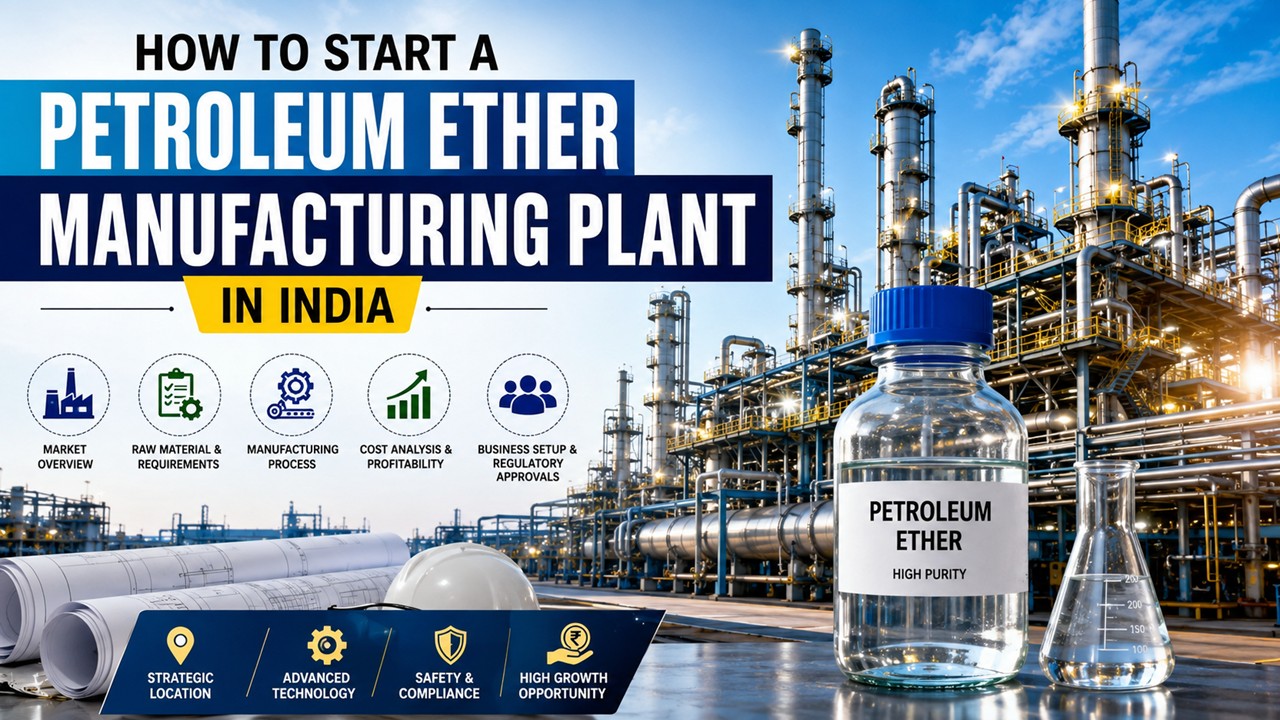
Petroleum Ether Manufacturing Plant Setup in India
Setting up a petroleum ether manufacturing plant in India presents a compelling investment case, driven by rising demand from pharmaceutical formulations, laboratory solvents, edible oil extraction, and industrial cleaning applications. Petroleum ether is a critical raw material for chemical, pharmaceutical, laboratory, and coatings applications, and its role in extraction, purification, degreasing, and formulation processes positions it as a cornerstone for reliable industrial operations. The expanding pharmaceutical production, increasing laboratory testing activities, and sustained demand from edible oil extraction processes are key factors propelling market growth.
India’s accelerated industrial development, growing pharmaceutical and chemical manufacturing base, and the government’s “Make in India” initiative provide strong tailwinds for domestic production of specialty solvents like petroleum ether. Government initiatives promoting domestic chemical production and Make-in-India schemes indirectly boost demand for petroleum ether. Key manufacturing states such as Gujarat, Maharashtra, and Tamil Nadu, with their established petrochemical and pharmaceutical clusters, offer strategic advantages for setting up production facilities. With the Asia-Pacific region playing a significant role in the production and consumption of petroleum ether, India offers a strategically sound environment for establishing a manufacturing facility.
India’s petroleum ether market presents strong investment potential, bolstered by policy support like Make in India, expanding pharmaceutical and laboratory sectors, and growing industrial applications. With gross margins typically ranging between 15-25% and net margins of 10-20%, investors can achieve healthy profitability and a viable break-even timeline.
What is Petroleum Ether?
Petroleum ether is a highly volatile, colorless, and flammable aliphatic hydrocarbon solvent derived from petroleum distillation. Despite its name, it does not contain ether functional groups; instead, it primarily consists of low-boiling hydrocarbons such as pentane and hexane. Petroleum ether is characterized by its low boiling range, rapid evaporation rate, non-polar nature, and excellent solvency for oils, fats, waxes, and resins. It exhibits low density, minimal residue after evaporation, and limited water solubility. These properties make petroleum ether suitable for laboratory analysis, pharmaceutical processing, extraction operations, and industrial cleaning applications. The petroleum ether manufacturing process uses fractional distillation, solvent extraction, and purification as the primary production method. Key end-use industries served include pharmaceuticals, laboratories, chemicals manufacturing, paints and coatings, and electronics.
Cost of Setting Up a Petroleum Ether Manufacturing Plant in India
The total cost of setting up a petroleum ether manufacturing plant in India depends on several critical factors, including plant capacity, technology, location, automation levels, and regulatory compliance requirements.
1. Capital Expenditure (CapEx)
The total capital investment required for establishing a petroleum ether manufacturing plant covers land acquisition, site preparation, and necessary infrastructure. The location must offer easy access to key raw materials such as petroleum distillate fractions and catalysts/stabilizers, with proximity to target markets to minimize distribution costs. The site must have robust infrastructure, including reliable transportation, utilities, and waste management systems. Compliance with local zoning laws and environmental regulations must also be ensured. Machinery costs account for the largest portion of the total capital expenditure. The cost of land and site development, including charges for land registration, boundary development, and other related expenses, forms a substantial part of the overall investment.
Key machinery required includes:
- Feedstock pre-treatment units
- Fractionation columns
- Hydrotreating reactors
- Catalyst regeneration systems
- Distillation towers
- Purification filters
- Stabilizers
- Storage tanks
- Dedicated loading facilities
Other capital costs include civil works (production shed, quality control lab, raw material and finished goods storage, administrative block), effluent treatment systems, and pre-operative and commissioning expenses.
Request a Sample Report for In-Depth Market Insights: https://www.imarcgroup.com/petroleum-ether-manufacturing-plant-project-report/requestsample
2. Operational Expenditure (OpEx)
The operating cost structure of a petroleum ether manufacturing plant is primarily driven by raw material consumption, particularly petroleum distillate fractions, which accounts for approximately 65–75% of total operating expenses (OpEx). Raw materials required include petroleum distillate fractions and catalysts/stabilizers. Implementing long-term contracts with reliable suppliers helps mitigate price volatility and ensure a consistent supply of materials. Utilities (electricity, water, steam) account for 10-15% of OpEx. Other OpEx components include transportation costs, packaging costs, salaries and wages, repairs and maintenance, depreciation, and taxes. By the fifth year, the total operational cost is expected to increase substantially due to factors such as inflation, market fluctuations, and potential rises in the cost of key materials.
3. Plant Capacity
The proposed manufacturing facility is designed with an annual production capacity ranging between 50,000-100,000 Metric Tonnes, enabling economies of scale while maintaining operational flexibility. Plant capacity can be customized per investor requirements. Profitability improves significantly with higher capacity utilization.
4. Profit Margins and Financial Projections
The project demonstrates healthy profitability potential under normal operating conditions. Gross profit margins typically range between 15-25%, supported by stable demand and value-added applications. Net profit margins are projected at 10-20%. Financial analysis includes comprehensive projections of net present value (NPV), internal rate of return (IRR), payback period, income projections, expenditure projections, and profit and loss accounts.
Why Set Up a Petroleum Ether Plant in India?
Essential Industrial Solvent: Petroleum ether is a critical raw material for chemical, pharmaceutical, laboratory, and coatings applications. Its role in extraction, purification, degreasing, and formulation processes positions it as a cornerstone for reliable industrial operations.
Megatrend Alignment: Growing demand from pharmaceuticals, paints and coatings, laboratory research, and specialty chemical production ensures stable, long-term consumption. Expansion in sectors such as biotech, analytical labs, and industrial chemicals is driving consistent market growth globally.
Policy and Regulatory Tailwinds: Government initiatives promoting domestic chemical production, Make-in-India schemes, and environmental regulations favoring controlled, high-quality solvents indirectly boost demand for petroleum ether.
Cost-Competitive Manufacturing: India offers competitive advantages in land, labour, and supply chain costs. The Asia-Pacific region plays a significant role in the production and consumption of petroleum ether.
Local Supply Chain Reliability: End-users increasingly prefer dependable, local suppliers to ensure timely delivery, manage price volatility, and maintain uninterrupted production—creating opportunities for regional petroleum ether manufacturers with streamlined operations and sourcing.
Active Industry Investment: In June 2025, Aether Speciality Chemicals signed a significant 10-year deal with Milliken for exclusive manufacturing of a strategic product at its existing Site 3+, leveraging complex chemistry for high-value sectors.
Manufacturing Process – Step by Step
The petroleum ether manufacturing process uses fractional distillation, solvent extraction, and purification as the primary production method.
- Raw Material Sourcing: Reliable suppliers must be secured for raw materials like petroleum distillate fractions and catalysts/stabilizers to ensure consistent production quality. Minimizing transportation costs by selecting nearby suppliers is essential. Sustainability and supply chain risks must be assessed, and long-term contracts should be negotiated to stabilize pricing and ensure a steady supply.
- Feedstock Pre-treatment: Raw petroleum distillate fractions undergo pre-treatment to remove impurities and prepare them for fractionation. Essential equipment includes feedstock pre-treatment units.
- Fractionation: Pre-treated feedstock is separated into different hydrocarbon fractions using fractionation columns.
- Hydrotreating: Fractions are processed through hydrotreating reactors to remove sulfur and other contaminants.
- Catalyst Regeneration: Catalyst regeneration systems are used to maintain the efficiency of the hydrotreating process.
- Distillation: The treated product undergoes further purification in distillation towers to achieve the desired boiling range and purity.
- Purification and Stabilization: The distilled product passes through purification filters and stabilizers to ensure final product quality and stability.
- Quality Assurance: A comprehensive quality control system should be established throughout production. Analytical instruments must be used to monitor product concentration, purity, and stability. Documentation for traceability and regulatory compliance must be maintained.
- Storage and Dispatch: Finished petroleum ether is stored in storage tanks and dispatched using dedicated loading facilities to end-use industries including pharmaceuticals, laboratories, chemicals manufacturing, paints and coatings, and electronics.
Key Applications
Petroleum ether serves a diverse range of industries and applications:
- Chemical Industry: Used as a solvent for extraction, cleaning, and degreasing processes.
- Pharmaceuticals: Used as a raw material for drug synthesis and as a laboratory reagent.
- Laboratories: Used for analytical procedures, sample preparation, and chromatography.
- Paints and Coatings: Used as a diluent for paints, varnishes, and adhesives.
Leading Manufacturers
Leading manufacturers in the global petroleum ether industry include several multinational companies with extensive production capacities and diverse application portfolios. Key players include:
- ExxonMobil Corporation
- Shell plc
- Bharat Petroleum Corporation Limited
- Indian Oil Corporation Limited
- Merck KGaA
These key players serve end-use sectors such as pharmaceuticals, laboratories, chemicals manufacturing, paints and coatings, and electronics.
Timeline to Start the Plant
- Feasibility study and project report preparation
- Land acquisition and site development
- Regulatory approvals and environmental clearances
- Factory licence and fire safety compliance
- Machinery procurement and installation
- Raw material supplier agreements and supply chain setup
- Trial production and quality testing
- Commercial production launch
Licences and Regulatory Requirements
Starting a petroleum ether manufacturing unit in India requires several approvals:
- Business registration (Proprietorship, LLP, or Pvt Ltd)
- Factory Licence under the Factories Act
- Environmental Clearance from State Pollution Control Board
- GST Registration
- Fire Safety NOC
- Hazardous/Chemical compliance (due to the flammable nature of petroleum ether)
- Effluent Treatment Plant (ETP) operational clearance
- Occupational Health and Safety compliance
Key Challenges to Consider
- High Capital Requirements: Machinery and infrastructure investments represent significant upfront costs. Equipment costs for feedstock pre-treatment units, fractionation columns, hydrotreating reactors, catalyst regeneration systems, distillation towers, purification filters, stabilizers, storage tanks, and dedicated loading facilities represent a significant portion of capital expenditure.
- Raw Material Price Volatility: Fluctuations in prices of petroleum distillate fractions and catalysts/stabilizers directly impact margins. Raw materials account for 65-75% of operating expenses.
- Regulatory Compliance: Navigating environmental clearances, factory licences, and pollution control board regulations requires careful planning. Safety protocols must be implemented throughout the manufacturing process.
- Safety and Environmental Compliance: Petroleum ether is highly volatile and flammable. Advanced monitoring systems should be installed to detect leaks or deviations in the process. Effluent treatment systems are necessary to minimize environmental impact and ensure compliance with emission standards.
- Competition: The market includes established global players such as ExxonMobil Corporation, Shell plc, Bharat Petroleum Corporation Limited, Indian Oil Corporation Limited, and Merck KGaA.
- Skilled Manpower: Access to skilled workers for distillation operations, quality control, and safety management is essential.
Frequently Asked Questions
- How much does it cost to set up a petroleum ether manufacturing plant in India?
The total capital investment depends on plant capacity, technology, and location, covering land acquisition, site preparation, infrastructure, and machinery costs. - Is petroleum ether manufacturing profitable in India in 2026?
Yes, gross profit margins typically range between 15-25%, with net profit margins of 10-20%, indicating healthy profitability potential. - What machinery is required for a petroleum ether plant in India?
Essential equipment includes feedstock pre-treatment units, fractionation columns, hydrotreating reactors, catalyst regeneration systems, distillation towers, purification filters, stabilizers, storage tanks, and dedicated loading facilities. - What licences and approvals are required to start a petroleum ether plant in India?
Required approvals include business registration, Factory Licence under the Factories Act, Environmental Clearance from State Pollution Control Board, GST Registration, Fire Safety NOC, hazardous/chemical compliance, and ETP operational clearance. - What raw materials are needed for petroleum ether manufacturing?
Raw materials required include petroleum distillate fractions and catalysts/stabilizers. - What are the environmental compliance requirements for a petroleum ether plant in India?
Facilities must implement effluent treatment systems, obtain environmental clearance from the State Pollution Control Board, and comply with emission standards. - What is the best location to set up a petroleum ether plant in India?
The location must offer easy access to key raw materials such as petroleum distillate fractions and catalysts/stabilizers, with proximity to target markets. Key manufacturing states such as Gujarat, Maharashtra, and Tamil Nadu offer strategic advantages. - What is the break-even period for this type of plant in India?
Financial projections including break-even analysis are provided in detailed feasibility reports, with timelines varying based on capacity, utilization rates, and operating efficiencies. - What government incentives are available for manufacturers in India?
Investors benefit from government initiatives promoting domestic chemical production, Make-in-India schemes, and environmental regulations favoring controlled, high-quality solvents.
Key Takeaways for Investors
Setting up a petroleum ether manufacturing plant in India offers a compelling investment opportunity, driven by strong demand from pharmaceuticals, laboratories, chemicals manufacturing, paints and coatings, and electronics end-use sectors. The project demonstrates healthy financial viability across various plant capacities (50,000-100,000 Metric Tonnes annually), with gross profit margins ranging between 15-25% and net margins of 10-20%. The global petroleum ether market was valued at USD 6.49 Billion in 2025 and is expected to reach USD 9.07 Billion by 2034, exhibiting a CAGR of 3.8% from 2026 to 2034. According to data from the Independent Commodity Intelligence Services (ICIS), demand for chemicals is expected to increase by 30% over the next decade. Rising investments in academic and industrial research laboratories have increased solvent demand for chromatography and analytical applications. With ongoing pharmaceutical expansion, laboratory research growth, and industrial chemical production, the petroleum ether industry is poised for continued expansion, making now an opportune time for investors to enter this dynamic market.
About the Author