A brass sheets manufacturing plant setup in India presents a compelling investment case driven by the country’s expanding demand across automotive, electronics, construction, and manufacturing sectors. The material – thin, flat plates made from a copper-zinc alloy – is a critical input in producing radiators, heat exchangers, connectors, plumbing fittings, and architectural fixtures. As India accelerates industrial activity, the relevance of durable, corrosion-resistant alloy sheets continues to grow across these high-consumption verticals.
India’s structural advantages position it as a strategic location for this investment. The Make in India initiative supports domestic manufacturing through policy incentives, while industrial states such as Gujarat and Maharashtra offer well-developed infrastructure, skilled labour, and proximity to metal supply chains. According to a PIB Research report, India’s industrial sector is projected to grow by 6.2% in FY26, up from 5.9% in FY25, reinforcing the demand trajectory for alloy materials. Asia Pacific – which includes India – accounts for 43.7% of the global brass sheets market, underlining the region’s dominance and long-term visibility.
Establishing this type of facility in India combines policy tailwinds, a growing industrial base, and strong demand from automotive, electronics, and construction sectors to offer gross margins of 20-30% and net margins of 10-15%. With an annual production capacity of 5,000-20,000 MT and cost-competitive Indian operations, the facility presents a viable break-even opportunity for serious capital allocators.
What are Brass Sheets?
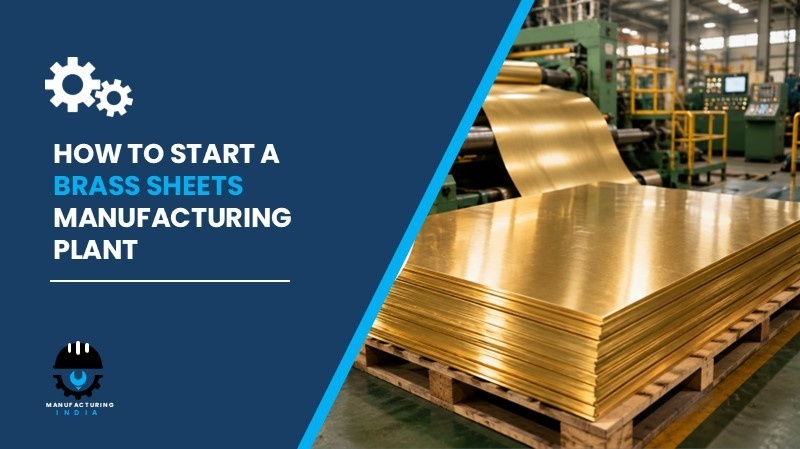
Brass sheets are thin, flat plates produced from an alloy of copper and zinc, with the zinc content ratio varied according to the desired mechanical characteristics. The material offers excellent strength, corrosion resistance, and ease of forming – properties that make it indispensable in functional and aesthetic applications alike. Brass is highly resistant to rust and tarnishing, making it suitable for both industrial use and decorative purposes. These plates are produced through rolling and annealing, which impart excellent mechanical properties for forming, welding, and machining. Variants differ by zinc content and dimensional specifications, catering to precise industry standards.
The primary brass sheets manufacturing process involves raw material sourcing, melting and alloying, rolling, annealing, surface treatment, cutting, and packaging. End-use industries include automotive, electronics, construction and plumbing, and manufacturing and engineering.
Cost of Setting Up a Brass Sheets Manufacturing Plant in India
The cost of establishing this type of plant depends on several interdependent variables, including production capacity, technology selection, geographic location, level of automation, and the extent of regulatory compliance required.
1. Capital Expenditure (CapEx)
The largest component of capital expenditure in the facility is machinery. Land and site development – covering land registration charges, boundary development, and related pre-construction expenses – represents a substantial additional portion of the overall investment. Locating the facility within a Special Economic Zone (SEZ) or notified industrial estate can reduce upfront infrastructure costs and offer tax advantages.
Civil works and construction costs include fabrication of the main production shed, laboratory, raw material storage, finished goods warehouse, and administrative block. These are sized to accommodate current capacity as well as future expansion.
Key machinery required includes:
- Rolling mills
- Annealing furnaces
- Cutting machines
- Surface treatment equipment
- Inspection equipment
Other capital costs include effluent treatment plant (ETP) installation, pre-operative expenditure, commissioning charges, and applicable import duties on specialised equipment.
Request a Sample Report for In-Depth Market Insights: https://www.imarcgroup.com/brass-sheets-manufacturing-plant-project-report/requestsample
2. Operational Expenditure (OpEx)
Raw material cost is the dominant driver of operating expenses, accounting for 80-85% of total OpEx. Core inputs include copper, zinc, and lead. Given the price sensitivity of copper in particular, establishing long-term supply contracts with reliable domestic or import-linked suppliers is a critical cost management strategy.
Utility costs – covering electricity, water, and steam required for melting, rolling, and annealing operations – account for 10-15% of OpEx. Other operating costs include transportation, packaging, salaries and wages, maintenance, depreciation, and applicable taxes. By the fifth year, total operational costs are expected to increase substantially due to inflation, market fluctuations, potential rises in key material costs, supply chain disruptions, rising consumer demand, and shifts in the global economy.
3. Plant Capacity
The proposed brass sheets plant is designed with an annual production capacity ranging between 5,000-20,000 MT, enabling economies of scale while maintaining operational flexibility. Capacity can be customized based on investor requirements and available capital. Profitability improves meaningfully with higher capacity utilisation, as fixed costs are distributed over a larger volume of output.
4. Profit Margins and Financial Projections
The facility demonstrates healthy profitability potential under normal operating conditions. Gross profit margins typically range between 20-30%, supported by stable industrial demand and value-added product applications. Net profit margins are in the range of 10-15%. Full financial projections – covering NPV, IRR, payback period, and sensitivity analysis – are available in the detailed project report, allowing investors to assess break-even timelines and long-term return visibility.
Why Set Up a Brass Sheets Manufacturing Plant in India?
Growing Industrial Demand: India’s automotive, electronics, and construction industries represent the primary demand engine for the product. The material’s durability, high thermal conductivity, and corrosion resistance make it a preferred input in radiators, heat exchangers, connectors, and plumbing fixtures – all of which are scaling with India’s industrial expansion.
Versatility and Durability Driving Market Preference: Brass offers a rare combination of corrosion resistance, machinability, and mechanical strength, making it adaptable across a wider range of applications than most competing metals. This versatility sustains consistent demand even as application requirements evolve across manufacturing and engineering segments.
Rising Demand for Sustainable Materials: The growing emphasis on sustainable industrial practices is a positive structural trend for brass, which is a highly recyclable material. Environmental policies and corporate sustainability mandates are increasingly steering procurement decisions toward recyclable metals, creating a favourable demand tailwind for the brass sheets plant and its output.
Technological Advancements in Manufacturing: Modern precision rolling and alloying techniques are improving product quality and expanding the range of applications. Investment in advanced machinery at the production level positions operators to capture premium-grade contracts in electronics and aerospace applications.
Active Industry Investment – November 2024: A study titled “Impact of Uniaxial Pre-Strains on the Forming Limit Curve (FLC) of CuZn 70-30 Brass Sheets” demonstrated that pre-straining significantly improves deformation resistance. The findings offer insights for improving performance in automotive and aerospace manufacturing processes, pointing to expanding high-value end-use demand.
Aesthetic and Functional Appeal Creating Local Demand: The golden appearance of brass combined with good tarnish resistance drives demand for decorative applications – including door handles, hinges, architectural elements, and jewellery – where Indian consumer preference for durable, visually appealing products is well established.
Manufacturing Process – Step by Step
The brass sheets manufacturing process uses rolling and annealing as the primary production method. Each stage involves precise material handling and quality verification to ensure dimensional accuracy and mechanical consistency.
- Raw Material Sourcing: Copper, zinc, and lead are procured from qualified suppliers, with supply chain continuity secured through long-term contracts.
- Melting and Alloying: Raw materials are charged into melting furnaces and combined in precise ratios to achieve the target copper-zinc alloy composition.
- Rolling: The molten alloy is cast into billets or slabs, then passed through rolling mills to reduce thickness and achieve required sheet dimensions.
- Annealing: Rolled output is subjected to controlled heat treatment in annealing furnaces to relieve internal stresses, restore ductility, and improve formability.
- Surface Treatment: Sheets undergo surface treatment to remove oxidation, improve finish, and meet specification requirements for downstream users.
- Cutting: Finished material is cut to required lengths and widths using cutting machines, as per customer or industry standards.
- Inspection and Packaging: Product is checked against quality criteria covering dimensional accuracy, surface finish, and mechanical properties, then packaged and dispatched to automotive, electronics, construction, and engineering end-users.
Key Applications
Brass sheets serve a broad range of industries where strength, machinability, and corrosion resistance are critical:
- Automotive: Used in radiators, heat exchangers, fuel system parts, and decorative items, leveraging good resistance properties and high thermal conductivity.
- Electronics: Applied in connectors and other devices requiring good conductivity and corrosion resistance properties.
- Construction and Plumbing: Used for faucets, valves, pipes, door handles, hinges, and other architectural features across residential and commercial construction.
- Manufacturing and Engineering: Applied in precision parts, tools, fasteners, and bearings, where machinability and non-ferrous resistance properties are essential.
Leading Manufacturers
The global industry includes several established multinational companies with extensive production capacities serving automotive, electronics, construction, and manufacturing end-use sectors. These leading manufacturers hold diverse application portfolios and serve customers across geographies. Detailed profiles of key players, including production capacities and geographic footprints, are covered in the full IMARC project report.
Timeline to Start the Plant
- Feasibility study and project report preparation
- Land acquisition and site development
- Regulatory approvals and environmental clearances
- Factory licence and fire safety compliance
- Machinery procurement and installation
- Raw material supplier agreements and supply chain setup
- Trial production and quality testing
- Commercial production launch
Licences and Regulatory Requirements
Starting a brass sheets manufacturing unit in India requires several approvals:
- Business registration (Proprietorship, LLP, or Pvt Ltd)
- Factory Licence under the Factories Act
- Environmental Clearance from State Pollution Control Board
- GST Registration
- Fire Safety NOC
- Hazardous materials and chemical handling compliance (applicable given copper, zinc, and lead inputs)
- Effluent Treatment Plant (ETP) operational clearance
- Occupational Health and Safety compliance
Key Challenges to Consider
High Capital Requirements: Establishing a brass sheets plant requires significant investment in rolling mills, annealing furnaces, cutting machines, surface treatment equipment, and inspection equipment. Capital planning must account for both machinery costs and land, construction, and utility infrastructure.
Raw Material Price Volatility: Copper – the dominant input, combined with zinc and lead, collectively representing 80-85% of total OpEx – is subject to global commodity price swings. Effective procurement strategy, including long-term contracts and hedging, is essential to protect margins.
Regulatory Compliance: Operating a metals processing facility in India requires adherence to environmental clearance norms, ETP operational standards, and occupational safety requirements, all of which carry ongoing compliance costs.
Technology and Innovation Pressure: As demonstrated by November 2024 research into pre-strain forming limits of CuZn 70-30 alloy, the industry is evolving toward higher-performance material specifications. Producers must invest in process innovation to remain relevant in automotive and aerospace supply chains.
Competition: The global market is served by several multinational manufacturers with established scale and distribution networks, creating competitive pricing pressure for new entrants.
Skilled Manpower: Operating rolling mills, annealing furnaces, and surface treatment equipment requires trained personnel with metallurgical and mechanical expertise, which can be a sourcing challenge in certain Indian industrial locations.
Frequently Asked Questions
How much does it cost to set up a brass sheets manufacturing plant in India?
The total cost depends on capacity, technology, location, and automation level. A facility designed for 5,000-20,000 MT per year covers land and site development, civil works, machinery (rolling mills, annealing furnaces, cutting machines, surface treatment equipment, and inspection equipment), ETP installation, and pre-operative expenses. Detailed CapEx breakdowns are available in the IMARC project report.
Is brass sheets manufacturing profitable in India in 2026?
Yes. The facility demonstrates healthy profitability under normal operating conditions. Gross margins are projected at 20-30% and net margins at 10-15%, supported by stable demand from automotive, electronics, and construction sectors and India’s industrial growth trajectory.
What machinery is required for a brass sheets manufacturing plant in India?
Key equipment includes rolling mills, annealing furnaces, cutting machines, surface treatment equipment, and inspection equipment. Equipment selection should prioritise corrosion-resistant, industry-standard machinery aligned with the rolling and annealing production process.
What licences and approvals are required to start a brass sheets manufacturing plant in India?
Required approvals include business registration, Factory Licence under the Factories Act, Environmental Clearance from the State Pollution Control Board, GST Registration, Fire Safety NOC, ETP operational clearance, hazardous materials compliance, and Occupational Health and Safety certification.
What raw materials are needed for brass sheets manufacturing?
The primary raw materials are copper, zinc, and lead. Copper is the most cost-significant input, with raw materials collectively representing 80-85% of total operational expenses. Reliable supplier contracts are essential for cost stability and consistent production quality.
What are the environmental compliance requirements for a brass sheets manufacturing plant in India?
The facility must obtain Environmental Clearance from the State Pollution Control Board, install and operate an effluent treatment plant, and comply with emission and waste disposal standards applicable to metal processing operations.
What is the best location to set up a brass sheets manufacturing plant in India?
Ideal locations offer proximity to copper and zinc suppliers, robust transportation and logistics infrastructure, and access to reliable utilities. Industrial clusters in Gujarat and Maharashtra offer these advantages, along with established metal manufacturing ecosystems.
What is the break-even period for this type of plant in India?
The break-even period depends on plant capacity, capacity utilisation rate, and prevailing market prices. The IMARC project report provides detailed payback period analysis, NPV, and IRR calculations based on realistic operating assumptions.
What government incentives are available for manufacturers in India?
Manufacturers can access incentives under the Make in India initiative, state industrial policies, SEZ benefits, and various central and state government subsidy and credit-linked capital subsidy schemes applicable to metals manufacturing and allied industries.
Key Takeaways for Investors
This investment opportunity in India offers a well-grounded case backed by sustained demand from the automotive, electronics, construction, and manufacturing sectors – all of which rely on brass’s unique combination of conductivity, corrosion resistance, and machinability. The production unit is financially viable across a range of plant capacities from 5,000 to 20,000 MT per year, with gross margins of 20-30% and net margins of 10-15% demonstrating strong return potential under normal operating conditions. Asia Pacific holds 43.7% of the global brass sheets market, and India’s industrial sector is projected to grow at 6.2% in FY26, providing durable market depth for domestic producers. Raw material costs – primarily copper, zinc, and lead – account for 80-85% of OpEx, making supplier contract management a core operational priority for sustained margin performance. The rolling and annealing production method is well-established, and modern precision techniques continue to expand application possibilities into high-value aerospace and advanced automotive segments. As urbanisation accelerates, construction activity expands, and India deepens its electronics and automotive manufacturing base, long-term demand for the product is expected to remain robust, supporting strong investment fundamentals through the decade ahead.
About the Author