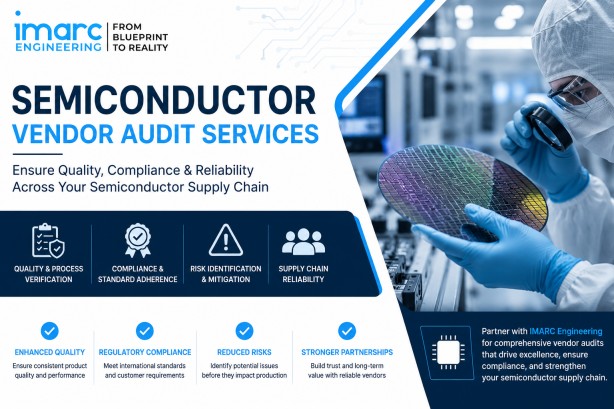
semiconductor vendor audit services
Semiconductor manufacturing depends on one of the most tightly controlled industrial supply chains in the world. Ultra-high-purity chemicals, specialty gases, silicon wafers, precision process equipment, and cleanroom consumables must consistently meet stringent quality and contamination-control requirements. Even minor deviations can affect wafer yield, product reliability, and customer qualification.
India’s semiconductor manufacturing ecosystem is expanding rapidly, driven by the India Semiconductor Mission, the Production Linked Incentive (PLI) scheme, and new fabrication, assembly, and testing facilities coming online across states such as Gujarat, Uttar Pradesh, and Karnataka. Every project depends on a specialized supply chain of raw materials, process chemicals, gases, and precision equipment sourced from vendors who must meet exacting purity, tolerance, and reliability standards. A single non-conforming material lot or poorly maintained equipment can compromise wafer yield, contaminate a production run, or trigger downtime.
Vendor audits are the mechanism by which manufacturers verify that material and equipment suppliers meet the technical, quality, and regulatory requirements of semiconductor production demands. As India positions itself as a credible global semiconductor manufacturing hub, structured vendor audit programs have become a core requirement for project bankability, customer qualification, and long-term reliability. This guide covers why semiconductor vendor audit services matter, common industry challenges, the steps to consider when selecting an audit consultant, and the framework IMARC Engineering follows to ensure vendor readiness.
Why Vendor Audits Matter
1. They Protect Yield and Product Quality Semiconductor processes operate within tight tolerances, and inconsistent material purity or equipment calibration drift can directly reduce wafer yield and device performance.
2. They Reduce Supply Chain Risk Formal audits identify vendors with weak quality systems, unstable capacity, or poor traceability before they become embedded in a critical supply chain. Vendor audits identify weaknesses in supplier quality systems, production capacity, contamination controls, calibration practices, and traceability before they affect manufacturing operations. Early identification reduces supply disruptions and costly supplier replacement during production.
3. They Support Regulatory and Customer Qualification Fabs and assembly units seeking global customer qualification must demonstrate documented, auditable vendor oversight.
4. They Prevent Costly Production Disruptions Equipment failures or contaminated batches traced back to unaudited vendors can halt production lines and trigger expensive requalification cycles.
Regulatory and Industry Framework for Vendor Audits in India
- ISO 9001 Quality Management Systems
- IATF 16949 (where applicable to associated electronics supply chains)
- SEMI International Standards
- India Semiconductor Mission guidelines
- PLI Scheme compliance requirements
- ISO 14644 for cleanroom-related material handling
- Customer-specific supplier qualification protocols
Industry Challenges and Common Mistakes
1. Treating Audits as a One-Time Step Many manufacturers audit a vendor once during onboarding but skip periodic reassessment as processes, ownership, or capacity change.
2. Insufficient Technical Depth in Audit Teams Generic quality audits often miss semiconductor-specific risks such as trace metal contamination or gas purity degradation.
3. Weak Documentation and Traceability Review Incomplete review of certificates of analysis, calibration records, and batch traceability creates blind spots that surface after a production issue.
4. Limited Visibility into Sub-Tier Suppliers Audits frequently stop at the primary vendor without assessing sub-suppliers of raw chemicals or critical components.
5. Inconsistent Audit Scoring and Follow-Up Without standardized scoring criteria and corrective action tracking, findings are not consistently resolved or verified for closure.
Steps to Consider While Selecting a Vendor Audit Consultant
1. Technical expertise
- Familiarity with material specifications, gas and chemical purity standards, and equipment qualification protocols
- Experience auditing wafer fabrication, assembly, and test equipment suppliers
2. Industry-specific experience
- Track record auditing suppliers of silicon wafers, specialty gases, photoresists, and process equipment
- Understanding of contamination control and traceability requirements specific to semiconductor manufacturing
3. Audit methodology capability
- Structured checklists aligned to SEMI standards and customer qualification requirements
- Clear scoring frameworks and corrective action tracking
4. Ongoing support capability
- Periodic reassessment scheduling and vendor performance monitoring
- Support for sub-tier supplier visibility and risk mapping
IMARC Engineering’s Vendor Audit Framework
IMARC Engineering follows a structured six-stage methodology to ensure semiconductor material and equipment vendors meet manufacturing project requirements.
Step 1: Vendor Risk Assessment and Prioritization
The process begins with mapping the vendor base by criticality, identifying suppliers posing the greatest risk to production continuity.
Step 2: Documentation and Quality System Review
Quality certifications, calibration records, certificates of analysis, and traceability systems are reviewed against project requirements.
Step 3: On-Site Technical Audit
Facility inspections assess manufacturing processes, contamination control practices, equipment maintenance records, and material handling at the vendor site.
Step 4: Performance and Capability Verification
Historical performance data, capacity commitments, and technical capability are verified against production volume requirements.
Step 5: Corrective Action and Closure Tracking
Findings are documented with defined corrective actions, responsible parties, and timelines, with follow-up verification to confirm closure.
Step 6: Periodic Reassessment and Vendor Monitoring
IMARC Engineering establishes ongoing reassessment schedules and performance monitoring to sustain vendor reliability throughout the project lifecycle.
Speak with IMARC Engineering’s Vendor Audit Specialists- https://www.imarcengineering.com/contact?service=vendor-audits-and-compliance-checks
Vendor Audit Lifecycle and Business Impact
| Stage | Key Activities | IMARC’s Role | Business Outcome |
| Risk Assessment | Vendor mapping, criticality ranking | Prioritization framework development | Focused audit resource allocation |
| Documentation Review | Quality system and certification review | Compliance gap identification | Verified vendor quality baseline |
| On-Site Audit | Facility and process inspection | Technical audit execution | Confirmed production readiness |
| Performance Verification | Capacity and capability assessment | Data validation against requirements | Reliable supply confidence |
| Corrective Action Tracking | Finding documentation, closure verification | Action plan management | Resolved compliance gaps |
| Periodic Reassessment | Scheduled monitoring, performance review | Ongoing vendor governance | Sustained supply chain reliability |
Industry-Specific Vendor Audit Considerations
1. Wafer and Substrate Suppliers Audits focus on crystal purity, surface defect rates, and dimensional consistency critical to fabrication yield.
2. Specialty Gas and Chemical Suppliers Purity certification, transport contamination control, and storage handling require close scrutiny given their impact on process integrity.
3. Process Equipment Vendors Calibration records, preventive maintenance history, and spare parts availability are key factors in assessing equipment reliability.
4. Test and Measurement Equipment Suppliers Audits verify measurement accuracy, traceability to recognized standards, and software validation for automated systems.
5. Packaging and Assembly Material Suppliers Material consistency, moisture sensitivity control, and handling procedures are assessed to prevent reliability failures.
Business Outcomes of Effective Vendor Audits
- Improved wafer yield through consistent supplier quality and reduced contamination-related losses
- Stronger supplier qualification records for customer reviews
- Reduced risk of production disruptions from vendor failures
- Greater visibility into sub-tier supply chain risks
- Faster resolution of quality issues through corrective action tracking
- Lower total cost of supplier quality management
Vendor Audit Trends in 2026
1. Digital Audit Management Platforms Cloud-based systems are streamlining audit scheduling, findings documentation, and corrective action tracking across vendor networks.
2. Risk-Based Audit Frequency Manufacturers are shifting toward risk-based reassessment schedules, focusing resources on the most critical material and equipment categories.
3. Sub-Tier Supplier Mapping Growing emphasis on extending audit visibility beyond primary vendors to raw material and component sub-suppliers.
4. Integration with Supplier Scorecards Audit results are increasingly linked to ongoing supplier performance scorecards used in procurement decisions.
5. Remote and Hybrid Audit Models Combining virtual documentation reviews with targeted on-site inspections to improve efficiency across dispersed vendor networks.
Conclusion
Vendor audits form a critical safeguard for semiconductor manufacturing projects in India, protecting production yield, supply chain reliability, and customer qualification standing. A structured approach, covering risk assessment, documentation review, on-site inspection, and reassessment, ensures vendors consistently meet the standards semiconductor manufacturing demands. Organizations that invest in professional audit programs reduce contamination and reliability risks while building long-term supply chain resilience.
As India’s semiconductor manufacturing base scales under national policy support and growing global demand, structured vendor audit programs will remain essential to production quality and supply chain confidence. Professional support enables manufacturers to move from vendor onboarding to fully qualified, risk-managed supply relationships.
Frequently Asked Questions
1. What is a semiconductor vendor audit?
A semiconductor vendor audit is a structured assessment of a supplier’s quality systems, technical capability, and documentation to confirm they meet the standards required for semiconductor manufacturing.
2. Which standards apply to semiconductor vendor audits in India?
Depending on the category, audits typically reference ISO 9001, SEMI standards, ISO 14644 for cleanroom handling, and protocols aligned with the India Semiconductor Mission.
3. How often should vendor audits be conducted?
Audit frequency depends on criticality and risk level, typically ranging from annual reassessment for critical suppliers to periodic reviews for lower-risk vendors.
4. What happens if a vendor fails an audit?
A failed audit requires documented corrective actions, a defined resolution timeline, and follow-up verification before the vendor is reinstated as qualified.
5. Does IMARC Engineering provide complete vendor audit support?
Yes. IMARC Engineering provides end-to-end vendor audit services, including risk assessment, documentation review, on-site audits, corrective action tracking, and periodic reassessment.
IMARC Engineering
Project Management | Vendor Audits | Industrial Engineering | Manufacturing Advisory
Phone: +91 120 433 0800
Email: sales@imarcengineering.com
Address: C-130, Sector 2, Noida, Uttar Pradesh 201301
LinkedIn: https://www.linkedin.com/showcase/imarc-engineering/
About the Author