Introduction
A new manufacturing plant’s first Bill of Materials is built before a single supplier has been finalised, before actual lead times are known, and often before the design is fully frozen which is exactly why it is the version most likely to be wrong.
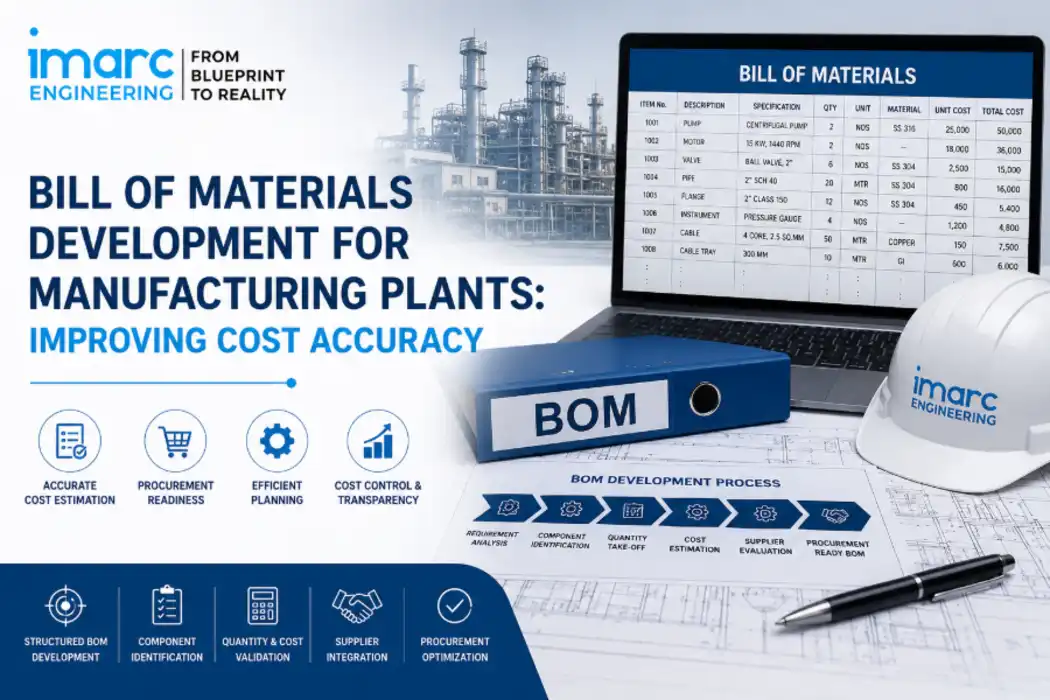
Cost estimates drawn from vendor catalogues rather than verified quotations, components specified before equipment selection is finalised, and quantities calculated from preliminary drawings all surface as procurement and cost problems once the project moves from planning to execution. This is one of the reasons why Bill of Materials Development preparation services for manufacturers have become increasingly important, helping organisations develop structured, accurate, and procurement-ready BOMs before project execution begins.
Getting this BOM right early changes the financial picture for the entire project: more accurate capital cost estimates, procurement that starts on schedule, and fewer change orders once construction and installation are underway.
IMARC Engineering provides Bill of Materials (BOM) preparation services for manufacturers setting up new plants, expanding capacity, or formalising procurement for existing operations across India. This article draws on that work to explain how to develop a cost-accurate, procurement-ready BOM for a new manufacturing plant, and where early-stage BOM errors most commonly originate.
Why BOM Development Matters for New Manufacturing Plants in 2026
Several factors are converging to make early-stage BOM accuracy a higher-stakes requirement for new plants than it was even a few years ago.
Record Private Capex Driving New Plant Investment
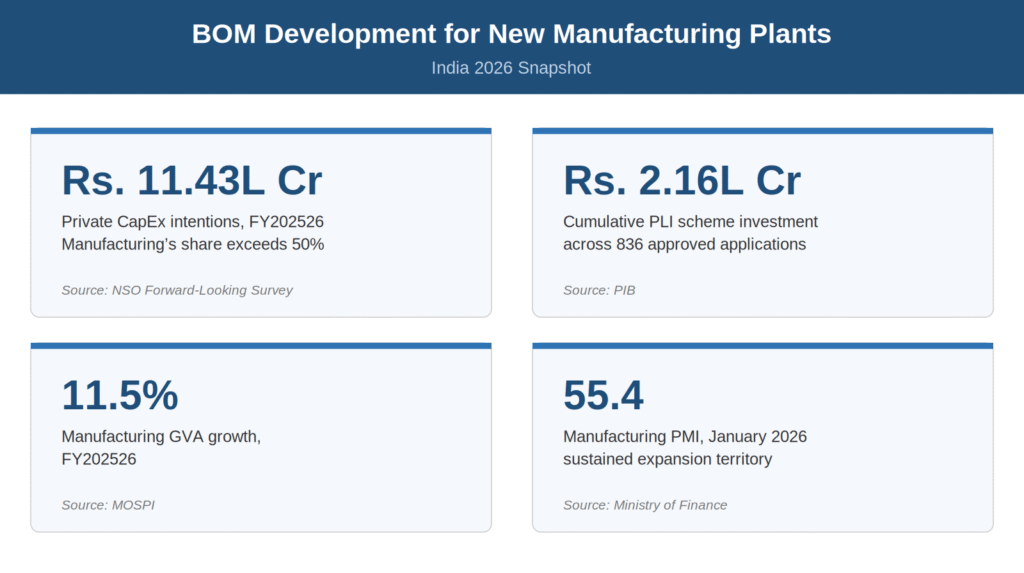
Manufacturing accounts for over 50% of India’s aggregate private capex intentions of ₹11.43 lakh crore for FY202526, per the NSO’s Forward-Looking Survey on Private Corporate Sector CAPEX a pipeline of new plants each starting from a first-draft BOM.
PLI-Linked Greenfield Capacity
The Production Linked Incentive scheme has driven cumulative investment exceeding ₹2.16 lakh crore across 836 approved applications in 14 sectors, per PIB the majority involving new manufacturing facilities built against incentive-linked cost and timeline commitments.
Manufacturing Growth Outpacing Planning Discipline
Manufacturing value added grew 11.5% in FY202526 under MOSPI’s revised national accounts series, pulling more first-time manufacturers into plant planning and procurement, often faster than their BOM development process can keep pace with.
Sustained Manufacturing Business Sentiment
India’s manufacturing PMI stood at 55.4 in January 2026, remaining in expansion territory since March 2023, per the Ministry of Finance order books that convert into new-plant investment decisions at a pace that leaves little room for cost estimates discovered to be wrong mid-project.
The capital is committed early. The risk is locking in a BOM before the cost and procurement data behind it can actually support that commitment.
Why an Incomplete or Inaccurate BOM Creates Risk for New Plants
Most early-stage BOM failures follow a predictable pattern: cost estimates inherited from a similar past project, components specified ahead of final equipment selection, and no formal process for refining the BOM as design and procurement progress.
The categories of risk that surface from an incomplete or inaccurate BOM at the new-plant stage:
- Capex estimation errors: Capital cost estimates built on indicative or outdated pricing are exceeded once actual vendor quotations and installation costs are confirmed.
- Procurement delays: Components specified before equipment selection is finalised trigger reordering, expedited freight, and schedule slippage.
- Installation gaps: Quantities calculated from preliminary drawings leave gaps that surface only once installation crews are on site.
- Stalled procurement readiness: A BOM that is not refined as the design progresses cannot reliably trigger purchase orders, stalling the procurement schedule.
- Compliance exposure at commissioning: Missing regulatory or material-grade fields surface as non-conformance findings during commissioning rather than during planning.
- No as-built baseline: Without a structured handover, the BOM used for design bears little resemblance to what is actually installed, leaving no accurate baseline for spares or future expansion.
Developing the BOM in deliberate stages rather than treating the first draft as final closes these gaps before procurement and construction commitments are made.
What BOM Development for a New Manufacturing Plant Typically Involves
BOM development for a new plant typically moves through three stages: an early-stage BOM built from design intent and preliminary vendor data, a procurement-ready BOM refined against confirmed suppliers and updated drawings, and an as-built BOM reconciled once installation and commissioning are complete.
Each stage carries a different level of accuracy, and treating the early-stage version as final rather than refining it as the project progresses is where most cost and procurement gaps for new plants originate.
Key Elements of BOM Development for New Manufacturing Plants
A dependable new-plant BOM addresses six interconnected elements, refined progressively as the project moves from design to commissioning.
1. Component Identification Against Final, Not Preliminary, Design
- Part numbers, specifications, and material grades reconciled against the latest approved drawing revision, not the design-intent version
- Equipment-driven components specified only once equipment selection is actually finalised
- Clear flagging of which line items are still provisional versus confirmed
- Re-verification built into the process whenever a design or equipment change is approved
A BOM that is not re-verified after equipment selection is finalised is still effectively a design-intent document, not a procurement-ready one.
2. Multi-Level BOM Structuring from Day One
- Parent-child hierarchy established from raw material through to finished product from the earliest draft
- Separate Engineering BOM (EBOM) and Manufacturing BOM (MBOM) views maintained as the project progresses
- Sub-assembly groupings aligned to the actual construction and installation sequence
- Version control distinguishing the early-stage, procurement-ready, and as-built structures
Starting with a single-level parts list and adding structure later costs significantly more than building the hierarchy in from the first draft.
3. Supplier Finalisation and Alternate Mapping
- Preferred suppliers confirmed and lead times verified before the BOM is treated as procurement-ready
- Alternate or second-source vendors identified for long-lead, import-dependent, or single-source components
- Supplier qualification status tracked against the manufacturer’s sector and target market requirements
- Substitution rules documented so a single unconfirmed supplier does not stall the entire procurement schedule
A BOM that lists a supplier without a verified lead time is not procurement-ready, regardless of how complete the rest of the line item looks.
4. Cost Estimation Refined Through Procurement Stages
- Indicative costs at the early stage replaced with verified vendor quotations as the BOM matures
- Make-versus-buy analysis applied to components with viable in-house production routes
- Cost roll-up logic maintained accurately from component to finished plant capital cost
- Variance tracked between the original costed BOM and actual procurement pricing as it is confirmed
Capital cost estimates that are never revisited after the early-stage BOM carry forward every assumption made before a single quotation existed.
5. Regulatory and Compliance Fields Built In from the Start
- Sector-specific compliance fields GMP, FSSAI, BIS, or equivalent embedded from the earliest BOM draft, not added later
- RoHS, REACH, or destination-market documentation included for export-oriented facilities
- Hazardous material flags and safety data references captured as components are specified
- Traceability fields structured to support commissioning records and future regulatory audits
Compliance fields added after equipment is already installed are far more expensive to retrofit than to specify from the outset.
6. ERP/MES-Ready Structure for a Plant That Doesn’t Exist Yet
- Data structures built to match the manufacturer’s intended ERP, MRP, or MES platform before the plant goes live
- Formal change control applied to BOM revisions throughout design, procurement, and construction
- Audit trail maintained from the earliest draft through to the as-built structure
- Final BOM reconciled against actual installed components ahead of system go-live
| BOM Development Stage | What It Should Capture | Risk if Treated as Final Too Early |
| Early-Stage BOM | Design intent, preliminary specifications, indicative costs | Capital estimates based on assumptions that change once vendors are confirmed |
| Procurement-Ready BOM | Confirmed suppliers, verified lead times, costed quantities | Purchase orders placed against components that no longer match the final design |
| As-Built BOM | Final installed components, actual costs, commissioning data | No accurate baseline for spares, maintenance, or future expansion |
| Multi-Level Structure | Parent-child hierarchy from raw material to finished product | Missing sub-assemblies discovered only during installation |
| Compliance Fields | Regulatory, material-grade, and traceability data | Non-conformance findings during commissioning or audit |
| ERP/MES Structure | Data fields aligned to the plant’s planning system | Manual re-entry and version drift once the plant goes live |
How IMARC Engineering Conducts BOM Development for New Manufacturing Plants
IMARC Engineering’s BOM development process is built to mature alongside the project from design intent through to a reconciled as-built structure rather than treating the first draft as the final word.
- Design-stage BOM development: Building the early-stage BOM from approved drawings, design specifications, and preliminary vendor data to establish a structured baseline.
- Multi-level BOM structuring: Building parent-child hierarchies from raw material to finished product, with separate EBOM and MBOM views from the outset.
- Supplier finalisation and cost refinement: Confirming preferred and alternate suppliers, verifying lead times, and refining cost estimates as quotations are received.
- Compliance and traceability integration: Embedding regulatory, material-grade, and traceability fields relevant to the manufacturer’s sector and target markets.
- ERP/MES-ready documentation: Structuring the BOM for direct integration with the manufacturer’s intended ERP, MRP, or MES platform ahead of go-live.
- As-built BOM reconciliation: Reconciling the BOM against actual installed components and costs once construction and commissioning are complete.
IMARC Engineering supports BOM development for new manufacturing plants across pharmaceuticals, food and dairy processing, chemicals, agrochemicals, FMCG and personal care, electronics, auto components, and industrial manufacturing.
Contact IMARC Engineering’s team for BOM development support for your new manufacturing plant in India.
https://www.imarcengineering.com/contact?service=bill-of-materials-preparation
Common Mistakes in BOM Development for New Manufacturing Plants
- Treating the early-stage BOM as final: Carrying forward indicative costs and provisional suppliers from the design-intent BOM into procurement without verification leaves capital estimates exposed to whatever changes once real quotations arrive.
- Specifying components ahead of equipment finalisation: Specifying downstream components before equipment selection is locked in creates rework the moment final equipment specifications differ from assumptions.
- Skipping supplier lead-time verification: Listing a supplier without a verified lead time creates a procurement schedule that looks complete but is not actually executable.
- Leaving compliance fields for later: Adding compliance and material-grade fields after equipment is already installed is far more expensive than specifying them from the outset.
- Skipping multi-level structuring early: Building a single-level parts list and adding structure after the fact costs more than establishing the hierarchy from the first draft.
- No as-built reconciliation after commissioning: Without a reconciled as-built BOM, there is no accurate baseline for spares, maintenance planning, or future capacity expansion.
Conclusion
India’s manufacturing base is adding new capacity quickly, supported by record private capex intentions, PLI-linked greenfield investment, and sustained double-digit manufacturing growth. Each of these new plants depends on a Bill of Materials that matures deliberately through design, procurement, and commissioning not one that is locked in before the cost and supplier data behind it can support that commitment.
Component identification, multi-level structuring, supplier finalisation, cost refinement, compliance integration, and ERP/MES readiness together determine whether a new plant’s BOM holds up from financial sanction through to commissioning, or becomes a recurring source of cost overruns and procurement delay.
Through staged BOM development, supplier finalisation, cost refinement, compliance integration, and as-built reconciliation, IMARC Engineering helps manufacturers build BOMs that improve cost accuracy and procurement readiness for new manufacturing plants across India.
Contact Us:
IMARC Engineering
Phone: +91-120-433-0800
Email: sales@imarcengineering.com
India: C-130, Sector 2, Noida, Uttar Pradesh 201301
LinkedIn: https://www.linkedin.com/showcase/imarc-engineering/
About the Author