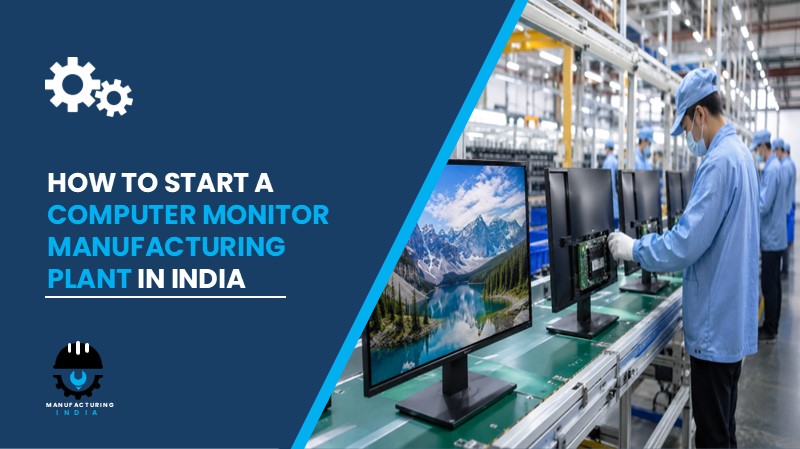
Setting up a computer monitor manufacturing plant in India presents a compelling investment case driven by surging demand from IT & telecom, education, corporate and SME offices, gaming and eSports, healthcare, government, BFSI, and retail sectors. Computer monitors are foundational hardware in every digitally enabled environment — from enterprise data centres and hospital imaging suites to school classrooms and home offices — making them indispensable to India’s expanding digital economy. As hybrid work models, digital learning initiatives, and cloud infrastructure proliferate across the country, the volume requirement for quality display units is growing at a measurable and sustained pace.
India offers a strategically sound environment for this investment. The country’s rapid urbanisation, infrastructure expansion, and the Make in India initiative collectively reduce barriers to entry for electronics manufacturers while opening access to a large domestic consumer base. States such as Tamil Nadu, Telangana, and Karnataka have developed robust electronics manufacturing clusters with reliable utility access, skilled engineering talent, and established logistics corridors. Coupled with competitive land and labour costs, India’s supply chain ecosystem — increasingly aligned with Asia-Pacific production networks — positions the country as a credible alternative manufacturing hub for display hardware.
Establishing a computer monitor manufacturing plant in India is financially viable and strategically timely. Policy tailwinds under Make in India, competitive manufacturing costs, and consistent demand from gaming, enterprise, healthcare, and education sectors create a compelling case. With gross margins in the range of 30–40% and net margins of 10–15%, this plant offers strong profitability and sustainable break-even prospects.
What is a Computer Monitor?
A computer monitor is an electronic visual display unit used to render images, videos, and graphical information processed by a computer or digital device. Modern monitors typically use LCD, LED, IPS, or OLED panels, produced through precision microfabrication processes involving glass substrate preparation, thin-film transistor (TFT) deposition, liquid crystal cell assembly, and LED backlighting integration. Computer monitors vary in size, resolution — spanning HD, FHD, QHD, 4K, and 5K — refresh rate, colour reproduction, and form factor including flat, curved, and ultrawide configurations.
Essential physical characteristics include high pixel density, luminance, contrast ratio, response time, and energy efficiency. Key variants include gaming monitors (characterised by high refresh rates of 120–240 Hz and adaptive sync), professional-grade monitors for design and medical imaging, and standard office displays for productivity use. The manufacturing process for this product is known as precision microfabrication. End-use industries served include consumer electronics, IT, gaming, industrial control systems, medical imaging, broadcasting, and education.
Cost of Setting Up a Computer Monitor Manufacturing Plant in India
The cost of establishing a computer monitor manufacturing plant in India depends on several interdependent variables including production capacity, technology selection, plant location, level of automation, and applicable regulatory compliance standards.
1. Capital Expenditure (CapEx)
The land and site development component forms a substantial part of the overall investment. Investors may consider placement within a Special Economic Zone (SEZ) or designated electronics industrial estate to benefit from fiscal incentives and improved infrastructure access. Civil works encompass construction of the production shed, quality laboratory, raw material and finished goods storage facilities, and administrative blocks designed to support large-scale assembly operations.
Key machinery required includes:
- SMT (Surface Mount Technology) automated PCB assembly machines for driver boards and control circuits
- Injection moulding machines for plastic housing, bezel, and frame fabrication
- Panel fabrication equipment for LCD/OLED deposition, cell assembly, and colour filter integration
- Backlight unit assembly equipment including optical film, reflector, and diffuser integration systems
- Driver IC integration stations for display driver chip mounting
- Circuit board assembly lines for interface ports and signal processing components
- Mechanical assembly workstations for combining panel modules, housings, stands, and wiring
- Calibration systems for colour, brightness, and uniformity adjustment
- Quality testing equipment for dead pixel inspection, backlight bleed detection, and electrical safety
- Burn-in and ageing test chambers for reliability validation
- Packaging lines with protective material handling and accessory compartmentalisation
Other capital costs include effluent treatment plant (ETP) installation, pre-operative expenses, commissioning charges, and applicable import duties on specialised fabrication equipment. A large-scale computer monitor plant typically operates at a capacity of 8–12 million units per year.
Request a Sample Report for In-Depth Market Insights: https://www.imarcgroup.com/computer-monitor-manufacturing-plant-project-report/requestsample
2. Operational Expenditure (OpEx)
Raw material cost is the single largest operational expense, accounting for 55–65% of total OpEx. Primary raw materials include display panels, glass and substrate materials, electronic components, enclosure and structural materials, and production consumables. Establishing long-term supplier contracts with panel manufacturers and component suppliers in Asia-Pacific — particularly those with established semiconductor supply chains — is a critical cost management strategy for Indian producers.
Utility cost accounts for 5–8% of total operating expenses and covers electricity for machinery operation, water for processing and cooling, fuel for heating reduction, and compressed air systems. Other operating costs include transportation to distribution partners and export destinations, protective packaging using reinforced corrugated cartons with foam inserts, employee salaries across production, quality control, maintenance, and administration, routine maintenance expenditure, depreciation on capital assets, and applicable taxes. By the fifth year of operations, total operational costs are expected to increase substantially due to inflation, market fluctuations, supply chain disruptions, and rising consumer demand globally.
3. Plant Capacity
A representative large-scale computer monitor manufacturing plant operates at a capacity of 8–12 million units per year. Investors may customise plant capacity based on their target market, available capital, and phased production strategy. Profitability improves consistently with higher capacity utilisation as fixed costs are amortised across a larger production volume, making ramp-up speed a critical success factor.
4. Profit Margins and Financial Projections
The computer monitor manufacturing plant delivers attractive financial returns. Average gross margins stand at 30–40% and average net profit margins at 10–15% over a five-year projection period. The comprehensive financial analysis covers NPV determination, IRR calculation, payback period assessment, profitability ratios, liquidity analysis, uncertainty and sensitivity analysis, and economic feasibility evaluation. These indicators confirm that the investment is viable across a range of plant configurations and market scenarios.
Why Set Up a Computer Monitor Plant in India?
Digital Workspace Expansion and Hybrid Work Models. Enterprise demand for computer monitors is expanding with increasing cloud adoption, data centre growth, and visualisation requirements. The proliferation of hybrid work models across Indian corporations, IT firms, and BPO services has generated sustained volume demand for professional-grade displays.
Gaming and eSports Ecosystem Growth. The gaming monitor segment — characterised by high refresh rates and adaptive sync technology — remains the fastest-growing category in the global market. India’s rapidly expanding gaming and eSports community represents a high-value domestic opportunity for manufacturers of advanced gaming displays.
Consumer Electronics and Home Office Demand. Consumer trends including home offices, remote learning, and content creation are stimulating volume sales across all screen categories. India’s young, digitally active population is among the fastest-growing segments purchasing personal monitors for coding, design, and entertainment.
Policy and Regulatory Tailwinds. India’s Make in India initiative and associated production-linked incentive (PLI) schemes for electronics manufacturing provide a direct policy impetus for establishing display hardware production units in the country. Domestic manufacturing reduces import dependency and strengthens supply chain resilience for electronics OEMs.
Active Industry Investment and Innovation. In October 2025, Dell introduced its new Plus Monitor series in India, covering the Dell 24 Plus and multiple 27-inch variants including QHD and USB-C models aimed at home users, professionals, and students. In December 2024, ViewSonic showcased a new range of monitors at the ColorPro Awards 2024 Exhibition in India, targeting gamers, creative professionals, and modern workplaces. These product launches confirm that India is a priority commercial market for global display manufacturers, validating local manufacturing investment.
Local Supply Chain Preference. Technological innovations including Mini-LED backlighting, organic OLED displays, curved monitors, and USB-C single-cable connectivity are reshaping product demands. Indian IT firms, educational institutions, healthcare providers, and BFSI enterprises increasingly prefer locally sourced display solutions for faster delivery, cost efficiency, and after-sales support.
Manufacturing Process – Step by Step
The computer monitor manufacturing process uses precision microfabrication as the primary production method. Each stage involves specialised equipment and strict quality controls to ensure display performance and product reliability.
- Panel Fabrication: Production of LCD/OLED panels involving deposition, cell assembly, colour filter integration, and backlight unit installation.
- Driver IC Integration: Mounting of display driver chips to control pixel activation and refresh timing.
- Module Assembly: Combining the display panel with bezels, frames, optical films, and protective glass.
- Housing Fabrication: Injection moulding or metal shaping of monitor enclosures, stands, and mounting brackets.
- Power Supply Integration: Installation of internal or external power units, voltage regulators, and electrical connectors.
- Circuit Board Assembly: Attaching main control boards, interface ports, and signal processing components.
- Mechanical Assembly: Combining panel modules, housings, stands, and internal components into complete units.
- Calibration: Colour, brightness, and uniformity adjustments to ensure quality consistency across production batches.
- Quality Testing: Inspection for dead pixels, backlight bleeding, electrical safety, and display performance standards.
- Packaging and Dispatch: Protective packing with accessories, manuals, and cables for shipment to distributors, retailers, and export destinations.
Key Applications
Computer monitors serve a wide range of professional, industrial, and consumer applications across multiple sectors.
- IT & Telecom: Desktop computing, programming, and software development workstations.
- Education: E-learning terminals, digital classroom displays, and student computing stations.
- Corporate and SME Offices: Business analytics dashboards, productivity workstations, and video conferencing setups.
- Gaming and eSports: High-refresh-rate displays for immersive gaming and competitive esports performance.
- Healthcare: Medical imaging workstations, diagnostic displays, and patient data terminals.
- Government: Administrative computing, data visualisation, and public service terminal displays.
- BFSI: Trading dashboards, financial analytics terminals, and secure transactional display systems.
- Retail: Point-of-sale display systems and digital signage for customer-facing environments.
Leading Manufacturers
The global computer monitor industry is served by several large multinational corporations with extensive production capacities, diversified product portfolios, and established distribution networks across emerging and developed markets. Key players include:
- Dell Technologies Inc.
- HP Inc.
- Lenovo Group Limited
- Samsung Group
- Acer Inc.
Timeline to Start the Plant
- Feasibility study and project report preparation
- Land acquisition and site development
- Regulatory approvals and environmental clearances
- Factory licence and fire safety compliance
- Machinery procurement and installation
- Raw material supplier agreements and supply chain setup
- Trial production and quality testing
- Commercial production launch
Licences and Regulatory Requirements
Starting a computer monitor manufacturing unit in India requires several approvals:
- Business registration (Proprietorship, LLP, or Private Limited Company)
- Factory Licence under the Factories Act
- Environmental Clearance from the State Pollution Control Board
- GST Registration
- Fire Safety NOC
- Hazardous and chemical compliance for electronic and display chemical handling
- Effluent Treatment Plant (ETP) operational clearance
- Occupational Health and Safety compliance
Key Challenges to Consider
High Capital Requirements. Establishing a computer monitor manufacturing plant demands significant upfront investment in precision fabrication equipment, SMT assembly lines, and climate-controlled storage infrastructure, making access to structured project financing a prerequisite.
Raw Material Price Volatility. Display panels, electronic components, and glass and substrate materials account for 55–65% of total OpEx. Price fluctuations driven by global semiconductor supply constraints or currency movements can materially affect margins.
Regulatory Compliance. Electronics manufacturing in India involves multilayered compliance requirements spanning environmental clearances, e-waste management regulations, electrical safety certifications, and occupational health standards that demand dedicated compliance resources.
Technology and Innovation Pressure. Rapid advancements in Mini-LED backlighting, organic OLED technology, and high-refresh-rate panel engineering require continuous capital reinvestment in machinery and R&D to remain competitive in the fast-moving display segment.
Competition from Global Players. Established manufacturers including Dell Technologies, HP Inc., Lenovo Group Limited, Samsung Group, and Acer Inc. operate with significant scale advantages, making product differentiation and cost discipline critical for new entrants.
Skilled Manpower. Precision microfabrication requires trained engineers and technicians in semiconductor processes, SMT assembly, calibration systems, and quality assurance — talent that requires structured recruitment and retention strategies in India’s competitive electronics workforce market.
Frequently Asked Questions
1. How much does it cost to set up a computer monitor manufacturing plant in India?
Setup costs vary based on capacity, location, machinery selection, and automation level. A large-scale facility targeting 8–12 million units per year involves significant CapEx covering land, civil works, fabrication equipment, and pre-operative expenses. A detailed project report provides full cost breakdowns.
2. Is computer monitor manufacturing profitable in India in 2026?
Yes. Average gross margins of 30–40% and net margins of 10–15% over a five-year projection period confirm strong profitability potential, supported by rising domestic demand across gaming, enterprise, education, and healthcare sectors.
3. What machinery is required for a computer monitor plant in India?
Key machinery includes SMT automated PCB assembly machines, injection moulding equipment, panel fabrication systems, backlight unit assembly lines, calibration systems, quality testing equipment, burn-in test chambers, and packaging lines.
4. What licences and approvals are required to start a computer monitor plant in India?
Required approvals include business registration, Factory Licence, Environmental Clearance, GST Registration, Fire Safety NOC, ETP clearance, chemical compliance certification, and Occupational Health and Safety compliance.
5. What raw materials are needed for computer monitor manufacturing?
Primary raw materials include display panels, glass and substrate materials, electronic components, enclosure and structural materials, and production consumables.
6. What are the environmental compliance requirements for a computer monitor plant in India?
Compliance requirements include Environmental Clearance from the State Pollution Control Board, an operational Effluent Treatment Plant, e-waste management adherence, and hazardous chemical handling compliance under applicable national regulations.
7. What is the best location to set up a computer monitor plant in India?
Electronics manufacturing clusters in Tamil Nadu, Telangana, and Karnataka offer strong infrastructure, skilled labour, and established supply chain access. SEZ placement and proximity to port infrastructure are additional location selection factors.
8. What is the break-even period for this type of plant in India?
The break-even period depends on plant capacity, market pricing, and utilisation rates. A comprehensive financial analysis covering NPV, IRR, and payback period calculations is provided in detailed project reports.
9. What government incentives are available for manufacturers in India?
The Make in India initiative and electronics-focused PLI schemes offer fiscal incentives for domestic manufacturers. State-level industrial policies further provide land subsidies, power tariff concessions, and capital investment support for eligible electronics units.
Key Takeaways for Investors
A computer monitor manufacturing plant in India represents a high-potential investment opportunity, underpinned by consistent demand from gaming and eSports, IT and telecom, healthcare, education, BFSI, and corporate office sectors, all of which are expanding at pace with India’s digital transformation. The financial profile of this investment — with gross margins of 30–40% and net margins of 10–15% — confirms viability across a range of plant capacities, from mid-scale to large-scale facilities targeting 8–12 million units per year. With the global computer monitors market valued at USD 47.2 billion in 2025 and projected to reach USD 75.51 billion by 2034 at a CAGR of 5.4%, the long-term demand trajectory is firmly positive. India’s policy environment, cost-competitive manufacturing base, and deepening electronics supply chain make this a strategically sound and commercially sustainable investment for both domestic entrepreneurs and international investors evaluating the Indian market.
About the Author