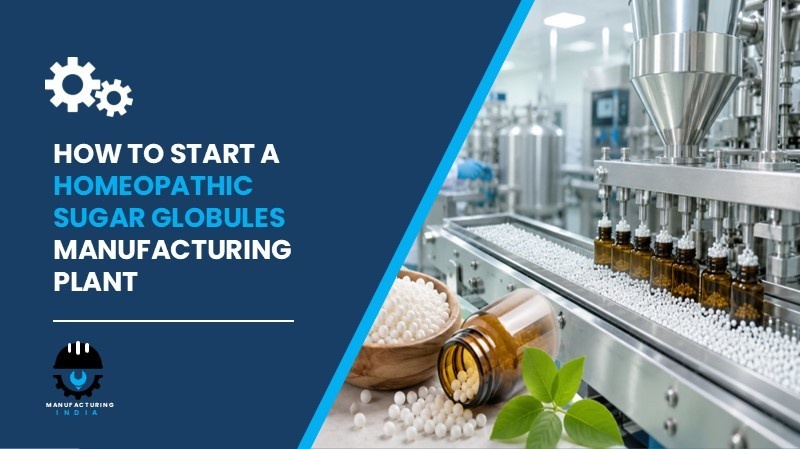
A homeopathic sugar globules manufacturing plant setup in India presents a compelling investment case for entrepreneurs entering the alternative healthcare manufacturing space. Demand is tied to homeopathic pharmaceuticals, wellness centers, alternative medicine clinics, and retail health stores, all of which depend on a steady, standardized supply of sugar globules as carriers for potentized liquid remedies. As homeopathy gains institutional recognition and consumer trust, sugar globules have become indispensable to the supply chain, making this an essential, recurring-demand category.
India’s position as a manufacturing base is strengthened by its expanding healthcare manufacturing ecosystem, growing industrial infrastructure, and a policy environment that encourages domestic production through initiatives such as Make in India. Regulatory support and institutional recognition of homeopathy in the country have already contributed to the expansion of pharmaceutical manufacturing, giving local producers direct access to an established customer base. Combined with a relatively low-complexity production process, this makes India a strategically sound location for the facility.
This investment combines policy support for domestic pharmaceutical manufacturing with a straightforward, cost-competitive production process. With gross margins of 40-50% and net margins of 20-30%, and demand anchored in homeopathic pharmaceuticals, wellness centers, and alternative medicine clinics, the facility offers a favorable path to financial viability across a wide range of capacities.
What are Homeopathic Sugar Globules?
Homeopathic sugar globules are small, spherical pellets primarily composed of pharmaceutical-grade sucrose or lactose that act as inert carriers for homeopathic medicinal preparations. They are manufactured through controlled granulation or pelletization to achieve uniform size, smooth surface texture, and high absorption capacity. Their porous structure allows them to efficiently absorb diluted homeopathic tinctures or potencies without altering the therapeutic properties of the active ingredient. The product is typically available in standard sizes such as No. 10, No. 20, No. 30, and No. 40, and exhibits excellent stability, sweetness, and rapid dissolution in the oral cavity. Their neutral taste and compatibility with liquid remedies make them a preferred dosage form across pharmaceutical formulations.
The manufacturing process relies on trituration, impregnation, and globule preparation as the primary production methods. End-use industries served include homeopathic pharmaceuticals, wellness centers, alternative medicine clinics, and retail health stores.
Cost of Setting Up a Homeopathic Sugar Globules Manufacturing Plant in India
The cost of setting up the unit depends on capacity, technology, location, automation level, and regulatory compliance requirements.
1. Capital Expenditure (CapEx)
Capital expenditure begins with land and site development, which can be planned within an industrial estate or a Special Economic Zone (SEZ) for established infrastructure and faster clearances. Land-related costs include registration, boundary development, and other site preparation expenses, forming a substantial part of the overall investment.
Civil works cover the manufacturing shed, quality control laboratory, storage areas, and the administrative block, with costs scaling alongside capacity and automation.
Machinery typically accounts for the largest portion of total capital expenditure for this facility. Key machinery required includes:
- Mixing vessels
- Impregnation drums
- Drying chambers
- Sieving machines
- Granulators
- Packaging units
All machinery must comply with industry safety and reliability standards, with selection prioritizing corrosion-resistant equipment.
Other capital costs include effluent treatment plant (ETP) installation, pre-operative expenses, and commissioning costs.
Request a Sample Report for In-Depth Market Insights: https://www.imarcgroup.com/homeopathic-sugar-globules-manufacturing-plant-project-report/requestsample
2. Operational Expenditure (OpEx)
Raw material cost is the largest component of operating expenditure, with pharmaceutical-grade sucrose and lactose accounting for approximately 60-70% of total OpEx. Long-term supplier contracts help mitigate price volatility.
Utility costs, covering electricity, water, and steam, represent roughly 10-15% of operating expenditure. Other costs include transportation, packaging, salaries, depreciation, taxes, and maintenance.
By the fifth year, total operational cost is expected to rise substantially due to inflation, market fluctuations, raw material cost increases, supply chain disruptions, and rising demand.
3. Plant Capacity
The proposed facility is designed with an annual production capacity ranging between 100 and 500 MT, allowing economies of scale alongside operational flexibility. Capacity can be customized to investor requirements, and profitability tends to improve as utilization increases.
4. Profit Margins and Financial Projections
Financial projections are built around realistic assumptions related to capital investment, operating costs, capacity utilization, pricing trends, and demand outlook, covering net present value (NPV), internal rate of return (IRR), and payback period. Under normal operating conditions, the project demonstrates healthy profitability, with gross margins typically between 40-50% and net margins between 20-30%.
Why Set Up a Homeopathic Sugar Globules Plant in India?
Growing Demand for Homeopathic Medicines: The expanding acceptance of homeopathy as a complementary healthcare system is increasing demand for standardized dosage forms, the essential carriers for liquid remedies.
Essential Dosage Carrier Status: This product is fundamental to the supply chain since it functions as the primary medium for administering diluted medicinal preparations, making it indispensable for remedy production.
Low Complexity Manufacturing Process: Compared to many other pharmaceutical operations, production involves relatively straightforward processes such as granulation, drying, and sieving, enabling faster-to-commission operations.
High Compatibility with Homeopathic Preparations: Excellent absorption properties and chemical neutrality ensure the product does not interfere with the potency or stability of remedies, supporting steady repeat demand.
Regulatory and Institutional Recognition in India: Regulatory support and institutional recognition of homeopathy in India have contributed to the expansion of pharmaceutical manufacturing, giving investors a stable demand base.
Expanding Global Alternative Medicine Market: Growing interest in natural and alternative healthcare solutions is increasing demand for homeopathic products, supporting production of the globules used in remedy preparation. The AYUSH market currently stands at approximately USD 10 billion and is projected to grow by around 50% over the next five years.
Manufacturing Process – Step by Step
The homeopathic sugar globules manufacturing process uses trituration, impregnation, and globule preparation as the primary production method, supported by a sequence of unit operations and quality checks.
- Raw Material Preparation: Pharmaceutical-grade sucrose or lactose is sourced and prepared as the base material.
- Mixing: The base material is processed in mixing vessels for uniform consistency.
- Granulation: Granulators form the mass into small, uniform pellets.
- Impregnation: Impregnation drums absorb diluted homeopathic tinctures or potencies into the pellets without altering the active ingredient’s properties.
- Drying: Drying chambers remove residual moisture for required stability and shelf life.
- Sieving: Sieving machines grade the dried pellets into standard sizes such as No. 10, No. 20, No. 30, and No. 40.
- Quality Assurance: Technical tests confirm uniform size, surface texture, absorption capacity, and compliance with standards.
- Packaging and Dispatch: Finished product is processed through packaging units and dispatched to homeopathic pharmaceuticals, wellness centers, alternative medicine clinics, and retail health stores.
Key Applications
This product serves as a core dosage and delivery medium across several segments of the homeopathic pharmaceutical industry.
- Homeopathic Remedies: Serve as carriers for potentized liquid remedies in oral dosage form.
- Pharmaceutical Preparation: Used for impregnation with mother tinctures and dilutions during remedy preparation.
- Clinical Dispensing: Packed in vials or sachets for accurate and convenient patient dosing.
- Research and Development: Utilized in homeopathic drug proving, formulation testing, and standardization studies.
Leading Manufacturers
The global industry includes several established companies with extensive production capacities and diverse application portfolios. Key players include:
- Boiron Group
- Schwabe Group (Dr. Willmar Schwabe)
- SBL Pvt. Ltd.
- Hahnemann Laboratories Inc.
- Ainsworths Homeopathic Pharmacy
- Washington Homeopathic Products
Timeline to Start the Plant
- Feasibility study and project report preparation
- Land acquisition and site development
- Regulatory approvals and environmental clearances
- Factory licence and fire safety compliance
- Machinery procurement and installation
- Raw material supplier agreements and supply chain setup
- Trial production and quality testing
- Commercial production launch
Licences and Regulatory Requirements
Starting this manufacturing unit in India requires several approvals:
- Business registration (Proprietorship, LLP, or Pvt Ltd)
- Factory Licence under the Factories Act
- Environmental Clearance from State Pollution Control Board
- GST Registration
- Fire Safety NOC
- Effluent Treatment Plant (ETP) operational clearance
- Occupational Health and Safety compliance
Key Challenges to Consider
High Capital Requirements: Machinery costs account for the largest portion of total capital expenditure, making upfront investment planning critical.
Raw Material Price Volatility: Pharmaceutical-grade sucrose and lactose make up 60-70% of operating expenditure, so price fluctuations can materially affect economics.
Regulatory Compliance: Meeting environmental, safety, and quality assurance requirements demands ongoing documentation and audit readiness.
Competition from Established Players: Companies such as Boiron Group, Schwabe Group, and SBL Pvt. Ltd. have extensive production capacities and distribution networks, creating a competitive benchmark for new entrants.
Quality Consistency: Maintaining uniform size, absorption capacity, and stability across batches requires disciplined quality assurance systems.
Skilled Manpower: Operating mixing vessels, impregnation drums, drying chambers, and sieving equipment to pharmaceutical-grade standards requires trained personnel.
Frequently Asked Questions
1. How much does it cost to set up a homeopathic sugar globules manufacturing plant in India?
Cost depends on capacity, technology, location, and automation level, with machinery and land development forming the largest share of capital expenditure. Capacities in the 100-500 MT range let investors scale to their available capital.
2. Is homeopathic sugar globules manufacturing profitable in India in 2026?
Yes, with gross margins typically between 40-50% and net margins between 20-30% under normal operating conditions, supported by stable demand from the pharmaceutical sector.
3. What machinery is required for a homeopathic sugar globules plant in India?
Core machinery includes mixing vessels, impregnation drums, drying chambers, sieving machines, granulators, and packaging units, selected for corrosion resistance and safety compliance.
4. What licences and approvals are required to start a homeopathic sugar globules plant in India?
Key requirements include business registration, a Factory Licence under the Factories Act, Environmental Clearance from the State Pollution Control Board, GST registration, Fire Safety NOC, ETP operational clearance, and Occupational Health and Safety compliance.
5. What raw materials are needed for homeopathic sugar globules manufacturing?
The primary raw material is pharmaceutical-grade sucrose or lactose, accounting for 60-70% of total operating expenditure.
6. What are the environmental compliance requirements for a homeopathic sugar globules plant in India?
Plants must secure Environmental Clearance from the State Pollution Control Board and operate an Effluent Treatment Plant (ETP) to stay compliant with emission standards.
7. What is the best location to set up a homeopathic sugar globules plant in India?
The ideal site offers easy access to sucrose and lactose suppliers, proximity to target markets, and robust infrastructure including transportation, utilities, and waste management.
8. What is the break-even period for this type of plant in India?
It depends on capacity utilization, pricing, and operating efficiency, assessed through payback period and net present value (NPV) analysis.
9. What government incentives are available for manufacturers in India?
India’s regulatory support and institutional recognition of homeopathy have directly contributed to the expansion of pharmaceutical manufacturing, creating a favorable policy environment for new entrants.
Key Takeaways for Investors
This investment taps into reliable demand from homeopathic pharmaceuticals, wellness centers, alternative medicine clinics, and retail health stores, anchoring it in an essential link of the supply chain. With gross margins of 40-50% and net margins of 20-30%, the project shows strong financial viability across capacities ranging from 100 to 500 MT, giving investors flexibility to scale to their available capital. The broader AYUSH market, currently valued at approximately USD 10 billion and projected to grow by around 50% over the next five years, points to a durable, expanding demand base for standardized dosage carriers like this one. As pharmaceutical manufacturing widens its product portfolios and distribution networks, sustained demand for the facility’s output looks well-supported for the years ahead.
About the Author