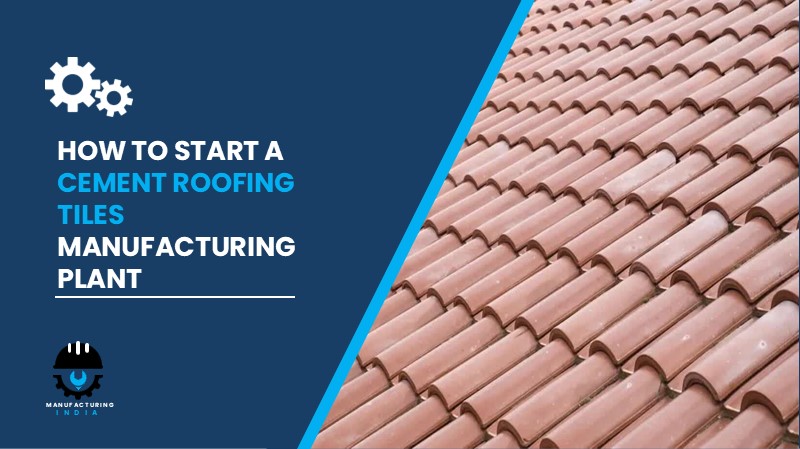
Setting up a cement roofing tiles manufacturing plant in India presents a compelling investment case anchored in the country’s rapidly expanding residential and commercial construction sector, the growing government commitment to affordable housing programmes, rising urbanisation driving sustained demand for durable and weather-resistant roofing solutions, and the broad-based preference for cost-effective building materials across Tier 1, Tier 2, and rural construction markets. Cement roofing tiles – durable roofing materials manufactured using a mixture of cement, sand, water, and pigments, moulded into various profiles and cured to achieve structural strength – offer high compressive strength, low water absorption, fire resistance, and resistance to extreme weather conditions that make them the preferred roofing solution across a wide range of residential, commercial, and institutional applications. Asia Pacific holds the largest share of the global cement roofing tiles market at 38% of the overall market – a position that India’s own construction boom is directly reinforcing – driven by the increasing housing requirements in emerging markets and the growth of commercial establishments across the region.
India’s structural advantages make it an exceptionally well-positioned location for establishing a cement roofing tiles manufacturing facility. The country’s abundant domestic supply of Portland cement and silica sand – the two primary raw materials – from established cement plants and quarry networks across Rajasthan, Andhra Pradesh, Madhya Pradesh, and Karnataka provides manufacturers with cost-competitive access to key inputs within proximity of major construction activity zones. The government’s Pradhan Mantri Awas Yojana (urban and rural) affordable housing programmes, smart city development projects, and rural infrastructure initiatives collectively create a large, government-funded, and geographically distributed domestic demand environment for durable roofing materials. With home sales in the U.S. projected to increase by around 14% in 2026 according to the National Association of REALTORS – signalling rising global residential construction activity – India’s own housing construction pipeline is expected to sustain comparable or stronger growth across the decade.
A cement roofing tiles manufacturing plant in India is positioned within Asia Pacific’s dominant 38% global market share, sustained by expanding residential construction, government affordable housing programmes, and growing preference for durable and weather-resistant roofing solutions. With gross margins of 35–45% and net margins of 15–25% at 5–20 million tiles annual capacity, and validated by active product innovation including Russell Roof Tiles’ GBP 2 million Bute3 launch and Westlake Royal’s expanded colour range in early 2025, this investment delivers commercially stable construction material manufacturing returns.
What are Cement Roofing Tiles?
Cement roofing tiles are durable roofing materials manufactured using a mixture of cement, sand, water, and pigments, moulded into various profiles and cured to achieve structural strength. They are typically produced using high-grade Portland cement and graded silica sand to ensure dimensional stability and mechanical durability. These tiles offer high compressive strength, low water absorption, fire resistance, and resistance to extreme weather conditions including heat, rain, wind, and frost. Cement roofing tiles are available in different shapes, such as flat, curved, and interlocking designs – with the interlocking format providing enhanced coverage, structural integrity, and installation efficiency relative to flat profile tiles.
Their long service life, thermal insulation properties, and aesthetic versatility make them suitable for residential, commercial, and institutional roofing applications across a wide price range and product specification spectrum. Compared to clay or metal roofing, cement tiles provide competitive pricing with comparable strength and performance – making them the preferred choice in price-sensitive mass market residential construction without sacrificing the technical performance required for long-term roofing integrity. The primary production method involves raw material batching and mixing, extrusion or moulding, hydraulic pressing, surface colouring and coating, curing, drying, and packaging. End-use industries served include residential construction, commercial construction, institutional buildings, and infrastructure projects.
Cost of Setting Up a Cement Roofing Tiles Manufacturing Plant in India
The total investment required to establish a cement roofing tiles manufacturing plant in India depends on plant capacity, tile profile range, geographic location, production technology selection, and compliance with BIS product standards and environmental regulatory requirements. Investors must account comprehensively for both one-time capital expenditure and recurring operational costs when preparing a feasibility study or detailed project report (DPR).
1. Capital Expenditure (CapEx)
Land and Site Development constitutes a foundational investment. Costs for land registration, boundary construction, internal road layout, drainage infrastructure, and site levelling vary based on whether the facility is within a government-notified construction materials manufacturing zone, a building products industrial estate, or on privately acquired land near construction activity corridors. Sites with proximity to Portland cement supply depots, silica sand quarries, and active housing construction project zones minimise both raw material inbound logistics costs and finished tile distribution costs to target buyer markets.
Civil Works and Construction encompasses the main raw material batching and mixing hall, moulding or extrusion production area, hydraulic press installation zone, surface coating and colouring facility, curing yard or chamber area, drying facility, quality control laboratory, finished tile storage yard with adequate hard-standing, and administrative block. The requirement for large curing yards or heated curing chambers – where tiles must be maintained under controlled moisture and temperature conditions for the specified curing duration – adds to civil construction footprint and cost relative to facilities without extended on-site curing requirements.
Machinery and Equipment represent the single largest component of capital expenditure. Key machinery required for a cement roofing tiles manufacturing plant includes:
- Concrete mixers
- Batching systems
- Extrusion machines
- Tile moulding equipment
- Hydraulic presses
- Drying racks
- Surface coating machines
Other Capital Costs include the effluent treatment plant (ETP) for managing process water and cement washout streams, pre-operative expenses covering regulatory filings and BIS certification preparation, plant commissioning charges, utility connection fees, and import duties applicable to specialised tile moulding equipment or automated coating systems sourced internationally.
Request a Sample Report for In-Depth Market Insights: https://www.imarcgroup.com/cement-roofing-tiles-manufacturing-plant-project-report/requestsample
2. Operational Expenditure (OpEx)
Raw Material Cost is the dominant driver of operating expenditure, accounting for approximately 55–65% of total OpEx. The primary inputs are cement, sand, pigments, and water. Portland cement – the binding material whose grade, quality, and proportion directly determine tile compressive strength, water absorption, and dimensional stability – represents the largest single raw material cost item. Cement prices are linked to coal, limestone, and energy commodity market dynamics and subject to both seasonal and supply-driven fluctuations in India’s large domestic cement market. Silica sand – the filler material providing bulk and dimensional stability – represents the second-largest volume input. Pigments are used in relatively small quantities to achieve the desired colour and surface appearance for different tile product variants. Investors are advised to negotiate long-term supply contracts with cement manufacturers and sand quarry operators in proximity to the plant site to stabilise input costs and reduce inbound transportation expenses. Water availability and treatment cost is also a meaningful site selection factor given concrete mixing requirements.
Utility Costs – covering electricity and water for concrete mixers, batching systems, hydraulic presses, surface coating machines, and curing chamber conditioning – account for approximately 15–20% of total OpEx, the second-largest operating cost category. Curing chambers that use steam or heated water for accelerated curing add significant energy consumption relative to ambient outdoor curing yard approaches. Investors in regions with competitive industrial electricity and water tariffs and reliable utility supply are materially better positioned to manage this significant cost component over the plant’s operational life.
Other Operating Costs include outbound transportation of finished cement roofing tiles – which are heavy per unit and require careful stacking and transport management to prevent breakage – to housing developers, building contractors, roofing material dealers, and project material depots; packaging materials for retail pallet formats and individual tile protection; employee salaries and wages for batching operators, moulding machine operators, curing technicians, quality inspectors, and logistics coordinators; equipment maintenance; quality assurance testing for compressive strength, water absorption, dimensional accuracy, and BIS IS 654 compliance; depreciation on civil and machinery assets; and applicable taxes including GST. By the fifth year of operations, total operational costs are expected to increase substantially due to inflation, market fluctuations, potential rises in cement and sand prices, supply chain disruptions, rising construction demand, and shifts in the global economy.
3. Plant Capacity
The proposed cement roofing tiles manufacturing facility is designed with an annual production capacity ranging between 5 and 20 million tiles, enabling significant economies of scale while maintaining operational flexibility across different tile profiles – flat, curved, and interlocking designs – colour options, and surface finishes. This capacity range is well-aligned with the requirements of housing developers, building contractors, roofing material distributors, and rural and urban housing programme procurement agencies across India’s active domestic construction market. Capacity can be customised based on investor requirements, site area, and target market geographic coverage. Profitability improves consistently with higher capacity utilisation, and cement roofing tile plants support phased capacity expansion through additional moulding lines and curing capacity with contained incremental CapEx.
4. Profit Margins and Financial Projections
The cement roofing tiles manufacturing plant demonstrates healthy profitability potential under normal operating conditions. Gross profit margins typically range between 35–45%, supported by stable construction sector demand and the value-added, specification-certified nature of moulded and cured cement tiles relative to commodity cement and sand inputs. Net profit margins range between 15–25%, reflecting the moderate raw material intensity and utility cost of the moulding, pressing, and curing production model. A comprehensive financial analysis should include income projections, expenditure forecasts, gross and net margin tracking across Years 1 through 5, net present value (NPV), internal rate of return (IRR), payback period, and a full profit and loss account. Sensitivity analysis covering cement commodity price movements and construction sector demand variability is recommended for investment-grade financial planning.
Why Set Up a Cement Roofing Tiles Manufacturing Plant in India?
Growing Construction Sector Creating Structural and Sustained Demand. Rapid urbanisation and housing development programmes across India are creating sustained demand for reliable and affordable roofing materials. The increase in housing requirements in emerging markets – including India’s own government-funded Pradhan Mantri Awas Yojana and rural housing programmes – together with the growth of commercial establishments is driving large and geographically distributed procurement of durable roofing solutions across every Indian state. Home sales in the U.S. are projected to increase by around 14% in 2026 according to the National Association of REALTORS, reflecting global residential construction momentum that is replicated and exceeded in India’s own rapidly urbanising economy.
Durable and Weather-Resistant Properties Sustaining Long-Term Consumer Preference. Cement roofing tiles offer long-term resistance to heat, rain, wind, and fire – reducing replacement frequency and lifecycle roofing costs relative to less durable alternatives. Their high compressive strength, low water absorption, and fire resistance make them a preferred specification for residential, institutional, and commercial roofing applications where long service life and low maintenance are primary buyer requirements. The combination of structural performance and competitive pricing against clay or metal roofing alternatives positions cement tiles as the roofing material of choice across a large proportion of India’s construction market.
Government Affordable Housing Programmes Providing Large-Volume Institutional Demand. Affordable housing programmes funded by government bodies contribute to sustained growth in cement roofing tile procurement at scale. India’s ongoing investment in rural housing under Pradhan Mantri Awas Yojana – Gramin, urban slum redevelopment, and state government housing schemes collectively represent a large, recurring institutional procurement stream for cement roofing tiles that provides manufacturers with contract-based revenue alongside direct contractor and dealer channel sales.
Product Innovation and Coating Technology Advancement Expanding Premium Segment. Advancement in coating technologies has increased the aesthetic appeal and service life of cement roofing tiles – and active global product innovation confirms the continued commercial investment in this category. In November 2024, Russell Roof Tiles introduced Bute3, a concrete roof tile in the UK following five years of development and over GBP 2 million in investment – featuring a triple interlocking design that enhances coverage and strength, offering a versatile aesthetic alternative to traditional clay, slate, and small-format concrete tiles for residential and commercial projects. In February 2025, Westlake Royal Building Products introduced new colour offerings for its Newpoint Concrete Roof Tile line to expand residential design options, providing a wider range of aesthetic choices while maintaining the durability and weather resistance of concrete roofing systems. These product development investments by global cement tile producers signal the ongoing product innovation trajectory that Indian manufacturers can replicate and adapt for domestic market requirements.
Cost-Effectiveness Relative to Alternative Roofing Materials. Cement roofing tiles can be manufactured using locally available raw materials – Portland cement, sand, water, and pigments – all of which are abundantly available across India’s established cement and construction materials supply chains. This local raw material base provides Indian producers with a structural cost advantage over import-dependent roofing alternatives, enabling competitive pricing against clay tiles, metal roofing sheets, and polycarbonate alternatives across the residential and institutional construction segments where procurement decisions are highly price-sensitive.
Asia-Pacific’s Dominant 38% Market Share Confirming Regional Demand Leadership. Asia Pacific holds the largest share of the global cement roofing tiles market at 38% – a position directly supported by India’s own large and rapidly expanding construction activity. The combination of India’s population scale, urbanisation trajectory, climate conditions that favour durable roofing materials, and government housing programme investment collectively positions India as one of the most commercially attractive domestic markets for cement roofing tile manufacturers in the global industry.
Manufacturing Process – Step by Step
The cement roofing tiles manufacturing process uses raw material batching and mixing, extrusion or moulding, hydraulic pressing, surface colouring and coating, curing, drying, and packaging as the primary production method. Below are the main stages involved in the cement roofing tiles manufacturing process flow:
- Raw Material Receipt and Quality Testing: Portland cement, silica sand, pigments, and water are received, tested for conformance to applicable IS specifications – including cement strength class, sand grading, and pigment purity – and cleared for production scheduling following quality verification.
- Raw Material Batching: Batching systems weigh and proportion cement, sand, pigments, and water in the precisely defined ratios specified for the target tile mix design, with batch-to-batch consistency maintained to ensure dimensional stability, compressive strength, and colour uniformity across production runs.
- Concrete Mixing: Concrete mixers blend the batched ingredients into a homogeneous, workable concrete mixture at the target consistency and water-cement ratio – with mixing duration and intensity controlled to ensure complete cement hydration initiation and uniform pigment distribution throughout the mix.
- Extrusion or Moulding: Extrusion machines or tile moulding equipment form the mixed concrete into the target tile profile – flat, curved, or interlocking geometry – with dimensional accuracy and profile consistency maintained across each production batch.
- Hydraulic Pressing: Hydraulic presses apply controlled compaction pressure to the moulded tile blanks, consolidating the concrete, reducing voids, and achieving the target density, surface finish, and dimensional precision required for structural performance and interlocking fit.
- Surface Colouring and Coating: Surface coating machines apply the specified pigment-based colour slurry or polymer-modified surface coating to the pressed tile surface, achieving the target colour, surface texture, and aesthetic appearance. Surface coatings also contribute to the tile’s water absorption resistance and weather durability over its service life.
- Curing: Freshly moulded and coated tiles are placed on drying racks and transferred to curing chambers or outdoor curing yards where they are maintained under controlled moisture and temperature conditions for the specified curing duration – typically a minimum of 7 to 28 days – to achieve the design compressive strength, low water absorption, and dimensional stability specified by BIS IS 654 and project specification.
- Drying: Following curing completion, tiles undergo controlled drying to reduce surface and absorbed moisture to the specified levels required for packaging, transport, and roofing installation without dimensional cracking or efflorescence development.
- Quality Inspection and Testing: Quality control instruments and testing equipment verify each production batch for compressive strength, water absorption, dimensional accuracy – including length, width, thickness, and profile geometry tolerances – and surface appearance against BIS IS 654 acceptance criteria. Non-conforming tiles are segregated before despatch.
- Packaging and Marking: Finished tiles are stacked in palletised packs with protective foam or cardboard interleaving, with product labelling including tile profile, colour, manufacturer identification, and batch reference for supply chain traceability.
- Storage and Dispatch: Finished cement roofing tiles are stored on hard-standing in the finished goods yard and dispatched by goods vehicles to housing developers, building contractors, roofing material distributors, rural housing programme procurement agencies, and project material depots.
Key Applications
Cement roofing tiles produced at this type of facility serve four primary end-use sectors with specific tile profile, colour, strength, and water absorption specifications for each:
- Residential Construction: Extensively used in individual houses, villas, and housing complexes due to their durability, aesthetic appeal, and cost-effectiveness – the largest single volume application for domestic cement roofing tile production in India.
- Commercial Construction: Applied in office buildings, retail centres, and hospitality projects where long service life and weather resistance are critical performance requirements alongside competitive installed cost.
- Institutional Buildings: Schools, hospitals, and government buildings utilise cement roofing tiles for their fire resistance, structural reliability, and low maintenance characteristics – particularly important for publicly funded institutional construction where lifecycle cost and minimal ongoing maintenance investment are primary procurement criteria.
- Infrastructure Projects: Used in community housing schemes, rural housing initiatives, and industrial sheds due to their structural integrity and resistance to environmental stress – including extreme heat, heavy monsoon rainfall, and wind loading conditions prevalent across India’s diverse climate zones.
Leading Cement Roofing Tiles Manufacturers
The global cement roofing tiles industry is served by several large-scale manufacturers with extensive production capacities and diversified end-use application portfolios. Key players include:
- Cementos Portland Valderrivas
- Cemex
- LafargeHolcim
- Boral Limited
- HeidelbergCement
- Saint-Gobain
- CRH plc
Timeline to Start the Plant
Investors planning to establish a cement roofing tiles manufacturing plant in India should anticipate the following project development phases:
- Feasibility study and project report preparation
- Land acquisition and site development
- Regulatory approvals and environmental clearances
- Factory licence and fire safety compliance
- Machinery procurement and installation
- Raw material supplier agreements and supply chain setup
- Trial production and quality testing
- Commercial production launch
Licences and Regulatory Requirements
Starting a cement roofing tiles manufacturing unit in India requires several approvals:
- Business registration (Proprietorship, LLP, or Private Limited Company)
- Factory Licence under the Factories Act
- Bureau of Indian Standards (BIS) certification under IS 654 for concrete roofing tiles – mandatory for supply to government housing programmes and qualified contractor procurement
- Environmental Clearance from the State Pollution Control Board
- GST Registration
- Fire Safety NOC
- Effluent Treatment Plant (ETP) operational clearance for concrete process water and cement washout management
- Occupational Health and Safety compliance covering cement dust exposure monitoring, hydraulic press safety, and heavy material handling protocols
- Mining or quarrying permits or approved supplier agreements for sand raw material procurement where applicable under state mining regulations
- Consent to Establish and Consent to Operate from the State Pollution Control Board
Key Challenges to Consider
Cement and Sand Price Volatility as the Primary Cost Variables. Cement and sand together account for 55–65% of total OpEx, with cement price movements directly and materially impacting gross margins. Cement prices in India are subject to significant fluctuations driven by coal cost cycles, government infrastructure demand patterns, capacity utilisation levels across the domestic cement industry, and seasonal construction activity variations. Long-term supply contracts and strategic cement inventory management during price-advantageous procurement windows are essential risk mitigation practices.
High Utility Cost Intensity for Curing Operations. Utility costs at 15–20% of total OpEx – higher than many other building materials manufacturing categories – reflect the energy requirements of accelerated curing chambers and the water consumption of concrete mixing and curing yard management. Managing curing energy costs through efficient chamber design, heat recovery, and optimised curing cycle management is a material operational priority for margin protection.
Transport Fragility and Logistics Management. Cement roofing tiles are heavy, brittle products requiring careful stacking, loading, and transport management to prevent breakage during road freight delivery – particularly on variable-quality rural road infrastructure serving housing project sites and dealer depots outside major urban centres. Building and maintaining an effective distribution logistics network with appropriate heavy goods vehicle capacity and driver training adds to operational complexity beyond the production plant investment.
BIS IS 654 Quality Certification and Testing Requirements. Supplying cement roofing tiles to government housing programmes and qualified institutional contractor procurement requires BIS IS 654 certification compliance, with batch-by-batch compressive strength, water absorption, and dimensional conformance testing and documentation. Maintaining this certification across all tile profile and colour variants in the production range requires dedicated testing infrastructure and ongoing quality system management.
Competition from Alternative Roofing Materials. Cement roofing tiles face competition from clay tiles, metal roofing sheets (GI and colour-coated), polycarbonate translucent sheets, and fibre cement sheets across different market segments and geographic regions. Changes in the rates of cement and sand pose a direct threat to competitive pricing relative to metal roofing alternatives when steel prices are declining – requiring manufacturers to manage cost competitiveness through efficient production and procurement rather than relying solely on product performance advantages.
Skilled Workforce for Consistent Tile Production Quality. Producing cement roofing tiles to the dimensional and performance consistency required by BIS IS 654 and contractor specification standards requires batching operators, moulding machine operators, and curing technicians trained in concrete mix design control, press operation, and curing cycle management. Sourcing and retaining qualified production personnel for facilities located in construction material manufacturing clusters presents an ongoing operational challenge as the sector expands.
Frequently Asked Questions
1. How much does it cost to set up a cement roofing tiles manufacturing plant in India?
The total cost depends on plant capacity (5–20 million tiles per annum), tile profile range, location, and production technology. CapEx covers land, industrial civil construction including curing yard or chamber infrastructure, and machinery including concrete mixers, batching systems, extrusion machines, tile moulding equipment, hydraulic presses, drying racks, and surface coating machines, along with pre-operative and regulatory costs including BIS certification.
2. Is cement roofing tiles manufacturing profitable in India in 2026?
Yes. With gross margins of 35–45% and net margins of 15–25%, supported by stable construction sector demand including government affordable housing programmes, Asia Pacific’s 38% dominant market share, and rising residential construction activity globally and in India specifically, the investment presents a commercially sound and government-demand-backed profitability case.
3. What machinery is required for a cement roofing tiles manufacturing plant in India?
Key equipment includes concrete mixers, batching systems, extrusion machines, tile moulding equipment, hydraulic presses, drying racks, and surface coating machines. Supporting systems include curing chambers or curing yard infrastructure, quality testing equipment including compressive strength testing rigs and water absorption test apparatus, and heavy material handling equipment for tile storage and loading.
4. What licences and approvals are required to start a cement roofing tiles manufacturing plant in India?
Required approvals include business registration, BIS certification under IS 654 for concrete roofing tiles, Factory Licence, Environmental Clearance, GST Registration, Fire Safety NOC, ETP operational clearance, State Pollution Control Board Consent to Operate, Occupational Health and Safety compliance, and mining permits or approved supply agreements for sand procurement.
5. What raw materials are needed for cement roofing tiles manufacturing?
The primary raw materials are Portland cement, silica sand, pigments, and water. Additional inputs include surface coating materials for colour and weather-resistance finishes, curing compounds, mould release agents, and packaging materials for pallet formats and individual tile protection.
6. What are the environmental compliance requirements for a cement roofing tiles manufacturing plant in India?
Environmental Clearance from the State Pollution Control Board is required, along with an ETP for managing concrete process water and cement washout streams, compliance with suspended solids and pH water discharge standards, dust management protocols for cement and sand handling and storage, and adherence to solid waste management rules for concrete waste disposal.
7. What is the best location to set up a cement roofing tiles manufacturing plant in India?
Locations with proximity to both cement supply depots or cement manufacturing plants and sand quarries, combined with access to active housing construction corridors and roofing material dealer networks – in states such as Rajasthan, Andhra Pradesh, Maharashtra, Karnataka, and Madhya Pradesh – offer the best combination of raw material cost competitiveness, logistics efficiency for heavy product distribution, and construction sector buyer proximity.
8. What is the break-even period for this type of plant in India?
The break-even period depends on plant capacity utilisation, product mix across tile profiles and colour options, cement and sand procurement cost management, and construction project demand seasonality. A full NPV and IRR analysis incorporating sensitivity testing for cement price movements and construction sector demand variability is recommended for investment-grade financial planning.
9. What government incentives are available for cement roofing tiles manufacturers in India?
Government schemes promoting local manufacturing of construction materials for affordable housing, BIS product certification support, state-level industrial incentive schemes for construction materials manufacturing, preferential procurement preferences for BIS-certified domestic products under government housing and infrastructure programmes, and Make in India manufacturing investment incentives all provide relevant financial and market access support for qualifying cement roofing tiles manufacturing investments.
Key Takeaways for Investors
A cement roofing tiles manufacturing plant in India represents a commercially stable, construction-demand-anchored investment opportunity backed by Asia Pacific’s dominant 38% share of the global cement roofing tiles market, the Indian government’s sustained affordable housing investment under Pradhan Mantri Awas Yojana and rural housing schemes, and the fundamental durability and cost-effectiveness advantages that keep cement roofing tiles the preferred roofing solution across a large proportion of India’s residential, institutional, and infrastructure construction market. Financial viability is demonstrated across a production capacity range of 5 to 20 million tiles per annum, with gross margins of 35–45% and net margins of 15–25% achievable under competitive cement procurement and efficient moulding and curing operations. Active global product innovation – including Russell Roof Tiles’ November 2024 Bute3 launch after GBP 2 million in investment over five years, and Westlake Royal’s February 2025 expanded colour range for its Newpoint Concrete Roof Tile line – confirms the sustained commercial confidence and product development investment that established global cement tile manufacturers are placing in this product category. With India’s urban housing construction expanding, rural housing programmes continuously funded, institutional construction scaling across schools and healthcare facilities, and the shift from non-permanent to durable roofing solutions accelerating across Tier 2 and rural India, the long-term demand sustainability and investment returns for cement roofing tiles manufacturing in India are comprehensively and durably well-supported throughout the decade ahead.
About the Author