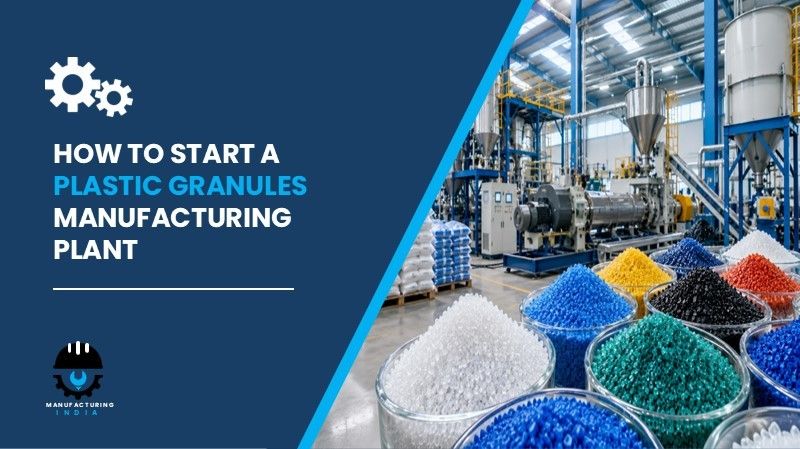
Setting up a plastic granules manufacturing plant in India presents a compelling investment case driven by surging demand from packaging, automotive, construction, electrical & electronics, consumer goods, and medical devices industries. Plastic granules serve as the fundamental feedstock for all plastic processing technologies, acting as the crucial intermediary between raw feedstocks – oil, gas, or recycled waste – and finished goods such as bottles, car parts, and packaging materials. As India’s manufacturing base deepens and domestic consumption expands across these sectors, demand for high-quality plastic granules continues to accelerate at a pace that makes local production not just viable, but strategically essential.
India’s combination of urbanisation, infrastructure growth, and the Make in India initiative creates an ideal environment for this investment. Industrial states such as Gujarat, Maharashtra, and Uttar Pradesh offer well-developed logistics corridors, proximity to petrochemical feedstock suppliers, and access to large end-user markets. The Asia-Pacific region – of which India is an increasingly dominant part – already holds the largest share, accounting for 45.0% of the global plastic granules market according to IMARC estimates. With e-commerce growth, vehicle lightweighting trends, and construction expansion all driving sustained demand, India stands out as one of the most strategically sound locations in the world for this type of production.
Investing in a plastic granules manufacturing plant in India combines policy-backed cost competitiveness with multi-sector demand stability. With gross profit margins of 25-35% and net margins of 10-15%, the investment case is financially robust across a capacity range of 10,000-20,000 MT per year, supported by strong recycling and circular economy tailwinds.
What are Plastic Granules?
Plastic granules are small, uniform pellets of thermoplastic polymers – including polyethylene, polypropylene, polystyrene, PVC, PET, and engineering plastics – that serve as the fundamental raw material for the plastics processing industry. These pellets are melted and moulded into a vast array of finished products, functioning as the critical link between raw feedstocks and end-use goods. Plastic granules can be virgin, recycled, or compounded with additives such as stabilisers, fillers, pigments, and plasticisers to enhance mechanical strength, durability, flexibility, chemical resistance, and thermal stability.
The primary production method is a multi-stage process involving polymerization, extrusion, cooling, pelletizing, drying, and packaging. Granules are available in three broad categories: virgin granules derived from petrochemical feedstocks, recycled granules produced from post-consumer or industrial plastic waste, and compounded granules engineered with specific additive blends for performance-critical applications. The end-use industries served include packaging, automotive, construction, electrical & electronics, consumer goods, and medical devices – a breadth of application that underpins the product’s consistent commercial demand.
Cost of Setting Up a Plastic Granules Manufacturing Plant in India
The total cost of establishing a plastic granules manufacturing plant in India depends on plant capacity, technology selection, geographic location, level of automation, and regulatory compliance requirements. Understanding both capital and operational expenditure is essential before committing to this investment.
1. Capital Expenditure (CapEx)
Land and Site Development costs form a substantial part of total capital investment, covering land registration charges, boundary development, site levelling, drainage infrastructure, and related pre-construction expenses. Locating the plant within a Special Economic Zone (SEZ) or a state-designated industrial estate can yield significant savings on land acquisition, utilities, and tax obligations.
Civil Works and Construction investment covers the main production shed, quality control laboratory, raw material storage warehouse, finished goods storage, administrative block, and safety infrastructure. Robust civil design is particularly important given the storage requirements for polymer resins and the thermal demands of extrusion processes.
Machinery and Equipment represent the largest single component of CapEx for this type of facility. Key machinery required includes:
- Polymerization reactors
- Twin-screw extruders
- Single-screw extruders
- Pelletizers
- Cooling conveyors
- Dryers
- Packaging systems
The scale of production and degree of automation will determine the final machinery cost. Higher automation reduces long-term labour costs and improves output consistency.
Other Capital Costs include effluent treatment plant (ETP) setup, pre-operative expenses, commissioning charges, and import duties applicable on specialised equipment not manufactured domestically.
Request a Sample Report for In-Depth Market Insights: https://www.imarcgroup.com/plastic-granules-manufacturing-plant-project-report/requestsample
2. Operational Expenditure (OpEx)
Raw Material Cost is the dominant driver of operating expenditure, accounting for approximately 60-70% of total OpEx. The core raw materials are polymer resins and recycled plastics. Securing long-term supply contracts with reliable domestic and import-based suppliers is critical to managing price volatility, particularly given global petrochemical price fluctuations.
Utility Cost constitutes the second-largest operating expense category, representing 15-20% of OpEx. This covers electricity for extrusion and pelletizing machinery, water for cooling conveyors, and steam for drying systems.
Other Operating Costs include transportation, packaging materials, salaries and wages, equipment maintenance, depreciation on fixed assets, and applicable taxes. By the fifth year of operations, total operational expenditure is projected to increase substantially due to inflation, market fluctuations, potential rises in the cost of key polymer materials, supply chain disruptions, and rising consumer demand.
3. Plant Capacity
The proposed manufacturing facility is designed with an annual production capacity ranging between 10,000-20,000 MT, enabling economies of scale while maintaining operational flexibility. This capacity range can be customised per investor requirements based on target market size, available capital, and growth trajectory. As with most process manufacturing investments, profitability improves significantly with higher capacity utilisation, making scale planning an important factor in the overall project design.
4. Profit Margins and Financial Projections
The project demonstrates healthy profitability under normal operating conditions. Gross profit margins typically range between 25-35%, supported by stable multi-sector demand and value-added compounding applications. Net profit margins average 10-15% across the production lifecycle. A comprehensive financial analysis covering NPV (Net Present Value), IRR (Internal Rate of Return), payback period, and detailed profit and loss projections is included in the IMARC full project report. The financial projections are developed on realistic assumptions related to capital investment, operating cost structures, production capacity utilisation rates, pricing trends, and demand outlook.
Why Set Up a Plastic Granules Plant in India?
Backbone of the Plastic Processing Industry: Plastic granules are the fundamental feedstock for all plastic processing technologies, enabling mass production of diverse products across industries. Every injection moulded component, every extruded pipe, and every blow-moulded bottle begins as a plastic granule, creating an inescapable structural demand from downstream manufacturers.
High and Diversified Demand Across Multiple Sectors: Consistent consumption from packaging, automotive, construction, and electronics ensures stable long-term demand for the production. India’s rapidly growing e-commerce sector, expanding vehicle fleet, and accelerating construction pipeline all reinforce a demand trajectory that is structurally sound and multi-dimensional.
Urbanisation and Infrastructure Growth: Demand for plastic granules remains closely tied to urbanisation, infrastructure development, and vehicle lightweighting trends. India’s urban population growth and ongoing public infrastructure investment programmes – roads, metro systems, affordable housing – directly stimulate demand for plastic pipes, profiles, and construction components produced from granules.
Policy and Regulatory Tailwinds: The Make in India initiative creates a supportive policy environment for domestic manufacturing investment by reducing import dependencies, encouraging local value addition, and facilitating industrial land acquisition in designated zones. State-level incentives in Gujarat, Maharashtra, and Uttar Pradesh further reduce effective project costs.
Active Industry Investment and Recent Developments: In January 2026, Avro Recycling Limited launched a 500 MTPM plastic recycling facility in Uttar Pradesh, India, producing recycled granules available at up to 40% lower cost than virgin plastic while meeting stringent technical and durability standards. This signals strong investor confidence and a growing circular economy ecosystem within India specifically.
Customisation, Value Addition, and Circular Economy Scope: Compounding and additive blending allow manufacturers to produce application-specific granules with enhanced performance characteristics, unlocking premium pricing opportunities. Recycled plastic granules additionally support sustainability goals and regulatory compliance while lowering raw material costs – a dual advantage that improves both margins and market positioning.
Manufacturing Process – Step by Step
The plastic granules manufacturing process uses polymerization, extrusion, cooling, pelletizing, drying, and packaging as the primary production method. The process is a multi-step operation involving several unit operations, material handling stages, and quality checks.
- Raw Material Receipt and Inspection: Polymer resins and recycled plastics are received, weighed, and inspected against quality specifications before entering the production line.
- Polymerization (where applicable): Polymerization reactors convert monomer feedstocks into polymer chains of the required molecular weight and structure for downstream processing.
- Compounding and Additive Blending: Stabilisers, fillers, pigments, and plasticisers are blended into the base polymer using twin-screw extruders to produce application-specific compounds.
- Extrusion: Twin-screw and single-screw extruders melt and homogenise the compounded polymer, forcing it through a die to form continuous strands.
- Cooling: Extruded strands pass through cooling conveyors or water baths to solidify the polymer into a workable intermediate form.
- Pelletizing: Pelletizers cut the cooled strands into uniform small granules of consistent size and shape.
- Drying: Dryers remove residual moisture from the granules to ensure product quality and storage stability.
- Quality Control Testing: Analytical instruments monitor product concentration, purity, and stability against technical specifications.
- Packaging and Dispatch: Finished granules are packed into appropriate packaging and dispatched to end-use industries including packaging manufacturers, automotive component producers, construction materials firms, and electronics assemblers.
Key Applications
Plastic granules serve a broad range of industries as the primary forming feedstock across multiple processing technologies.
- Packaging Industry: Used to manufacture films, bottles, containers, caps, closures, and flexible packaging materials.
- Automotive Industry: Utilised in dashboards, bumpers, interior trims, cable insulation, fuel system components, and under-the-hood parts.
- Construction Industry: Applied in pipes, fittings, insulation sheets, window profiles, flooring materials, and waterproof membranes.
- Electrical & Electronics Industry: Used in wire and cable insulation, connectors, housings, switches, and appliance components.
- Consumer Goods Industry: Applied in household items, furniture, toys, storage containers, and personal care product packaging.
- Medical Devices: Utilised in the manufacture of medical-grade components requiring precise mechanical and chemical performance.
Leading Manufacturers
The global plastic granules industry is served by a group of large multinational producers with extensive production capacities and diverse portfolios. Key players in the market include:
- BASF SE
- Braskem
- Carbokene FZE
- Covestro AG
- Dow Inc.
- DuPont de Nemours Inc.
- Eastman Chemical Co.
- Exxon Mobil Corp.
- Formosa Plastics Corp.
Timeline to Start the Plant
- Feasibility study and project report preparation
- Land acquisition and site development
- Regulatory approvals and environmental clearances
- Factory licence and fire safety compliance
- Machinery procurement and installation
- Raw material supplier agreements and supply chain setup
- Trial production and quality testing
- Commercial production launch
Licences and Regulatory Requirements
Starting a plastic granules manufacturing unit in India requires several approvals:
- Business registration (Proprietorship, LLP, or Pvt Ltd)
- Factory Licence under the Factories Act
- Environmental Clearance from State Pollution Control Board
- GST Registration
- Fire Safety NOC
- Hazardous/Chemical compliance for polymer resin and additive storage and handling
- Effluent Treatment Plant (ETP) operational clearance
- Occupational Health and Safety compliance
Key Challenges to Consider
High Capital Requirements: The machinery-intensive nature of plastic granules production – polymerization reactors, twin-screw extruders, pelletizers, and associated systems – means initial CapEx is substantial, requiring careful project financing and phased investment planning.
Raw Material Price Volatility: The primary raw materials – polymer resins and recycled plastics – are closely linked to global petrochemical prices, which can fluctuate significantly with crude oil markets and supply chain disruptions. Long-term supplier contracts are essential to managing this exposure.
Regulatory Compliance: Environmental clearances, ETP operational requirements, and chemical handling compliance add both cost and timeline risk to the project setup phase. Investors must factor regulatory timelines into their go-live planning.
Technology and Innovation Pressure: The ongoing shift toward recycled and circular plastic granules, driven by sustainability targets and regulatory mandates, means manufacturers must assess technology selection carefully to remain competitive and compliant over the medium term.
Competition from Established Players: The market includes well-capitalised global competitors such as BASF SE, Dow Inc., Covestro AG, and Exxon Mobil Corp. Domestic investors will need to differentiate through product customisation, cost efficiency, and regional supply chain advantages.
Skilled Manpower: Operating extrusion, compounding, and quality control systems requires trained technical personnel. Recruitment and retention of skilled operators and quality chemists is an ongoing operational challenge, particularly in smaller industrial locations.
Frequently Asked Questions
1. How much does it cost to set up a plastic granules manufacturing plant in India?
Total setup cost depends on plant capacity (10,000-20,000 MT/year range), technology, location, and automation level. Machinery represents the largest CapEx component, followed by land, site development, and civil works. Request the IMARC sample report for detailed cost breakdowns.
2. Is plastic granules manufacturing profitable in India in 2026?
Yes. The project demonstrates healthy profitability with gross margins of 25-35% and net margins of 10-15% under normal operating conditions, supported by strong demand across packaging, automotive, and construction sectors.
3. What machinery is required for a plastic granules plant in India?
Essential equipment includes polymerization reactors, twin-screw extruders, single-screw extruders, pelletizers, cooling conveyors, dryers, and packaging systems.
4. What licences and approvals are required to start a plastic granules plant in India?
Key requirements include business registration, Factory Licence, Environmental Clearance, GST Registration, Fire Safety NOC, ETP operational clearance, chemical compliance certification, and Occupational Health and Safety compliance.
5. What raw materials are needed for plastic granules manufacturing?
The primary raw materials are polymer resins and recycled plastics. Additives such as stabilisers, fillers, pigments, and plasticisers are also required for compounded granule production.
6. What are the environmental compliance requirements for a plastic granules plant in India?
Operators must obtain Environmental Clearance from the State Pollution Control Board, install and operate an Effluent Treatment Plant (ETP), comply with emission standards, and implement chemical handling protocols for resin and additive storage.
7. What is the best location to set up a plastic granules plant in India?
States such as Gujarat, Maharashtra, and Uttar Pradesh offer strong advantages – petrochemical proximity, established industrial infrastructure, logistics connectivity, and state-level incentives. The January 2026 Avro Recycling facility in Uttar Pradesh demonstrates active investor activity in the region.
8. What is the break-even period for this type of plant in India?
Break-even projections depend on capacity utilisation, pricing, and cost structure. The full IMARC DPR covers payback period, NPV, and IRR analysis. Request the sample report for plant-specific projections.
9. What government incentives are available for manufacturers in India?
The Make in India initiative, SEZ investment benefits, state industrial promotion policies, and sustainability-linked incentives for recycled plastic processing all provide support to investors setting up manufacturing units in India.
Key Takeaways for Investors
A plastic granules manufacturing plant in India represents a high-conviction investment opportunity, anchored by structurally growing demand from packaging, automotive, construction, electrical & electronics, consumer goods, and medical devices industries. The financial profile is viable across the 10,000-20,000 MT per year capacity range, with gross margins of 25-35% and net margins of 10-15% supporting strong returns across multiple production scales. The Asia-Pacific region – led increasingly by India – holds 45.0% of the global plastic granules market, and the domestic industry is seeing active new investment, as demonstrated by the 500 MTPM Avro Recycling facility launched in Uttar Pradesh in January 2026. With global export data recording 129,887 shipments of plastic granules supplied by 9,907 exporters worldwide, the commercial infrastructure for this market is mature and demand-driven, ensuring that a well-positioned Indian facility can achieve long-term, sustainable production economics supported by both domestic consumption growth and export potential.
About the Author