Steel Rolling Products Manufacturing Plant
Setting up a steel rolling products manufacturing plant in India presents a compelling investment case anchored in the country’s rapid infrastructure modernisation, large-scale urban housing expansion, robust automotive and transportation growth, accelerating renewable energy project investments, and one of the world’s largest and most active steel consumption markets. Steel rolling products — semi-finished or finished steel materials produced through hot or cold rolling processes to achieve desired thickness, shape, and mechanical properties — form the structural foundation of every major industrial and infrastructure category. From reinforced concrete buildings and highway bridges to automotive chassis, wind turbine towers, shipbuilding, and industrial machinery, rolled steel products are indispensable across the entire spectrum of India’s economic development. As India’s per capita steel consumption rises toward and beyond the global average of 214.7 kg recorded in 2024, the demand for domestically manufactured, quality-certified rolled steel products will expand in proportion.
India’s strategic advantages for this investment are clearly established. The country’s large and growing construction sector, government-backed infrastructure stimulus through the National Infrastructure Pipeline, active automotive manufacturing base, and rapidly expanding renewable energy project pipeline collectively create a deep and diversified institutional buyer base for steel rolling product manufacturers. Asia Pacific — with India as a key contributor — accounts for over 45% share in the global steel rolling products market, confirming the region’s dominant position in both production and consumption. States such as Chhattisgarh, Jharkhand, Odisha, Maharashtra, and Gujarat offer established steel and metal processing industry clusters, raw material access, and state government support for heavy industry investment. The Make in India initiative and National Steel Policy further reinforce the investment environment for establishing a steel rolling products manufacturing plant in India.
A steel rolling products manufacturing plant in India captures mandatory structural material demand from construction, automotive, energy, shipbuilding, and industrial machinery sectors — all expanding simultaneously in one of the world’s most active infrastructure investment markets. With gross margins of 15–25% and net margins of 5–12%, and Asia Pacific holding over 45% of global market share, this investment delivers commercially sound returns at scale for technically capable domestic producers.
What are Steel Rolling Products?
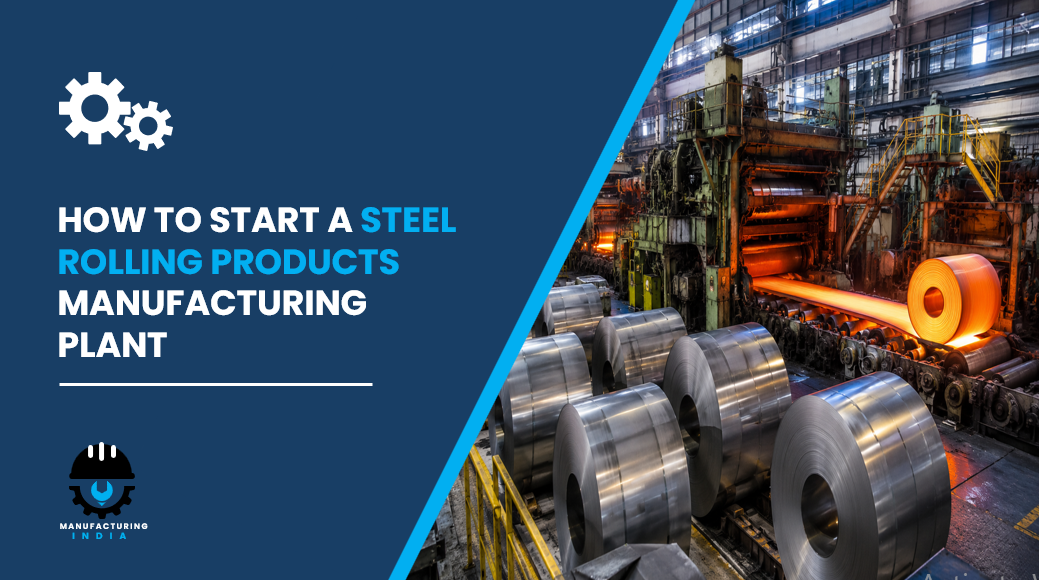
Steel rolling products are semi-finished or finished steel materials produced through hot or cold rolling processes to achieve the desired thickness, shape, and mechanical properties. These products include flat products such as plates, sheets, and coils; long products such as bars, rods, and rails; and structural sections such as beams, channels, and angles. The rolling process enhances dimensional accuracy, surface finish, strength, and ductility while enabling large-scale, cost-efficient production.
Depending on application requirements, steel rolling products can be carbon steel, alloy steel, or stainless steel grades. Their high tensile strength, formability, weldability, and load-bearing capability make them indispensable across construction, automotive, machinery, shipbuilding, energy, and infrastructure sectors. The primary production method spans raw material charging, reheating furnace, hot rolling mill, controlled cooling, pickling, annealing, finishing operations, surface treatment, inspection, and packaging. The product serves end-use industries including construction and infrastructure, automotive and transportation, industrial machinery and equipment, energy and power generation, and shipbuilding and heavy engineering.
Cost of Setting Up a Steel Rolling Products Manufacturing Plant in India
The total cost of establishing a steel rolling products manufacturing plant in India depends on production capacity, rolling technology (hot vs. cold rolling), product mix, plant location, degree of automation, and regulatory compliance requirements.
1. Capital Expenditure (CapEx)
The capital investment required to set up this facility covers several major cost heads. Land and site development — including land registration, boundary development, heavy-duty industrial flooring, internal road networks, and related site infrastructure — forms a substantial portion of total CapEx. Investors should consider locating the unit within integrated steel and metal processing industrial zones in Chhattisgarh, Jharkhand, Odisha, Maharashtra, or Gujarat, where proximity to steel billet and slab suppliers, established metal processing infrastructure, and port access for raw material imports create a commercially and logistically favourable operating environment. Access to reliable high-voltage power supply is a critical site selection criterion given the energy demands of reheating furnaces and rolling mill drives.
Civil works and construction costs cover the raw material receiving and billet/slab storage yard, reheating furnace building with heavy-duty foundations, hot rolling mill hall — requiring large clear-span, high-clearance structural design — controlled cooling beds, pickling line and annealing zone, finishing and surface treatment area, inspection and packaging section, quality control laboratory, effluent treatment area, and administrative block. The scale and structural specification of civil works for a 250,000–500,000 MT annual capacity rolling mill are substantially greater than most manufacturing categories, reflecting the scale of the rolling mill equipment and its associated process infrastructure.
Machinery and equipment represent the largest component of total capital expenditure for this steel rolling products manufacturing plant. Key machinery required includes:
- Reheating furnaces
- Rolling mills
- Continuous casting machines
- Pickling lines
- Annealing furnaces
- Galvanizing and coating lines
- Straightening machines
- Cutting and shearing machines
- Packaging systems
Other capital costs include effluent treatment plant (ETP) installation, mill scale pit and water treatment systems for rolling mill coolant management, pre-operative and commissioning expenses, and any applicable import duties on specialised rolling mill and annealing furnace equipment not manufactured domestically.
Request a Sample Report for In-Depth Market Insights: https://www.imarcgroup.com/steel-rolling-products-manufacturing-plant-project-report/requestsample
2. Operational Expenditure (OpEx)
The operating cost structure of a steel rolling products manufacturing plant is almost entirely dominated by raw material procurement. Raw material cost — covering steel billets and slabs as the dominant and effectively sole primary material input, along with rolling mill rolls and lubricants — accounts for approximately 80–85% of total OpEx, making billet and slab procurement pricing the single most critical strategic and operational lever for plant-level profitability. Steel billet and slab prices are directly linked to global steel market pricing on commodity exchanges, creating significant input cost exposure to international steel market movements. Investors should establish long-term procurement agreements with integrated steel producers, electric arc furnace billet manufacturers, and authorised steel distributors, and consider backward integration into steelmaking for large-scale facilities to stabilise input costs.
Utility costs, covering electricity for reheating furnaces, rolling mill drives, and finishing line operations, along with water for cooling systems, account for 10–15% of OpEx — an important cost component reflecting the energy intensity of high-temperature reheating and continuous rolling operations. Other operating costs include transportation and logistics for steel billet procurement and finished product dispatch to construction sites, automotive suppliers, steel service centres, and infrastructure contractors, packaging and strapping materials, salaries and wages, maintenance and roll change costs, depreciation of heavy equipment, and applicable taxes. By the fifth year of operations, total operational costs are projected to increase substantially due to inflation, steel billet price escalation, energy cost movements, market fluctuations, supply chain disruptions, and rising construction and industrial demand dynamics.
3. Plant Capacity
The proposed manufacturing facility is designed with an annual production capacity ranging between 250,000–500,000 MT, enabling economies of scale while maintaining operational flexibility. Capacity can be customised based on specific investor requirements, target product mix between flat products, long products, and structural sections, regional market geography, and available capital. Rolling mills can achieve high throughput volumes, enabling cost efficiency and competitive pricing in large-scale construction and industrial project supply. Profitability and unit economics improve meaningfully with higher capacity utilisation given the very high fixed-cost base of reheating furnace and rolling mill infrastructure.
4. Profit Margins and Financial Projections
The steel rolling products manufacturing plant demonstrates solid profitability potential under normal operating conditions. Gross profit margins typically range between 15–25%, supported by stable and growing multi-sector demand across construction, automotive, energy, and industrial machinery segments, and the value-added nature of rolled, finished, and surface-treated products relative to raw billet inputs. Net profit margins are projected in the range of 5–12%. Key financial indicators including NPV, IRR, payback period, liquidity analysis, and sensitivity analysis are covered comprehensively in the full project report. Manufacturers can enhance margins further through value addition via coated, alloyed, or precision-rolled products tailored for specialised applications.
Why Set Up a Steel Rolling Products Manufacturing Plant in India?
Core Industrial Backbone Material with Non-Discretionary Demand. Steel rolling products form the structural foundation of infrastructure, transportation, and industrial development, ensuring consistent and long-term demand across every economic cycle. The global per capita steel use of 214.7 kg in 2024 reflects sustained demand across construction, automotive, and industrial sectors, directly supporting consumption of steel rolling products such as bars, sheets, and structural sections. India’s per capita steel consumption — still below the global average — has significant room to grow as urbanisation deepens and infrastructure intensity accelerates.
Urbanisation and Infrastructure Programmes Driving Sustained Consumption. Ongoing urban expansion and infrastructure programmes globally and in India support sustained steel consumption across residential housing, commercial construction, road and rail networks, bridges, and smart city development projects. India’s National Infrastructure Pipeline and government-backed affordable housing initiatives create a massive and sustained multi-year demand pipeline for structural steel rolling products directly supplied by domestic mills.
Renewable Energy Expansion Generating New Demand Channels. Increasing investments in renewable energy projects — including wind turbine towers, transmission infrastructure, solar plant support structures, and hydro project components — are generating steady demand for rolled structural steel from the energy sector. India’s ambitious renewable energy capacity targets and the global expansion of wind and solar installations represent a structurally growing demand channel that complements the traditional construction and automotive base for rolled steel consumption.
Automotive Sector Driving Innovation and Product Development. The automotive sector’s shift toward lightweight, high-strength steel grades is supporting product innovation and growth in the rolled steel market. Advanced high-strength steel (AHSS) and ultra-high-strength steel (UHSS) grades produced through precision rolling — used in vehicle chassis, body panels, and suspension components — command premium pricing relative to commodity structural steel, enabling value-added product strategy for mills investing in downstream processing capabilities.
Active Industry Investment Confirming Global Market Confidence. In February 2026, Roofings Rolling Mills Ltd (RRM) introduced its new cold-mill complex in Uganda, enhancing its production capabilities and product quality standards. The facility has an annual production capacity of approximately 150,000 tons, supplies material to the company’s galvanizing line, and enables consistent rolling of ultra-thin steel strips down to 0.15 mm thickness — with the integrated galvanizing line designed to process strips from 0.15 mm to 0.8 mm in thickness and 600 mm to 1,250 mm in width at speeds of up to 160 metres per minute. This investment demonstrates continued global capital commitment to rolling mill capacity expansion.
Recyclability and Circular Economy Advantage Strengthening Commercial Positioning. Steel is highly recyclable, supporting sustainability goals and compliance with environmental regulations. The participation of 93 steel companies representing 956.1 million tonnes — 51% of global crude steel output — highlights strong production activity and industrial scale, reinforcing steady supply and market growth for rolled steel products worldwide. India-based rolling mills using electric arc furnace (EAF) technology sourcing recycled scrap benefit from both lower carbon intensity and competitive raw material economics relative to integrated blast furnace-based producers.
Manufacturing Process — Step by Step
The steel rolling products manufacturing process uses raw material charging, reheating furnace, hot rolling mill, controlled cooling, pickling, annealing, finishing operations, surface treatment, inspection, and packaging as the primary production method. The process involves multiple heavy unit operations, material handling stages, and quality verification checkpoints throughout.
- Raw Material Receipt and Inspection: Steel billets or slabs are received from integrated steel producers or EAF billet manufacturers, inspected for chemistry, dimensional tolerance, and surface quality, and staged in the raw material yard for furnace charging sequences.
- Reheating Furnace: Billets or slabs are charged into reheating furnaces and heated to the required rolling temperature — typically 1,150–1,280°C — to achieve the thermal uniformity and plasticity required for consistent hot rolling across the full cross-section of the product.
- Hot Rolling Mill: Heated billets or slabs are passed through a series of rolling mill stands — roughing, intermediate, and finishing stands — where progressive reduction in thickness and shaping into the target profile (flat plate, bar, rod, structural section, coil) is achieved. Rolling speed, roll gap, and tension are continuously controlled to meet dimensional specifications.
- Controlled Cooling: Rolled products exiting the finishing mill are cooled on cooling beds or through accelerated cooling systems to achieve the required mechanical properties — including tensile strength, yield strength, and elongation — determined by the target application and product grade specification.
- Pickling: Cold-rolled or hot-rolled products requiring clean, scale-free surfaces undergo acid pickling in pickling lines to remove surface oxides and mill scale, preparing the surface for downstream coating, galvanizing, or precision cold rolling.
- Annealing: Cold-worked steel undergoes annealing in annealing furnaces to relieve internal stresses, restore ductility, and achieve the required mechanical properties for forming and stamping applications in automotive and consumer goods industries.
- Finishing Operations: Finished rolled products undergo straightening on straightening machines and are cut to length or slit to width using cutting and shearing machines to meet customer order specifications.
- Surface Treatment: Depending on the target application, products undergo galvanizing, zinc coating, or other surface treatment processes in galvanizing and coating lines to enhance corrosion resistance for construction, automotive, and outdoor structural applications.
- Inspection and Quality Testing: Finished products are tested for dimensional accuracy, surface quality, mechanical properties (tensile, yield, impact), chemical composition, and coating thickness against applicable BIS, IS, ASTM, or customer-specific quality standards.
- Packaging and Dispatch: Approved steel rolling products — plates, sheets, coils, bars, rods, or structural sections — are bundled, strapped, labelled, and dispatched using packaging systems to construction companies, automotive OEM supply chains, steel service centres, infrastructure contractors, energy project fabricators, and shipbuilders.
Key Applications
The steel rolling products manufacturing plant serves multiple high-volume industries with consistent and structurally growing demand for dimensionally accurate, mechanically certified rolled steel inputs:
- Construction and Infrastructure: Used in reinforced concrete structures, bridges, commercial buildings, industrial sheds, and highways due to high load-bearing capacity and structural reliability — the largest volume application segment for rolled long products and structural sections.
- Automotive and Transportation: Applied in vehicle chassis, body panels, suspension systems, and rail components requiring strength-to-weight optimisation and durability, with advanced high-strength grades supporting lightweighting strategies in passenger vehicles.
- Industrial Machinery and Equipment: Used in the fabrication of heavy equipment frames, gears, shafts, and processing machinery components across manufacturing, mining, and agricultural equipment sectors.
- Energy and Power Generation: Used in wind turbine towers, transmission poles, oil and gas pipelines, and thermal and renewable power plant structural components — a rapidly growing application segment driven by India’s renewable energy build-out.
- Shipbuilding and Heavy Engineering: Applied in hull construction, offshore platforms, and marine structural reinforcements requiring certified marine-grade steel plate and structural section supply.
Leading Manufacturers
The global steel rolling products industry is served by several major companies with extensive production capacities and diverse application portfolios. Key players include:
- Worthington Industries Inc.
- Shanghai Metal Corporation
- GNEE Multinational Trade Co. Ltd.
- Runfei Steel Group
- MESCO Steel
- J.K. Steel Strips LLP
- JMT Steel (Group of Doshi Steel)
- Tata Steel Ltd.
Timeline to Start the Plant
- Feasibility study and project report preparation
- Land acquisition and site development
- Regulatory approvals and environmental clearances
- Factory licence and fire safety compliance
- Machinery procurement and installation
- Raw material supplier agreements and supply chain setup
- Trial production and quality testing
- Commercial production launch
Licences and Regulatory Requirements
Starting a steel rolling products manufacturing unit in India requires several approvals:
- Business registration (Proprietorship, LLP, or Pvt Ltd)
- Factory Licence under the Factories Act
- Environmental Clearance from State Pollution Control Board
- GST Registration
- Fire Safety NOC
- Bureau of Indian Standards (BIS) certification — mandatory for structural steel products (TMT bars, structural sections) supplied to construction projects under applicable IS standards
- Consent to Establish and Consent to Operate from State Pollution Control Board covering reheating furnace emissions and mill scale effluent management
- Effluent Treatment Plant (ETP) operational clearance for rolling mill coolant and pickling line wastewater
- Occupational Health and Safety compliance
Key Challenges to Consider
Steel Billet and Slab Price Volatility. Steel billets and slabs — accounting for 80–85% of total OpEx — are priced on global steel commodity markets and subject to significant price cycles driven by iron ore, coking coal, scrap steel, and global demand movements. Building a diversified procurement network across domestic integrated steel producers and EAF billet manufacturers, and considering backward integration into steelmaking for large-scale mills, are essential price risk management strategies.
Very High Capital Requirements. Reheating furnaces, continuous rolling mill stands, annealing furnaces, galvanizing lines, and associated heavy civil foundations constitute one of the largest CapEx commitments in manufacturing. Access to long-term institutional financing, government steel sector investment incentives, and careful financial structuring are prerequisites for project viability at the 250,000–500,000 MT capacity scale.
Energy Cost Management. At 10–15% of OpEx, electricity and fuel costs for reheating furnaces and rolling mill drives are a significant and ongoing operational management challenge. Investing in heat recovery systems, energy-efficient reheating furnace designs, and reliable power supply infrastructure is essential to protecting net margin over the plant’s operating life.
Regulatory Compliance for BIS Certification. BIS IS certification for TMT bars and structural steel sections — mandatory for supply to Indian construction projects under applicable quality control orders — requires third-party testing, production process qualification, and ongoing surveillance audits. Maintaining BIS certification across multiple product grades adds compliance management complexity and cost to operations.
Competition. Global players such as Tata Steel Ltd., Worthington Industries Inc., and Shanghai Metal Corporation, alongside established Indian producers including J.K. Steel Strips LLP and JMT Steel, maintain strong market positions. New entrants must compete on product quality certification, dimensional precision, delivery reliability, and competitive pricing across target product categories to win construction and industrial buyer contracts.
Skilled Manpower for Heavy Rolling Mill Operations. Operating reheating furnaces, multi-stand rolling mills, and integrated finishing lines to BIS certification standards requires metallurgically trained engineers, rolling mill operators, and maintenance technicians — a specialised workforce category that requires targeted recruitment from established steel industry clusters and ongoing technical training investment.
Frequently Asked Questions
1. How much does it cost to set up a steel rolling products manufacturing plant in India? Total investment depends on production capacity (250,000–500,000 MT annually), rolling technology, product mix (hot vs. cold rolled, flat vs. long products), location, and automation level. Key cost components include land and heavy-duty site infrastructure, large-scale civil construction for rolling mill halls and furnace buildings, machinery (reheating furnaces, rolling mills, continuous casting machines, pickling lines, annealing furnaces, galvanizing and coating lines, straightening, cutting, and shearing machines, packaging systems), ETP and mill scale management infrastructure, and substantial working capital for steel billet procurement. A detailed project report provides capacity-specific CapEx and OpEx estimates.
2. Is steel rolling products manufacturing profitable in India in 2026? Yes. The facility demonstrates gross profit margins of 15–25% and net profit margins of 5–12% under normal operating conditions. Revenue at 250,000–500,000 MT annual scale generates substantial absolute returns commensurate with the investment quantum. Profitability improves with higher capacity utilisation, effective steel billet procurement cost management, and value addition through coated and alloyed product lines.
3. What machinery is required for a steel rolling products manufacturing plant in India? Key equipment includes reheating furnaces, rolling mills, continuous casting machines, pickling lines, annealing furnaces, galvanizing and coating lines, straightening machines, cutting and shearing machines, and packaging systems.
4. What licences and approvals are required to start a steel rolling products manufacturing plant in India? Required approvals include business registration, Factory Licence under the Factories Act, Environmental Clearance from the State Pollution Control Board, GST registration, BIS certification for structural steel products under applicable IS standards, Consent to Establish and Operate from the State Pollution Control Board for furnace emissions and effluent management, ETP operational clearance, Fire Safety NOC, and Occupational Health and Safety certification.
5. What raw materials are needed for steel rolling products manufacturing? Key raw materials are steel billets and slabs as the dominant primary input — available from integrated steel producers and EAF billet manufacturers. Supporting process inputs include rolling mill rolls, lubricants, and cooling water, along with pickling chemicals, annealing gas, and coating materials (zinc, chromate) for finishing and surface treatment operations.
6. What are the environmental compliance requirements for a steel rolling products manufacturing plant in India? Operators must obtain Environmental Clearance, maintain an operational ETP for rolling mill coolant and pickling line acid wastewater management, install and operate air emission control systems for reheating furnace stack gases, comply with State Pollution Control Board guidelines on effluent quality and hazardous waste management for mill scale disposal, and implement water recycling systems to minimise fresh water consumption in cooling operations.
7. What is the best location to set up a steel rolling products manufacturing plant in India? Ideal locations offer proximity to steel billet and slab supply sources, reliable high-voltage power infrastructure, strong rail and road logistics connectivity to construction and industrial buyer markets, and access to established metal processing industry clusters. Chhattisgarh, Jharkhand, and Odisha are well-positioned given their proximity to integrated steel producers, while Maharashtra and Gujarat offer strong market access and port infrastructure for imported billet supply where required.
8. What is the break-even period for this type of plant in India? Break-even depends on production scale, steel billet procurement costs, capacity utilisation, product mix, and prevailing rolled steel market pricing. The high-volume nature of the business at 250,000–500,000 MT capacity and the scale economics achievable at full utilisation support a commercially competitive payback timeline despite the large CapEx. A detailed feasibility study provides project-specific break-even, NPV, and IRR projections.
9. What government incentives are available for manufacturers in India? Steel rolling products manufacturers in India can benefit from capital subsidies under state-level heavy industry and metal sector investment schemes in Chhattisgarh, Odisha, and Maharashtra, tax exemptions under state industrial promotion policies, concessional land and utility rates in integrated steel and metal processing industrial estates, export-linked benefits for BIS-certified structural steel products, and National Steel Policy support for domestic steel manufacturing capacity expansion. Make in India policies actively support steel sector investment and downstream value addition.
Key Takeaways for Investors
The steel rolling products manufacturing plant opportunity in India is underpinned by structural, non-discretionary demand from construction and infrastructure, automotive and transportation, industrial machinery, energy and power generation, and shipbuilding sectors — all scaling simultaneously as India’s economy industrialises, urbanises, and invests in its physical infrastructure at an accelerating pace. The financial profile is commercially sound at 250,000–500,000 MT annual capacity, with gross margins of 15–25% and net margins of 5–12%, supported by Asia Pacific’s over 45% share of global market consumption and the scale economics achievable at the plant’s production range. The global per capita steel use of 214.7 kg in 2024 and the participation of 93 steel companies representing 956.1 million tonnes — 51% of global crude steel output — confirm the industrial scale and market depth of the rolled steel products segment. As India’s infrastructure investment deepens, its renewable energy targets drive demand for structural steel towers and transmission infrastructure, and its automotive sector scales advanced high-strength steel adoption, domestically produced steel rolling products are positioned for durable, multi-decade demand growth across every major industrial end-use category.
About the Author