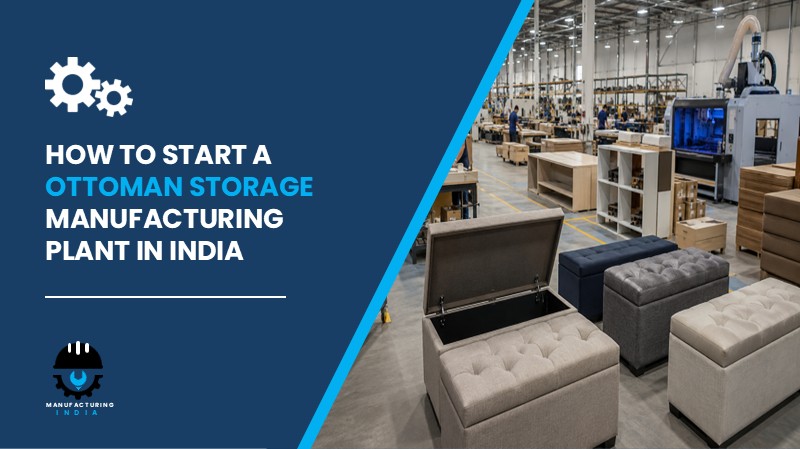
Setting up an ottoman storage manufacturing plant in India presents a compelling investment case at a time when the country’s urban residential construction is booming, compact and multifunctional furniture is experiencing exceptional demand growth, e-commerce is transforming furniture retail accessibility, and India’s middle class is investing in home aesthetics and space-optimisation solutions at an unprecedented pace. Ottoman storage units — the versatile, upholstered seating and decorative furniture pieces that incorporate concealed storage compartments beneath their cushioned tops — serve the dual function of seating or footrest and practical household storage simultaneously, making them one of the most commercially appealing products in the space-constrained urban home market. As Indian households in metropolitan and tier-1 cities downsize into smaller apartments, consumer preference for multifunctional, space-efficient, aesthetically designed furniture is growing rapidly — with storage ottomans, sofa-cum-beds, expandable tables, and modular units all gaining strong commercial traction among urban consumers who need furniture that works harder in smaller spaces.
India’s furniture market data confirms the exceptional scale and momentum of this opportunity. The India furniture market was valued at USD 25.38 Billion in 2025 and is projected to reach USD 44.30 Billion by 2034 at a CAGR of 6.38% — a decade-long growth trajectory driven by rising disposable incomes, rapid urbanisation, real estate development, growing demand for modular and multifunctional furniture, and the expanding reach of organised furniture retail and e-commerce platforms into tier-2 and tier-3 cities. Rising demand for compact urban living solutions has catalysed substantial demand for modular and multifunctional furniture including storage ottomans — a trend explicitly cited as a key driver of India’s furniture market expansion. The Make in India initiative and government programmes supporting organised furniture manufacturing, wood-based panel industry development, and residential construction are all creating a policy environment that supports furniture manufacturing investment in India across the current decade.
Investing in an ottoman storage manufacturing plant in India today aligns rapidly expanding compact urban living demand, India’s USD 25.38 Billion furniture market growing to USD 44.30 Billion by 2034 at a 6.38% CAGR, and the megatrend of space-efficient multifunctional furniture adoption with a commercially accessible, moderate-capital manufacturing model. With gross profit margins of 30–45% and net profit margins of 15–22% at annual production capacities of 50,000–200,000 units, the unit economics are commercially attractive and the investment’s position in India’s most dynamically growing furniture segment supports strong long-term returns.
What is Ottoman Storage?
An ottoman storage unit is a versatile piece of furniture that serves the dual purpose of providing comfortable seating or a footrest while incorporating a concealed storage compartment inside its body beneath the cushioned top. Typically upholstered in fabric, leather, or faux leather over a structural wood or engineered wood frame with high-density foam cushioning, ottoman storage units come in a variety of shapes — square, rectangular, round, and tufted designs — and sizes suited to living rooms, bedrooms, entryways, and children’s rooms across both residential and commercial interior applications.
The appeal of ottoman storage units lies in their multifunctionality: a single piece of furniture delivers seating comfort, aesthetic focal point, and practical storage for blankets, pillows, toys, accessories, and household items simultaneously. This value proposition is particularly compelling for India’s urban apartment dwellers, where maximising utility from every square metre of living space is a practical necessity. Modern ottoman storage designs incorporate premium upholstery materials, tufted button detailing, metal or wooden legs, and hinged or lift-top opening mechanisms that combine visual appeal with functional ease of use.
The primary production process covers frame fabrication, foam cutting and layering, fabric cutting and upholstery, hardware assembly, quality inspection, and packaging. End-use industries served include residential furniture, hospitality and hotels, commercial interiors, e-commerce and retail. Applications span living room seating and storage, bedroom bench and bedside storage, children’s toy storage, hospitality lounge seating, and home office accent furniture.
Cost of Setting Up an Ottoman Storage Manufacturing Plant in India
The cost of establishing an ottoman storage manufacturing plant in India depends on plant capacity in units per year, product mix across fabric, faux leather, and genuine leather upholstery, frame construction material between solid wood, plywood, and MDF, automation level for upholstery and assembly operations, geographic location, and the quality compliance requirements applicable to furniture supplied to organised retail chains, hospitality buyers, and export customers.
1. Capital Expenditure (CapEx)
Land and Site Development forms a foundational component of total capital investment, covering land acquisition charges, site registration, boundary development, drainage infrastructure, and site utilities. The location must offer easy access to key raw materials such as solid wood, plywood, MDF, high-density foam, upholstery fabric, faux leather or genuine leather, and metal hardware. Proximity to target retail and hospitality customer markets minimises distribution costs on bulky finished furniture. The site must have robust infrastructure including reliable transportation, utilities, and waste management systems. Compliance with local zoning laws and environmental regulations must also be ensured. Furniture manufacturing clusters in Jodhpur, Rajasthan — India’s largest furniture manufacturing hub for both domestic and export markets — and industrial zones in Maharashtra, Gujarat, and Karnataka offer established supply chains, skilled woodworking and upholstery workforces, and established export logistics.
Plant Layout Optimisation is critical for an ottoman storage manufacturing facility. The layout must be optimised to enhance workflow efficiency, safety, and minimise material handling between the frame fabrication, foam cutting, upholstery, hardware fitting, and packaging stages. Separate areas for wood and engineered wood frame material storage, frame cutting and assembly, foam cutting and layering, fabric and upholstery work, hardware fitting and finishing, quality control inspection, finished goods storage, and dispatch must be designated. Space for future capacity expansion should be incorporated to accommodate business growth as retail, hospitality, and export customer volumes develop.
Machinery and Equipment represent the largest single component of total CapEx for an ottoman storage manufacturing plant. Essential equipment includes:
- Wood cutting and shaping machines
- Foam cutting machines
- Upholstery and sewing machines
- Frame assembly jigs and tools
- Staple guns and fabric tensioning tools
- Hardware fitting stations
- Quality control inspection equipment
- Packaging systems
Other Capital Costs include an effluent treatment plant (ETP) for managing wood processing dust and finishing chemical effluents, dust collection and extraction systems for wood cutting and sanding operations, pre-operative expenses, commissioning charges, and any import duties on specialised CNC wood cutting or automated upholstery equipment not available domestically.
Request a Sample Report for In-Depth Market Insights: https://www.imarcgroup.com/ottoman-storage-manufacturing-plant-project-report/requestsample
2. Operational Expenditure (OpEx)
Raw Material Cost is the dominant operational expense, accounting for approximately 55–65% of total OpEx. The primary raw materials are wood and engineered wood panels for frame construction, high-density foam for cushioning, upholstery fabric or leather for covering, and metal or wooden hardware for legs, hinges, and decorative elements. Wood and engineered wood — consumed in the largest volumes for frame production — drive the majority of raw material cost and are available from domestic timber yards, plywood producers, and MDF manufacturers. High-density foam provides the cushion comfort characteristic that defines the product’s premium positioning. Upholstery fabric, faux leather, and genuine leather are the most visible quality-defining materials and the key differentiators between value, mid-range, and premium ottoman storage product lines. Long-term contracts with reliable suppliers for all primary raw materials must be negotiated to stabilise pricing and ensure a steady supply across seasonal demand cycles.
Utility Cost is the second-largest OpEx component, representing approximately 8–12% of total operating expenses — a moderate utility proportion reflecting the energy requirements of wood cutting and shaping machines, foam cutting equipment, and sewing machines, alongside general plant lighting, ventilation, and compressed air for pneumatic tools. Dust extraction and ventilation for wood processing operations adds an additional continuous utility draw.
Other Operating Costs include transportation and distribution to organised furniture retailers, e-commerce fulfilment centres, hospitality procurement agencies, interior designers, and direct consumer channels, protective packaging materials for ottoman storage units including carton boxing and bubble wrap, salaries and wages for carpenters, upholsterers, foam cutters, and quality control staff, routine machinery maintenance, depreciation on production equipment, and applicable taxes. By the fifth year, the total operational cost is expected to increase substantially due to factors such as inflation, market fluctuations, and potential rises in the cost of key materials. Additional factors, including supply chain disruptions, rising consumer demand, and shifts in the global economy, are expected to contribute to this increase.
3. Plant Capacity
The proposed manufacturing facility is designed with an annual production capacity ranging between 50,000 and 200,000 units, enabling economies of scale while maintaining operational flexibility across the full range of ottoman storage product variants — from compact individual-seating storage cubes for children’s rooms through to large, premium tufted living room storage ottomans with genuine leather upholstery. Plant capacity can be customised per investor requirements and scaled through additional upholstery stations and assembly lines as retail distribution relationships and export market penetration develop. Profitability improves with higher capacity utilisation, making secured private-label supply agreements with large furniture retail chains, hospitality procurement companies, or export buyers a strategic commercial foundation from the outset.
4. Profit Margins and Financial Projections
The financial projections for an ottoman storage manufacturing plant demonstrate healthy profitability potential under normal operating conditions. Gross profit margins typically range between 30–45%, supported by stable and growing demand across residential, hospitality, and commercial furniture customer segments and the moderate entry barriers created by design capability, upholstery quality, and established retail relationships. Net profit margins are projected at 15–22% — reflecting the meaningful value-added manufacturing conversion of raw wood, foam, and fabric materials into a designed, finished, and branded furniture product. A comprehensive financial analysis covering NPV (net present value), IRR (internal rate of return), payback period, gross margin progression, and net margin development across a five-year horizon is essential before committing capital.
Why Set Up an Ottoman Storage Plant in India?
Compact Urban Living Driving Multifunctional Furniture Demand. Rising demand for compact urban living solutions has catalysed substantial demand for modular and multifunctional furniture solutions across Indian households. Consumers residing in metropolitan areas with limited living spaces increasingly prefer furniture that maximises utility without compromising aesthetic appeal. Storage ottomans are explicitly cited among the products — alongside expandable dining tables, sofa-cum-beds, and wall-mounted units — that have gained strong market prominence among urban dwellers seeking versatility. This compact living megatrend provides a structural, demographic-driven demand tailwind for ottoman storage products that is accelerating rather than decelerating as India’s urban apartment stock expands.
India Furniture Market Growing at 6.38% CAGR to USD 44.30 Billion by 2034. The India furniture market, valued at USD 25.38 Billion in 2025, is projected to reach USD 44.30 Billion by 2034 at a CAGR of 6.38%, driven by rising disposable incomes, rapid urbanisation, real estate development, growing demand for modular and customised furniture, and expanding e-commerce and organised retail penetration. This sustained, broad-based market growth provides a large and growing domestic demand environment that Ottoman storage manufacturers can access through multiple distribution channels — from flagship furniture retailers to online marketplaces and interior design procurement channels.
E-Commerce and Organised Retail Transforming Market Access. E-commerce platform proliferation has enhanced product accessibility and strengthened the India furniture market’s consumer reach, extending premium furniture access beyond metro cities into tier-2 and tier-3 markets where organised furniture retail previously had limited penetration. In January 2026, Royaloak Furniture inaugurated two new company-owned stores in Bengaluru’s Rajajinagar and Banashankari neighbourhoods, extending its retail footprint to over 200 stores across India and the UAE — a signal of the sustained organised retail expansion that creates volume procurement opportunities for domestic ottoman storage manufacturers who can supply consistent quality at competitive prices.
Rising Consumer Investment in Home Aesthetics and Premium Living. Growing consumer preference for premium, customised, and aesthetically designed home furnishings — including tufted, button-detailed, and designer-upholstered ottoman storage pieces — is driving trading-up across the furniture market. The influence of global design aesthetics, changing lifestyle patterns, and demand for sustainable materials continue shaping purchasing decisions. India’s social media and digital design content ecosystem is accelerating consumer awareness and aspiration for premium home interior products, creating a growing premium segment within the ottoman storage category where higher-quality upholstery, premium finishes, and design differentiation command significantly better margins.
Hospitality and Commercial Interior Expansion Creating Institutional Demand. The expansion of hotel chains, boutique hospitality, serviced apartments, and commercial office interior projects across India’s rapidly growing hospitality and commercial real estate sectors creates institutional procurement demand for ottoman storage units as lobby seating, lounge accent pieces, and room furniture — a channel that provides larger order volumes, longer-term supply relationships, and stable procurement cycles compared to retail consumer channels.
Export Market Opportunity from India’s Furniture Manufacturing Position. India’s furniture manufacturing sector — anchored in Jodhpur, Rajasthan’s world-renowned furniture export hub — has established significant export credentials across markets in North America, Europe, and the Middle East. Ottoman storage products that combine Indian craft quality in upholstery and woodworking with competitive pricing relative to Western market alternatives are well-positioned for export revenue alongside domestic sales, providing a dual-market strategy that diversifies revenue and improves capacity utilisation.
Manufacturing Process — Step by Step
The ottoman storage manufacturing process uses frame fabrication, foam cutting and layering, fabric cutting and upholstery, hardware assembly, quality inspection, and packaging as the primary production method. Each stage requires controlled dimensional accuracy, upholstery tension management, and quality verification to deliver ottoman storage units meeting the structural, aesthetic, and functional specifications required by residential, hospitality, and commercial customers.
- Frame Design and Material Preparation: Wood, plywood, or MDF panel materials are received from certified suppliers, quality-checked for moisture content, surface quality, and dimensional specification, and prepared for cutting and machining according to the ottoman storage frame design drawings for the product being manufactured.
- Frame Cutting and Shaping: Prepared wood and engineered wood materials are processed through wood cutting and shaping machines — panel saws, jigsaws, and routers — to produce the base, side panels, and lid components of the ottoman storage frame at the specified dimensions and with any decorative shaping or routing profiles incorporated into the design.
- Frame Assembly: Cut frame components are assembled using frame assembly jigs and tools with wood adhesive and structural fasteners — screws, dowels, or staples — to produce a rigid, dimensionally accurate ottoman storage box structure with the integrated hinge mechanism or lift-top fitting points prepared for hardware installation.
- Foam Cutting and Layering: High-density foam blocks are processed through foam cutting machines to produce seat cushion inserts of the specified dimensions and density profile — typically 30–40 kg/m³ high-resilience foam for quality ottoman seating — with foam layering or topping applied where dual-density comfort profiles are specified for premium product lines.
- Fabric and Upholstery Cutting: Upholstery fabric, faux leather, or genuine leather materials are precision-cut using fabric cutting equipment and templates to produce the seat top panel, side panels, and any decorative border or piping components required by the product design, with pattern matching and grain alignment managed for premium upholstery materials.
- Upholstery and Covering: Using upholstery and sewing machines and manual staple guns and fabric tensioning tools, the cut upholstery materials are applied over the foam and frame assembly — first the seat top cushion with foam padded and fabric tensioned to the lid, then the body panels — creating the smooth, taut upholstered surfaces and clean corner folds that define product quality.
- Hardware Fitting and Finishing: Metal or wooden legs, decorative buttons or tufting, hinges, lid support chains or pistons, and any decorative nailhead trim are fitted at hardware fitting stations to complete the ottoman storage unit, with finish inspection at each hardware fitting stage to verify aesthetic quality and functional operation of the storage opening mechanism.
- Quality Control Inspection: Completed ottoman storage units are inspected at quality control inspection equipment stations covering structural integrity, upholstery quality including surface smoothness, corner finish, and seam alignment, hardware function including lid opening and closing performance, dimensional compliance, and aesthetic appearance before release for packaging.
- Packaging and Dispatch: Inspected and approved ottoman storage units are protected with foam corners, wrapped with protective material, and packed in branded cartons using packaging systems for safe transit, then dispatched to organised furniture retailers, e-commerce fulfilment centres, hospitality procurement buyers, export container consolidators, and direct consumer delivery channels.
Key Applications
Ottoman storage units manufactured in India serve a commercially diverse and growing range of residential, hospitality, and commercial interior applications:
- Residential Living Rooms and Bedrooms: Used as multifunctional seating, footrests, and concealed storage for blankets, pillows, accessories, and household items in compact urban apartments and family homes where space optimisation is a priority.
- Children’s Rooms and Playrooms: Widely used as toy and game storage solutions that double as seating, combining practical storage with child-friendly design in a product that parents and interior designers actively specify.
- Hospitality and Hotels: Deployed as lobby seating, room end-of-bed benches with luggage storage, and lounge accent pieces in hotels, boutique hospitality, and serviced apartment properties across India’s expanding hospitality sector.
- Commercial Interiors and Offices: Used as reception seating, lounge furniture, and accent pieces in corporate offices, co-working spaces, and commercial interior projects where multifunctional, aesthetically designed furniture is increasingly specified.
Leading Manufacturers
The global ottoman storage furniture industry is served by a group of large furniture companies and specialist upholstered furniture producers with diverse production capabilities and retail channel portfolios. Key players in the Indian and global markets include established furniture brands actively expanding their storage ottoman and multifunctional furniture ranges, with Royaloak Furniture’s January 2026 Bengaluru store expansion to 200+ outlets across India and the UAE representing the domestic organised furniture retail growth trajectory. The global furniture market, valued at USD 669.55 Billion in 2025, supports a large and diversified manufacturing ecosystem of which indian producers are an increasingly significant component.
Timeline to Start the Plant
Establishing an ottoman storage manufacturing plant in India involves a structured multi-phase development sequence. Investors should plan for the following phases:
- Feasibility study and project report preparation
- Land acquisition and site development
- Regulatory approvals and environmental clearances
- Factory licence and fire safety compliance
- Machinery procurement and installation
- Raw material supplier agreements and supply chain setup
- Trial production and quality testing
- Commercial production launch
Licences and Regulatory Requirements
Starting an ottoman storage manufacturing unit in India requires several approvals spanning business registration, environmental, wood-based industry compliance, and industrial safety domains:
- Business registration (Proprietorship, LLP, or Pvt Ltd)
- Factory Licence under the Factories Act
- Environmental Clearance from the State Pollution Control Board
- GST Registration
- Fire Safety NOC — important given the flammable nature of foam, fabric, and wood materials in the production environment
- Timber transit and storage compliance under applicable state forest and wood-based industry regulations where solid wood is used
- Effluent Treatment Plant (ETP) or dust collection and waste management clearance for wood processing dust and finishing chemical management
- Occupational Health and Safety compliance including wood dust exposure monitoring and fire prevention measures
Key Challenges to Consider
Raw Material Price Volatility in Wood, Foam, and Upholstery Materials. Wood and engineered wood, high-density foam, and upholstery fabric or leather together account for 55–65% of total OpEx, with wood and panel material pricing subject to timber availability cycles and import dynamics, foam pricing linked to polyol and isocyanate petrochemical markets, and fabric and leather pricing tied to textile and animal product commodity cycles. Managing this multi-material cost exposure requires diversified supplier relationships, long-term procurement contracts, and active material cost monitoring across all three primary input categories.
Design and Trend Cycle Management. Ottoman storage is a fashion-influenced furniture category where consumer and hospitality buyer preferences for upholstery colours, materials, tufting patterns, leg styles, and size formats change with interior design trends. Manufacturers must maintain active product development capability — managing a rolling design portfolio that stays current with market aesthetics — while managing the inventory risk of design discontinuation and end-of-life clearance on slower-moving variants.
Upholstery Quality Consistency at Scale. Maintaining consistently taut, crease-free, and symmetrical upholstery across large production volumes of fabric-covered ottoman storage units requires trained upholstery technicians with skilled manual techniques, standardised tensioning procedures, and rigorous quality inspection at each upholstery stage. Upholstery quality inconsistency is the most common cause of customer returns and hospitality buyer contract cancellations — making upholstery skills development and retention a critical operational priority.
Competition in a Fragmented Market. India’s furniture manufacturing sector is largely fragmented, with a large number of small-scale carpenters and upholstery workshops producing ottoman storage units alongside established organised furniture brands. New entrants must differentiate through consistent quality, design innovation, reliable large-volume supply capability, and brand development to compete effectively in both domestic retail channels and export markets where buyers assess suppliers on quality consistency and delivery reliability.
Regulatory Compliance for Timber and Wood-Based Materials. Using solid wood or timber in furniture manufacturing in India requires compliance with applicable state forest transit and storage regulations, legal timber sourcing documentation, and in some states, specific wood-based industry licencing. Managing this regulatory requirement adds administrative complexity that must be planned from the project development stage, particularly for plants in states with active forest governance frameworks.
Skilled Workforce Availability and Retention. Quality ottoman storage manufacturing requires skilled carpenters for precise frame cutting and assembly, experienced upholsterers for consistent fabric application, and foam cutters for accurate cushion production — a multi-skilled craft workforce that requires investment in recruitment, apprenticeship training, and competitive compensation to build and maintain at the production volumes required for commercial-scale facility economics.
Frequently Asked Questions
1. How much does it cost to set up an ottoman storage manufacturing plant in India?
The total setup cost depends on plant capacity, product mix across fabric and leather upholstery variants, frame material selection, automation level, and location. CapEx covers land and site development, furniture manufacturing facility civil construction, core machinery including wood cutting and shaping machines, foam cutting machines, upholstery and sewing machines, frame assembly tools, hardware fitting stations, quality control equipment, and packaging systems, along with dust collection infrastructure, ETP, and other capital costs. A detailed project report with full CapEx and OpEx breakdowns is available on request.
2. Is ottoman storage manufacturing profitable in India in 2026?
Yes. The project demonstrates gross profit margins of 30–45% and net profit margins of 15–22% under normal operating conditions, supported by growing demand from India’s USD 25.38 Billion domestic furniture market — projected to reach USD 44.30 Billion by 2034 at a 6.38% CAGR — driven by compact urban living adoption, rising consumer spending on home aesthetics, expanding organised retail, and growing hospitality and commercial interior procurement.
3. What machinery is required for an ottoman storage plant in India?
Key machinery includes wood cutting and shaping machines, foam cutting machines, upholstery and sewing machines, frame assembly jigs and tools, staple guns and fabric tensioning tools, hardware fitting stations, quality control inspection equipment, and packaging systems. Upholstery and sewing machines are the most craft-critical production tools, as they directly determine the quality, appearance, and consistency of the finished product’s most visible commercial attribute.
4. What licences and approvals are required to start an ottoman storage plant in India?
Required approvals include business registration, a Factory Licence under the Factories Act, Environmental Clearance from the State Pollution Control Board, GST registration, a Fire Safety NOC, timber sourcing compliance for solid wood materials, ETP or dust collection clearance for wood processing waste streams, and Occupational Health and Safety compliance.
5. What raw materials are needed for ottoman storage manufacturing?
The primary raw materials are wood and engineered wood panels for frames, high-density foam for cushioning, upholstery fabric or leather for covering, and metal or wooden hardware for legs, hinges, and decorative elements. Together these materials account for approximately 55–65% of total operating expenses, making multi-material procurement strategy and supplier relationship management the most critical cost management priorities for the investment.
6. What are the environmental compliance requirements for an ottoman storage plant in India?
The unit must obtain Environmental Clearance from the State Pollution Control Board, install dust collection and extraction systems for wood cutting and sanding operations to manage airborne wood dust, implement waste management for foam offcuts and fabric scrap, and maintain monitoring systems for air quality in line with applicable state pollution control standards for wood-based furniture manufacturing facilities.
7. What is the best location to set up an ottoman storage plant in India?
Optimal locations offer proximity to wood and engineered wood panel supply chains, foam and upholstery fabric suppliers, skilled woodworking and upholstery workforce availability, logistics connectivity to large furniture retail and hospitality customer markets, and established furniture manufacturing ecosystems. Jodhpur in Rajasthan — India’s largest furniture export hub — and industrial zones in Maharashtra, Gujarat, and Karnataka are among the most strategically relevant options.
8. What is the break-even period for this type of plant in India?
The break-even period depends on plant capacity, product mix, capacity utilisation rate, raw material pricing trends, and the balance between retail, hospitality, and export distribution channels. A detailed financial analysis including payback period, NPV, and IRR projections is included in the full project report, available via the sample request link.
9. What government incentives are available for manufacturers in India?
The Make in India initiative, state-level furniture and wood-based industry manufacturing incentives, export promotion programmes for furniture under APEDA and export promotion councils, and capital subsidy schemes under state investment promotion boards provide financial and regulatory support for ottoman storage manufacturing investments. Furniture exporters may additionally access duty drawback benefits and export credit insurance through government trade facilitation programmes.
Key Takeaways for Investors
An ottoman storage manufacturing plant in India represents a commercially accessible, margin-rich, and demand-driven investment in one of the most dynamically growing segments of India’s USD 25.38 Billion domestic furniture market — a segment explicitly identified by market research as a beneficiary of the rising compact urban living trend that is driving consumers to adopt multifunctional, space-optimising furniture solutions across India’s rapidly urbanising apartment residential market. The project demonstrates sound financial viability across annual production capacities of 50,000 to 200,000 units, with gross profit margins of 30–45% and net profit margins of 15–22% confirming commercially attractive unit economics supported by the meaningful value-added design, foam, and upholstery conversion of raw materials into aesthetically finished and functionally superior consumer furniture products. India’s furniture market trajectory — from USD 25.38 Billion in 2025 to USD 44.30 Billion by 2034 at a 6.38% CAGR — combined with Royaloak’s ongoing retail expansion, Wakefit’s December 2025 IPO signalling capital market confidence in India’s home and furnishings sector, and the rising consumer demand for storage ottomans and multifunctional furniture in compact urban homes, confirms that demand sustainability for India-based ottoman storage manufacturing is structurally robust, consumer trend-driven, and commercially compelling across the full investment horizon.
About the Author