Setting up a mobile phone charger manufacturing plant in India presents a compelling investment case driven by the country’s explosive growth in smartphone adoption, expanding retail and e-commerce platforms, rising institutional electronics supply requirements, and increasing demand from the automotive accessories market. As consumers across urban and semi-urban India rely ever more heavily on mobile devices for communication, entertainment, remote work, and digital services, consistent replacement cycles and evolving charging standards continue to sustain robust domestic demand. The consumer electronics industry and mobile phone manufacturers represent the largest volume consumers of chargers, creating a deep and dependable order base for local producers.
India’s structural advantages reinforce this opportunity at every level. Rapid urbanisation, sustained infrastructure investment, and the Make in India initiative create favourable conditions for electronics manufacturing to scale efficiently. Industrial states such as Gujarat, Maharashtra, and Uttar Pradesh offer established supply chains, reliable logistics corridors, and access to a skilled workforce at internationally competitive wage rates. Special Economic Zones (SEZs) and dedicated electronics manufacturing clusters further reduce input costs and streamline regulatory processes. For investors evaluating the electronics segment, establishing such a manufacturing plant here sits at the intersection of policy support, cost-efficient production, and a structurally growing consumer base.
India’s mobile phone charger manufacturing sector benefits from strong policy tailwinds under Make in India, a cost-competitive labour and land environment, and multi-sector demand from consumer electronics, retail, automotive, and institutional supply channels. With gross margins of 25–35% and net margins of 10–15%, the investment offers financially viable returns across a range of plant capacities, making break-even a realistic near-term target.
What is a Mobile Phone Charger?
A mobile phone charger is an electronic device designed to deliver electrical power for recharging the batteries of mobile phones and other portable electronic devices. It functions by converting alternating current (AC) from a wall outlet or other power source into regulated direct current (DC) suitable for safe battery charging. The device is composed of essential components including transformers, rectifiers, capacitors, resistors, integrated circuits, printed circuit boards (PCBs), connectors, cables, and protective casings.
Modern mobile chargers incorporate advanced features such as fast charging technology, overvoltage and short-circuit protection, temperature regulation, and compatibility with multiple devices. They are available in several formats — wall chargers, travel adapters, car chargers, and wireless charging pads — catering to diverse user needs and usage environments. The primary production method is PCB assembly combined with component mounting and soldering, transformer integration, casing moulding, circuit testing, insulation and safety checks, final assembly, performance testing, quality inspection, and packaging.
End-use industries served include the consumer electronics industry, mobile phone manufacturers, retail and e-commerce platforms, the automotive accessories market, and institutional electronics supply.
Cost of Setting Up a Mobile Phone Charger Manufacturing Plant in India
The total cost of establishing a mobile phone charger manufacturing plant depends on plant capacity, technology selection, geographic location, level of automation, and regulatory compliance requirements. Investors should evaluate both capital and operational components carefully before committing to a project structure.
1. Capital Expenditure (CapEx)
Land and Site Development constitutes a substantial portion of the total capital investment, covering charges for land registration, boundary development, and related site infrastructure. Investors may consider SEZ locations or dedicated electronics industrial estates to benefit from fiscal incentives and streamlined clearances.
Civil Works and Construction encompasses the manufacturing shed, quality control laboratory, raw material storage warehouse, finished goods storage area, and the administrative block. The layout must designate separate zones for production, quality assurance, and logistics to maintain workflow efficiency and regulatory compliance.
Machinery and Equipment represent the largest single component of CapEx. Key machinery required includes:
- SMT (Surface Mount Technology) assembly lines
- Soldering machines
- Testing benches
- Injection moulding machines for casings
- Insulation testers
- Packaging systems
Other Capital Costs include pre-operative expenses, plant commissioning charges, effluent treatment plant (ETP) installation, and applicable import duties on specialised electronic manufacturing equipment sourced from overseas.
Request a Sample Report for In-Depth Market Insights: https://www.imarcgroup.com/mobile-phone-charger-manufacturing-plant-project-report/requestsample
2. Operational Expenditure (OpEx)
Raw Material Cost is the dominant driver of operating expenditure, accounting for approximately 75–85% of total OpEx. Core raw materials required for production include PCBs, capacitors, transformers, USB cables, plastic casings, and packaging materials. Securing long-term supply contracts with reliable domestic and international vendors is essential to stabilise pricing and ensure production continuity.
Utility Cost covers electricity consumption for SMT lines and soldering equipment, water for cooling and general operations, and any steam requirements, representing approximately 5–10% of OpEx. Establishing the unit in a location with stable power infrastructure significantly reduces downtime risk.
Other Operating Costs encompass transportation and outbound logistics, product packaging, salaries and wages for skilled technicians and quality personnel, routine equipment maintenance, depreciation on machinery and civil assets, and applicable statutory taxes. By the fifth year of operations, total operational costs are projected to increase substantially due to inflation, potential rises in the cost of key materials such as PCBs and capacitors, supply chain disruptions, and shifts in the global electronics economy.
3. Plant Capacity
The proposed manufacturing facility is designed with an annual production capacity ranging between 10 and 30 million units, enabling economies of scale while maintaining operational flexibility. This capacity range is customisable based on investor requirements, market strategy, and available capital. Profitability and unit economics improve meaningfully at higher capacity utilisation rates, making scale planning a critical element of the feasibility study.
4. Profit Margins and Financial Projections
The project demonstrates healthy profitability potential under normal operating conditions. Gross profit margins typically range between 25–35%, supported by stable demand and value-added product applications. Net profit margins are projected in the range of 10–15% on average across a five-year horizon. The financial model also covers net present value (NPV), internal rate of return (IRR), payback period analysis, sensitivity analysis, and a full profit and loss account — providing investors with a comprehensive view of the project’s long-term financial viability and ROI.
Why Set Up a Mobile Phone Charger Plant in India?
Rising Smartphone Adoption. The continued increase in smartphone penetration across India is driving consistent demand for chargers across consumer markets. According to the Global Findex Digital Connectivity Tracker 2025, mobile phone ownership reached 86% of adults worldwide, with smartphones accounting for 68% of adult users — underscoring the scale of demand that Indian manufacturers can serve.
Demand for Fast and Multi-Device Charging. Growing consumer reliance on multiple electronic devices is accelerating the need for fast-charging and multi-port charging solutions. Widespread adoption of USB-C interfaces, power delivery protocols, and wireless charging technologies is reshaping charger designs and performance standards, creating ongoing product refresh cycles.
Frequent Replacement and Upgrade Cycles. Wear and tear, evolving charging standards, and regular technology upgrades contribute to recurring replacement demand among Indian consumers. This structural replacement dynamic provides manufacturers with a stable, non-cyclical revenue base that is less sensitive to macroeconomic downturns.
Policy and Regulatory Tailwinds. The Make in India initiative actively encourages domestic electronics manufacturing through incentives, reduced import duties on inputs, and streamlined approvals within notified industrial zones. Government support for electronics production clusters in states such as Gujarat and Maharashtra further reduces greenfield setup risk.
Active Industry Investment. The sector is attracting innovation-led investment globally with direct implications for Indian suppliers. In January 2026, Anker introduced the Nano 45W Smart Display Charger, reportedly the first charger to identify iPhone models and automatically regulate output power. In June 2025, Kerala-based startup E-Quark Molecule Innovations launched its “Hold & Charge” charger under the Keratin brand, priced at INR 1,099, with plans for global expansion — signalling growing domestic entrepreneurship in this space.
Local Supply Chain Preference. Retail and e-commerce platforms, mobile phone manufacturers, and institutional buyers including offices, educational institutions, and service centres are increasingly prioritising local sourcing. Growth in organised retail networks and e-commerce platforms is significantly improving market reach and accessibility for domestically manufactured chargers.
Manufacturing Process – Step by Step
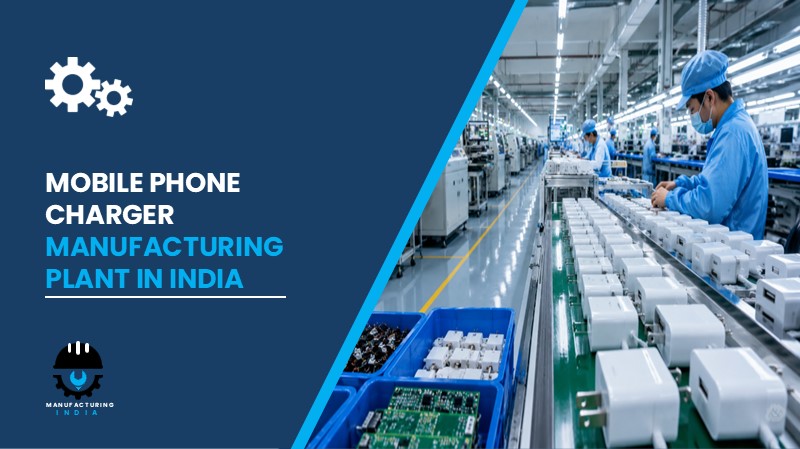
The mobile phone charger manufacturing process uses PCB assembly, component mounting, and soldering as the primary production method, integrated with a multi-stage quality and safety framework. Each stage of the mobile phone charger manufacturing process is designed to ensure electrical safety, performance consistency, and regulatory compliance before units reach end-use markets.
- PCB Assembly: Printed circuit boards are prepared and populated with electronic components including resistors, integrated circuits, and capacitors using SMT assembly lines.
- Component Mounting and Soldering: Components are precisely mounted and soldered onto the PCB using automated soldering machines to ensure reliable electrical connections.
- Transformer Integration: Transformers are integrated into the circuit assembly to enable the conversion of AC power to regulated DC output.
- Casing Moulding: Plastic casings are produced through injection moulding machines, forming the protective outer shell of the charger in the required form factor.
- Circuit Testing: Each assembled unit undergoes circuit testing on testing benches to verify electrical performance and output accuracy.
- Insulation and Safety Checks: Insulation testers are used to verify that all internal components are properly insulated, ensuring the product meets electrical safety standards.
- Final Assembly: The tested PCB assembly is secured within the moulded casing, and connectors and USB cables are attached to complete the unit.
- Performance Testing: Assembled chargers undergo comprehensive performance testing to validate fast-charging capability, overvoltage protection, and temperature regulation functions.
- Quality Inspection: A final quality inspection confirms that all units meet product concentration, purity, and stability standards before dispatch.
- Packaging and Dispatch: Finished units are packaged using dedicated packaging systems and dispatched to the consumer electronics industry, retail and e-commerce platforms, automotive accessories markets, and institutional electronics supply channels.
Key Applications
Chargers manufactured at this facility serve a diverse range of industries and end-use scenarios:
- Household Use: Widely used for charging smartphones and personal electronic devices in homes across urban and semi-urban India.
- Retail and E-commerce: Branded and private-label chargers are sold through online platforms and physical retail stores, ensuring broad consumer access and strong distribution reach.
- Automotive Accessories: Chargers are commonly integrated into vehicles for travel and on-the-go charging applications, representing a growing segment of the automotive accessories market.
- Institutional Supply: Chargers are supplied in bulk to offices, educational institutions, service centres, and commercial establishments for operational use.
Leading Manufacturers
The global charger industry is served by several multinational companies with extensive production capacities and diverse application portfolios. Key players in the market include:
- Alpha Group
- Fantasia Trading LLC (Anker Innovations)
- Apple Inc.
- AUKEY Official
- Baseus.com
- Belkin
- ELECOM CO., LTD.
- Hama GmbH & Co KG
Timeline to Start the Plant
Investors should plan for the following eight phases to bring the manufacturing plant from concept to commercial production:
- Feasibility study and project report preparation
- Land acquisition and site development
- Regulatory approvals and environmental clearances
- Factory licence and fire safety compliance
- Machinery procurement and installation
- Raw material supplier agreements and supply chain setup
- Trial production and quality testing
- Commercial production launch
Licences and Regulatory Requirements
Starting a mobile phone charger manufacturing unit in India requires several approvals:
- Business registration (Proprietorship, LLP, or Pvt Ltd)
- Factory Licence under the Factories Act
- Environmental Clearance from the State Pollution Control Board
- GST Registration
- Fire Safety NOC
- Hazardous/Chemical compliance (applicable for solvents and flux materials used in soldering processes)
- Effluent Treatment Plant (ETP) operational clearance
- Occupational Health and Safety compliance
Key Challenges to Consider
High Capital Requirements. Establishing an electronics manufacturing facility requires substantial upfront investment in SMT assembly lines, injection moulding machines, testing benches, and civil infrastructure, which can be a barrier for smaller investors.
Raw Material Price Volatility. The cost of key inputs — particularly PCBs, capacitors, transformers, USB cables, and plastic casings — is subject to global supply chain fluctuations and currency movements, which can significantly impact operating margins if not hedged through long-term procurement contracts.
Regulatory Compliance. Obtaining environmental clearances, ETP operational approvals, and electrical safety certifications requires dedicated compliance management, and any delay in approvals can push back the commercial production launch timeline.
Technology and Innovation Pressure. The rapid adoption of USB-C standards, wireless charging technologies, and power delivery protocols means that product designs must be updated regularly to remain competitive in the market.
Competition. The production space is served by established global players including Anker Innovations, Apple Inc., Belkin, Baseus.com, AUKEY Official, ELECOM CO., LTD., Hama GmbH & Co KG, and Alpha Group, requiring domestic manufacturers to compete on quality, price, and delivery efficiency.
Skilled Manpower. Operating SMT assembly lines and precision testing equipment requires trained electronics technicians and quality assurance personnel, necessitating ongoing investment in workforce training and retention.
Frequently Asked Questions
1. How much does it cost to set up a mobile phone charger manufacturing plant in India?
The total setup cost depends on plant capacity, level of automation, machinery selection, and location. The proposed capacity range of 10–30 million units per year provides a framework for cost modelling, and a detailed feasibility report covering CapEx, OpEx, and financial projections is recommended before committing capital.
2. Is mobile phone charger manufacturing profitable in India in 2026?
Yes. The production facility demonstrates gross profit margins of 25–35% and net profit margins of 10–15% under normal operating conditions, supported by stable consumer demand, replacement cycles, and institutional procurement volumes.
3. What machinery is required for a mobile phone charger plant in India?
Key equipment includes SMT assembly lines, soldering machines, testing benches, injection moulding machines for casings, insulation testers, and packaging systems.
4. What licences and approvals are required to start a mobile phone charger plant in India?
Required approvals include business registration, Factory Licence, Environmental Clearance, GST Registration, Fire Safety NOC, ETP operational clearance, and Occupational Health and Safety compliance.
5. What raw materials are needed for mobile phone charger manufacturing?
Core raw materials include PCBs, capacitors, transformers, USB cables, plastic casings, and packaging materials.
6. What are the environmental compliance requirements for a mobile phone charger plant in India?
Manufacturers must obtain Environmental Clearance from the State Pollution Control Board, operate a compliant Effluent Treatment Plant, and maintain Occupational Health and Safety standards throughout production.
7. What is the best location to set up a mobile phone charger plant in India?
States such as Gujarat, Maharashtra, and Uttar Pradesh offer established electronics manufacturing ecosystems, reliable logistics infrastructure, and access to skilled labour. SEZs and dedicated electronics industrial clusters provide additional fiscal incentives.
8. What is the break-even period for this type of plant in India?
The break-even period depends on plant capacity, pricing, and operating cost management. A detailed financial analysis including payback period, NPV, and IRR is provided in the full project report.
9. What government incentives are available for manufacturers in India?
The Make in India initiative, Production Linked Incentive (PLI) schemes for electronics, SEZ benefits, and state-level industrial promotion schemes offer a range of fiscal and operational incentives for electronics manufacturers.
Key Takeaways for Investors
A mobile phone charger manufacturing plant in India offers a strategically sound investment opportunity, underpinned by sustained demand from the consumer electronics industry, retail and e-commerce platforms, the automotive accessories market, and institutional electronics supply channels. The production facility delivers financial viability across a capacity range of 10–30 million units per year, with gross margins of 25–35% and net margins of 10–15% providing a strong return profile for investors at multiple scales. The global mobile phone charger market was valued at USD 40,824.17 million in 2025 and is projected to reach USD 71,349.69 million by 2034 at a CAGR of 6.4% from 2026 to 2034, confirming that this is a high-growth segment with a long demand runway. As smartphone penetration deepens, charging standards evolve, and replacement cycles accelerate, domestic production in India is well-positioned to capture an increasing share of both local consumption and export-oriented supply.
About the Author