PET Flakes Manufacturing Plant
Setting up a PET flakes manufacturing plant in India presents a compelling investment case, driven by the increasing global focus on plastic recycling, stringent regulations on plastic waste management, and the rising adoption of circular economy practices. PET flakes are recycled plastic materials derived from post-consumer or post-industrial polyethylene terephthalate products such as beverage bottles, food containers, and packaging waste. The growing demand for recycled polyethylene terephthalate (rPET) in packaging, textiles, and automotive applications across India makes this an opportune moment for investors to enter the market. As APAC holds the largest share accounting for over 35% of the global market India is well-positioned to benefit from this regional dominance.
India’s rapid urbanisation, expanding infrastructure projects, and the government’s Make in India initiative create a favourable environment for setting up a PET flakes manufacturing plant in India. Key manufacturing states such as Gujarat, Maharashtra, and Tamil Nadu offer robust industrial infrastructure, proximity to raw material sources, and access to major consumption hubs. The country’s growing emphasis on plastic waste management and recycling aligns perfectly with the circular economy model, making India a strategically sound location for PET flakes production.
With strong policy support for recycling programs, cost-competitive manufacturing advantages, rising demand from packaging and textile sectors, healthy gross margins of 25–35%, and break-even viability through value-added applications, establishing a PET flakes plant in India offers a sustainable and profitable investment opportunity.
What are PET Flakes?
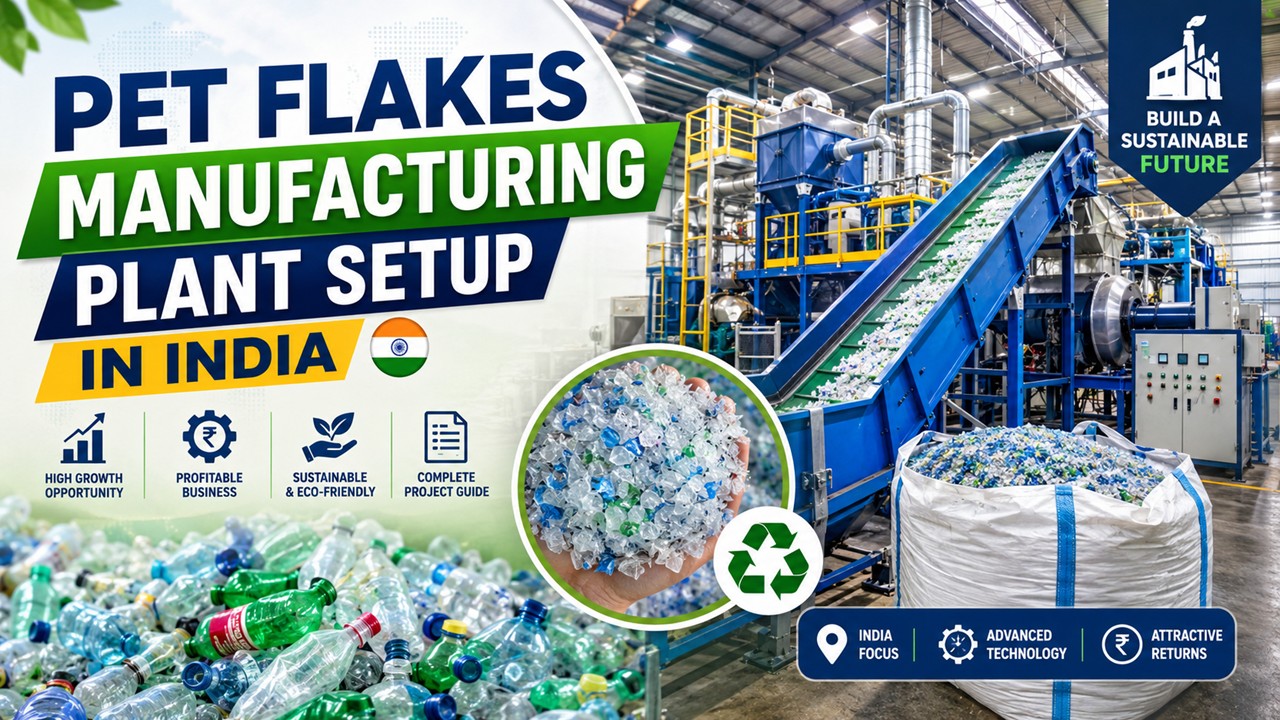
PET flakes are recycled plastic materials derived from post-consumer or post-industrial polyethylene terephthalate products such as beverage bottles, food containers, and packaging waste. They serve as a sustainable alternative to virgin plastics, providing excellent durability, lightweight properties, and recyclability. PET flakes come in different grades, including clear, green, and mixed colour flakes, enabling various industrial applications while decreasing environmental harm and enhancing resource efficiency.
The production process of PET flakes involves sorting, washing, shredding, and drying to create clean plastic fragments that have a uniform size and can be reused. The material serves as a primary input to create polyester fibres, sheets, films, strapping, and food-grade packaging, which requires further processing. Plastic manufacturing ecosystems benefit significantly from this material, which enables resource efficiency by transforming plastic waste into essential materials for industrial production.
The end-use industries served by PET flakes include the packaging industry, textile and fibre industry, automotive sector, construction materials, and consumer goods manufacturing. Key applications include the production of polyester fibres, PET sheets and films, strapping materials, thermoformed products, and recycled packaging solutions.
Cost of Setting Up a PET Flakes Manufacturing Plant in India
The cost of setting up a PET flakes manufacturing plant in India depends on several factors, including production capacity, technology selection, location, automation level, and regulatory compliance requirements. A thorough understanding of both capital expenditure (CapEx) and operational expenditure (OpEx) is essential for accurate financial planning.
1. Capital Expenditure (CapEx)
Capital expenditure for a PET flakes manufacturing plant covers land acquisition, site development, civil works, machinery procurement, and other pre-operative expenses. Land and site development costs include charges for land registration, boundary development, and related expenses, forming a substantial part of the overall investment. Setting up the facility in a Special Economic Zone (SEZ) or industrial estate can provide additional infrastructure benefits and tax advantages. Civil works and construction include the main production shed, quality control laboratory, raw material storage area, finished goods godown, and administrative block.
Key machinery required includes:
- Sorting conveyors
- Shredders
- Washing lines
- Friction washers
- Hot washing systems
- Dryers
- Packaging units
Machinery costs account for the largest portion of total capital expenditure, with the scale of production and automation level determining the total cost of equipment. Other capital costs include effluent treatment plant (ETP) installation, pre-operative expenses, commissioning charges, and import duties if machinery is sourced from overseas suppliers.
Request a Sample Report for In-Depth Market Insights: https://www.imarcgroup.com/pet-flakes-manufacturing-plant-project-report/requestsample
2. Operational Expenditure (OpEx)
Operational expenditure for a PET flakes manufacturing unit is primarily driven by raw material consumption, particularly post-consumer PET bottles, which accounts for approximately 60–70% of total operating expenses. The key raw materials required for PET flakes manufacturing include post-consumer PET bottles, water, and washing chemicals such as caustic soda. Establishing long-term contracts with reliable suppliers helps mitigate price volatility and ensures a consistent supply of materials.
Utility costs, including electricity, water, and steam, represent approximately 15–20% of OpEx. Other operating costs include transportation, packaging, salaries and wages, depreciation, taxes, and repairs and maintenance. In the first year of operations, operating costs are projected to be significant, covering all these components. By the fifth year, total operational costs are expected to increase substantially due to inflation, market fluctuations, potential rises in the cost of key materials, supply chain disruptions, rising consumer demand, and shifts in the global economy.
3. Plant Capacity
The proposed manufacturing facility is designed with an annual production capacity ranging between 10,000–30,000 tons, enabling economies of scale while maintaining operational flexibility. Plant capacity can be customised per investor requirements based on available capital, target market demand, and growth projections. Profitability improves with higher capacity utilisation, as fixed costs get distributed over a larger output volume.
4. Profit Margins and Financial Projections
The project demonstrates healthy profitability potential under normal operating conditions. Gross profit margins typically range between 25–35%, supported by stable demand and value-added applications, while net profit margins range between 12–18%. Comprehensive financial analysis includes liquidity analysis, profitability analysis, payback period, net present value (NPV), internal rate of return (IRR), profit and loss account, uncertainty analysis, sensitivity analysis, and economic analysis. The financial projections are developed based on realistic assumptions related to capital investment, operating costs, production capacity utilisation, pricing trends, and demand outlook.
Why Set Up a PET Flakes Plant in India
Rising Demand for Recycled Plastics: The environmental regulations and sustainability targets of organisations lead to increased usage of recycled PET by multiple industries across India. The implementation of stringent recycling requirements and extended producer responsibility (EPR) systems by governments and regulatory bodies is driving companies to use recycled PET materials more frequently.
Circular Economy Integration: PET recycling helps businesses achieve resource efficiency because it transforms plastic waste into essential materials for industrial production. India’s commitment to circular economy principles creates a supportive ecosystem for PET flakes manufacturing.
Expanding End-use Applications: The textile, packaging, and automotive industries require more products, which results in higher market demand for PET flakes. The packaging sector continues to lead in rPET consumption because food and beverage companies use it more to achieve their environmental sustainability goals. The textile industry is now experiencing a major transition towards using recycled polyester fibres, which increases the demand for PET flakes.
Policy and Regulatory Tailwinds: The government supports recycling programs through policy development because these programs help reduce plastic waste and promote recycling. For instance, a 2025 estimate by UNEP indicates that 19–23 million tonnes of plastic waste enter aquatic ecosystems each year, equivalent to nearly 2,000 garbage trucks dumped daily. This escalating crisis is prompting stricter regulations, significantly accelerating demand for recycled materials such as PET flakes across global recycling and packaging industries.
Cost-Competitive Manufacturing: India offers competitive advantages in land acquisition costs, labour availability, and supply chain infrastructure. The location must offer easy access to key raw materials such as post-consumer PET bottles, water, and washing chemicals. Proximity to target markets helps minimise distribution costs, and the site must have robust infrastructure including reliable transportation, utilities, and waste management systems.
Active Industry Investment: Recent industry developments demonstrate strong momentum in the recycling sector. In January 2025, Race Eco Chain Ltd and Ganesha Ecosphere Limited entered a joint venture, forming Ganesha Recycling Chain Private Limited to strengthen India’s recycling ecosystem. The initiative targets nationwide washing lines to convert PET bottles into high-quality PET flakes. The venture supports ESG and EPR compliance, addresses rising rPET demand, and advances circular economy goals.
Manufacturing Process
The PET flakes manufacturing process uses collection and sorting, washing and decontamination, shredding and grinding, drying, and packaging as the primary production method. Below are the main stages involved in the PET flakes manufacturing process flow:
- Collection and sorting: Post-consumer PET bottles and packaging waste are collected and sorted by colour and quality to ensure consistent input material for processing.
- Washing and decontamination: The sorted PET material undergoes thorough washing and decontamination to remove labels, adhesives, and contaminants using washing chemicals such as caustic soda.
- Shredding and grinding: The cleaned PET material is shredded and ground into smaller fragments using shredders, preparing it for further processing into uniform flakes.
- Drying: The shredded PET flakes are dried to remove moisture content, ensuring the final product meets quality standards for various applications.
- Packaging: The final PET flakes are packaged into appropriate containers or bags for dispatch to end-use industries including packaging, textiles, automotive, and construction materials.
Key Applications
PET flakes serve a diverse range of industries, with applications spanning multiple sectors:
- Packaging Industry: The packaging industry uses PET flakes for creating recycled bottles and sheets and food-grade packaging materials, which achieve both sustainable results and recycling compliance.
- Textile and Fiber Industry: The textile and fibre industry uses PET flakes to produce polyester fibres, which serve as affordable and environmentally friendly materials for textile manufacturing.
- Automotive Sector: The automotive sector uses recycled PET materials to create components for vehicle interiors and to produce insulation and lightweight structural elements.
- Construction Materials: PET flakes are used in the creation of plastic-based panels, insulation materials, and reinforcement products.
- Consumer Goods Manufacturing: PET flakes serve as raw material for manufacturing various consumer goods, including strapping materials, PET sheets and films, and thermoformed products.
Leading Manufacturers
Leading manufacturers in the global PET flakes industry include several multinational companies with extensive production capacities and diverse application portfolios. Key players in the market include:
- RETAL
- Plastipak
- Hon Chuan Group
- Resilux NV
- Alpla
These manufacturers serve end-use sectors such as packaging, textiles, automotive, and construction materials.
Timeline to Start the Plant
Setting up a PET flakes manufacturing plant in India typically follows these phases:
- Feasibility study and project report preparation
- Land acquisition and site development
- Regulatory approvals and environmental clearances
- Factory licence and fire safety compliance
- Machinery procurement and installation
- Raw material supplier agreements and supply chain setup
- Trial production and quality testing
- Commercial production launch
Licences and Regulatory Requirements
Starting a PET flakes manufacturing unit in India requires several approvals:
- Business registration (Proprietorship, LLP, or Pvt Ltd)
- Factory Licence under the Factories Act
- Environmental Clearance from State Pollution Control Board
- GST Registration
- Fire Safety NOC
- Effluent treatment systems are necessary to minimise environmental impact and ensure compliance with emission standards
- Occupational Health and Safety compliance
Key Challenges to Consider
High Capital Requirements: Machinery costs account for the largest portion of total capital expenditure, and the total capital investment depends on plant capacity, technology, and location. This investment covers land acquisition, site preparation, and necessary infrastructure.
Raw Material Price Volatility: Raw materials including post-consumer PET bottles, water, and washing chemicals (caustic soda) are a major part of operating costs. Price fluctuations in these inputs can impact profitability.
Regulatory Compliance: Safety protocols must be implemented throughout the manufacturing process, with advanced monitoring systems installed to detect leaks or deviations. Compliance with local zoning laws and environmental regulations must also be ensured.
Competition: The market features established players including RETAL, Plastipak, Hon Chuan Group, Resilux NV, and Alpla, all serving similar end-use sectors. New entrants must differentiate themselves through quality, cost efficiency, or niche applications.
Skilled Manpower: Operating sophisticated machinery such as sorting conveyors, shredders, washing lines, friction washers, hot washing systems, dryers, and packaging units requires trained personnel. Ongoing expenses for labour, maintenance, quality control, and environmental compliance must be accounted for.
Frequently Asked Questions
1. How much does it cost to set up a PET flakes manufacturing plant in India?
The total capital investment depends on plant capacity, technology, and location, covering land acquisition, site preparation, and necessary infrastructure. Equipment costs for sorting conveyors, shredders, washing lines, friction washers, hot washing systems, dryers, and packaging units represent a significant portion of capital expenditure.
2. Is PET flakes manufacturing profitable in India in 2026?
Yes, the project demonstrates healthy profitability potential under normal operating conditions. Gross profit margins typically range between 25–35%, supported by stable demand and value-added applications, with net profit margins ranging between 12–18%.
3. What machinery is required for a PET flakes plant in India?
Key machinery required includes sorting conveyors, shredders, washing lines, friction washers, hot washing systems, dryers, and packaging units.
4. What licences and approvals are required to start a PET flakes plant in India?
Required approvals include Business registration, Factory Licence under the Factories Act, Environmental Clearance from State Pollution Control Board, GST Registration, Fire Safety NOC, effluent treatment system operational clearance, and Occupational Health and Safety compliance.
5. What raw materials are needed for PET flakes manufacturing?
Raw materials required include post-consumer PET bottles, water, and washing chemicals such as caustic soda.
6. What are the environmental compliance requirements for a PET flakes plant in India?
Effluent treatment systems are necessary to minimise environmental impact and ensure compliance with emission standards. Safety protocols must be implemented throughout the manufacturing process, with advanced monitoring systems installed to detect leaks or deviations.
7. What is the best location to set up a PET flakes plant in India?
The location must offer easy access to key raw materials such as post-consumer PET bottles, water, and washing chemicals. Proximity to target markets helps minimise distribution costs, and the site must have robust infrastructure including reliable transportation, utilities, and waste management systems.
8. What is the break-even period for this type of plant in India?
Financial analysis includes payback period calculations as part of the comprehensive profitability analysis, along with liquidity analysis, net present value, internal rate of return, profit and loss account, and uncertainty analysis.
9. What government incentives are available for manufacturers in India?
The government supports recycling programs through policy development because these programs help reduce plastic waste and promote recycling. The escalating plastic waste crisis is prompting stricter regulations, significantly accelerating demand for recycled materials such as PET flakes.
Key Takeaways for Investors
The PET flakes manufacturing plant in India represents a compelling investment opportunity, driven by rising demand from the packaging, textile, automotive, and construction materials sectors. Financial viability is strong across plant capacities ranging from 10,000–30,000 tons annually, with gross profit margins of 25–35% and net margins of 12–18% under normal operating conditions. According to IMARC Group estimates, APAC holds the largest share, accounting for over 35% of the global market, positioning India favourably within this expanding regional demand. With increasing regulatory push for plastic waste reduction, growing corporate commitment to sustainability goals, and active industry investments strengthening India’s recycling ecosystem, the demand for PET flakes is poised for sustained long-term growth.
About the Author