export compliance advisory for manufacturers entering new markets
Introduction
India has become a preferred global manufacturing destination, supported by strong industrial growth, expanding export capabilities, and government initiatives including the Production Linked Incentive (PLI) schemes. According to DPIIT, India attracted over USD 83.57 billion in FDI inflows during FY 2021–22, while PLI schemes across 14 sectors have secured committed investments exceeding INR 1.97 lakh crore.
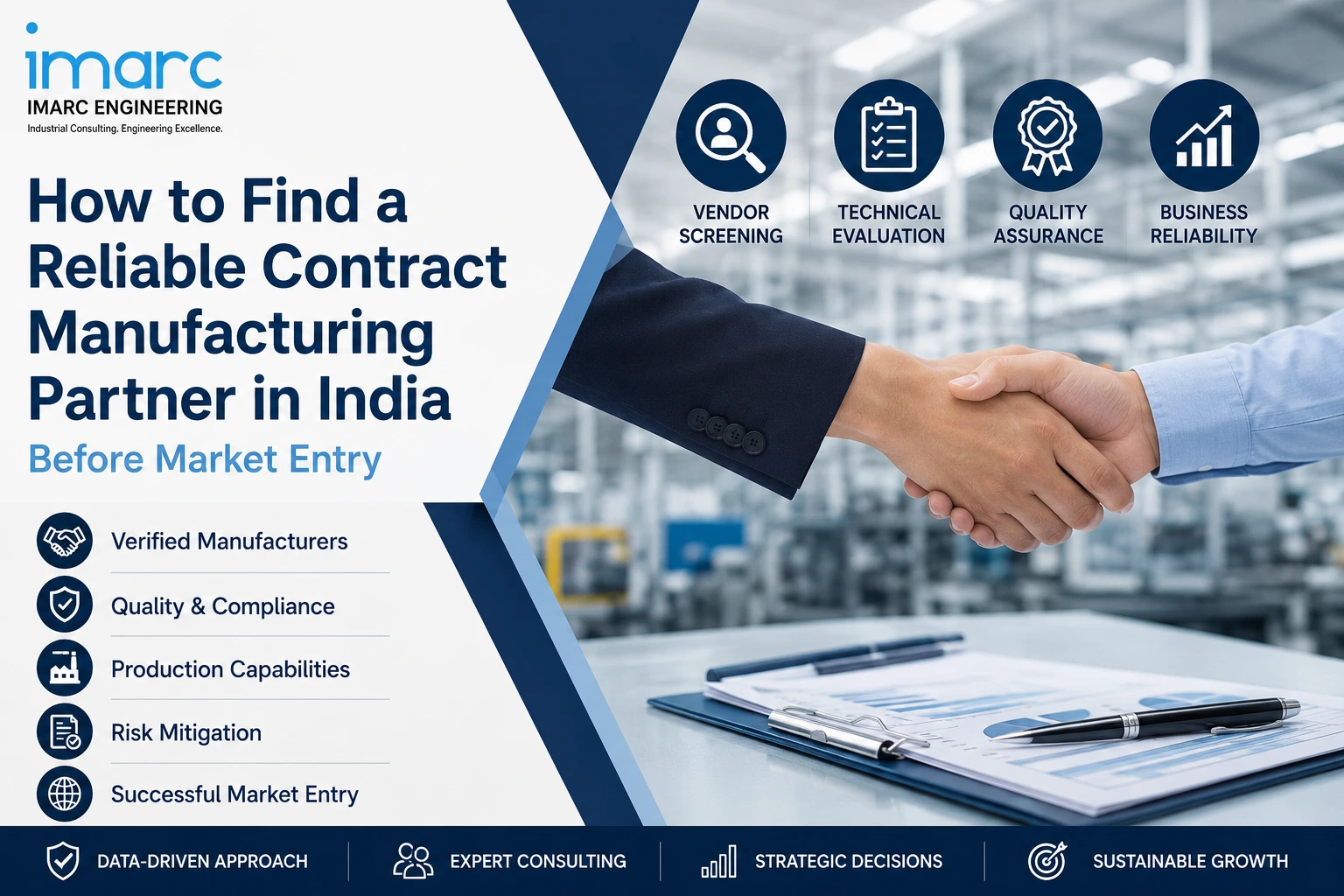
As global companies diversify supply chains and seek cost-effective production solutions, contract manufacturing in India has gained significant momentum across pharmaceuticals, electronics, chemicals, food processing, automotive components, and consumer goods. However, India’s large pool of manufacturers varies substantially in quality systems, regulatory compliance, production capacity, export experience, and operational capability.
For foreign companies, selecting the right export compliance advisory for manufacturers entering new markets is not a sourcing exerciseit is a critical due diligence process. A structured evaluation framework covering supplier qualification, factory audits, compliance verification, and capacity assessment reduces operational risks and establishes the foundation for reliable, long-term manufacturing partnerships.
1. Why Foreign Companies Choose Contract Manufacturing in India
India offers a combination of manufacturing scale, technical talent, industrial infrastructure, and export capability. The commercial case rests on four structural advantagesnot cost alone.
- Lower capital expenditure. Contract manufacturing eliminates factory asset costs. Foreign companies pay for output, not infrastructure.
- Skilled workforce. India produces approximately 1.5 million engineering graduates annually (AICTE). Industrial clusters in Maharashtra, Gujarat, Tamil Nadu, and Telangana carry experienced production and quality teams.
- Government support. PLI schemes provide direct production-linked incentives. The NSWS portal (DPIIT / Invest India) reduces industrial approval timelines. Over 70 MSME technology centres support manufacturer quality upgrades.
- Export infrastructure. DGFT has streamlined export documentation. Export Promotion CouncilsEEPC, Pharmexcil, AEPCmaintain verified directories of export-ready manufacturers with IEC registrations.
As a result, contract manufacturing has become a preferred strategy for India market entry, product localisation, and supply chain diversification.
India’s Manufacturing Presence Across Key Sectors
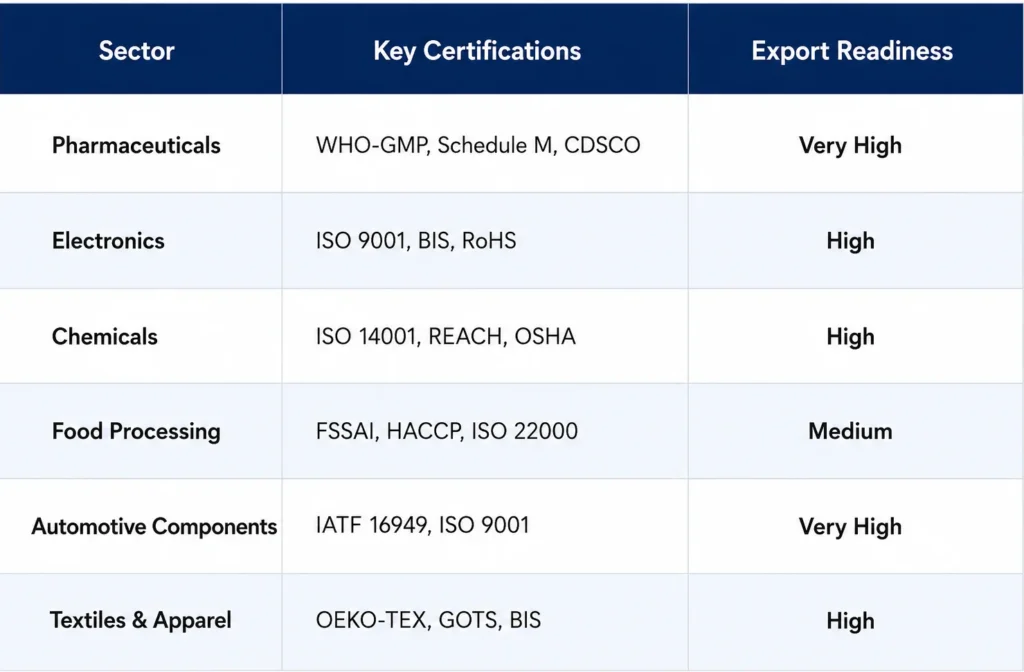
The following sectors represent the strongest contract manufacturing capability in India, with established cluster infrastructure, skilled labour, and regulatory systems aligned to export requirements.
2. Common Risks of Selecting the Wrong Manufacturing Partner
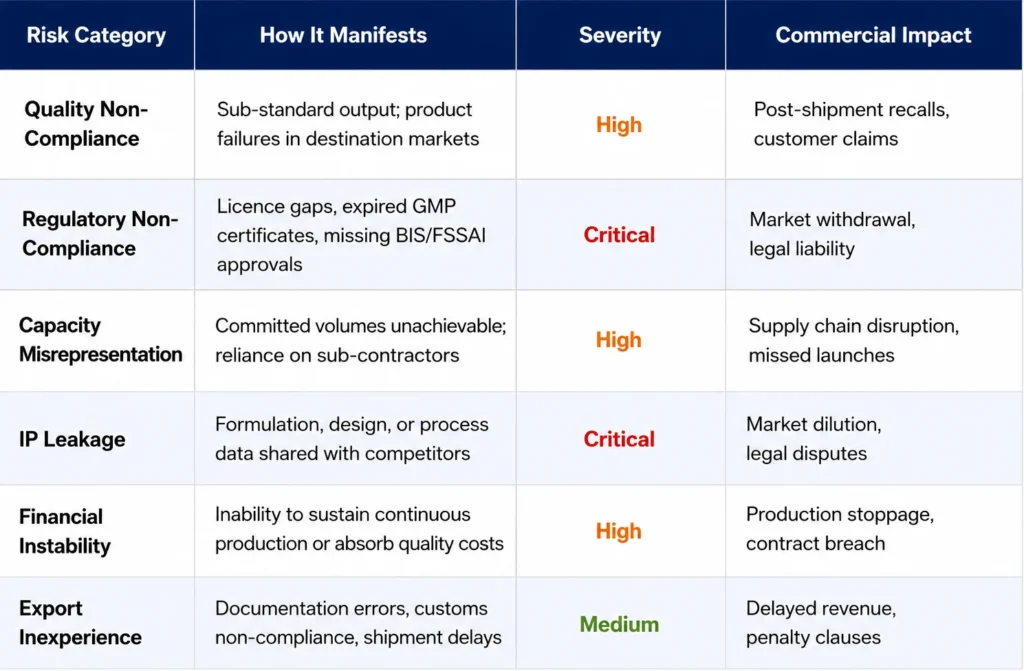
Risks compound after production commenceswhen remediation is most expensive. Understanding them before partner selection is the only reliable mitigation. Companies that skip structured evaluation typically encounter two or more of these risks simultaneously.
3. Define Manufacturing Requirements Before Beginning the Search
Requirements documentation is the baseline against which every manufacturer is evaluated. Without a defined requirements document, shortlisting criteria cannot be establishedand manufacturers approached without one consistently overpromise on capability and underdeliver in production.
- Product specifications. Material compositions, tolerances, finish standards, and performance parameters. Ambiguous specifications are the most common cause of quality disputes.
- Production volumes. Minimum order quantities, annual volumes, and production frequency. Required to verify whether a manufacturer has genuine available capacity.
- Certification requirements. Destination market compliance: CE / REACH for EU; FDA / UL / ASTM for US. Indian regulatory requirements: BIS, GMP, ISO 9001 as applicable.
- Export documentation. Certificate of origin, product testing documentation, and compliance declarations per DGFT and the importing country’s import regulations.
4. Building a Reliable Manufacturer Shortlist
Shortlisting requires verified sourcesnot marketing directories.
- Export Promotion Councils. EEPC India (engineering), Pharmexcil (pharmaceuticals), AEPC (apparel), CHEMEXCIL (chemicals). These directories include export track records and basic compliance indicators.
- Government portals. NSWS (DPIIT / Invest India) for licensed industrial units. MCA21 for registered company verification. State investment boardsInvest Tamil Nadu, Gujarat IDC, Invest UPfor state-registered units.
- Industrial clusters. Pharmaceuticals: Hyderabad, Ahmedabad, Baddi. Electronics: Chennai, Bengaluru, Noida. Textiles: Tiruppur, Surat, Ludhiana. Auto components: Pune, Chennai, NCR.
- Trade exhibitions. India International Trade Fair, Pharma India, Auto Expo, Electronica India. Useful for identifying manufacturers investing in international-standard quality and export presentation.
5. Key Criteria for Evaluating Contract Manufacturing Partners
Evaluation must cover seven distinct dimensions. No single dimension substitutes for the others.
Quality Management Systems
Verify ISO 9001, ISO 13485 (medical devices), IATF 16949 (automotive), or GMP certification through the issuing body’s online registry. Request internal audit records and corrective action logs from the previous two years. The absence of documented quality incidents may reflect an absence of documentationnot an absence of problems.
Regulatory Compliance
Confirm all mandatory licences: FSSAI for food products; CDSCO and Schedule M GMP for pharmaceuticals; BIS product licences for applicable categories. Verify environmental Consent to Operate from the State Pollution Control Board and confirm factory licence currency with the relevant State Factory Inspectorate.
Production Capacity
Request machine lists, shift schedules, and output records. Ask what percentage of current capacity is committed to existing clients. Overcapacity claims are the most common misrepresentation encountered in contract manufacturer selection in India.
Financial Stability
Request three years of audited financials. Review working capital, debt levels, and banking relationships. Cross-reference company filings and director information on the MCA21 portal. A financially weak manufacturer cannot sustain continuous production or absorb quality remediation costs.
Export Experience
Request foreign client references, export documentation samples, and the IEC certificate from DGFT. Manufacturers active with Export Promotion Councils and holding valid IEC registrations have demonstrated baseline export capability.
Supply Chain Depth
Map key raw material inputs and identify primary and secondary suppliers. Single-source dependencies represent production risk. Verify that alternative suppliers have been formally qualifiednot simply listed.
Technology Capability
Assess equipment condition, calibration records, and whether manufacturing execution systems or automated quality inspection are in use. For pharmaceuticals, electronics, or precision engineering, technology capability assessment is non-negotiable.
6. Factory Audit and Due Diligence
Factory audits are the most reliable verification mechanism available. Document review cannot substitute for on-site inspection.
- Facility inspection. Production areas, raw material storage, finished goods warehousing, utilities, and waste management. Discrepancies between represented and actual facilities are a disqualifying finding.
- Production capability. Walk the production process. Observe machine condition, calibration records, and operator competency. Verify process control documentation is present at production stations and actively followed.
- Quality systems. Inspect the quality laboratory. Review in-process and finished product inspection records. Verify non-conforming product management and the internal audit programme.
- Workforce. Review qualification records and training logs. High turnover is a risk indicator. Confirm Factories Act compliance for occupational health and safety obligations.
- EHS compliance. Inspect effluent treatment plant operation, hazardous waste disposal records, and fire safety systems. EHS non-compliance creates regulatory risk for both the manufacturer and the contracting foreign company.
7. Regulatory and Compliance Verification
Regulatory verification must be completed before any contract is signed. The framework is multi-layeredcentral, state, and sector-specific bodies each carry independent requirements.
- BIS. Mandatory for electronics, electrical appliances, cement, steel, and food contact materials under compulsory registration schemes. Verify current product licences for specific variants to be produced.
- FSSAI. Valid licence required for all food production, processing, or packaging. Confirm licence category covers the specific product and that the licensed facility address matches the production site.
- CDSCO. Drug manufacturing licence from State Licensing Authority, Schedule M GMP compliance, and WHO-GMP certification for export products. Medical Devices Rules, 2017 apply for device manufacturers.
- Factory Act. Valid factory licence from state authority required. Verify PF and ESI registrations through the respective government portals.
- Environmental approvals. Consent to Establish and Consent to Operate from the State Pollution Control Board. EIA clearance from MoEFCC for large projects. Verify no pending enforcement notices or closure orders.
- GST. Verify GSTIN registration and return filing status on the GST portal. Transacting with a GST-non-compliant supplier creates input tax credit issues for the contracting company.
8. Pilot Production and Sample Validation
Pilot production is the final qualification step. It cannot be replaced by sample submissions or bench-scale tests.
- Trial production. Run at commercial batch scale, on the same equipment and workforce that will handle production orders. In-process quality checks and output documentation must mirror commercial production procedures.
- Third-party testing. Test pilot output through a NABL-accredited laboratory. For export products, test against importing country standardsnot just Indian standards.
- Packaging validation. Verify labelling compliance, language requirements, material composition, and shipping durability against destination market regulations.
- Formal approval. Define acceptance criteria before the pilot begins. Sign off with quality, regulatory, and commercial teams. Deviations must be resolved and re-tested before commercial production commences.
Professional Manufacturer Evaluation vs. Basic Supplier Selection
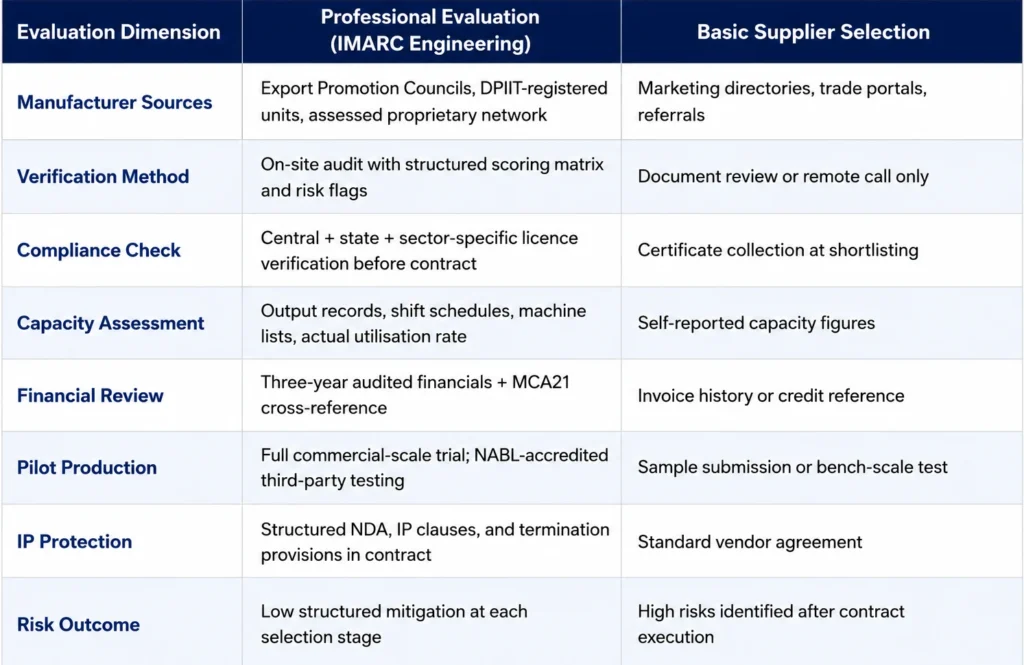
The table below summarises the difference in approach, rigour, and risk outcome between structured professional evaluation and the basic supplier selection processes that many sourcing teams default to.
9. How IMARC Engineering Supports Contract Manufacturer Identification
IMARC Engineering provides end-to-end support for foreign companies at every stage of contract manufacturer selection in Indiafrom initial identification through pilot production approval and contract execution.
- Supplier identification and shortlisting. Manufacturer database built from EEPC, Pharmexcil, DPIIT-registered units, and a proprietary assessed networkmatched against client-specific certification, volume, and export requirements.
- Factory audits and vendor qualification. On-site audits against standardised evaluation frameworks customised by product category. Audit reports include scoring matrices, risk flags, and qualification recommendations.
- Regulatory compliance reviews. Full verification of central and state-level licences, certifications, and documentation before contracts are signed.
- Commercial negotiation support. Pricing benchmarks, IP protection clauses, quality warranty terms, and termination provisions appropriate to Indian contract manufacturing agreements.
- Market entry advisory. Investment structuring, regulatory registration, liaison office or WOS setup, and transition planning from contract to captive manufacturing.
| Engage Our Expert Team :https://www.imarcengineering.com/contact?service=export-readiness-consulting |
Conclusion
India’s contract manufacturing sector offers genuine capability across pharmaceuticals, engineering, electronics, chemicals, food processing, and consumer goods. The challenge for foreign companies is not finding manufacturersit is identifying the ones that will actually perform.
A structured approach to contract manufacturer identificationverified requirements, systematic shortlisting, comprehensive evaluation, on-site audits, regulatory compliance verification, and pilot production validationis the primary risk mitigation tool available to international sourcing teams. Companies that invest in this process build supply chains that support sustained growth. Those that shortcut it inherit risks that are significantly more expensive to remediate than the cost of doing it correctly the first time.
IMARC Engineering provides the advisory, audit, and market entry support that international companies need to navigate Indian contract manufacturer selection with confidencefrom initial identification through to commercial production launch.
Contact Us:
IMARC Engineering
Phone: +91-120-433-0800
Email: sales@imarcengineering.com
India: C-130, Sector 2, Noida, Uttar Pradesh 201301
LinkedIn: https://www.linkedin.com/showcase/imarc-engineering/
About the Author