Plastic Cement Manufacturing Plant Setup in India
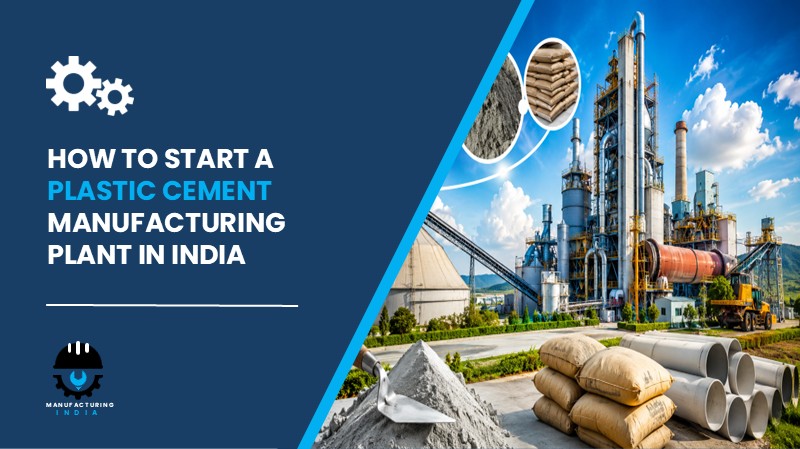
Setting up a plastic cement manufacturing plant in India presents a compelling investment case driven by surging demand from construction, waterproofing, road infrastructure, and industrial sectors. As India accelerates its urbanisation, the need for advanced, flexible, and water-resistant bonding materials has never been stronger. Plastic cement which incorporates polymers such as acrylic or latex into conventional cement is rapidly displacing traditional alternatives in grouting, tiling, plastering, and surface-bonding applications across both residential and commercial projects.
India’s strategic advantages make it an ideal location for this production. Abundant low-cost land in industrial estates across states such as Gujarat and Maharashtra, a cost-competitive labour force, and strong government backing through the Make in India initiative collectively lower the entry barrier for new manufacturers. Proximity to large-scale infrastructure projects and an expanding DIY segment further ensure consistent offtake for investors who establish production capacity at scale.
India’s policy environment, competitive manufacturing costs, and multi-sector demand create a strong foundation for this investment. With gross profit margins of 35–45% and net profit potential of 15–20%, the project demonstrates healthy viability across a range of capacities.
What is Plastic Cement?
Plastic cement is a specialised type of cement that incorporates polymers such as acrylic or latex to enhance adhesion, flexibility, and workability. The product is engineered to resist cracking, improve water resistance, and maintain superior bond strength across substrates and environmental conditions. The plastic cement manufacturing process involves material selection, a mixing process, polymer integration, grinding and packaging, and quality control, ensuring consistent polymer dispersion and product stability. End-use industries include construction (residential, commercial, and industrial), waterproofing applications, road construction, tile and flooring, masonry and plastering, and DIY and home improvement.
Cost of Setting Up a Plastic Cement Manufacturing Plant in India
The total cost of establishing a plastic cement manufacturing plant depends on capacity, technology selection, site location, automation level, and regulatory compliance requirements in India.
1. Capital Expenditure (CapEx)
Land and Site Development involves acquiring a site with proximity to PVC resin and solvent suppliers. Establishing the unit within an SEZ or state-designated industrial estate reduces land costs and provides infrastructure benefits.
Civil Works and Construction covers the manufacturing shed, quality control laboratory, raw material and finished goods storage, utilities block, effluent treatment area, and administrative offices.
Machinery and Equipment represents the largest share of capital expenditure for this type of production facility. Key machinery required includes:
- Mixing equipment
- Extrusion machines
- Curing ovens
- Molding machines
- Packaging machinery
Other Capital Costs include ETP construction, pre-operative expenses, commissioning costs, import duties on specialised equipment, and contingency provisions for cost overruns.
Request a Sample Report for In-Depth Market Insights: https://www.imarcgroup.com/plastic-cement-manufacturing-plant-project-report/requestsample
2. Operational Expenditure (OpEx)
Raw Material Cost is the dominant driver, accounting for approximately 70–80% of total OpEx. Core inputs are PVC resin, solvents (THF, cyclohexanone), additives, and cans/tubes for packaging. Long-term supply contracts with reliable suppliers are recommended to mitigate price volatility.
Utility Cost covering electricity, water, and steam accounts for approximately 5–10% of OpEx. Other operating costs include transportation, packaging, salaries, maintenance, depreciation, and taxes. By the fifth year, total operational costs are projected to increase substantially due to inflation, rising material costs, and supply chain disruptions.
3. Plant Capacity
The facility is designed with an annual production capacity of 5,000–10,000 MT, enabling economies of scale while maintaining operational flexibility. Capacity can be customised to match investor requirements, and profitability improves with higher utilisation as fixed costs are spread across greater output volume.
4. Profit Margins and Financial Projections
Gross profit margins range between 35–45% and net profit margins are projected at 15–20%. The full project report includes NPV, IRR, payback period, liquidity analysis, and sensitivity analysis to provide investors with a complete view of return on investment and long-term financial sustainability.
Why Set Up a Plastic Cement Plant in India?
Demand for Superior Adhesion and Flexibility. The growing need for durable, flexible building materials in India’s construction sector is a primary driver. Superior bond strength makes this material the preferred choice for grouting, tile adhesives, and masonry applications in new construction and renovation projects.
Focus on Waterproofing and Sustainability. Superior moisture resistance in basements, swimming pools, bathrooms, and industrial flooring is driving accelerating adoption of plastic cement across the country’s construction sector.
Innovation in Construction Materials. Polymer-based innovations are making the product eco-friendlier. The use of plastic waste as a partial replacement — 50% to 75% — for aggregate, which constitutes 85% of concrete’s weight, creates lighter concrete with improved thermal insulation while repurposing plastic waste.
Policy and Regulatory Tailwinds. The Make in India initiative and related government manufacturing schemes provide a supportive policy backdrop. Industrial estate infrastructure and capital subsidy programmes for manufacturing units improve the economics of plant establishment.
Cost-Competitive Manufacturing. India offers competitive land acquisition costs, lower civil construction expenses, and an experienced industrial labour pool that reduces operational staffing costs throughout the production lifecycle.
Active Industry Investment. In December 2025, Bengaluru Solid Waste Management Ltd (BSWML) dispatched 160 tons of RDF from low-value plastic waste to Dalmia Cement Ltd. In April 2025, the Cuttack Municipal Corporation introduced a programme transforming plastic waste into refuse-derived fuel for cement manufacturing validating the commercial integration of plastics into cement production in India.
Manufacturing Process Step by Step
The plastic cement manufacturing process uses material selection, mixing, polymer integration, grinding and packaging, and quality control as its primary production sequence.
- Material Selection: PVC resin, solvents (THF, cyclohexanone), additives, and cans/tubes are received, inspected, and approved before entering production.
- Mixing Process: Raw materials are fed into mixing equipment in controlled ratios to achieve a homogenous blend.
- Polymer Integration: Acrylic or latex polymer is introduced to enhance adhesion, flexibility, and moisture resistance, with parameters monitored to ensure uniform distribution.
- Extrusion: The compounded material passes through extrusion machines to achieve the required form factor.
- Curing: The extruded product is processed through curing ovens to achieve target strength and bond characteristics.
- Molding: Molding machines shape specific product variants where applicable.
- Quality Control: Analytical instruments monitor concentration, purity, particle size, and stability at multiple stages.
- Grinding and Packaging: Finished product is ground, packaged in cans or tubes, and dispatched to construction, waterproofing, road infrastructure, and industrial customers.
Key Applications
The facility serves a broad range of sectors driven by demand for superior bond strength and moisture resistance.
- Construction and Infrastructure: Grouting, plastering, and masonry in residential and commercial buildings.
- Waterproofing Applications: Sealing basements, swimming pools, and bathrooms where moisture resistance is critical.
- Road Construction and Infrastructure: Paving and road repair under extreme weather and heavy traffic loads.
- Industrial Construction: Flooring in warehouses, factories, and chemical plants requiring high-strength bonding.
- Tile and Flooring Applications: Adhesive for tile laying and flooring installation in residential and commercial settings.
- Masonry and Plastering: Surface bonding on walls and ceilings, improving finish quality and adhesion longevity.
- DIY and Home Improvement: Easy-to-apply bonding materials for repair and renovation.
Leading Manufacturers
The global plastic cement market is served by several multinational companies with extensive production capacities. Key players include:
- Ningbo Yinzhou Fuhui Plastic Cement
- Resisto
- Quikrete
- W. R. MEADOWS
- Cemex, S.A.B. de C.V.
- Humbrol
- Sealflex
- Pro-Grade (Henry Company)
- CalPortland
Timeline to Start the Plant
Establishing a plastic cement manufacturing unit in India typically follows eight sequential phases:
- Feasibility study and project report preparation
- Land acquisition and site development
- Regulatory approvals and environmental clearances
- Factory licence and fire safety compliance
- Machinery procurement and installation
- Raw material supplier agreements and supply chain setup
- Trial production and quality testing
- Commercial production launch
Licences and Regulatory Requirements
Starting a plastic cement manufacturing unit in India requires several approvals:
- Business registration (Proprietorship, LLP, or Pvt Ltd)
- Factory Licence under the Factories Act
- Environmental Clearance from State Pollution Control Board
- GST Registration
- Fire Safety NOC
- Hazardous/Chemical compliance (relevant given use of solvents including THF and cyclohexanone)
- Effluent Treatment Plant (ETP) operational clearance
- Occupational Health and Safety compliance
Key Challenges to Consider
High Capital Requirements. Significant upfront investment in land, civil works, and specialised machinery requires robust financial planning and access to debt or equity capital.
Raw Material Price Volatility. PVC resin, solvents (THF, cyclohexanone), and polymer additives are subject to global commodity price fluctuations. Long-term supply contracts help mitigate margin compression.
Regulatory Compliance. Operating with chemical solvents requires strict adherence to ETP standards, environmental clearance conditions, and occupational safety norms to avoid production stoppages.
Technology and Innovation Pressure. As eco-friendly formulations gain regulatory preference, manufacturers must invest in process upgrades and product development to remain competitive.
Competition. The market includes well-capitalised global players such as Cemex, Quikrete, W. R. MEADOWS, and CalPortland, alongside regional producers.
Skilled Manpower. Operating mixing, extrusion, and curing equipment requires technically trained personnel, making recruitment and retention an ongoing operational challenge.
Frequently Asked Questions
1. How much does it cost to set up a plastic cement manufacturing plant in India? Total setup cost varies by capacity, technology, location, and automation. Full CapEx details for this type of facility are available in the project report based on a 5,000–10,000 MT per year capacity model.
2. Is plastic cement manufacturing profitable in India in 2026? Yes with gross margins of 35–45% and net margins of 15–20%, supported by strong demand from construction, waterproofing, and infrastructure sectors.
3. What machinery is required for a plastic cement plant in India? Key machinery includes mixing equipment, extrusion machines, curing ovens, molding machines, and packaging machinery.
4. What licences and approvals are required to start a plastic cement plant in India? Business registration, Factory Licence, Environmental Clearance, GST registration, Fire Safety NOC, chemical compliance, ETP clearance, and Occupational Health and Safety compliance.
5. What raw materials are needed for plastic cement manufacturing? PVC resin, solvents (THF, cyclohexanone), additives, and cans/tubes. PVC resin accounts for approximately 70–80% of total operating costs.
6. What are the environmental compliance requirements for a plastic cement plant in India? Environmental Clearance from the State Pollution Control Board, operational ETP, chemical handling compliance, and occupational health and safety standards.
7. What is the best location to set up a plastic cement plant in India? Locations near PVC resin and solvent suppliers with strong construction demand, like Gujarat or Maharashtra, are strategically suitable due to established chemical and construction material supply chains.
8. What is the break-even period for this type of plant in India? Full payback period analysis, NPV, IRR, and sensitivity analysis are available in the detailed project report.
9. What government incentives are available for manufacturers in India? Make in India scheme incentives, state-level industrial policies, SEZ benefits, capital subsidy programmes, and GST input credit mechanisms with eligibility varying by state, plant size, and product category.
Key Takeaways for Investors
Investing in a plastic cement manufacturing facility in India represents a compelling opportunity for investors seeking exposure to the construction, waterproofing, road infrastructure, and industrial sectors all characterised by structural, long-term demand growth. This investment is financially viable across a range of capacities, with gross margins of 35–45% and net margins of 15–20% providing meaningful return potential. The global plastic cement market was valued at USD 21.00 billion in 2025 and is projected to reach USD 32.33 billion by 2034 at a CAGR of 4.9% from 2026 to 2034, signalling robust and sustained demand over the investment horizon. With active policy support, a cost-competitive environment, and innovation-driven product adoption, demand sustainability for a domestic Indian producer is well-founded over the long term.
About the Author