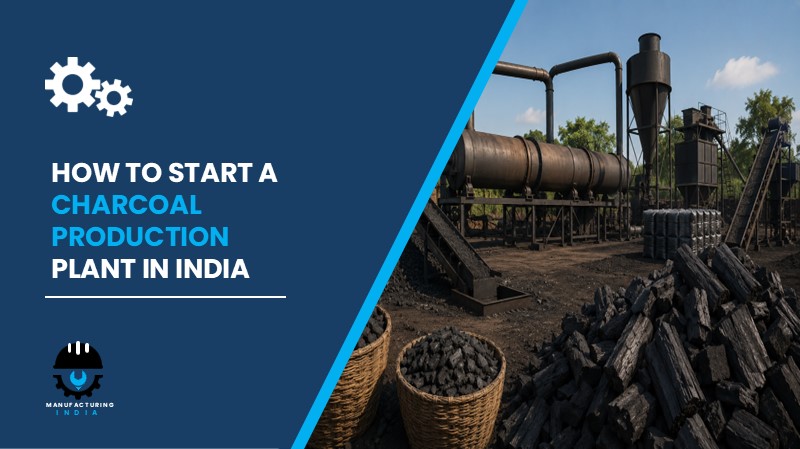
Setting up a charcoal production plant in India presents a compelling investment case driven by the country’s expanding metallurgical sector, rising demand for cooking and barbecue fuel, and growing applications in water and air purification infrastructure. Charcoal serves as an essential industrial input across steel processing, agriculture, food services, and pharmaceuticals, making it one of the few commodities with simultaneous rural and urban demand. As India positions itself as a global production powerhouse, the charcoal sector benefits directly from the steel industry’s growth, the food service industry’s expansion in tier-2 and tier-3 cities, and increasing investments in environmental management systems.
India offers a uniquely advantageous environment for charcoal production, thanks to its vast agricultural biomass base, competitive land and labour costs, and strong policy emphasis on renewable and biomass-based fuel utilisation. States like Gujarat, Maharashtra, Uttar Pradesh, and Madhya Pradesh offer industrial estates and Special Economic Zones with tax incentives, reliable logistics connectivity, and access to feedstock-rich hinterlands. The Make in India initiative further strengthens the case by providing policy support and infrastructure investment that reduces the friction of establishing a new production unit. India’s status as the world’s second-largest crude steel producer — with 151.14 million tonnes of output in FY25, a 4.7% increase over the previous year as reported by IBEF — ensures a deep and growing industrial customer base for charcoal producers.
Establishing a charcoal production plant in India is financially viable across a range of capacities, supported by Make in India policy momentum, biomass-rich supply chains, and sustained demand from the metallurgy, agriculture, and filtration sectors. With gross margins of 30–40% and a net profit potential of 15–20%, well-run charcoal production units can achieve break-even within a competitive timeframe while benefiting from cost-competitive operations and growing domestic offtake.
What is Charcoal?
Charcoal is a solid fuel with high carbon content, obtained from the thermal decomposition of biomass — primarily wood — in limited oxygen. This production method is known as carbonization, and the resulting material is characterised by low weight, high calorific value, significant porosity, low ash content, and high absorbability. These properties make charcoal distinct from raw firewood and more suitable for both industrial and domestic applications. Because it can be derived from renewable biomass sources, charcoal is also categorised as a transitional fuel with sustainability credentials.
Based on the type of carbonization process or the biomass type used, charcoal can be categorised into three principal variants: lump charcoal, briquettes charcoal, and the initial form of activated charcoal. The production process involves carbonization followed by crushing, screening, and briquetting where applicable. Charcoal serves end-use industries spanning metallurgy, agriculture, water purification, culinary, pharmaceuticals, and artisanal crafts — a diverse demand base that provides inherent revenue stability for producers.
Cost of Setting Up a Charcoal production Plant in India
The total cost of establishing a charcoal production plant in India depends on several variables including production capacity, technology chosen, plant location, level of automation, and local regulatory compliance requirements. Below is a structured breakdown of the major cost heads investors must account for.
1. Capital Expenditure (CapEx)
The capital investment for a charcoal production plant covers land and site development, civil construction, machinery procurement, and other pre-operative costs. Land and site development expenses — including land registration fees, boundary development, and site preparation — form a substantial portion of the total outlay. Locating the facility within a designated industrial estate or SEZ can reduce these costs while providing access to shared infrastructure.
Civil works include construction of the production shed, laboratory, finished goods storage, raw material warehouse, and administrative block. These must be designed to accommodate both the carbonization process and required emissions compliance systems.
Key machinery required includes:
- Wood chippers and splitters
- Carbonization kilns or retorts
- Briquette presses
- Carbon crushers and grinders
- Screening and grading systems
- Drying ovens
- Bagging or palletizing machines
Additional capital costs include effluent treatment plant (ETP) installation, pre-operative and commissioning expenses, and any import duties applicable to specialised equipment not manufactured domestically.
Request a Sample Report for In-Depth Market Insights: https://www.imarcgroup.com/charcoal-production-plant-project-report/requestsample
2. Operational Expenditure (OpEx)
Raw material cost is the single largest component of operating expenditure, accounting for approximately 40–50% of total OpEx. Key raw materials for charcoal production include wood, coconut shells, agricultural waste, sawdust, and bamboo — all of which must be dry and carbon-rich. Entering into long-term supplier contracts with biomass aggregators close to the plant site is the recommended strategy to stabilise pricing and ensure supply continuity. Utility costs — covering electricity, water, and steam requirements for the carbonization and drying processes — account for 20–25% of OpEx.
Other operating costs include transportation, packaging, salaries and wages, equipment maintenance, depreciation, and taxes. By the fifth year of operations, total operational costs are projected to increase substantially due to inflation, market fluctuations, potential rises in the cost of key biomass inputs, supply chain disruptions, and shifts in global energy costs. Prudent investors should build a 5-year cost escalation model into their financial projections from the outset.
3. Plant Capacity
The proposed production facility is designed with an annual capacity ranging between 10,000 and 20,000 metric tonnes (MT), a scale that enables economies of operation while maintaining flexibility. This capacity range can be customised based on investor requirements, target markets, and available feedstock. Profitability improves meaningfully with higher capacity utilisation, making efficient plant management and stable raw material supply central to financial performance.
4. Profit Margins and Financial Projections
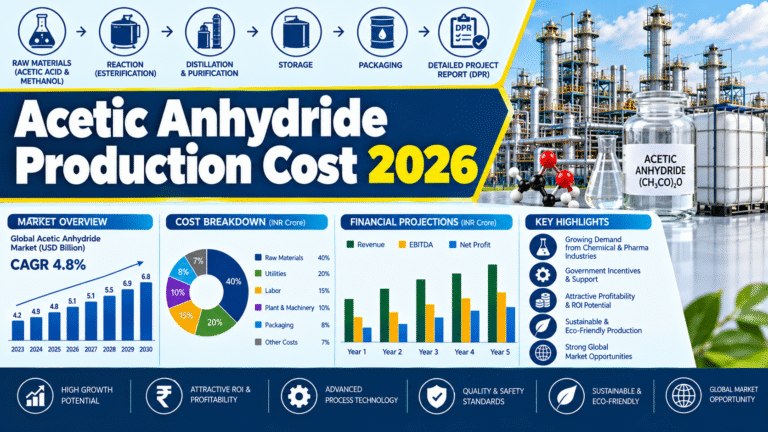
A charcoal production plant demonstrates healthy profitability under normal operating conditions. Gross profit margins typically range between 30–40%, supported by stable industrial demand and value-added applications such as activated carbon production. Net profit margins range between 15–20%, making this a financially sound investment at the right capacity. Full financial projections — including Net Present Value (NPV), Internal Rate of Return (IRR), payback period analysis, and sensitivity analysis — are covered in the detailed project report. Break-even timelines typically range from 3 to 5 years depending on production scale, local demand conditions, and pricing strategy.
Why Set Up a Charcoal Plant in India?
Metallurgical Sector Demand. India is the world’s second-largest crude steel producer, having output 151.14 million tonnes in FY25 — a 4.7% year-on-year increase — according to IBEF. Charcoal is a preferred reductant and heat source in iron and steel processing, particularly in operations requiring low-impurity carbon inputs, making the domestic steel industry a powerful and growing demand anchor for charcoal producers.
Rising Food Service and Cooking Fuel Consumption. Rapid urbanisation and the expansion of the food service industry across Indian cities are supporting increased consumption of barbecue and cooking charcoal. As more restaurants, dhabas, and food chains adopt charcoal grilling, domestic demand for culinary-grade charcoal is expected to strengthen across both urban and semi-urban markets.
Filtration and Environmental Management Infrastructure. Expanding investments in water and air purification infrastructure across India are boosting demand for charcoal as a feedstock for activated carbon production. Charcoal’s high absorbability makes it central to filtration systems deployed by municipalities, industrial facilities, and healthcare providers — a growing spend category in India’s environment sector.
Agricultural Biochar Adoption. Agricultural adoption of biochar — the use of charcoal for soil amendment and carbon enrichment — is emerging as a new and commercially significant demand segment. As Indian farmers increasingly seek sustainable crop yield enhancement methods, biochar presents charcoal manufacturers with a value-added product line that commands premium pricing.
Policy and Regulatory Tailwinds. Government emphasis on renewable biomass utilisation, waste-to-energy initiatives, and forest management indirectly supports organised charcoal production, especially efficient and low-emission operations. The Make in India programme provides manufacturers with access to capital subsidies, reduced utility tariffs, export incentives, and interest subsidies that can meaningfully reduce the effective cost of establishing this type of plant.
Active Industry Investment. In October 2024, CarbonCure Technologies announced that the company had saved more than 500,000 metric tons of CO₂ across 7.5 million truckloads of CarbonCure concrete, highlighting the growing global momentum behind carbon-utilisation technologies that intersect with charcoal-derived inputs.
Production Process – Step by Step
The charcoal production process uses carbonization as the primary production method, converting biomass feedstock into high-carbon solid fuel through controlled thermal decomposition in limited oxygen. The full production sequence involves the following stages:
- Raw Material Collection: Wood, coconut shells, sawdust, bamboo, or agricultural waste is sourced and inventoried at the plant.
- Drying and Size Reduction: Feedstock is dried to reduce moisture content and then processed through wood chippers and splitters to achieve uniform particle size suitable for carbonization.
- Carbonization: Prepared biomass is loaded into carbonization kilns or retorts, where thermal decomposition occurs under limited oxygen conditions, producing raw charcoal with high fixed carbon content.
- Cooling: Carbonized material is allowed to cool safely before handling to prevent spontaneous combustion and ensure operator safety.
- Crushing and Screening: Carbon crushers and grinders reduce the material to the required particle size, followed by screening and grading systems to separate product by specification.
- Briquetting (Optional): Where briquette charcoal is the target product, briquette presses compact the crushed charcoal into uniform shapes for packaging and sale.
- Quality Testing: Analytical monitoring is conducted to verify fixed carbon content, ash levels, moisture, and purity against product specifications and customer requirements.
- Packaging and Dispatch: Finished charcoal is bagged or palletized using bagging or palletizing machines and dispatched to end-use sectors including metallurgy, agriculture, water purification, culinary, pharmaceuticals, and artisanal crafts.
Key Applications
Charcoal manufactured in India serves a wide range of industries spanning energy, industrial processing, environmental management, and consumer markets:
- Metallurgy: Used as a reductant and heat source in iron and steel processing, particularly in operations requiring low-sulfur, low-impurity carbon inputs.
- Energy Production: Serves as a fuel for cooking, heating, and small-scale power generation in both rural and urban settings.
- Agriculture: Applied in the form of biochar for soil amendment and carbon enrichment, improving crop yields and soil health.
- Environmental Management: Used in water filtration, air purification, and broader pollution control systems.
- Pharmaceuticals: Deployed as a medicinal adsorbent in various healthcare applications.
- Artisanal Crafts: Used as a drawing material and heat source in traditional craft and small industry applications.
Leading Producers
The global charcoal market features several multinational producers with extensive production capacities and diversified application portfolios. Key players in the global charcoal industry include:
- Duraflame
- Royal Oak Enterprises
- Namchar
- Carvão São Manoel
- Gryfskand
Timeline to Start the Plant
- Feasibility study and project report preparation
- Land acquisition and site development
- Regulatory approvals and environmental clearances
- Factory licence and fire safety compliance
- Machinery procurement and installation
- Raw material supplier agreements and supply chain setup
- Trial production and quality testing
- Commercial production launch
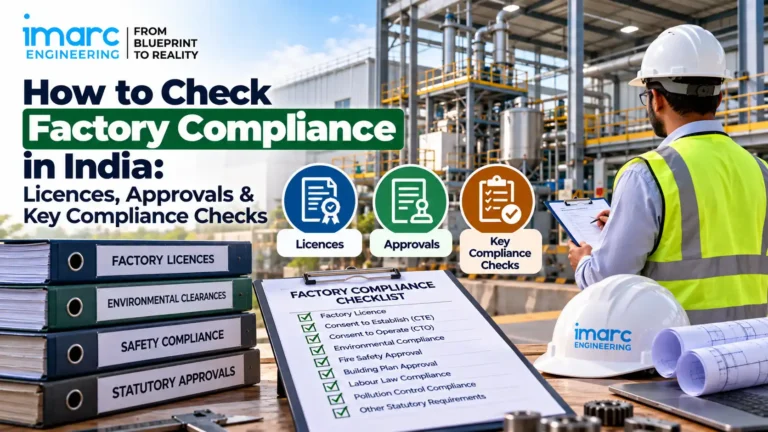
Licences and Regulatory Requirements
Starting a charcoal production unit in India requires several approvals:
- Business registration (Proprietorship, LLP, or Pvt Ltd)
- Factory Licence under the Factories Act
- Environmental Clearance from State Pollution Control Board
- GST Registration
- Fire Safety NOC
- Hazardous/Chemical compliance (applicable to carbonization gas and emission control processes)
- Effluent Treatment Plant (ETP) operational clearance
- Occupational Health and Safety compliance
Key Challenges to Consider
High Capital Requirements. Establishing a charcoal production plant with carbonization kilns, briquette presses, and emissions control infrastructure involves significant upfront investment in both equipment and civil works, which can be a barrier for first-time investors without access to structured financing.
Raw Material Price Volatility. The cost of key raw materials — including wood, coconut shells, agricultural waste, sawdust, and bamboo — is subject to seasonal fluctuation and supply chain disruption, particularly in regions with competing biomass demand from the energy and paper industries.
Regulatory Compliance. Charcoal production involves combustion-related emissions that attract scrutiny from state pollution control boards. Securing and maintaining environmental clearances, operating an ETP, and meeting emission standards require ongoing investment and process discipline.
Technology and Innovation Pressure. The shift toward cleaner and more efficient carbonization processes — including retort-based systems over traditional kilns — requires producers to stay current with equipment upgrades and emissions-reduction technology to remain competitive and compliant.
Competition. The global charcoal market includes established players such as Duraflame, Royal Oak Enterprises, Namchar, Carvão São Manoel, and Gryfskand, whose scale advantages and brand recognition can make market entry challenging for new producers without a differentiated product or regional supply chain advantage.
Skilled Manpower. Operating carbonization kilns, maintaining quality consistency in fixed carbon and ash levels, and managing biomass logistics require technically trained personnel, which can be difficult to source and retain in regions close to feedstock supply but distant from industrial labour pools.
Frequently Asked Questions
1. How much does it cost to set up a charcoal production plant in India?
Total investment depends on plant capacity, location, technology, and automation level. It covers land acquisition, civil construction, machinery including carbonization kilns and briquette presses, pre-operative expenses, and working capital. A detailed project report provides site-specific estimates.
2. Is charcoal production profitable in India in 2026?
Yes. Charcoal production offers gross margins of 30–40% and net profit margins of 15–20% under normal operating conditions. Profitability improves with higher capacity utilisation and stable biomass supply contracts.
3. What machinery is required for a charcoal plant in India?
Key equipment includes wood chippers and splitters, carbonization kilns or retorts, briquette presses, carbon crushers and grinders, screening and grading systems, drying ovens, and bagging or palletizing machines.
4. What licences and approvals are required to start a charcoal plant in India?
Required approvals include business registration, a Factory Licence, Environmental Clearance from the State Pollution Control Board, GST registration, Fire Safety NOC, ETP clearance, and Occupational Health and Safety compliance.
5. What raw materials are needed for charcoal production?
The production process requires biomass feedstocks such as wood, coconut shells, sawdust, bamboo, and agricultural waste. All materials must be dry and carbon-rich for effective carbonization.
6. What are the environmental compliance requirements for a charcoal plant in India?
Operators must obtain environmental clearance from the State Pollution Control Board, install and operate an Effluent Treatment Plant, comply with carbonization emissions standards, and maintain documentation for regulatory audits.
7. What is the best location to set up a charcoal plant in India?
The ideal location offers proximity to biomass feedstock sources, reliable transportation infrastructure, access to utilities, and compliance with local zoning regulations. Industrial estates in Gujarat, Maharashtra, Madhya Pradesh, and Uttar Pradesh are commonly considered for this type of plant.
8. What is the break-even period for this type of plant in India?
Break-even typically ranges from 3 to 5 years, depending on production scale, local market demand, raw material costs, and pricing strategy. Efficient operations and strong market access can shorten this window.
9. What government incentives are available for manufacturers in India?
Governments may offer capital subsidies, tax exemptions, reduced utility tariffs, export benefits, and interest subsidies under national and regional industrial promotion policies. Make in India and biomass/renewable energy schemes are particularly relevant for charcoal producers.
Key Takeaways for Investors
A charcoal production plant in India represents a well-rounded investment opportunity, with sustained demand from the metallurgy, agriculture, food service, and water purification sectors providing multi-vertical revenue security. The production unit demonstrates financial viability across a range of capacities, with gross margins of 30–40% and net margins of 15–20% achievable under normal operating conditions, and a projected break-even period of 3 to 5 years. The global charcoal market was sized at 73.17 million tonnes in 2025 and is projected to reach 105.23 million tonnes by 2034, growing at a CAGR of 4.12% from 2026 to 2034, indicating a long runway of expanding demand. As India’s steel output continues to rise, urban food service culture deepens, and biochar adoption in agriculture accelerates, domestic charcoal demand is positioned for durable, multi-decade growth — making this a strategically sound entry point for organised, compliant producers.
About the Author