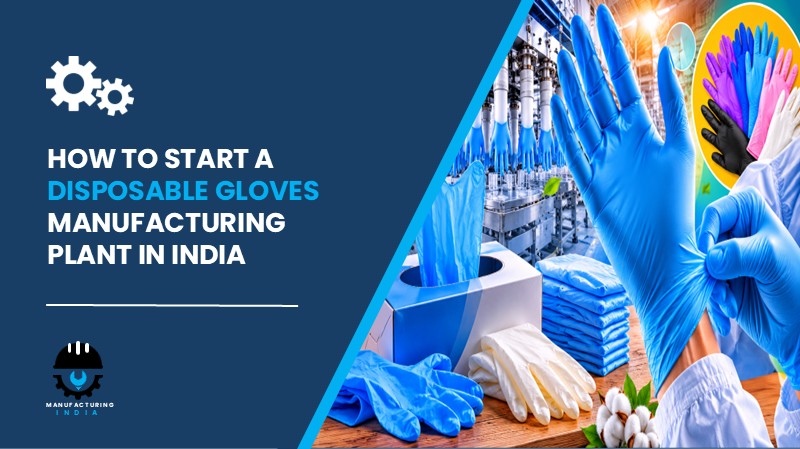
Disposable Gloves Manufacturing Plant in India
Setting up a disposable gloves manufacturing plant in India presents a compelling investment case driven by surging demand across healthcare, foodservice, pharmaceutical, and laboratory sectors. As hygiene awareness deepens across urban and rural India alike, single-use protective handwear has shifted from a discretionary purchase to an operational necessity. The global disposable gloves market was valued at USD 19.80 Billion in 2025 and is projected to reach USD 44.33 Billion by 2034 at a CAGR of 9.4%, underlining the scale of opportunity for domestic manufacturers.
India’s structural advantages make it a strategically sound location for this investment. The country’s expanding healthcare infrastructure, growing organised food processing industry, and make in India policy tailwinds provide strong demand and incentive support. Manufacturing states such as Gujarat, Maharashtra, Tamil Nadu, and Uttar Pradesh offer industrial estates, logistics connectivity, and access to chemical and polymer supply chains. With raw material costs accounting for 60–70% of operating expenditure, India’s established rubber processing and petrochemical base creates a genuine cost edge for domestic producers.
India is ideally positioned to become a significant domestic supplier, supported by policy-driven healthcare expansion, cost-competitive manufacturing, and a fast-growing market across healthcare, food processing, and pharmaceuticals. With gross profit margins of 20–30% and a break-even horizon of 3–6 years, this investment delivers both near-term returns and long-term demand sustainability.
What are Disposable Gloves?
Disposable gloves are single-use protective gloves manufactured from materials such as latex, nitrile, vinyl, and polyethylene, designed to protect hands from contaminants, chemicals, biological agents, and infectious materials. Latex gloves offer excellent elasticity, comfort, and tactile sensitivity, while nitrile gloves deliver superior puncture resistance and chemical protection. Vinyl gloves are a cost-effective option for low-risk tasks, and polyethylene gloves are used for basic food handling.
The production method involves raw material selection, preparation of glove molds, sequential dipping into liquid glove compounds, then curing, drying, stripping, quality inspection, and final packaging with sterilization added for medical-grade variants. End-use industries include healthcare and medical services, foodservice and hospitality, pharmaceuticals, laboratories and research facilities, and cleaning and janitorial services.
Cost of Setting Up a Disposable Gloves Manufacturing Plant in India
The total investment required for a disposable gloves manufacturing plant depends on plant capacity, technology selection, automation level, location, and regulatory compliance. A structured understanding of both capital and operating expenditure is essential before committing to this venture.
1. Capital Expenditure (CapEx)
Land and site development represent a substantial portion of overall capital investment, covering land registration, boundary development, drainage, and access road construction. Investors may consider locating the facility within a Special Economic Zone (SEZ) or a state-designated industrial estate to benefit from reduced costs and streamlined clearances. Civil works include factory shed construction, a quality control laboratory, raw material and finished goods storage, utility blocks, and an administrative office.
Machinery costs account for the largest share of capital expenditure. Key machinery required includes:
- Dipping vats (for mold immersion into liquid compound)
- Coagulating tanks
- Hot air ovens and drying/curing ovens
- Glove stripping machines
- Paddle mixers
- Pot mills with jars
- Tensile strength testers
- Pinhole detectors and quality control inspection machines
- Packaging machines
- Sterilization units (for medical-grade gloves)
- Micrometer and hardness testers
Other capital costs include ETP construction, pre-operative expenses, legal and regulatory fees, import duties on specialised machinery, and commissioning costs.
Request a Sample Report for In-Depth Market Insights: https://www.imarcgroup.com/disposable-gloves-manufacturing-plant-project-report/requestsample
2. Operational Expenditure (OpEx)
Raw material cost is the dominant operating expense at 60–70% of total OpEx. Core inputs include natural rubber latex, nitrile rubber (acrylonitrile butadiene rubber / NBR), polyvinyl chloride (PVC), synthetic polymers, sulfur, zinc oxide, accelerators, coagulants, and pigments. Securing long-term supplier contracts for nitrile and latex compounds is strongly recommended to manage price volatility. Utility costs covering electricity, water, and steam contribute a further 15–20% of operating expenses. Remaining costs include transportation, packaging, salaries, maintenance, depreciation, and applicable taxes. By the fifth year, total operational costs are expected to increase substantially due to inflation, market fluctuations, and rising input prices.
3. Plant Capacity
The proposed facility is designed with an annual production capacity of 500 million to 1 billion pairs, enabling economies of scale while maintaining operational flexibility. Capacity can be customised per investor requirements, and profitability improves directly with higher capacity utilisation as fixed costs spread across a larger output base.
4. Profit Margins and Financial Projections
The disposable gloves manufacturing process delivers healthy profitability under normal operating conditions. Gross profit margins range between 20–30%, with net profit margins of 8–15%. A full financial analysis covering NPV, IRR, payback period, and profit and loss projections is available through the detailed project report. Break-even typically occurs within 3–6 years depending on scale, raw material pricing, and market demand.
Why Set Up a Disposable Gloves Plant in India?
Increasing Hygiene and Safety Awareness. Growing awareness of hygiene in healthcare and food industries drives consistent demand for disposable gloves. As per UNICEF, between 2015 and 2024, an additional 1.6 billion people were provided with basic hygiene services globally, with coverage rising from 66% to 80%.
Essential Protective Gear in Healthcare. Disposable gloves are a critical component of infection control in healthcare settings, protecting both workers and patients from cross-contamination. India’s expanding hospital network and pharmaceutical manufacturing capacity are fuelling structural growth in medical-grade glove demand.
Adoption Across Diverse Industries. Beyond healthcare, rising usage in foodservice, pharmaceuticals, and cleaning services ensures multi-sector demand. Laboratories and manufacturing facilities are placing greater emphasis on standardised glove protocols, broadening the addressable market.
Policy and Regulatory Tailwinds. Stringent regulations in food safety, healthcare, and industrial environments mandate protective glove use. The Make in India initiative and government workplace safety mandates together support local production scale-up and import substitution.
Cost-Competitive Manufacturing. India’s competitive labour costs, established industrial estates, and improving logistics infrastructure provide structural cost advantages for any new disposable gloves manufacturing plant set up in the country.
Active Industry Investment. In October 2025, Shield Scientific launched high-performance gloves for cleanrooms and industrial environments. In April 2025, INTCO Medical launched Syntex Synthetic Disposable Latex Gloves compliant with FDA, EU CE, and ASTM standards, targeting healthcare, food processing, and industrial sectors globally signalling robust market momentum.
Manufacturing Process Step by Step
The disposable gloves manufacturing process uses a sequential dipping and curing method as its primary production approach.
- Mold Cleaning and Preparation: Glove formers are thoroughly cleaned to ensure a contamination-free substrate.
- Coagulant Dipping: Formers are immersed in coagulant solution using coagulating tanks to condition the surface for compound adhesion.
- Compound Dipping: Coated formers are dipped into liquid glove material — nitrile/latex compound, PVC, or polyethylene blend — using dipping vats.
- Leaching: Gloves are leached to remove impurities, residues, and water-soluble proteins.
- Vulcanising / Curing: Gloves pass through drying and curing ovens where heat-driven vulcanisation builds strength and elasticity.
- Stripping: Finished gloves are stripped from formers using glove stripping machines.
- Quality Inspection and Testing: Each batch is tested using tensile strength testers, pinhole detectors, micrometers, and hardness testers.
- Packaging and Sterilization: Gloves are packaged using packaging machines; medical-grade variants undergo sterilization before dispatch to healthcare and pharmaceutical end-use sectors.
Key Applications
Disposable gloves serve hygiene-critical and safety-sensitive industries across diverse regulated environments:
- Healthcare and Medical Industry: Used for medical examinations, surgical procedures, and clinical settings to prevent cross-contamination between patients and healthcare workers.
- Foodservice and Hospitality: Applied in food handling and preparation to ensure hygiene and prevent contamination from foodborne pathogens.
- Pharmaceutical Industry: Used in drug manufacturing, research, and laboratory settings to prevent contamination during chemical handling.
- Laboratory and Research: Required for safely handling biological samples, chemicals, and hazardous materials.
- Cleaning and Janitorial Services: Protect workers from cleaning agents, dirt, and debris while maintaining required sanitation standards.
Leading Manufacturers
The global disposable gloves industry is served by several multinational companies with extensive production capacities. Key players include:
- Ansell Ltd
- Top Glove Corporation Bhd
- Hartalega Holdings Berhad
- Supermax Corporation Berhad
- Kossan Rubber Industries Bhd
- Ammex Corporation
- Kimberly-Clark Corporation
- Sempermed USA, Inc
- MCR Safety
Timeline to Start the Plant
Setting up a facility in India typically takes 12–24 months from initiation to commercial launch:
- Feasibility study and project report preparation
- Land acquisition and site development
- Regulatory approvals and environmental clearances
- Factory licence and fire safety compliance
- Machinery procurement and installation
- Raw material supplier agreements and supply chain setup
- Trial production and quality testing
- Commercial production launch
Licences and Regulatory Requirements
Starting a disposable gloves manufacturing unit in India requires several approvals:
- Business registration (Proprietorship, LLP, or Pvt Ltd)
- Factory Licence under the Factories Act
- Environmental Clearance from State Pollution Control Board
- GST Registration
- Fire Safety NOC
- Chemical and hazardous material handling compliance (relevant given use of sulfur, zinc oxide, accelerators, and synthetic polymers)
- Effluent Treatment Plant (ETP) operational clearance
- Occupational Health and Safety compliance
Key Challenges to Consider
High Capital Requirements. Establishing a mid-to-large scale facility demands substantial upfront investment in land, civil infrastructure, and specialised equipment such as dipping vats and sterilization units.
Raw Material Price Volatility. Core inputs natural rubber latex, nitrile rubber (NBR), PVC, sulfur, and zinc oxide are globally traded commodities. Long-term supplier contracts are essential to manage exposure.
Regulatory Compliance. Meeting environmental clearances, factory licences, ETP standards, and occupational health norms across Indian state jurisdictions requires dedicated compliance resources.
Technology and Innovation Pressure. Ongoing product development evidenced by Shield Scientific’s October 2025 launch and INTCO Medical’s April 2025 Syntex launch meeting FDA, EU CE, and ASTM standards requires continual investment in product quality.
Competition from Global Players. Market leaders including Top Glove Corporation Bhd, Hartalega Holdings Berhad, Supermax Corporation Berhad, and Ansell Ltd operate at significant scale. New entrants must differentiate on quality, local service, and cost.
Skilled Manpower. Operating dipping lines and maintaining curing and sterilization equipment requires trained technical personnel, creating ongoing recruitment challenges.
Frequently Asked Questions
1. How much does it cost to set up a disposable gloves manufacturing plant in India? Total investment varies with capacity (500 million to 1 billion pairs annually), automation level, and location, covering land, civil construction, machinery, and working capital.
2. Is disposable gloves manufacturing profitable in India in 2026? Yes. Gross margins of 20–30% and net margins of 8–15% are achievable under normal operating conditions, with break-even in 3–6 years.
3. What machinery is required for a disposable gloves plant in India? Dipping vats, coagulating tanks, curing ovens, stripping machines, paddle mixers, pot mills, tensile strength testers, pinhole detectors, packaging machines, and sterilization units.
4. What licences and approvals are required to start a disposable gloves plant in India? Business registration, Factory Licence, Environmental Clearance, GST registration, Fire Safety NOC, chemical handling compliance, ETP clearance, and occupational health compliance.
5. What raw materials are needed for disposable gloves manufacturing? Natural rubber latex, nitrile rubber (NBR), PVC, synthetic polymers, sulfur, zinc oxide, accelerators, coagulants, and pigments.
6. What are the environmental compliance requirements for a disposable gloves plant in India? Environmental Clearance from the State Pollution Control Board, an operational ETP, emission compliance, and safety protocols for chemical inputs including sulfur and zinc oxide.
7. What is the best location to set up a disposable gloves plant in India? Industrial estates or SEZs in Gujarat, Maharashtra, Tamil Nadu, or Uttar Pradesh, given polymer supply chains, logistics connectivity, and skilled industrial labour availability.
8. What is the break-even period for this type of plant in India? Typically 3–6 years, depending on scale, capacity utilisation, and raw material pricing. Export opportunities can accelerate returns.
9. What government incentives are available for manufacturers in India? Capital subsidies, tax exemptions, reduced utility tariffs, export benefits, and interest subsidies under Make in India and state-level industrial promotion schemes.
Key Takeaways for Investors
A disposable gloves manufacturing plant in India represents a compelling, multi-decade investment opportunity anchored by sustained demand from healthcare, foodservice, pharmaceutical, laboratory, and cleaning service sectors. The project is financially viable across a range of plant capacities, with gross margins of 20–30%, net margins of 8–15%, and a break-even horizon of 3–6 years. The global market, valued at USD 19.80 Billion in 2025, is forecast to reach USD 44.33 Billion by 2034 at a CAGR of 9.4%, providing a long growth runway for domestic Indian producers. Regulatory mandates, rising hygiene awareness, and the continued expansion of India’s healthcare and food processing industries together ensure structurally supported demand well into the next decade.
How IMARC Can Help?
IMARC Group is a global management consulting firm that helps the world’s most ambitious changemakers to create a lasting impact. The company provide a comprehensive suite of market entry and expansion services. IMARC offerings include thorough market assessment, feasibility studies, company incorporation assistance, factory setup support, regulatory approvals and licensing navigation, branding, marketing and sales strategies, competitive landscape and benchmarking analyses, pricing and cost research, and procurement research.
Contact Us:
IMARC Group
134 N 4th St. Brooklyn, NY 11249, USA
Email: sales@imarcgroup.com
Tel No:(D) +91 120 433 0800
United States: (+1-201971-6302)
About the Author