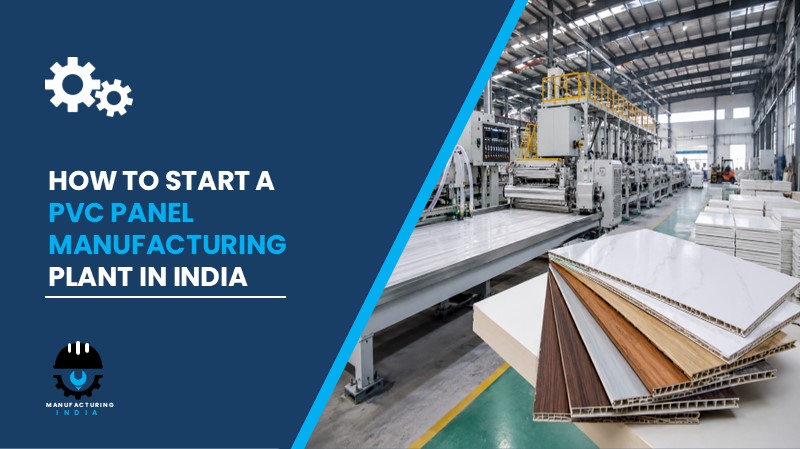
Setting up a PVC panel manufacturing plant in India presents a compelling investment case anchored in the country’s rapidly expanding construction, real estate, and interior finishing sectors. PVC panels – valued for their moisture resistance, durability, and cost-effectiveness – have emerged as the preferred alternative to traditional materials such as wood, plywood, and gypsum boards across residential housing, commercial buildings, healthcare facilities, and industrial interiors. As India’s urban centres accelerate in scale and density, the demand for high-performance, low-maintenance interior solutions continues to surge, creating a structurally robust market for domestic PVC panel producers. The residential construction sector, commercial real estate segment, and institutional building industry collectively drive the primary demand pull for this versatile product.
India’s manufacturing advantages position it as a strategically sound destination for this investment. The Make in India initiative incentivises domestic production of construction materials, reducing import reliance while creating pathways for government-backed financing and industrial support. States such as Gujarat, Maharashtra, and Uttar Pradesh – already home to established polymer processing industries and dense construction activity – offer ideal locations for a PVC panel facility, combining raw material proximity, logistics infrastructure, and a skilled workforce. The landmark data point from the source page reinforces this opportunity: real estate investments in Uttar Pradesh alone reached INR 69,000 crore in 2025, a 53% rise over the prior year, signalling accelerating developer confidence and surging demand for modern interior materials including PVC panels.
A PVC panel manufacturing plant in India combines strong policy tailwinds under Make in India, cost-competitive raw material access, and booming demand from residential, commercial, and institutional construction sectors to deliver a financially attractive investment. With gross margins of 25–35%, net margins of 10–15%, and a break-even horizon of 2–4 years, this plant presents a credible, scalable, and profitable venture for investors seeking exposure to India’s construction boom.
What is a PVC Panel?
PVC panels are sturdy, rigid panels constructed from a mixture of polyvinyl chloride together with stabilisers, plasticisers, fillers, and additives. Their common applications span wall cladding, suspended ceilings, modular partitions, and decorative interior areas. The defining properties of PVC panels include resistance to water, termites, and fire, a long service life, and ease of installation — attributes that make them a preferred choice in high-humidity regions and environments with demanding hygiene requirements.
PVC panels are available in a wide range of textures and surface finishes, including wood grain, marble-like, matte, and glossy variants, enabling manufacturers to address evolving interior design trends across diverse market segments. Their lightweight construction, low maintenance requirements, and competitive pricing relative to wood and gypsum boards have established them as the modern alternative in both residential and commercial fit-outs. Beyond aesthetics and durability, the recyclability of PVC panels gives them an additional sustainability advantage that increasingly resonates with environmentally conscious developers and specifiers. The primary production method is extrusion molding, supported by raw material compounding, mixing and homogenisation, surface finishing and lamination, and cooling and cutting operations. End-use industries served include residential construction, commercial real estate, the interior design industry, industrial infrastructure, and institutional buildings.
Cost of Setting Up a PVC Panel Manufacturing Plant in India
The total investment for a PVC panel manufacturing plant depends on production capacity, technology configuration, geographic location, degree of automation, and the regulatory compliance infrastructure put in place. Investors must approach planning across both capital expenditure and operational expenditure dimensions to develop a financially realistic project baseline.
1. Capital Expenditure (CapEx)
Land and Site Development is the foundational cost head for this facility. Proximity to PVC resin suppliers, calcium carbonate fillers, and target construction markets significantly influences site selection. Establishing the unit within a Special Economic Zone (SEZ) or designated industrial estate in states like Gujarat, Maharashtra, or Uttar Pradesh can yield land cost advantages, faster regulatory processing, and access to common infrastructure. Site development costs encompass land registration, boundary development, drainage, and utility connection charges.
Civil works and construction cover the main production shed, raw material storage area, finished goods warehouse, quality control laboratory, administrative block, and worker facilities. Given the scale of extrusion equipment and the storage requirements for bulk polymer inputs, the production building must be designed for heavy floor loading and efficient material flow from intake through to finished panel dispatch.
Machinery and equipment represent the single largest capital cost component for this facility. Key machinery required includes:
- Twin-screw extruders
- Molds and calibration units
- Mixing systems
- Cooling conveyors
- Cutting units
- Stacking systems
- Surface laminators
- Inspection equipment
- Molding dies
Other capital costs include pre-operative expenses, commissioning and trial production costs, effluent treatment plant (ETP) installation, and contingency provisions for import duties on specialised tooling or calibration equipment not manufactured domestically.
Request a Sample Report for In-Depth Market Insights: https://www.imarcgroup.com/pvc-panel-manufacturing-plant-project-report/requestsample
2. Operational Expenditure (OpEx)
Raw material cost is the dominant recurring expenditure, accounting for approximately 70–80% of total operating expenses. The primary inputs for this production unit are PVC resin (polyvinyl chloride), calcium carbonate fillers, plasticisers, stabilisers, lubricants, UV stabilisers, colorants, fire retardants, and printing or coating materials. Establishing long-term supply contracts with domestic polymer distributors and filler suppliers is essential to stabilise input costs and protect margins against resin price volatility. By the fifth year of operations, total operational costs are expected to increase due to inflation, market fluctuations, rising input material costs, supply chain shifts, and growing consumer demand.
Utility costs — primarily electricity for extrusion and mixing equipment, water for cooling systems, and compressed air for pneumatic handling — account for approximately 10–15% of operational expenditure. Other operating cost heads include transportation and logistics, packaging materials for panel bundling and wrapping, salaries and wages for production and quality control staff, maintenance and spare parts, depreciation on machinery and civil assets, and applicable taxes under the Indian GST framework.
3. Plant Capacity
The proposed PVC panel manufacturing facility is designed with an annual production capacity ranging between 20,000 and 40,000 MT, enabling economies of scale while maintaining operational flexibility for product mix variation across wall panels, ceiling panels, cladding, and partition products. Capacity within this range can be customised to match investor requirements, available capital, and target market size. As with all extrusion-based process plants, profitability and unit economics improve materially with higher capacity utilisation, making efficient production scheduling and consistent order book management critical to financial performance.
4. Profit Margins and Financial Projections
The financial projections for a PVC panel manufacturing plant in India reflect a healthy profitability profile under normal operating conditions. Gross profit margins typically range between 25–35%, supported by stable demand across construction end-markets and value-added applications in decorative and moisture-resistant segments. Net profit margins are projected in the range of 10–15%, reflecting the impact of depreciation, financing costs, taxes, and operational overheads. The full financial model in IMARC Group’s project report covers Net Present Value (NPV), Internal Rate of Return (IRR), payback period, liquidity analysis, sensitivity analysis, and uncertainty modelling — with break-even typically achievable within 2–4 years depending on capacity utilisation and market pricing.
Why Set Up a PVC Panel Plant in India?
Rising Construction and Renovation Activities. The continual demand for PVC panels is driven by rapid urban development and the accelerating renovation of residential and commercial interiors. In Uttar Pradesh alone, real estate investments reached INR 69,000 crore in 2025, up 53% compared with the prior year — a data point that signals stronger developer confidence and higher spending on commercial and mixed-use projects across India’s largest states.
Durability and Low Maintenance Demand. PVC panels can last a long time without requiring maintenance, making them suitable for both residential and commercial applications. Their resistance to moisture, termites, corrosion, and fire makes them particularly sought-after in high-humidity regions and industrial environments — driving repeat and large-volume procurement from builders and contractors.
Cost-Effective Alternative to Traditional Materials. When compared with wood, plywood, and gypsum boards, PVC panels offer competitive pricing alongside superior moisture resistance and longer service life. This value proposition has made them the material of choice in affordable housing projects and large-scale commercial renovations, two of India’s fastest-growing construction categories.
Design Versatility and Market Expansion. Manufacturers can offer a wide range of textures, colours, and finishes — including wood grain, marble-like, matte, and glossy surfaces — to align with evolving interior design trends. This design flexibility enables producers to serve premium residential, hospitality, retail, and corporate interior segments simultaneously, broadening addressable market scope.
Active Industry Investment and Innovation. In January 2026, the 13th Vinyl India Summit and Exhibition 2026 took place in Mumbai as a key industry platform uniting PVC resin producers, converters, construction material partners, and regulators — focusing on technology exchange, sustainability, and collaboration across PVC panel solutions. In November 2025, TimberTech’s Harvest+ Collection from the Advanced PVC Decking line earned recognition as a winner in Good Housekeeping’s 2026 Home Reno Awards, highlighting PVC panel decking aesthetics, durability, and sustainability including up to 65% recycled content.
Scalable Manufacturing Operations. The use of twin-screw extrusion methods, combined with proper inventory management, enables production capacity to be expanded efficiently as market demand grows. This scalability makes a PVC panel plant a particularly attractive platform investment for entrepreneurs seeking to grow output in line with India’s expanding construction pipeline.
Manufacturing Process – Step by Step
The PVC panel manufacturing process uses extrusion molding as the primary production method, supported by a sequence of compounding, surface treatment, and quality control operations that transform raw polymer inputs into finished, market-ready panels.
- Raw Material Preparation: PVC resin, calcium carbonate fillers, plasticisers, stabilisers, lubricants, UV stabilisers, colorants, and fire retardants are received, inspected, weighed, and prepared for compounding in the correct formulation ratios.
- Mixing and Homogenisation: The raw material blend is fed into high-speed mixing systems where all components are thoroughly combined to achieve a uniform compound with consistent properties ahead of extrusion.
- Extrusion Molding: The homogenised compound is conveyed into twin-screw extruders, where heat and mechanical pressure transform the blend into a continuous molten profile shaped by precision molding dies to the target panel geometry.
- Calibration and Cooling: The extruded panel profile passes through calibration units and cooling conveyors where it is dimensionally stabilised, cooled to the required temperature, and set to its final cross-sectional shape.
- Surface Finishing and Lamination: Panels are passed through surface laminators where decorative films — wood grain, marble-like, matte, or glossy finishes — are applied to achieve the target aesthetic specification.
- Cutting to Final Size: Cutting units trim the continuous panel profile to customer-specified lengths with clean, precise edges, readying panels for quality inspection.
- Quality Inspection: Each batch of finished panels is subjected to rigorous inspection and technical testing covering dimensional accuracy, surface quality, structural integrity, and compliance with product specifications.
- Packaging and Dispatch: Approved panels are bundled, wrapped, and packaged for dispatch to residential construction sites, commercial interiors contractors, healthcare facilities, industrial plants, and retail distribution networks.
Key Applications
PVC panels serve a diverse range of end-use industries across the construction, interior design, and industrial sectors, with each segment valuing distinct performance properties.
- Residential Construction: PVC panels create interior spaces that are attractive, cost-effective, durable, and low-maintenance for housing projects — including affordable and mid-market residential developments.
- Commercial and Office Spaces: Panels facilitate rapid installation and design consistency across office spaces, shops, hotels, and corporate interiors, reducing fit-out timelines and costs.
- Healthcare and Institutional Buildings: Moisture-resistant, easy-to-clean panel surfaces make the product suitable for hospitals, laboratories, schools, and other institutional environments where hygiene is critical.
- Industrial Interiors: Panels are installed in power plants, storage facilities, and industrial sites where corrosion resistance and long service life are essential in demanding operating environments.
- Decorative Cladding: Wood grain, marble-like, and premium surface finishes enable PVC panels to serve decorative interior cladding applications in retail, hospitality, and luxury residential segments.
- Modular Partitions: Lightweight construction and ease of installation make PVC panels the preferred material for modular partition systems in commercial and institutional buildings.
Leading Manufacturers
The global PVC panel market is served by several leading manufacturers with extensive production capacities and diverse application portfolios across residential, commercial, industrial, and institutional segments. Key players include:
- MAA Group
- Azek
- Citadel
- ABC
- Allied
- Palram Industries Ltd.
- Duramax PVC Panels
- Grosfillex
- VEKA AG
- Zap Exports Private Limited
- Jiangsu Acemien Machinery Co., Ltd.
- EGGER Holzwerkstoffe GmbH
Timeline to Start the Plant
Establishing a PVC panel manufacturing plant in India involves a structured, phased development process spanning regulatory, procurement, and operational milestones:
- Feasibility study and project report preparation
- Land acquisition and site development
- Regulatory approvals and environmental clearances
- Factory licence and fire safety compliance
- Machinery procurement and installation
- Raw material supplier agreements and supply chain setup
- Trial production and quality testing
- Commercial production launch
Licences and Regulatory Requirements
Starting a PVC panel manufacturing unit in India requires several approvals across business, environmental, and safety compliance domains:
- Business registration (Proprietorship, LLP, or Pvt Ltd)
- Factory Licence under the Factories Act
- Environmental Clearance from the State Pollution Control Board
- GST Registration
- Fire Safety NOC
- Hazardous chemical compliance (for plasticisers, stabilisers, and UV additives handling)
- Effluent Treatment Plant (ETP) operational clearance
- Occupational Health and Safety compliance
Key Challenges to Consider
High Capital Requirements. The initial investment in twin-screw extrusion lines, surface lamination equipment, calibration systems, and civil infrastructure represents a significant capital commitment that requires careful financing strategy and phased deployment planning.
Raw Material Price Volatility. PVC resin — which accounts for approximately 70–80% of operational expenditure — is a petrochemical-derived commodity subject to global oil price movements and supply chain disruptions. Calcium carbonate fillers, stabilisers, and plasticisers also exhibit price variability, requiring active procurement management.
Regulatory Compliance. Operating a polymer processing facility in India requires ongoing compliance with environmental regulations, ETP discharge standards, factory safety rules, and GST filing obligations — all of which add to operational cost and management complexity.
Design and Innovation Pressure. The interior finishing market evolves rapidly in terms of surface aesthetics, texture trends, and sustainability expectations. Manufacturers must continually invest in new lamination films, surface finish tooling, and product development to remain competitive.
Competition. The global PVC panel market includes established multinational players such as Palram Industries Ltd., Grosfillex, VEKA AG, and Duramax PVC Panels, alongside strong domestic competitors — creating a competitive environment that demands quality differentiation, efficient cost structures, and active sales network development.
Skilled Manpower. Operating twin-screw extrusion lines, calibration systems, and surface lamination equipment requires trained polymer processing technicians and quality control personnel — a workforce profile that must be actively recruited and retained.
Frequently Asked Questions
1. How much does it cost to set up a PVC panel manufacturing plant in India?
The total setup cost depends on plant capacity, technology configuration, location, and automation level. A facility designed for 20,000–40,000 MT per annum covers land, civil works, twin-screw extruders, laminators, and ancillary equipment. IMARC Group’s project report provides a detailed CapEx and OpEx breakdown.
2. Is PVC panel manufacturing profitable in India in 2026?
Yes, the unit demonstrates healthy profitability with gross margins of 25–35% and net margins of 10–15% under normal operating conditions. Profitability improves with higher capacity utilisation and value-added product mix in decorative and moisture-resistant segments.
3. What machinery is required for a PVC panel plant in India?
Key equipment includes twin-screw extruders, molds and calibration units, mixing systems, cooling conveyors, cutting units, stacking systems, surface laminators, molding dies, and inspection equipment.
4. What licences and approvals are required to start a PVC panel plant in India?
Required approvals include business registration, Factory Licence, Environmental Clearance from the State Pollution Control Board, GST registration, Fire Safety NOC, hazardous chemical compliance, ETP clearance, and occupational health and safety compliance.
5. What raw materials are needed for PVC panel manufacturing?
The primary raw materials are PVC resin (polyvinyl chloride), calcium carbonate fillers, plasticisers, stabilisers, and lubricants. Additives including UV stabilisers, colorants, fire retardants, and printing or coating materials are also required.
6. What are the environmental compliance requirements for a PVC panel plant in India?
The facility must obtain Environmental Clearance from the State Pollution Control Board, operate an approved Effluent Treatment Plant, manage polymer additive waste in line with hazardous materials regulations, and maintain ongoing emission standard compliance.
7. What is the best location to set up a PVC panel plant in India?
States such as Gujarat, Maharashtra, and Uttar Pradesh — with established polymer supply chains, strong construction activity, and industrial infrastructure — offer strategic advantages for locating a PVC panel facility.
8. What is the break-even period for this type of plant in India?
Break-even in a PVC panel manufacturing business typically ranges from 2–4 years, depending on production capacity, raw material cost management, market demand, and pricing strategy.
9. What government incentives are available for manufacturers in India?
Manufacturers can potentially benefit from Make in India scheme incentives, capital subsidies under state industrial policies, tax exemptions, reduced utility tariffs, export benefits, and interest subsidies available under national and regional industrial promotion schemes.
Key Takeaways for Investors
A PVC panel manufacturing plant in India represents a well-timed, commercially attractive investment opportunity driven by sustained demand from residential construction, commercial real estate, healthcare, industrial interiors, and the interior design sector. The investment demonstrates strong financial viability across the 20,000–40,000 MT capacity range, with gross margins of 25–35%, net margins of 10–15%, and a break-even horizon of 2–4 years providing investors with a clear and achievable return pathway. The global PVC panel market, valued at USD 3.90 billion in 2025, is projected to reach USD 6.90 billion by 2034 at a CAGR of 6.50% — with India’s accelerating urbanisation, affordable housing push, and commercial infrastructure expansion ensuring that domestic demand remains a powerful and durable long-term growth driver for this investment.
About the Author