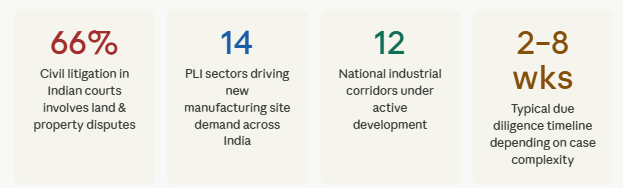
India’s industrial investment landscape is expanding at a pace that few markets can match. The government’s production-linked incentive (PLI) schemes across 14 sectors, the development of 12 industrial corridors under the National Industrial Corridor Programme, and the sustained inflow of foreign direct investment have collectively created one of the most active phases of greenfield and brownfield manufacturing activity in the country’s history. Yet every committed investor, from a multinational setting up a semiconductor plant in Telangana to a domestic MSME acquiring a plot in an MIDC zone, faces the same foundational risk: India’s land and legal records system is a labyrinth where surface appearances routinely conceal serious liabilities.
This reality makes legal due diligence services in India not a discretionary item but a non-negotiable component of the investment lifecycle. Whether the context is a corporate merger, a strategic acquisition of an industrial asset, or a greenfield manufacturing site purchase, the quality of pre-transaction legal scrutiny determines whether the deal succeeds or becomes a protracted, capital-consuming dispute.
Why Legal Due Diligence Is Non-Negotiable in India
India’s land records system is among the most complex in the world. A single manufacturing site acquisition may require verification of multiple document types, including:
- 7/12 extracts (Satbara Utara) — the primary revenue document confirming land ownership and cultivation status
- Mutation registers — recording changes in ownership, inheritance, and title transfers
- Encumbrance certificates — disclosing registered charges, mortgages, and liens on a property
- DILRMP digital records — maintained under the Digital India Land Records Modernisation Programme for cross-verification
Each document carries distinct legal significance, and none is sufficient in isolation.
According to the World Bank, land and property disputes account for approximately 66% of all pending civil litigation in Indian courts. A property that appears clean in a seller-provided document package can carry undisclosed liabilities such as:
- Disputed succession claims from undocumented heirs
- Unregistered mortgages filed with agricultural credit societies
- Tenancy rights that survive a sale under state tenancy legislation
- Pending acquisition proceedings under the LARR Act 2013
The LARR Act requires consent from 80% of affected families for private projects and 70% for PPP projects. Where prior acquisition notifications exist on a parcel, they can fundamentally compromise an investor’s ability to take clear possession even after registration.
Beyond title, manufacturing investors must navigate CLU requirements, Environmental Clearance mandates, zoning permissions under state Master Plans, and the specific regulations of industrial development authorities including MIDC (Maharashtra), GIDC (Gujarat), KIADB (Karnataka), and APIIC (Andhra Pradesh). Each authority carries its own allotment conditions, transfer restrictions, and compliance timelines, departures from which can void an allotment entirely.
Critical Land Title Risks in Indian Manufacturing Site Acquisitions
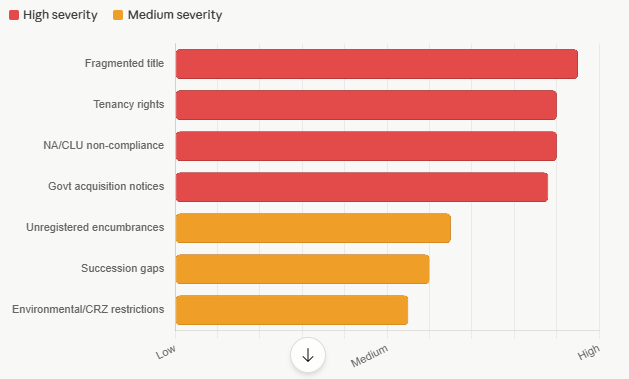
Legal due diligence practitioners in India consistently encounter a specific set of high-recurrence risk categories that investors must understand before committing capital:
- Fragmented or incomplete title — missing mutation entries or gaps in the 30-year ownership chain can render a sale void or voidable
- Tenancy rights on agricultural land — these often survive a transaction under state tenancy legislation, creating possession disputes that no Sale Deed can resolve
- NA order and CLU non-compliance — industrial use of agricultural land without conversion orders exposes the project to full regulatory invalidation
- Prior government acquisition notices — Section 4 or Section 6 notifications under the LARR Act that have not been formally rescinded remain enforceable against a new owner
- Unregistered encumbrances — agricultural credit society mortgages and informal liens do not appear in the standard Encumbrance Certificate but are legally enforceable against a buyer
- Succession gaps — incomplete inheritance documentation generates heir challenges years after a transaction closes
- Environmental and CRZ restrictions — Coastal Regulation Zone classification or Eco-Sensitive Zone designation can prohibit industrial use regardless of what the Sale Deed states
The Four-Phase Framework for Comprehensive Legal Due Diligence
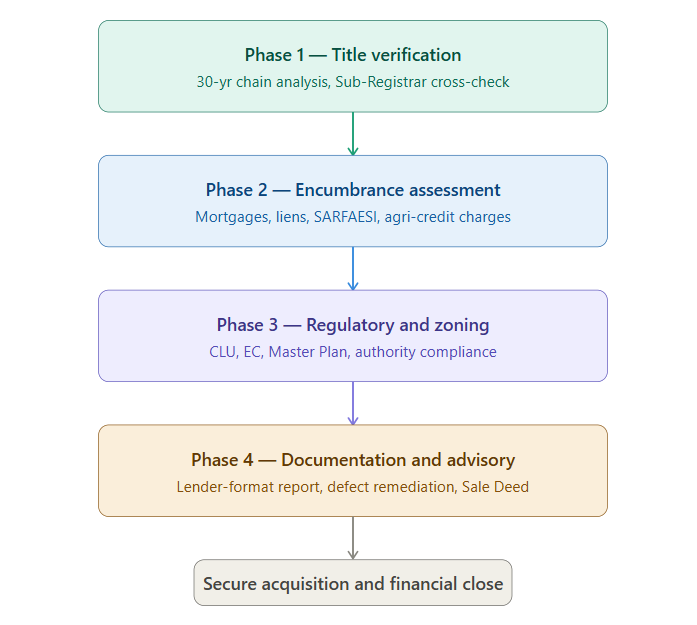
Best-in-class legal due diligence in India operates across four structured phases. The quality of each phase directly determines whether a report is merely informational or genuinely protective of investor capital.
Phase 1 — Title Verification and Ownership Chain Analysis Exhaustive title searches going back a minimum of 30 years, covering Sale Deeds, Gift Deeds, Powers of Attorney, and Partition Deeds, cross-verified against Sub-Registrar records rather than seller-supplied copies. This phase confirms clear, marketable title free from defects or contested claims.
Phase 2 — Encumbrance and Liability Assessment Investigation of mortgages, liens, easements, SARFAESI proceedings, and execution petitions. This phase extends beyond the standard Encumbrance Certificate to include agricultural credit society charges and unregistered financial obligations that remain legally enforceable against a buyer.
Phase 3 — Regulatory Compliance and Zoning Verification Evaluation of land use classifications under applicable state Town Planning legislation, industrial zoning permissions, Environmental Clearances, and development authority compliance requirements. Assessments are conducted at the state-specific standard, not generalized national guidance.
Phase 4 — Legal Documentation and Transaction Advisory Production of a comprehensive due diligence report structured to satisfy SIDBI, NABARD, scheduled commercial bank, and development finance institution requirements. Where curable defects are identified, this phase provides advisory on remediation, Sale Deed structuring, and regulatory approval procurement.
Get expert legal due diligence support in India: https://www.imarcengineering.com/contact?service=land-acquisition-legal-due-diligence
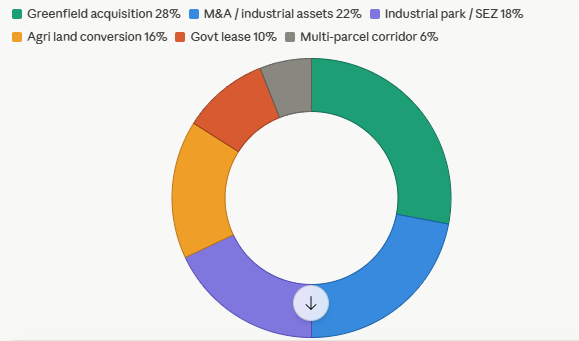
Due Diligence Across Investment Categories
The scope and methodology of legal due diligence must be calibrated to the specific investment type. Key categories include:
- Greenfield manufacturing site acquisitions — focus on independent title verification, encumbrance mapping, multi-court litigation search, and zoning compliance for privately negotiated transactions in industrial corridors or open land markets
- Mergers and acquisitions involving industrial assets — scope extends to existing regulatory approvals, pending litigation exposure, compliance obligations, and representation and warranty risk identification on the target entity
- Industrial park and SEZ plot allotments — critical assessment of MIDC, GIDC, KIADB, and APIIC allotment conditions, transfer restrictions, and cancellation clauses that can void an allotment if breached
- Agricultural land conversion projects — NA order procurement pathway analysis, CLU compliance verification, and state-specific conversion procedure coordination before any capital commitment
- Government lease acquisitions — review of lease terms, renewal conditions, transfer restrictions, and encumbrance status for sites held on state or central government lease rather than freehold title
- Multi-parcel corridor acquisitions — phased due diligence with consolidated encumbrance mapping and progressive risk reporting across multiple parcels from different sellers, each with distinct title chains
How IMARC Engineering Helps with Legal Due Diligence Services in India
IMARC Engineering is a leading EPCM advisory firm that provides end-to-end land acquisition and legal due diligence services in India for manufacturers, industrial investors, project developers, and financial institutions. Its practice rests on a single foundational principle: every assessment is conducted exclusively in the interest of the investor, free from the commercial conflicts structurally prevalent in India’s property services industry. IMARC has no business ties with land sellers, property developers, registration agents, or legal service providers.
1. Independent, Conflict-Free Assessment Most providers in India carry existing commercial relationships with brokers, developers, or registration attorneys, creating bias that compromises findings. IMARC conducts every title opinion and regulatory assessment without external commercial influence, giving investors a factual, unvarnished picture of the property’s legal position before any capital is committed.
2. Multi-Layer Primary Source Verification Where most due diligence exercises rely on seller-supplied documents, IMARC independently verifies all records at primary sources, including:
- State revenue authority databases and physical revenue offices
- Sub-Registrar records covering a minimum 30-year title chain
- District Court, High Court, and Supreme Court litigation registers
- Revenue court and tribunal records in tenancy and land reform jurisdictions
- Municipal authority records and DILRMP digital databases
- Development Authority files for industrial zone and allotment compliance
3. Deep Regulatory and Zoning Expertise IMARC’s regulatory team navigates the LARR Act 2013, state Town Planning legislation, Master Plans, Environmental legislation, and the authority-specific requirements of MIDC, GIDC, KIADB, APIIC, and other state industrial development bodies — assessing CLU and NA order requirements at current, applicable state-level standards rather than generalized national guidance.
4. Comprehensive Litigation and Encumbrance Risk Identification IMARC’s encumbrance verification goes beyond the standard Encumbrance Certificate to include agricultural credit society mortgages, SARFAESI proceedings, and execution petitions — all enforceable against a buyer despite being invisible in a routine document review.
5. Project Finance-Ready Reporting IMARC Engineering’s due diligence reports are specifically structured to satisfy the documentation requirements of major lenders including SIDBI, NABARD, scheduled commercial banks, and development finance institutions. Each report delivers:
- Title opinion and clear ownership confirmation
- Encumbrance summary covering registered and unregistered charges
- Litigation search certificate across all relevant courts and tribunals
- Zoning compliance assessment and regulatory approval verification
This structured approach reduces documentation re-submissions and the delays they cause between site acquisition and financial close.
6. End-to-End Support from Due Diligence to Title Clearance Where curable defects are identified — including incomplete mutation, missing NA orders, or pending encumbrance discharges — IMARC assists with remediation, coordinates regulatory approvals, and structures the Sale Deed to protect buyer interests through to final acquisition completion. For multi-parcel acquisitions, ongoing phased support is provided with consolidated risk tracking across the full programme.
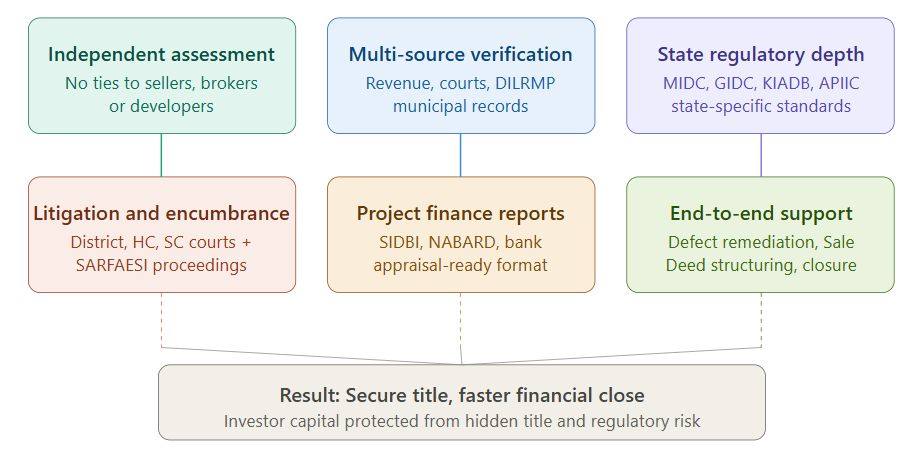
Investors conducting manufacturing site acquisitions, M&A transactions, or industrial project development in India operate in one of the world’s most legally complex land environments. With approximately 66% of Indian civil court caseloads originating in property disputes, and title systems spanning fragmented records, unregistered encumbrances, and multi-authority regulatory layers, the difference between a secure acquisition and a costly legal dispute often comes down to the depth and independence of pre-transaction due diligence. IMARC Engineering’s structured, conflict-free, multi-source methodology provides the legal foundation that protects investment capital and accelerates the path from site identification to financial close.
Contact Us:
IMARC Engineering
Phone: +91-120-433-0800
Email: sales@imarcengineering.com
India: C-130, Sector 2, Noida, Uttar Pradesh 201301
LinkedIn: https://www.linkedin.com/showcase/imarc-engineering/
About the Author