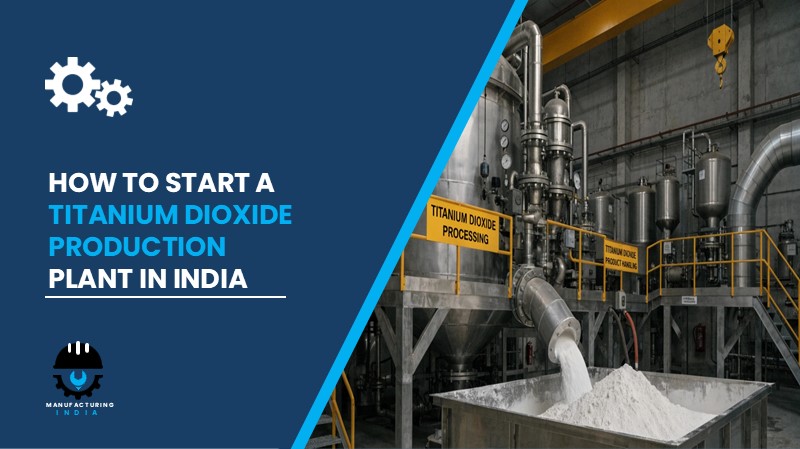
Setting up a titanium dioxide production plant in India presents a compelling investment case, driven by sustained and diversified demand from paints and coatings, plastics and polymers, cosmetics and personal care, paper, food and pharmaceuticals, textiles, construction, and automotive sectors. Titanium dioxide (TiO₂) is one of the most widely used industrial pigments globally, valued for its superior whiteness, brightness, opacity, and UV resistance — properties that make it indispensable in the manufacture of paints, coatings, and plastics across India’s fast-expanding construction and consumer goods industries. As India’s infrastructure build-out accelerates and domestic consumption of premium coatings and personal care products rises, the case for a domestic TiO₂ supply chain has never been stronger.
India’s structural advantages make it a strategically sound base for titanium dioxide production. The country’s construction and automotive sectors continue to register robust growth, directly fuelling demand for high-performance white pigments in architectural paints, industrial coatings, and plastic components. The Make in India initiative supports capital-intensive specialty chemical investments through subsidies, tax incentives, and industrial estate frameworks, while manufacturing hubs in Gujarat, Maharashtra, and Andhra Pradesh offer proximity to port infrastructure, chemical supply chains, and skilled technical labour. Establishing a titanium dioxide production plant in India positions investors to capture both import substitution opportunities and growing export demand across South and Southeast Asia.
India’s titanium dioxide production opportunity is anchored by policy support through Make in India, a cost-competitive production base, and structurally diversified demand from construction, automotive, cosmetics, and specialty chemicals. With gross margins of 25–40% and a break-even horizon of three to seven years, the investment is viable across a wide range of plant configurations.
What is Titanium Dioxide?
Titanium dioxide (TiO₂) is a naturally occurring oxide of titanium, typically appearing as a white powder that is widely used as a pigment across multiple industries due to its brightness, opacity, and UV resistance. With exceptional light-scattering properties and a high refractive index, TiO₂ enhances the colour and brightness of end products while delivering durability and long-lasting finishes. Its widespread application across paints, plastics, cosmetics, paper, food, and pharmaceuticals has established it as one of the most widely used industrial pigments in the world, with approximately 95% of all titanium consumed globally in the form of titanium dioxide.
TiO₂ is primarily produced using two methods: the sulfate process and the chloride process. The sulfate process involves ore digestion using sulfuric acid, while the chloride process uses chlorine gas to extract titanium tetrachloride (TiCl₄) from rutile ore or high-grade titanium slag before oxidation to TiO₂. Both routes yield a fine white powder that is then surface-treated to improve performance characteristics for specific end-use applications. Product variants include rutile and anatase grades, with rutile dominant in paints, coatings, and plastics, and anatase used in paper and certain specialty applications. End-use industries served include paints and coatings, plastics and polymers, cosmetics and personal care, paper, food and pharmaceuticals, textiles, construction, and automotive.
Cost of Setting Up a Titanium Dioxide Production Plant in India
The total cost of establishing a titanium dioxide production plant in India depends on plant capacity, technology route (sulfate or chloride process), geographic location, automation level, and regulatory compliance requirements. Both capital expenditure and operational expenditure must be modelled carefully across a five-year horizon to capture the full financial picture.
1. Capital Expenditure (CapEx)
Land and site development constitute a foundational component of total CapEx, covering land registration charges, boundary development, drainage, and access road construction. Investors may consider industrial estate allocations or special economic zones to benefit from pre-approved utility connections, reduced land costs, and streamlined environmental clearance frameworks. Civil works and construction costs encompass production sheds, quality control laboratories, raw material and finished goods storage warehouses, and an administrative block sized to support the plant’s workforce and compliance requirements.
Machinery and equipment represent the single largest share of capital expenditure in a titanium dioxide production plant. Key machinery required includes:
- Sulfuric acid reactors or chlorine reactors (depending on process route)
- Mills for grinding the ore
- Reaction vessels (digestion or chlorination units)
- Separation and filtration equipment
- Hydrolysis units
- Calcination kilns
- Dryers
- Coating machines for surface treatment
- Milling machines
- Packaging machines
Other capital costs include effluent treatment plant construction, pre-operative expenses such as feasibility study preparation and project report development, commissioning charges, and applicable import duties on specialised reactor systems or calcination kilns.
Request a Sample Report for In-Depth Market Insights: https://www.imarcgroup.com/titanium-dioxide-manufacturing-plant-project-report/requestsample
2. Operational Expenditure (OpEx)
Raw material cost is the principal driver of operating expenditure, accounting for approximately 60–70% of total OpEx. The primary raw materials are rutile ore or high-grade titanium slag as the titanium source, along with chlorine gas and coke as a reductant (for the chloride process), or sulfuric acid and additional process chemicals (for the sulfate process). Additional inputs include reducing agents, caustic soda, and other process chemicals. Long-term supply contracts with reliable regional suppliers are strongly recommended to stabilise input pricing and mitigate exposure to global ore price volatility.
Utility costs — covering electricity for calcination and milling, process water, and steam — represent approximately 20–30% of total OpEx, reflecting the energy-intensive nature of TiO₂ production relative to many other specialty chemicals. Additional operating costs include transportation and outbound logistics, packaging materials, salaries and wages for process technicians and quality control personnel, scheduled maintenance, depreciation on plant and machinery, and applicable taxes. By the fifth year of operations, total operational cost is projected to increase substantially due to inflation, market fluctuations, and potential rises in the cost of key ore and chemical inputs, as well as supply chain disruptions and rising consumer demand.
3. Plant Capacity
The proposed production facility is designed with an annual production capacity of approximately 100,000 metric tons, enabling significant economies of scale while maintaining operational flexibility for grade and product mix adjustments. Capacity can be customised to suit individual investor requirements based on target markets and available capital, and profitability improves meaningfully with higher capacity utilisation rates as fixed costs are distributed across a larger output base.
4. Profit Margins and Financial Projections
The project demonstrates strong profitability under normal operating conditions. Gross profit margins typically range between 25–40%, supported by stable and diversified demand across construction, automotive, cosmetics, and pharmaceutical applications. Net profit margins range between 15–25%. Financial projections include detailed analysis of net present value (NPV), internal rate of return (IRR), payback period, and a full profit and loss account, alongside sensitivity and uncertainty modelling. Break-even in a titanium dioxide production business typically ranges from three to seven years, depending on production scale, operating costs, raw material pricing, and the pace of customer base development.
Why Set Up a Titanium Dioxide Production Plant in India?
High Demand in Paints, Coatings, and Construction. The growing need for high-quality pigments in paints, coatings, and plastics — driven by construction, automotive, and consumer goods sectors — continues to fuel demand for titanium dioxide. India’s infrastructure expansion and rising residential and commercial construction activity directly translate into sustained procurement of architectural and industrial coatings that rely on TiO₂ as their primary white pigment.
Critical Role in UV Protection and Cosmetics. With increasing consumer awareness about UV protection, demand for TiO₂ as an effective UV filter in sunscreens, foundations, and skin-care products is rising globally. India’s personal care and cosmetics sector is among the fastest-growing in the Asia-Pacific region, creating a high-volume domestic offtake channel for cosmetic-grade titanium dioxide that currently relies heavily on imports.
Sustainability and Eco-Friendly Product Demand. Titanium dioxide’s role in promoting long-lasting finishes and environmentally friendly products is driving its use in green construction and eco-friendly product development. Government regulations pushing for eco-friendly and durable products are making TiO₂ a preferred choice across a range of applications, including low-VOC architectural coatings and UV-stable plastic components.
Technological Advancement and Innovation. Innovations in nano-sized TiO₂ particles and bio-based production methods are improving functionality and sustainability, expanding the addressable market for speciality-grade TiO₂. In July 2025, The Chemours Company launched a new low-abrasion grade of Ti-Pure titanium dioxide pigment specifically engineered to enhance the formulation and performance of printing inks, demonstrating active product innovation across the value chain.
Active Industry Investment. In March 2025, Venator introduced its TMP- and TME-free TIOXIDE TR81 grade, initiating a new series of reformulated TiO₂ pigments designed to help customers comply with stricter chemical regulations while preserving high performance. These global product launches underscore the sector’s momentum and signal strong forward demand for compliant, high-specification TiO₂ grades across regulated industries.
Cost-Competitive Production Base. India offers competitive land, labour, and utility costs relative to major TiO₂-producing regions in Europe and China. Proximity to ilmenite mineral deposits along India’s eastern and southern coastlines — particularly in Odisha, Tamil Nadu, and Andhra Pradesh — supports domestic raw material sourcing and reduces ore import dependence for the sulfate process route.
Production Process – Step by Step
The titanium dioxide production process uses the sulfate process or the chloride process as the primary production method, with both routes converging on calcination and surface treatment to yield a high-purity white pigment powder.
- Raw Material Preparation: Procurement and quality verification of rutile ore or high-grade titanium slag, along with chlorine gas and coke (chloride route) or sulfuric acid and process chemicals (sulfate route), with incoming material assessed against purity and moisture specifications.
- Ore Digestion — Chlorination or Acid Leaching: Reaction of the titanium ore with chlorine gas in chlorination units (chloride process) to produce titanium tetrachloride (TiCl₄), or dissolution of ilmenite in sulfuric acid in digestion reactors (sulfate process) to yield titanium sulfate solution.
- Purification and Hydrolysis: Purification of TiCl₄ by distillation (chloride route) or precipitation of impurities from the titanium sulfate solution (sulfate route), followed by hydrolysis to produce hydrated titanium dioxide.
- Filtration and Washing: Separation of the hydrated TiO₂ precipitate using filtration systems and multiple wash cycles to remove residual acids, sulphates, and trace metal impurities to within specification.
- Calcination to Form TiO₂: High-temperature calcination in rotary kilns to convert hydrated titanium dioxide into crystalline TiO₂ in rutile or anatase form, with temperature and atmosphere controls governing crystal phase and particle size.
- Milling and Particle Size Control: Processing through milling machines to achieve the target particle size distribution and surface area required for specific end-use applications.
- Coating and Surface Treatment: Application of surface coatings using coating machines to improve dispersibility, durability, UV stability, and compatibility with specific formulation systems for paints, plastics, or cosmetics.
- Quality Testing: Analytical testing of TiO₂ purity, brightness, refractive index, particle size, and surface treatment levels against product specification and customer requirements.
- Packaging and Dispatch: Weighing and packaging into specified formats for dispatch to end-use industries including paint formulators, plastic compounders, cosmetics producers, paper mills, and pharmaceutical manufacturers.
Key Applications
Titanium dioxide serves a broad and structurally diversified industrial base, ensuring that the production unit’s revenue portfolio is supported by demand across multiple consuming sectors.
- Paints and Coatings: Used as a high-quality white pigment providing opacity and durability in both interior and exterior architectural and industrial coating applications.
- Plastics and Polymers: Used as a whitening agent improving brightness and durability of products such as plastic films, pipes, and automotive parts.
- Cosmetics and Personal Care: Used in sunscreens, foundations, and skin-care products for UV-blocking properties and ability to provide a smooth, even finish.
- Food and Pharmaceuticals: Used as a colouring agent to enhance product appearance in food items and tablet coatings, providing whiteness and opacity to finished products.
- Paper and Textiles: Used in paper production to improve whiteness and opacity, and in textiles to provide brightness and colour stability to fabric products.
Leading Producers
The global titanium dioxide market is served by several large multinational producers with extensive production capacities and diverse application portfolios spanning paints, plastics, cosmetics, and specialty chemicals. Key players in the industry include:
- The Chemours Company
- Tronox Holdings plc
- LB Group
- Venator Materials PLC
- KRONOS Worldwide Inc.
- Evonik Industries AG
- Ishihara Sangyo Kaisha, Ltd.
Timeline to Start the Plant
Establishing a titanium dioxide production plant in India typically requires 12 to 24 months from project inception to commercial production launch, depending on plant capacity, process route complexity, equipment sourcing timelines for specialised reactor systems, and regulatory approval schedules.
- Feasibility study and project report preparation
- Land acquisition and site development
- Regulatory approvals and environmental clearances
- Factory licence and fire safety compliance
- Machinery procurement and installation
- Raw material supplier agreements and supply chain setup
- Trial production and quality testing
- Commercial production launch
Licences and Regulatory Requirements
Starting a titanium dioxide production unit in India requires several approvals spanning business registration, environmental compliance, safety certification, and operational domains:
- Business registration (Proprietorship, LLP, or Pvt Ltd)
- Factory Licence under the Factories Act
- Environmental Clearance from the State Pollution Control Board
- GST Registration
- Fire Safety NOC
- Hazardous chemical compliance for chlorine gas and sulfuric acid handling under applicable chemical safety regulations
- Effluent Treatment Plant (ETP) operational clearance
- Occupational Health and Safety compliance
Key Challenges to Consider
High Capital Requirements. Total capital investment covers land, civil construction, and a broad machinery suite including chlorination or acid digestion reactors, calcination kilns, milling machines, coating machines, and packaging systems, along with ETP and pre-operative costs, making initial funding arrangement a critical success factor.
Raw Material Price Volatility. Rutile ore and high-grade titanium slag, chlorine gas, and coke are the primary input materials, and their pricing is subject to global ore market cycles, energy cost inflation, and logistics disruptions, all of which can compress operating margins in periods of input cost escalation.
Regulatory Compliance. Handling reactive intermediates including chlorine gas, sulfuric acid, and titanium tetrachloride requires robust EHS management systems, advanced process monitoring, and strict effluent and emission controls to satisfy State Pollution Control Board requirements and factory inspectorate standards.
Technology and Innovation Pressure. Ongoing product innovation — including nano TiO₂ grades, TMP- and TME-free formulations such as Venator’s TIOXIDE TR81, and bio-based production methods — requires continuous investment in R&D capability and process upgrades to remain competitive across high-specification customer segments.
Competition. The global market is dominated by established players including The Chemours Company, Tronox Holdings plc, LB Group, Venator Materials PLC, KRONOS Worldwide Inc., Evonik Industries AG, and Ishihara Sangyo Kaisha, requiring Indian producers to compete on product quality, regulatory compliance, and supply reliability.
Skilled Manpower. Operating calcination kilns, chlorination or acid digestion reactors, and surface treatment coating lines to consistent quality standards requires specialised chemical process engineers and quality control analysts, which can be a constraint outside established chemical manufacturing clusters.
Frequently Asked Questions
1. How much does it cost to set up a titanium dioxide production plant in India?
Total capital investment depends on capacity, process route (sulfate or chloride), and location, covering land, civil construction, machinery including reactors, calcination kilns, dryers, milling and coating machines, ETP, and pre-operative expenses. The full CapEx breakdown is available in the detailed project report.
2. Is titanium dioxide production profitable in India in 2026?
Yes. Gross profit margins typically range between 25–40% and net profit margins between 15–25% under normal operating conditions, supported by diversified demand across paints, coatings, plastics, cosmetics, and pharmaceuticals.
3. What machinery is required for a titanium dioxide production plant in India?
Key equipment includes sulfuric acid reactors or chlorine reactors, mills for grinding ore, reaction vessels, separation and filtration systems, hydrolysis units, calcination kilns, dryers, coating machines, milling machines, and packaging machines.
4. What licences and approvals are required to start a titanium dioxide production plant in India?
Required approvals include business registration, Factory Licence under the Factories Act, Environmental Clearance from the State Pollution Control Board, GST Registration, Fire Safety NOC, hazardous chemical compliance for chlorine and sulfuric acid handling, ETP operational clearance, and Occupational Health and Safety certification.
5. What raw materials are needed for titanium dioxide production?
Primary raw materials are rutile ore or high-grade titanium slag as the titanium source, along with chlorine gas and coke as a reductant (chloride process) or sulfuric acid (sulfate process), plus reducing agents, caustic soda, and other process chemicals.
6. What are the environmental compliance requirements for a titanium dioxide production plant in India?
An operational effluent treatment plant is mandatory, along with State Pollution Control Board environmental clearance, compliant management of acid and chlorine-based effluents, and ongoing monitoring of air and water emissions against prescribed discharge standards.
7. What is the best location to set up a titanium dioxide production plant in India?
Optimal sites offer proximity to ilmenite or rutile mineral sources along India’s eastern and southern coast (Odisha, Tamil Nadu, Andhra Pradesh), reliable utilities, and access to port infrastructure for chemical imports and product exports. Industrial estates in Gujarat and Maharashtra also offer strong supply chain and logistics connectivity.
8. What is the break-even period for this type of plant in India?
Break-even typically ranges from three to seven years depending on production scale, capacity utilisation, raw material pricing, process route selection, and the pace of customer base development across paints, coatings, plastics, and cosmetics.
9. What government incentives are available for manufacturers in India?
Governments may offer capital subsidies, tax exemptions, reduced utility tariffs, export benefits, and interest subsidies under national and state industrial policies, including schemes aligned with the Make in India initiative for specialty chemical investments.
Key Takeaways for Investors
A titanium dioxide production plant in India represents a high-potential industrial investment, anchored by structurally diversified demand from paints and coatings, plastics and polymers, cosmetics and personal care, paper, food, pharmaceuticals, textiles, construction, and automotive sectors that together provide strong revenue resilience across economic cycles. The facility delivers compelling financial returns across a range of plant configurations, with gross margins of 25–40% and net margins of 15–25% achievable under normal operating conditions and a break-even horizon of three to seven years. The global titanium dioxide market was valued at USD 21.78 billion in 2025 and is projected to reach USD 33.38 billion by 2034, exhibiting a CAGR of 4.9% from 2026 to 2034, according to IMARC Group estimates, confirming a long and sustained demand trajectory. As India’s construction pipeline deepens, its personal care market expands, and domestic specialty chemical capacity grows under Make in India, the forward demand base for TiO₂ is set to strengthen meaningfully over the full investment horizon.
About the Author